


4-days

Four-Day Workweek Statistics: Productivity, Retention & Trials Worldwide

What global trials and research really reveal about the four-day workweek, from productivity shifts to employee well-being and retention.

Editor's Choice: Four-Day Workweek Statistics

Top Four-Day Workweek Statistics in 2026
40%
Productivity boost at Microsoft Japan.
united-kingdom
57%
Fewer resignations during the UK pilot.
41%
Better mental health and 38% better sleep.
workplace-culture
92%
Of UK firms kept the four-day week.
productivity
50%
Of Spanish workers saw higher productivity.
hiring
83%
Of employers found hiring easier.

Four-Day Workweek Statistics: Key Facts

  1. Microsoft Japan saw a 40% jump in productivity during its four-day week trial.
  2. The UK’s 2022 national pilot involved 61 companies and nearly 3,000 employees.
  3. 92% of UK firms continued the four-day schedule after the pilot ended.
  4. 71% of employees in the UK trial reported less burnout.
  5. A multi-country study found a 67% drop in burnout rates across participants.
  6. 83% of employers said hiring became easier after adopting shorter weeks.
  7. 41% of workers reported better mental health and 38% improved sleep.
  8. Spain’s pilot showed nearly half of all participants became more productive.

Check All Four-Day Workweek Statistics

Here are some of the most important Four-Day Workweek Statistics that you need to know about.

Productivity & Revenue

1

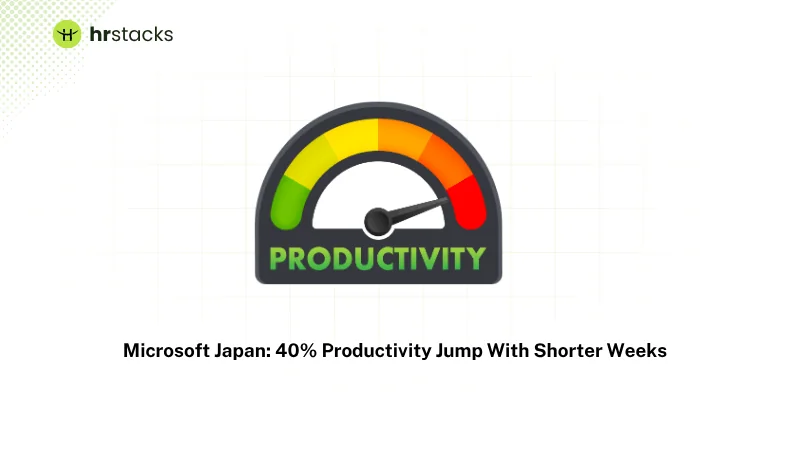
Microsoft Japan: 40% Productivity Jump With Shorter Weeks

In August 2019, Microsoft Japan closed its offices on Fridays for a month and measured outcomes carefully. The firm reported roughly a 40% increase in sales per employee during the trial period, which leaders attributed to fewer, shorter meetings, clearer priorities, and longer blocks of focused work.

Staff also took fewer sick days and reported higher satisfaction; the company treated the experiment as a learning lab to adjust meeting norms and explore further iterations rather than a one-off stunt.
Increase in Productivity
2

Autonomy Study: Four-Day Week Boosted Productivity by 20%

Autonomy’s analysis of multiple pilots found that firms that adopted a four-day work week with no pay cut typically reported productivity increases near 20%. Those gains weren’t automatic; they relied on redesigning processes, shortening meetings, and measuring outputs instead of hours.

The study also shows well-being improvements, suggesting happier, better-rested staff are more focused on tasks that matter. Autonomy cautions that coaching for managers and measurement frameworks are crucial to prevent workload from simply being squeezed into fewer days.
3

UK 2022 Pilot: Revenue Stayed Stable or Rose Slightly

The UK’s coordinated 2022 pilot spanned 61 firms and roughly 2,900 workers and produced broad evidence that reduced hours did not reduce revenue overall.

Firms that prepared, trained managers, redesigned workflows, and tracked outputs generally reported stable or modestly increased revenues.

Researchers emphasized that the outcome depends on how the change is implemented: firms that simply shortened time without addressing low-value work struggled, while those that rethought processes preserved cash flow and service quality.
4

Perpetual Guardian: Productivity Held Steady With Shorter Hours

Perpetual Guardian’s 2018 New Zealand trial ran for six weeks and reported that productivity was maintained or improved while employees saw better work–life balance.

The company combined the shorter week with clearer output goals and trust-based management; staff stress fell, and life satisfaction rose.

Because leaders measured wellbeing and performance side-by-side, they felt confident enough to make the change permanent, illustrating how short pilots with strong metrics can drive lasting policy shifts.
5

Spain Pilot: Half of Participants Reported Higher Productivity

Regional and national pilots in Spain found that nearly half of participants reported slight to significant productivity gains during reduced-hour trials.

These programs often paired shortened schedules with incentives for companies to redesign roles and digitize workflows; the productivity boost, therefore, tracks process improvements as much as hours cut.

Additional observed benefits included lower stress and reduced commuting, which together helped cement political interest in scaling pilot models
6

Atom Bank: 91% of Staff Met Goals on Four-Day Schedule

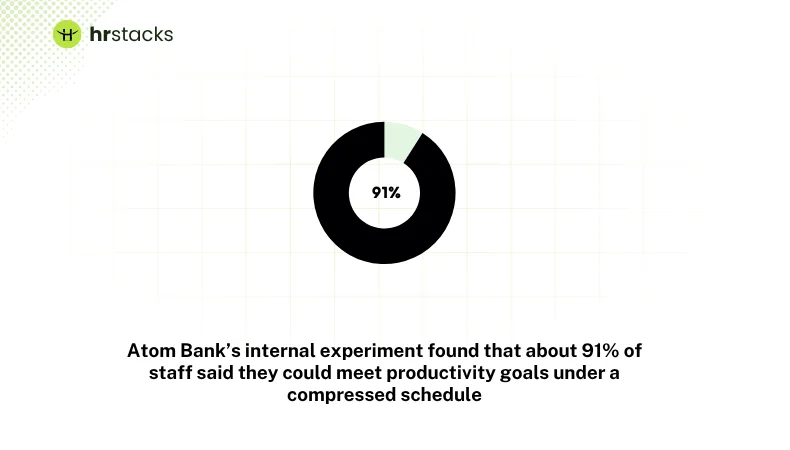
Atom Bank’s internal experiment found that about 91% of staff said they could meet productivity goals under a compressed schedule; managers also reported departmental productivity improvements.

The bank’s example shows that well-structured roles with clear deliverables, common in finance and tech teams, can adapt to compressed schedules with planning, automation, and tightened meeting discipline.
Atom Bank’s internal experiment found that about 91% of staff said they could meet productivity goals under a compressed schedule
7

Microsoft Japan: Short Pilot Sparked Long-Term Work Redesign

Microsoft Japan’s one-month “Work Life Choice Challenge” produced notable gains and prompted the company to treat the month as a repeatable experiment to refine meeting rules and work norms.

It’s a useful example for HR: short, controlled trials with clear metrics can surface practical levers, like meeting length and attendance rules, that matter more than the calendar day count.

Employee Wellbeing & Mental Health

8

41% Better Mental Health and 38% Improved Sleep Quality

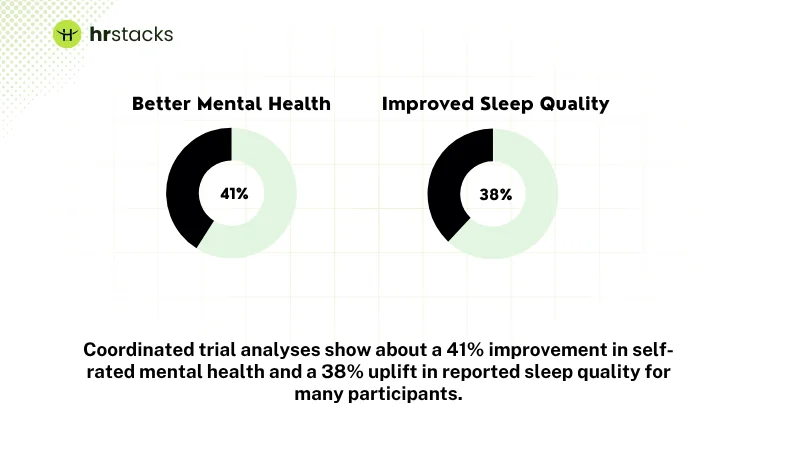
Coordinated trial analyses show about a 41% improvement in self-rated mental health and a 38% uplift in reported sleep quality for many participants.

These changes often appeared quickly and persisted when firms protected the extra day from work intrusions, allowing employees to catch up on health and caregiving tasks that otherwise erode evenings and weekends.
Four-Day Workweek Positive Effects
9

UK Trial: 39% of Workers Reported Lower Stress Levels

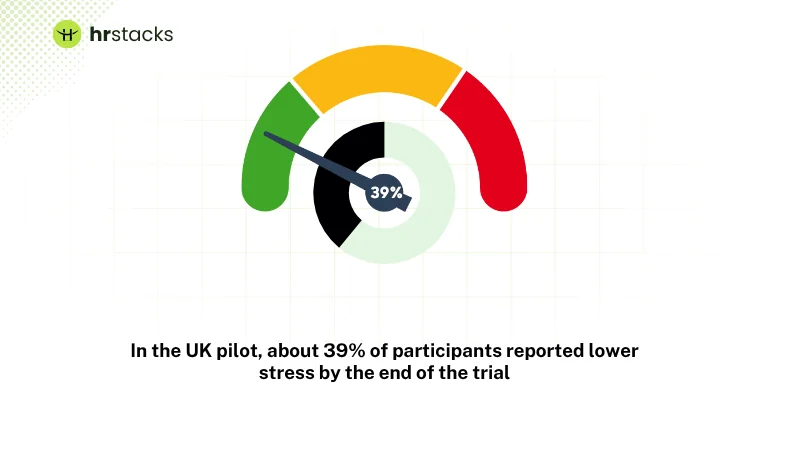
In the UK pilot, about 39% of participants reported lower stress by the end of the trial, linking the change to extra time for medical appointments, family care, and rest. The decline in stress was most pronounced where managers redistributed low-value tasks and enforced meeting discipline, highlighting that protective practices on workdays amplify wellbeing gains.

Four-Day Workweek Lower Stress Level
10

UK Pilot: 71% of Employees Reported Less Burnout

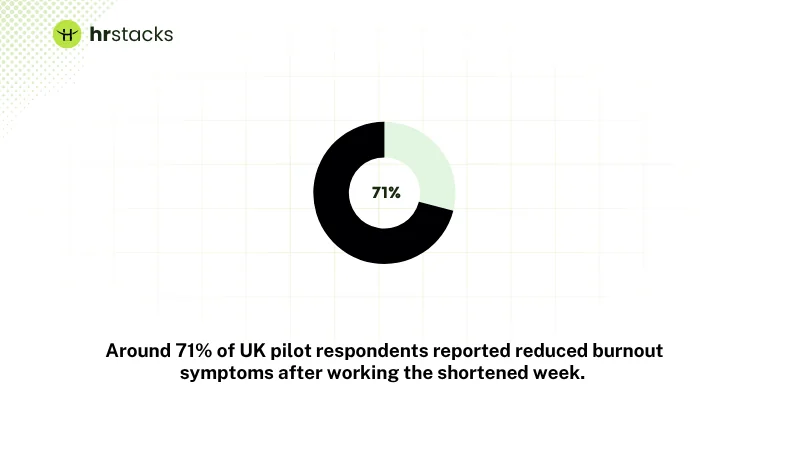
Around 71% of UK pilot respondents reported reduced burnout symptoms after working the shortened week. The effect was strongest in organizations that combined time reduction with rotation of duties, clearer priorities, and managerial coaching to prevent workload compression.

This suggests the model reduces emotional exhaustion when implemented with intent rather than as a superficial schedule tweak.
Employees Reported Less Burnout
11

Multi-Country Study: 67% Drop in Burnout Rates

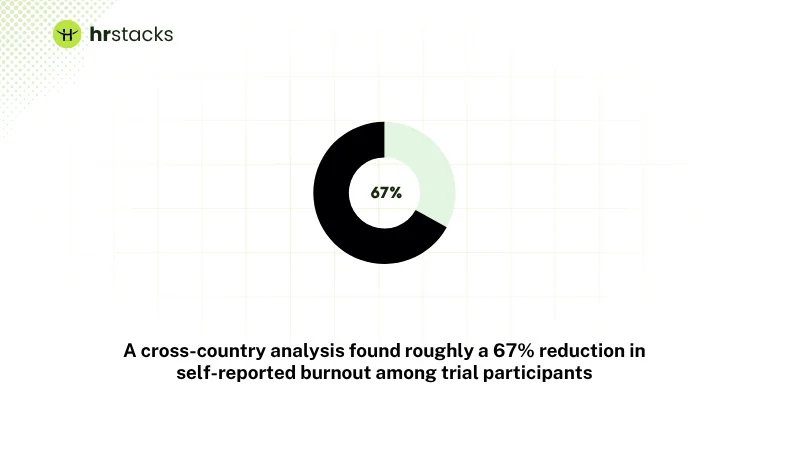
A cross-country analysis found roughly a 67% reduction in self-reported burnout among trial participants, reinforcing that reduced hours can have meaningful mental-health effects at scale.

The study cautions that results depend on sector mix and implementation, but the consistency across geographies strengthens the claim that shorter weeks, when well managed, lower emotional exhaustion.
reduction in self-reported burnout
12

Perpetual Guardian: Stress Down 7 Points, Life Satisfaction Up 5

Perpetual Guardian’s evaluation after its six-week trial recorded a seven-percentage-point drop in stress and a five-point rise in life-satisfaction scores.

The company credits success to outcome-focused goal setting and managerial trust, which reduced busywork and allowed staff to use free time for recharge.

These early figures remain a common touchstone in four-day week conversations because they showed measurable well-being gains alongside steady output.
13

Scotland’s Public Sector: 32-Hour Week Cut Sick Leave by 25%

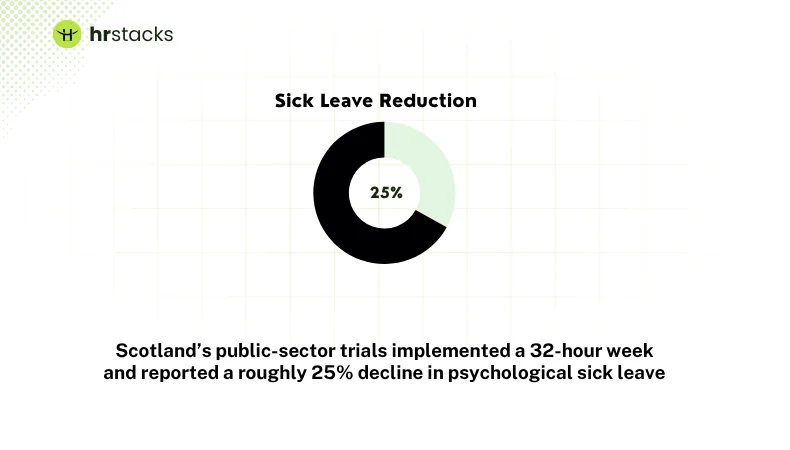
Scotland’s public-sector trials implemented a 32-hour week and reported a roughly 25% decline in psychological sick leave, while maintaining service levels by staggering non-working days and cross-training staff.

These pilots illustrate that with careful scheduling and role coverage, public services can trial reduced hours without immediate service degradation, though scalability and long-term budget impacts remain areas for study.
Sick Leave Reduction

Retention & Hiring Impact

14

UK Pilot: Resignations Fell by 57% During Trial

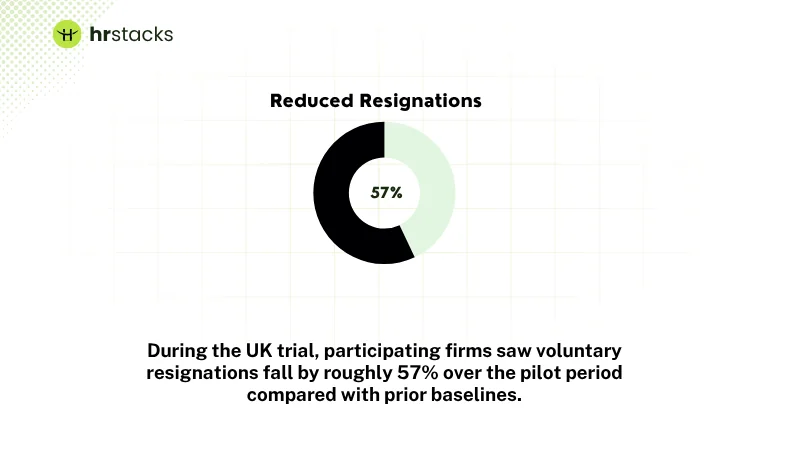
During the UK trial, participating firms saw voluntary resignations fall by roughly 57% over the pilot period compared with prior baselines.

Employees cited better work–life balance and clearer boundaries as reasons to stay, while managers reported fewer open roles and less hiring churn. The retention bump appears strongest where companies kept pay steady and communicated workloads and expectations transparently.
Reduced Resignations
15

Recruiting Edge: Four-Day Week Boosts Candidate Interest

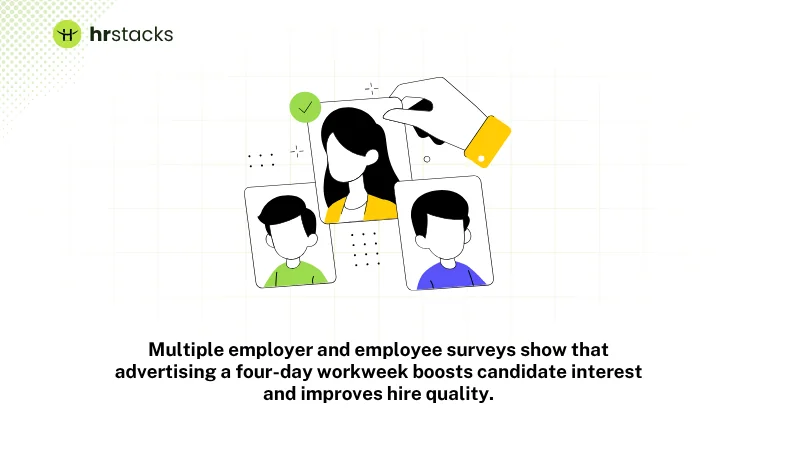
Multiple employer and employee surveys, including syntheses by BambooHR and Qualtrics, show that advertising a four-day workweek boosts candidate interest and improves hire quality.

Employers report increased application volumes and faster fills for roles where flexibility is valued, and workers signal a strong preference for roles that preserve pay while offering compressed time.

The hiring uplift adds a strategic talent dimension to the operational calculus for firms weighing pilots.
Four-Day Week Boosts Candidate Interest
16

83% of Employers Found Hiring Easier After Adopting Four-Day Week

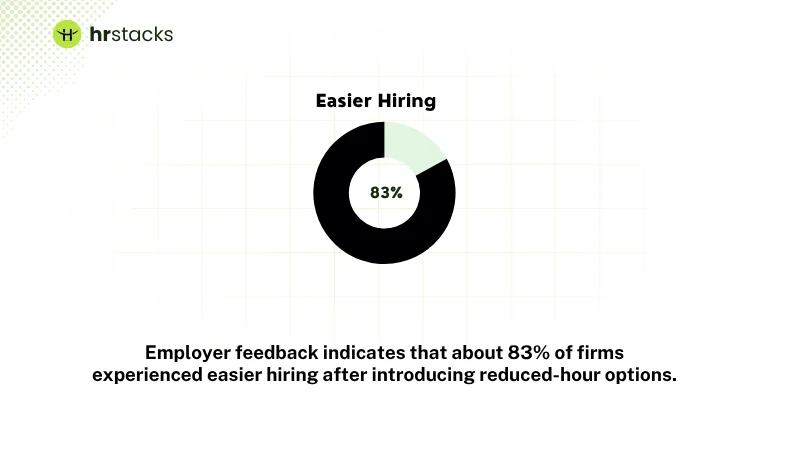
Reports aggregating employer feedback indicate that about 83% of firms experienced easier hiring after introducing reduced-hour options.

Employers noted increased candidate flow and improved cultural fit when four-day options were available, especially in tight labor markets.

While not universal, the hiring benefit often offsets transition costs by lowering agency spend and vacancy downtime in the medium term.
Employers Found Hiring Easier After Adopting Four-Day Week
17

88% Believe a Four-Day Week Would Improve Work-Life Balance

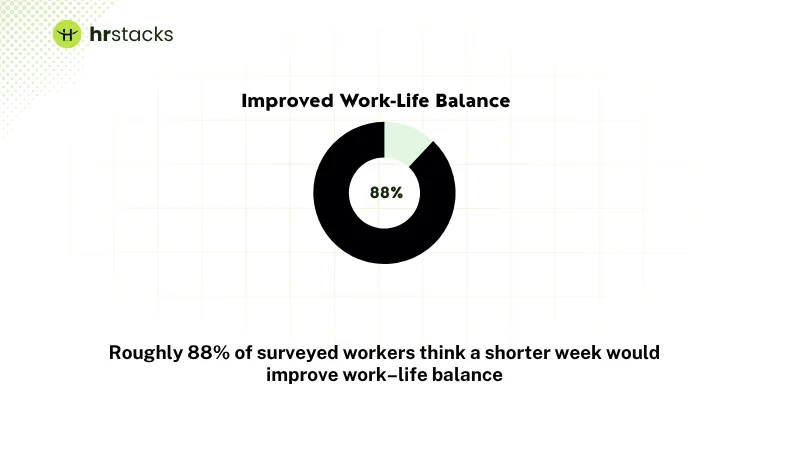
Roughly 88% of surveyed workers think a shorter week would improve work–life balance, which helps explain the political and recruiting momentum behind pilots. Employers often leverage this expectation to improve retention, but they must ensure fairness across roles to avoid creating a two-tier system between flexible and fixed-schedule jobs.

Four-Day Week Would Improve Work-Life Balance
18

82% of Employees Believe They’d Be More Productive With a Four-Day Week

Surveys show that about 82% of employees believe a four-day work week would boost their productivity. That belief affects behavior: employees who expect gains are likelier to adopt time-blocking and meeting discipline that realize those expectations.

But perception alone isn’t proof; organizations must pair pilot data with administrative metrics to validate claims.
19

79% Believe a Four-Day Week Would Boost Mental Health

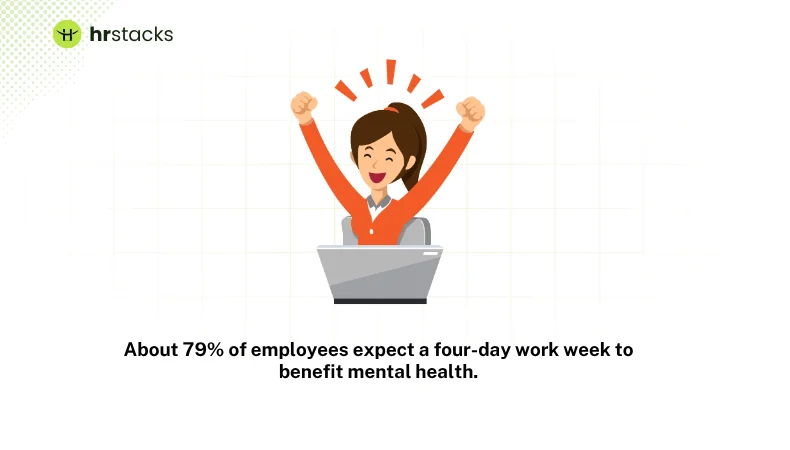
About 79% of employees expect a four-day work week to benefit mental health.

Firms that pilot the model typically pair the schedule with wellbeing supports and leave policies to convert expectation into measurable improvements rather than rely on perceived benefits alone
Four-Day Week Would Boost Mental Health
20

Perpetual Guardian: Made Four-Day Week Permanent After Success

Following its initial trial, Perpetual Guardian made reduced hours permanent, citing sustained engagement, lower stress, and stronger retention.

The firm’s move underscores that short pilots, when backed by measurement and managerial alignment, can translate into durable policy rather than a temporary perk

Adoption & Continuation Rates

21

4 Day Week Global: Benefits Sustained One Year Later

4 Day Week Global’s long-term follow-up shows many firms sustained initial benefits a year after transitioning. Their 12-month analysis highlights persistent reductions in burnout and continued or improved productivity when companies embedded cross-training, handover protocols, and clear success metrics.

The report warns, however, that firms relying solely on morale without operational redesign sometimes hit capacity crunches as novelty wears off, so long-term planning and measurement are key to durable outcomes.
22

92% of UK Firms Continued the Four-Day Week After the Pilot

After the UK pilot’s conclusion, about 92% of participating organizations chose to continue the shortened working model in some form.

That high continuation rate reflects both positive employee outcomes and business leaders’ comfort with output metrics; many firms invested in managerial training and process changes during the pilot, which made continuation operationally viable rather than aspirational.
Continued the Four-Day Week
23

31 UK Firms Made the Four-Day Week Permanent

Roughly 31 of the 61 companies involved in the UK trial ultimately adopted a permanent reduced-week arrangement. Firms reporting permanence typically had robust pre-trial planning, clear success criteria, and follow-up evaluation.

Their choices suggest that when pilots are designed with measurement and change management, a significant minority will move from experiment to policy.
24

4 Day Week Global: Now Supporting Over 1,000 Organizations

4 Day Week Global has supported more than a thousand organizations with toolkits, pilot guidance, and research synthesis, helping shift pilots from isolated experiments to a replicable practice.

Their playbooks emphasize redesign, measurement, and manager coaching, the same elements that correlate with successful pilots, and their broader reach means more data for long-term assessment.
26

UK 2022 Pilot: 61 Companies and Nearly 3,000 Workers Participated

The scale of the UK 2022 pilot, 61 companies and about 2,900 workers, makes it one of the most informative coordinated experiments to date.

Sectoral breadth allowed researchers to compare where the model held up and where it strained, giving HR leaders practical insights about pre-trial preparation, manager training, and the importance of outcome metrics over time logged.

Environmental & Societal Impact

27

Valencia and Spain Pilots: Wellbeing Up, Emissions Down

Valencia’s municipal pilot and subsequent Spanish initiatives reported improved worker wellbeing and a measurable drop in commuting-related emissions.

Local subsidies and coordinated off-days amplified environmental effects, while company-level process redesigns underpinned productivity results, showing that geographic policy and employer action can combine to magnify benefits.
28

Lower Commuting Times and Reduced Emissions Reported

Multiple pilots, notably in Spain and city programs, recorded reduced commuting and small but measurable emissions drops, especially when non-working days synced across households.

Environmental benefits add a civic argument for trials, and some local governments have used this data to subsidize pilot participants.
29

Extra Day Commonly Used for Rest, Family Care, and Errands

Survey and interview data show employees commonly use the extra day for caregiving, health appointments and rest, activities that otherwise crowd evenings and weekends.

Clearing those tasks from workdays improves focus and reduces “time poverty,” which can enable better performance during work hours

Methodology & Study Context

30

Self-Reporting Bias Remains a Limitation in Four-Day Studies 

Researchers repeatedly warn that much of the four-day evidence comes from self-reported surveys, which can inflate positive outcomes through enthusiasm or selection effects.

Increasingly, trials are combining subjective surveys with administrative data (revenue, error rates, sick days) to provide a fuller, less biased picture, a practice HR teams should emulate when evaluating pilots.
31

Most Four-Day Week Pilots Skew Toward White-Collar, Volunteer Firms

Most pilots have been concentrated in white-collar, tech, finance, and public-sector settings, who volunteered to participate, which limits generalisability to frontline, shift-based, or essential-service roles.

Practitioners should therefore avoid assuming universal applicability and design differentiated models for roles that require coverage or continuous operations.

Four-Day Workweek Statistics: Conclusion

Trials across countries are starting to show a consistent pattern. Productivity doesn’t collapse when hours are reduced; in many cases, it holds steady or improves. Microsoft Japan reported a 40% increase in output, and half of the Spanish pilot participants saw productivity rise. In the UK’s national trial, 92% of companies kept the shorter schedule, and resignations dropped by more than half.

The wellbeing data is just as clear. Burnout fell by around 70% in the UK pilot and by two-thirds in multi-country studies. Workers slept better, felt healthier, and took fewer sick days. These aren’t minor lifestyle perks; they’re measurable outcomes that connect directly to retention and performance.

That said, success depended on structure. Companies that trained managers, tracked output, and cut unnecessary meetings saw the biggest gains. Those who simply removed a day without rethinking workflows struggled. The takeaway isn’t that everyone should move to four days overnight; it’s that time alone isn’t the lever. Design, trust, and process matter more.

The four-day week is no longer a fringe experiment. It’s a management choice with growing evidence behind it, and for many teams, it’s proving that less time can still deliver more value.

Manjuri Dutta
Manjuri Dutta
Manjuri Dutta is the co-founder and Content Editor of HR Stacks, a leading HR tech and workforce management review platform, and EmployerRecords.com, specializing in Employer-of-Record services for global hiring. She brings a thoughtful and expert voice to articles designed to inform HR leaders, practitioners, and tech buyers alike.
Get HR Stacks Weekly
Get our weekly news update with all latest news in HR community.
Featured Products
Deel Logo
Deel
Deel is a well-recognized all-in-one HR solution...
usemultiplier_logo
Multiplier
Multiplier is an emerging global employment platform...
Connecteam Logo
Connecteam
Connecteam is an all-in-one employee management platform...
bamboohr Logo
BambooHR
BambooHR is a leading cloud-based HR software...
HiBob Logo
HiBob
HiBob is a modern HRIS designed for...
Latest Statistics
Receive the latest HR news

Subscribe To Our Weekly HR Newsletter

Get the latest from the HR & AI tech industry. All your news at one place. 

HR Stacks uses cookies

This website uses cookies to enhance user experience and to analyze performance and traffic on our website. By continuing to browse this site you are agreeing to our use of cookies.