


What is Remote.com
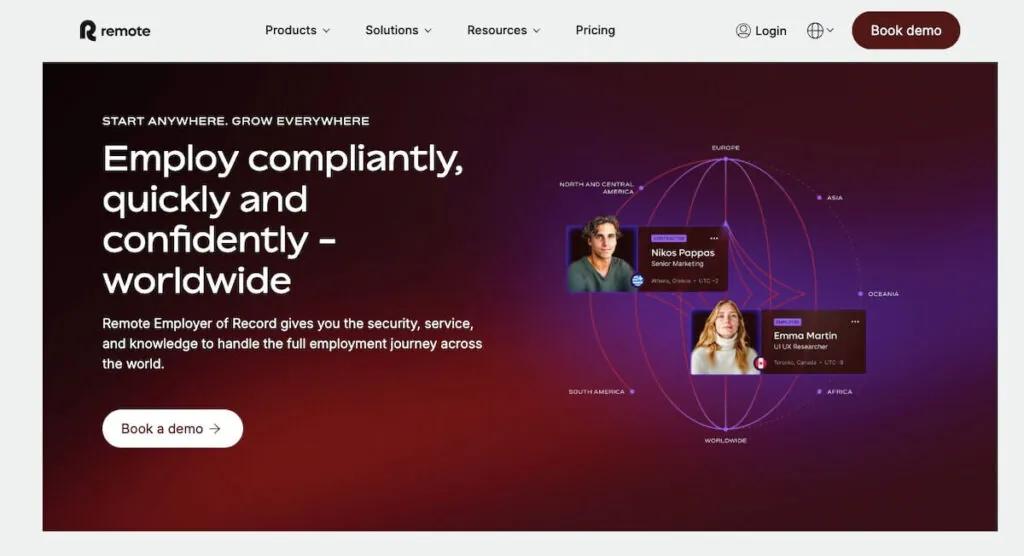
Remote.com is a global Employer of Record platform that helps companies hire, pay, and manage international employees without setting up local legal entities in every country.
It handles the compliance side of global hiring, employment contracts, payroll, taxes, statutory benefits, and labor law obligations, while the client company manages the employee’s day-to-day work.
What makes Remote different from many competitors is how its infrastructure is built. In countries where it provides EOR services, Remote operates through legal entities it owns directly rather than relying on local third-party partners. That’s a meaningful distinction in the EOR market, where many providers still depend partly on partner networks behind the scenes.
The company was founded in 2019 by former GitLab leaders Job van der Voort and Marcelo Lebre. Like GitLab, Remote operates as a fully distributed company itself and has scaled rapidly over the last few years.
It has raised more than $500 million from investors including SoftBank Vision Fund, Sequoia Capital, Index Ventures, and Accel, reaching a reported $3 billion valuation during its Series C round in 2022.
Remote’s EOR coverage spans more than 80 countries through owned entities, while contractor payments and management extend to over 180 countries and territories. Its customer list includes companies like GitLab, DoorDash, HelloFresh, Loom, and Paystack.
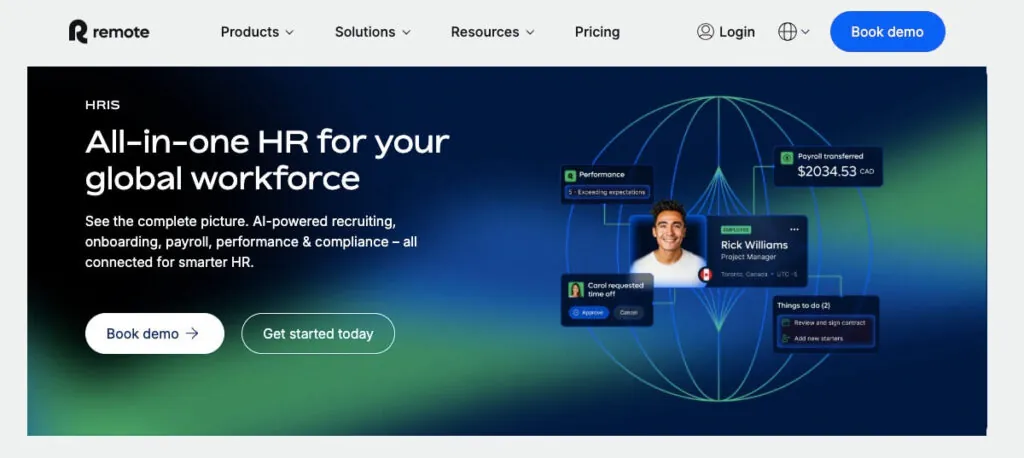
The platform itself has expanded well beyond EOR services. Remote now includes contractor management, a free HRIS, global benefits administration, equity management capabilities following its Easop acquisition, and newer AI-driven onboarding and compliance tools.
The broader product direction is clearly aimed at becoming a centralized platform for international workforce operations rather than just an EOR vendor.
Pricing is relatively transparent compared to much of the industry. EOR services start at $599 per employee per month on annual billing, while contractor management starts at $29 per contractor monthly. Remote also stands out for avoiding many of the extra charges common in this category, including setup, onboarding, offboarding, and deposit fees.
From a security and compliance perspective, Remote maintains SOC 2 Type II compliance and follows GDPR and ISO 27001 standards. One feature worth highlighting for tech companies is Remote IP Guard, which is designed to help ensure intellectual property created by international employees remains assigned to the client company.
This review breaks down the platform in more detail, including features, pricing, limitations, support quality, and how Remote compares with other leading EOR providers.

Editor’s Rating for Remote.com
Remote sits in a specific position in the EOR market: genuinely strong compliance infrastructure at a price that doesn’t require a deposit conversation. For mid-market companies hiring across Europe and North America, that combination is hard to find at $599/month.
The support model is where the confidence should pause. No dedicated CSM means a payroll issue at month-end sits in a ticket queue for up to 48 hours. At this price point, Oyster HR gives you a named contact for the same fee.
The owned-entity model is Remote’s clearest argument, when something goes wrong in Germany or Singapore, accountability stays with Remote, not a partner you’ve never spoken to. For compliance-first buyers, that’s worth more than a larger country count through third parties.
$599/month, no deposit, no setup fee, no offboarding charge. The startup discount takes it to ~$509 for early-stage companies. Deel matches the headline price but requires a deposit of 1–1.5x monthly employment cost per employee — for a 10-person team that can lock up $100,000 in working capital. Remote doesn’t ask for any of it.
80–90+ EOR countries through fully owned entities, contractor payments across 180+ territories. The headline number is lower than Deel or Oyster — but those platforms run partner networks in markets where Remote holds its own entity. For companies where compliance accountability can’t be passed down a partner chain, the 80+ owned markets carry more weight than a competitor’s 150+ through third parties.
SOC 2 Type 2, GDPR, and ISO 27001 — with full accountability in every covered market because there’s no partner to redirect blame to. Remote IP Guard keeps intellectual property with the hiring company, which is the primary reason tech companies choose Remote over cheaper alternatives.
Fully self-serve for both employer and employee, with no implementation calls required. Buyers running simultaneous hires across UK, Germany, and India consistently report going live without contacting support. Countries with stricter local documentation requirements add time — that’s a regulation reality, not a platform failure.
Consistent multi-country payroll with automated deductions and on-time payments across covered markets. Global health insurance via Kota and equity management across 70+ countries via Easop both landed in 2024, meaningfully expanding what was a thin benefits layer. Finance teams needing cross-country variance analysis will want an external BI tool alongside it.
50+ native connections covering the mid-market stack well. SAP and Oracle users will hit manual export workarounds. Deel’s 300+ native integrations aren’t close.
Ticket-based at standard tier — no dedicated CSM. Live chat and a 24/7 AI assistant handle routine queries well enough. The problem surfaces when a payroll issue needs resolution before end of cycle and the queue says 24–48 hours. 3,078 verified reviews flag this as the platform’s most consistent failure point, and it compounds as headcount grows.
The highest-consensus score on the card — buyers frustrated with support and pricing still rate the platform experience positively. Non-HR admins navigate without training. Employees manage payslips, time off, and expenses without raising a ticket. One verified reviewer documented completing a full onboarding in a new country without opening the help docs once.
Remote’s owned-entity model and zero-deposit pricing earn their scores — the structural advantages are real. The 3.5 on support is the number to pressure-test before signing at $599 per head.
Remote.com: Strengths and Limitations
Compressed from verified user reviews, vendor documentation, and independent platform research.
Every country Remote covers for EOR is backed by a legal entity it owns outright. When something goes wrong in Germany or Singapore, there’s no partner to redirect the blame to. Remote is accountable, full stop.
Deel requires a deposit of 1–1.5x monthly employment cost per employee at sign-up. For a 10-person team, that’s potentially $100,000 locked up before a single contract runs. Remote charges none of it — and that difference shows up in cash flow from month one.
Built into every EOR contract at no extra cost. Your code, designs, and product are legally anchored to the hiring company regardless of where the employee is based. For tech companies hiring engineers internationally, this is the feature that makes Remote a category-specific choice rather than a generic EOR.
Clean dashboard, self-serve onboarding, employee portal that works without a support ticket. The one thing buyers agree on regardless of their other frustrations with the platform.
Global health insurance via Kota landed November 2024. Equity management across 70+ countries followed via the Easop acquisition in April. Remote’s benefits layer was a documented weak point for years. Two product moves in one calendar year closed most of that gap.
Ticket queue with live chat and an AI assistant. Fine until a payroll error needs fixing before end of cycle. Oyster HR at the same $599 price gives you a named CSM. Remote doesn’t — and 3,078 verified reviews make clear this is where frustration concentrates.
50+ native integrations covers BambooHR, HiBob, Greenhouse, Slack, and Xero. SAP SuccessFactors and Oracle HCM users will be doing manual exports. Deel’s 300+ native connections aren’t a close comparison — for enterprise stack buyers, that gap is a deciding factor.
Anything requiring variance analysis or cross-country cost drill-down needs an external BI tool. Papaya Global built an entire finance intelligence layer for this problem. Remote hasn’t, and at $599/month per head, that gap becomes harder to justify as headcount grows past 10.
Remote.com’s Core Features
Remote’s product has expanded well beyond its EOR origins. What started as a hire-without-an-entity tool now covers global payroll, contractor management, equity compensation, global benefits, and a free HRIS, all built on the same owned-entity infrastructure. The feature breakdown below is assessed against verified user review patterns, vendor documentation, and independent platform analysis.
Evaluated against G2 and Capterra review patterns, vendor documentation, and independent platform analysis.
Full-scope EOR across 80–90+ countries through 100% owned legal entities. Compliant contracts, payroll, tax filings, statutory benefits, and offboarding — no partner in the compliance chain.
Multi-country payroll for companies with existing entities. Built-in payroll engine launched May 2025 processes in 100+ countries without third-party processors. Consistent on-time payments across covered markets.
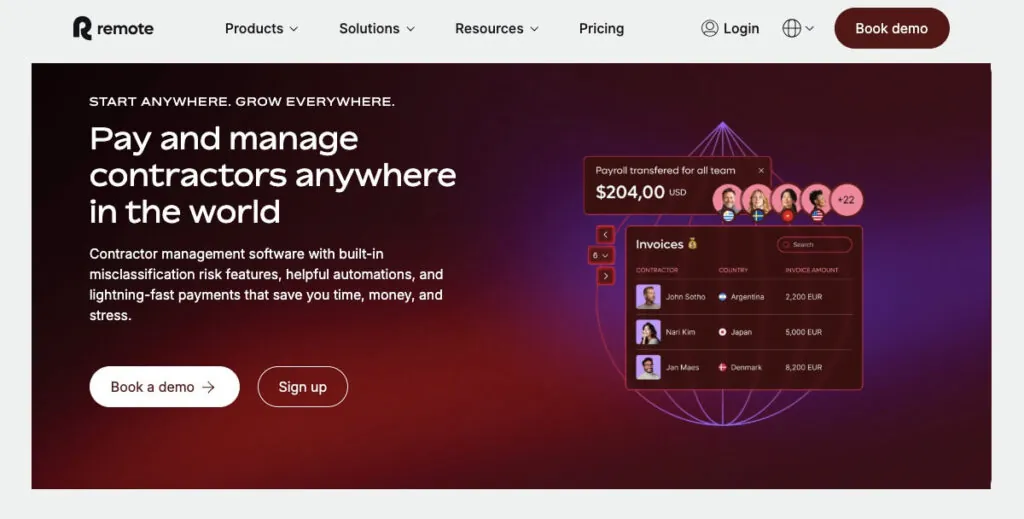
$29/contractor/month across 180+ countries. Contractor of Record launched January 2025 handles legal onboarding, invoicing, tax management, and payments. AI-powered misclassification risk tools included.
SOC 2 Type 2, GDPR, ISO 27001. Remote IP Guard protects intellectual property at the contract level. AI-driven compliance and onboarding tools rolled out through 2025.
Country-tailored statutory benefits across all covered markets. Global health insurance via Kota added November 2024. Equity compensation across 70+ countries via Easop acquisition April 2024.
Free. Covers employee records, time off, expenses, documents, and performance reviews. Launched September 2023. Functional for small and mid-market teams — not a replacement for enterprise HRIS.
Fully self-serve for both employer and employee. Fast in most markets. Delays surface in countries with stricter local documentation requirements — a regulation issue, not a platform flaw.
Stock and equity compensation across 70+ countries via the Easop acquisition. Covers compliance and administration for equity grants to international employees. Still maturing relative to dedicated equity platforms.
Payslips, headcount summaries, and basic payroll reports work reliably. Cross-country variance analysis needs an external BI tool. Finance teams managing 10+ markets will feel this gap quickly.
Visa and work permit support for cross-border relocations handled through the platform. Useful for moving existing employees into new markets. Not a core EOR differentiator.
Remote.com Integrations
50+ native connections cover the core mid-market stack, SAP SuccessFactors and Oracle HCM are not supported natively, and teams on those systems will need API workarounds.
Native connections confirmed from remote.com. Developer API available for custom workflows and automation.

When Remote is the right choice
Remote earns its scores most consistently within a specific buyer profile. The four personas below reflect where the platform genuinely delivers, based on review patterns, pricing structure, and what the owned-entity model actually means in practice.
Remote IP Guard is written into every EOR contract. Your code, designs, and product stay legally owned by your company regardless of where the engineer sits. GitLab built its distributed engineering team on Remote specifically because of this. No other EOR in this comparison makes IP protection a contract-level feature rather than a policy document.
Deel asks for 1–1.5x monthly employment cost per employee before the first contract runs. On a 10-person team, that’s $100,000 sitting idle. Remote requires no deposit at all. If working capital is tight or your CFO won’t sign off on that kind of cash lock-up, Remote removes the problem entirely.
These are Remote’s strongest markets. Owned entities in the UK, Germany, France, Netherlands, Canada, and the US mean one invoice, one compliance chain, no partner handoffs. Teams without a dedicated legal or HR function find this setup significantly easier to manage than platforms that rely on partner networks in the same markets.
No minimum headcount, no setup fees, published pricing. Pre-seed through Series A companies qualify for 15% off EOR for the first 12 months, bringing the rate to roughly $509/month. The onboarding is fully self-serve, so you don’t need an HR team or a procurement process to get moving.
When to consider alternatives to Remote.com
Remote has real limits. These four scenarios are where a better-fit alternative is wide enough to matter before you get to a demo call.
Remote’s owned-entity coverage thins outside Europe and North America. If Singapore, Indonesia, Brazil, or Mexico are your primary hiring markets, you’ll get better coverage depth from Oyster’s 180+ country footprint or Deel’s owned entities in those specific regions. Verify country-level availability before you get to a demo.
Consider Deel or Oyster HRNeither SAP SuccessFactors nor Oracle HCM has a native Remote connector. That means manual data exports, reconciliation overhead, and a gap in your reporting chain every pay cycle. Papaya Global and Deel both have native integrations with enterprise HCM systems. Remote doesn’t, and there’s no indication that’s changing soon.
Consider Papaya Global or DeelStandard tier gets you tickets, live chat, and an AI assistant. That works fine for routine questions. It falls apart when a payroll error surfaces two days before pay runs and you need someone who knows your account to fix it fast. Oyster HR costs $100 more per employee per month and gives you exactly that.
Consider Oyster HRRemote gives you payslips and headcount summaries. If your CFO wants cross-country cost variance, real-time spend dashboards, or AI-driven anomaly detection across 10+ markets, Remote can’t deliver that without a separate BI tool. Papaya Global was built specifically for finance teams running multi-country payroll at scale.
Consider Papaya GlobalHow Remote.com Compares to Alternatives
Remote sits in a crowded EOR market where the right choice depends heavily on which trade-off matters most to your business. We mapped it against six direct competitors, Deel, Oyster HR, Papaya Global, Pebl, Rippling, and Multiplier, across four attributes that actually drive buying decisions: price, entity ownership model, integration depth, and IP protection.
These aren’t the only differences, but they’re the ones that consistently separate Remote from the field in pre-purchase conversations.
$599/month, price-matched with Deel, no deposit required. The zero-deposit policy is the real differentiator here, not the headline rate.
100% owned entities in every EOR market. No partner network, no tripartite arrangements. Full compliance accountability sits with Remote.
50+ native connections cover mid-market stacks well. SAP and Oracle users hit workarounds. Deel and Rippling are in a different tier entirely at enterprise scale.
Remote IP Guard is written into every EOR contract. No other EOR in this comparison makes IP protection a structural contract feature rather than a policy document or optional add-on.
vs
Same $599 price, but Deel requires a deposit of up to $100,000 for a 10-person team before a single contract runs. Remote doesn’t. Deel wins on integration depth — 300+ native connections versus Remote’s 50+. The deposit difference is what decides this for most finance teams.
Depends on deposit policy
vs
Remote costs $100 less per employee per month and requires no deposit. Oyster gives you a named CSM and holds B Corp certification. If having a dedicated contact matters more than the $100 saving, Oyster is the better call.
Depends on support needs
vs
These two serve different buyers. Remote is the cleaner choice for compliance-first EOR. Papaya is built for finance teams that need real-time cost dashboards, AI variance detection, and Azimo payment rails across 10+ markets. If your CFO is asking for consolidated payroll reporting, Remote won’t cut it.
Different buyer profiles
vs
Pebl has a decade-plus compliance audit history that carries weight in enterprise procurement where legal teams require long vendor track records. Remote has published pricing, a modern platform, and no deposit. For companies that don’t need that audit history and want to move without a sales cycle, Remote is faster.
Enterprise favours Pebl
vs
Rippling is an HR, IT, and finance platform that includes EOR as one module. If you want device management and app provisioning alongside global hiring, Rippling covers ground Remote doesn’t touch. For companies that specifically need owned-entity EOR without the platform sprawl, Remote is the simpler choice.
Depends on platform scope
vs
Multiplier starts at $400, which is $199 cheaper per employee per month. That gap compounds fast on a growing team. Remote counters with owned-entity accountability and IP Guard, neither of which Multiplier can match structurally. Equity-heavy companies tip toward Multiplier for ESOP administration. Compliance-first buyers tip toward Remote.
Depends on compliance priorityReal-World Use Cases for Remote.com
Pricing tables tell you what Remote costs. These four scenarios tell you whether it will actually work for your situation, with specific headcount, geography, and honest fit verdicts.
Four scenarios with specific headcount, geography, and honest fit verdicts based on Remote’s published pricing and documented capabilities.
Both markets covered through owned entities. Self-serve onboarding, no deposit, no setup fee. The 15% startup discount brings EOR to ~$509/month for qualifying companies. Remote IP Guard is active from contract day one — useful if you’re hiring engineers.
All three markets covered through owned entities. One dashboard, one invoice, full IP protection across every contract. No deposit required — for a 12-person team that removes roughly $120,000 in locked working capital compared to Deel. The clearest Remote use case.
Contractor and EOR management in the same platform. The Contractor of Record service handles compliance during the transition. Remote IP Guard activates the moment the employment contract goes live. For a SaaS company converting engineering contractors, IP protection alone justifies the evaluation.
At this scale, Remote’s basic payroll reporting becomes a real operational problem. No real-time cost dashboards, no AI variance detection, no cross-country drill-down. Finance teams running payroll across 15+ markets need Papaya Global’s BI layer. Remote isn’t built for that problem.
What Users Say About Remote.com
We analyzed 4,000+ verified reviews across G2, Capterra, and Trustpilot. The scores are consistent on the platform’s core strengths. The complaints are equally consistent and worth reading before you sign.
Aggregated from verified reviews across G2, Capterra, and Trustpilot — approximately 4,000+ data points.
HR teams consistently cite the ability to hire in a new country in days rather than months. No entities to maintain, no local accountants to manage. G2 reviewers managing distributed teams across multiple jurisdictions describe it as genuine operational relief.
Non-HR admins navigate without training. Employees manage payslips, expenses, and time off without raising tickets. The one thing reviewers on all three platforms agree on.
Published rates, zero hidden fees, no deposit requirement. Reviewers switching from Deel specifically highlight the cash-flow difference. What you see on the pricing page is what Finance reconciles at month end.
New hires complete their own onboarding flow without HR involvement. Multiple G2 reviewers document going from offer to payroll-active in under a week across markets they’d never hired in before.
The most consistent complaint across Trustpilot’s 3,078 reviews. When a payroll issue needs resolution before end of cycle, a 24–48 hour ticket response creates real operational friction. Grows worse as headcount increases.
$599/month per employee is manageable at 5 hires. At 20, it’s $143,760 annually before a single salary is paid. G2 reviewers with growing headcounts flag the per-employee model as a structural tension with scaling.
Finance teams managing costs across multiple markets quickly outgrow what Remote’s reporting offers. No variance detection, no cross-country drill-down. External BI tools become a necessity, not an option.
Markets with strict local documentation requirements slow things down. Capterra reviewers hiring in parts of APAC and LATAM flag longer timelines. Not a platform failure — a local regulation reality that Remote is transparent about.
How Much Does Remote.com Cost?
Remote publishes all plan rates openly, no demo required to see what you’ll pay. The $599 EOR rate is the platform fee only. Employer taxes, statutory contributions, and benefits layer on top and vary significantly by country. Factor those into your total cost modeling before comparing against competitors.
Hire and manage full-time employees across 80–90+ countries through 100% owned legal entities. Covers compliant contracts, payroll, tax filings, statutory benefits, Remote IP Guard, and self-serve onboarding. Month-to-month available at $699.
Compliant contractor engagement across 180+ countries. Localized contracts, invoice management, multi-currency payments, and AI-powered misclassification risk tools. Fair Price Guarantee means you only pay for contractors you’re actively working with.
Launched January 2025. Remote takes on full legal responsibility for contractor onboarding, invoicing, tax management, and payments. Built for companies running large contractor networks where misclassification risk is a real operational concern.
For companies with existing legal entities that need consolidated multi-country payroll. Automated calculations, local compliance, and HRIS integrations. An implementation fee applies at setup and a recurring payroll delivery fee applies per cycle.
Employee records, time off, expenses, document management, and performance reviews. Launched September 2023. No payroll processing included — pairs with EOR or Global Payroll for full workforce management.
The $599 EOR rate is the platform fee only. Employer taxes and statutory benefits layer on top and vary by market. In Germany or France, total employer cost can run 30–40% above base salary alone.
Get the exact figure in writing before signing. Also confirm whether the recurring per-cycle delivery fee is charged per country or per payroll run.
On a 10-person team that’s $12,000 a year for the flexibility of avoiding an annual commitment. Model both scenarios before deciding on billing cadence.
Pricing excludes employer taxes, statutory contributions, and optional benefits — these vary by country and add to plan fees. Startup discount of 15% available for pre-seed through Series A companies on EOR and contractor management for the first 12 months. Month-to-month EOR available at $699/employee/month. Verified from remote.com/pricing as of April 2026.
Our Final Verdict on Remote.com
100% owned entities, zero deposit, IP protection built into every contract. The platform earns its compliance scores. Support and reporting depth are the documented limits buyers need to weigh before signing.
Remote is the right call for companies that want full compliance accountability without a partner network in the middle. At $599/month with no deposit and IP Guard in every contract, the owned-entity model justifies the price for the right buyer.
Remote’s owned-entity model is its clearest argument. Every market it covers for EOR is a market where Remote holds the legal accountability directly, no partner in the chain, no ambiguity when something goes wrong.
The zero-deposit policy and $599 price point remove two common friction points competitors don’t bother addressing. For IP-sensitive tech companies and mid-market teams hiring across Europe, those two factors alone often decide the evaluation.
The gaps are real and documented. No dedicated CSM, basic payroll reporting, and integration depth that stops at mid-market. Trustpilot’s 3,078 reviews make the support limitation clear. Know them before you sign.
For the right buyer, Remote is one of the most structurally sound EOR platforms at this price point. For everyone else, Oyster HR, Papaya Global, and Deel each close a specific gap better.
Frequently Asked Questions
Remote.com FAQs
Remote.com is a global Employer of Record platform that lets companies hire, pay, and manage full-time employees and contractors in other countries without opening local legal entities. Remote becomes the legal employer in each covered market, handling employment contracts, payroll, taxes, statutory benefits, and offboarding while the employee works directly for you.
What separates Remote from most EOR competitors is its owned-entity model. Every country it covers for EOR is backed by a legal entity Remote owns outright — no third-party partners in the compliance chain.
EOR starts at $599 per employee per month on an annual plan, or $699 month-to-month. Contractor management runs $29 per contractor per month. The HRIS is free. Remote charges no deposit, no setup fee, and no offboarding fee on EOR and contractor products.
Pre-seed through Series A companies qualify for a 15% startup discount on EOR for the first 12 months, bringing the effective rate to approximately $509/month.
No. Remote does not require a deposit for EOR or contractor management. This is a meaningful structural difference from Deel, which requires a deposit of 1–1.5x monthly employment cost per employee at sign-up. For a 10-person team, that can lock up $100,000–$150,000 in working capital before a single contract runs.
Remote offers EOR services across 80–90+ countries through fully owned legal entities. Contractor management and payments extend to 180+ countries and territories. Coverage is strongest in Europe and North America. If your primary hiring markets are in APAC or LATAM, verify specific country availability before committing.
Remote IP Guard is an intellectual property protection feature built into every Remote EOR contract. It legally anchors your code, designs, and product to the hiring company regardless of where the employee is based. For tech companies hiring software engineers internationally, this removes IP ownership risk at the contract level rather than leaving it to a policy document.
Yes. Contractor management costs $29 per contractor per month across 180+ countries, with localized contracts, invoice management, multi-currency payments, and AI-powered misclassification risk tools. A Fair Price Guarantee means you only pay for contractors you’re actively working with.
Remote also launched a Contractor of Record service in January 2025, where Remote takes on full legal responsibility for contractor onboarding, tax management, and payments — reducing misclassification risk for companies running large contractor networks.
Both start at $599/month for EOR. Remote requires no deposit; Deel requires 1–1.5x monthly employment cost per employee. Remote holds 100% owned entities in every EOR market. Remote IP Guard is built into every contract.
Deel leads on integration depth — 300+ native connections versus Remote’s 50+ — and covers more countries. For teams where deposit policy and IP protection are the decision factors, Remote holds its ground at the same price.
Yes, particularly for pre-seed through Series A companies. The 15% startup discount brings EOR to approximately $509/month for the first 12 months. Self-serve onboarding, no minimum headcount, no setup fees, and no deposit make the barrier to entry low. Model your total EOR spend at 12 and 24 months before committing — $599/month per employee compounds fast as headcount grows.