


What is Papaya Global
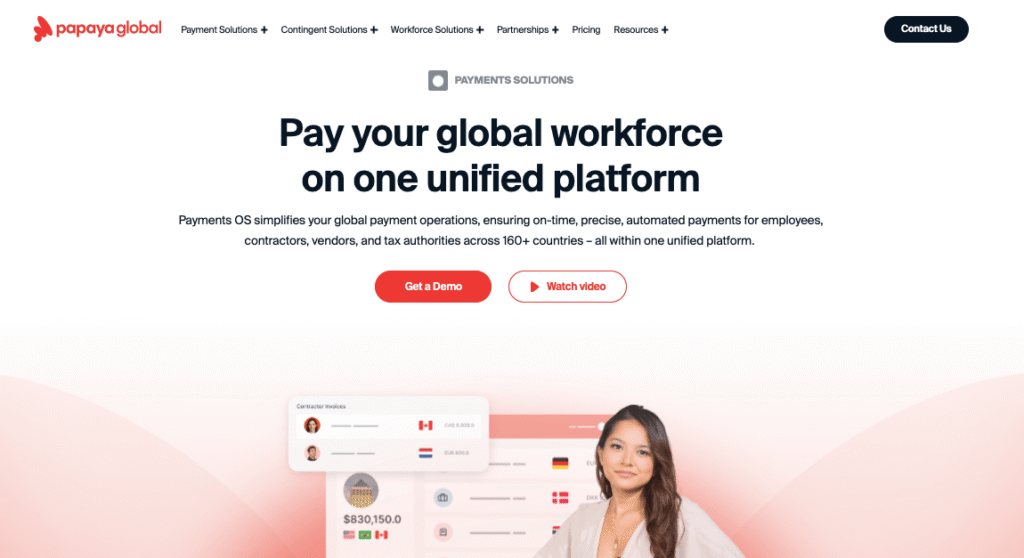
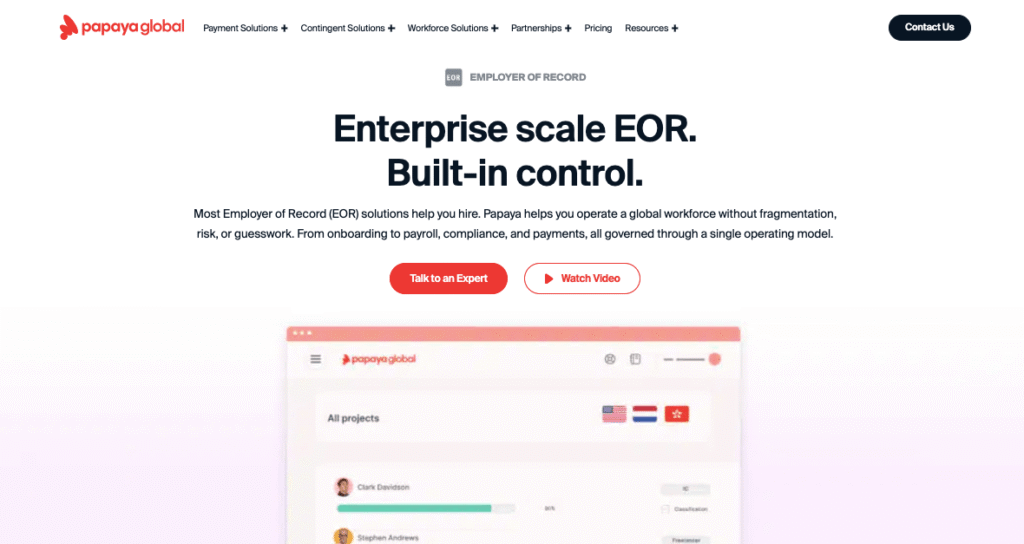
Papaya Global is a workforce management platform built around the idea that payroll, employment, and payments should live in one system, not three. The platform serves as an Employer of Record in 160+ countries, manages global payroll and contractor payments, and sits on top of a proprietary payments infrastructure that most EOR companies don’t have.
Its primary clients are mid-market and enterprise HR and finance teams managing distributed workforces across multiple countries simultaneously.
The company was founded in 2016 by Eynat Guez, who currently serves as CEO, and is headquartered in New York with offices across Europe, North America, and Asia. Papaya has raised over $450 million in funding and holds a valuation of $3.7 billion as of its last published round.
It has been named to the Forbes Cloud100 and CNBC’s Inaugural Top Startups for the Enterprise, and won the Global Payroll Association’s Automation and Integration Award. The company reports a 99% customer retention rate across its enterprise client base.
Coverage spans 160+ countries across EOR, contractor, and payroll services, with 130+ currencies supported for payments. Named clients include SentinelOne, Rubrik, Within3, Bright Machines, and CyberArk. Within3 grew its workforce four times over while tripling its operational footprint on Papaya’s platform.
Papaya’s product architecture is structured as three interconnected operating systems: Workforce OS for employment and payroll, Payments OS for cross-border disbursements, and Contingent OS for contractor and vendor workforce governance.
Pricing is published in tiers. EOR services start at $650 per employee per month for standard coverage, with a premium tier at $770 that adds dedicated HR support and priority compliance review. Global Payroll (for companies with their own entities) runs at $25 per employee per month.
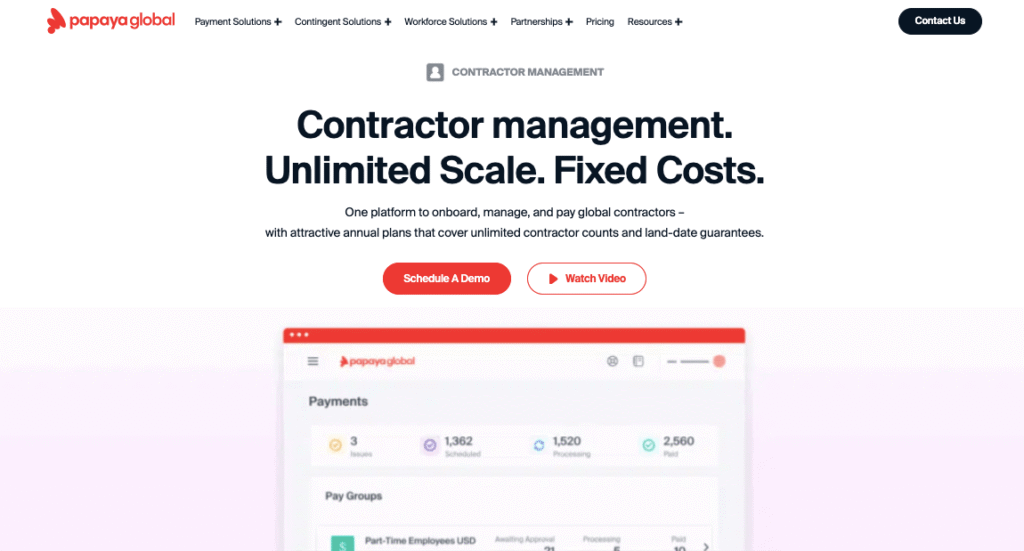
Contractor management starts at $30 per contractor per month. Workforce Payments, for companies that only need cross-border payment infrastructure, starts at $2.50 per transaction. Enterprise contracts are typically negotiated on annual minimums.
Papaya holds SOC 2, GDPR, and ISO 27001 certifications. Its payments arm, Azimo, holds money transfer licenses in five Tier-1 jurisdictions, which means payment processing runs through regulated rails rather than third-party services.
Editor’s Rating for Papaya Global
Papaya Global’s scores reflect a platform built for a specific kind of buyer, one where payroll intelligence, payments infrastructure, and enterprise integrations matter more than price.
The 4.6 on payroll and benefits and the 4.4 on integrations aren’t flukes; they reflect a product that finance teams at companies like SentinelOne and Rubrik have put through real operational pressure across 10+ countries simultaneously.
The 3.2 on pricing is equally deliberate. At $650/month, Papaya is the most expensive EOR in this comparison — $51 more than Deel, $250 more than Multiplier.
That gap is defensible for the right buyer. The 3.6 on customer support maps directly to the Trustpilot pattern: account managers are strong, but first-line responsiveness at scale is where the product shows friction. The four limitations below follow from both scores.
The scores above tell you where Papaya sits in the category. What they don’t tell you is what that feels like operationally, which features hold up under real payroll pressure, and where the gaps show up three months in. That’s what the breakdown below covers.
Papaya Global Review: Strengths & Limitations
What buyers gain and give up — based on G2, Capterra, and Trustpilot reviews, vendor documentation, and independent platform analysis.
Strengths
Real-time cost dashboards, AI-powered variance detection, and cross-country reporting built for CFOs. Within3 cut onboarding time by 70% across 18 countries. SentinelOne runs global payroll here at scale. The BI layer is what separates Papaya from every other EOR in this comparison.
Papaya owns Azimo, which holds money transfer licenses in five Tier-1 jurisdictions. Same-day disbursements in 130+ currencies with full liability. Every other EOR in this comparison routes payments through third parties. This one doesn’t.
Workday, SAP SuccessFactors, Oracle HCM, HiBob, BambooHR, NetSuite, Expensify, Beeline, SAP Fieldglass. The HCM Cloud Connector cuts 95% of manual data sync. If your stack runs on enterprise HCM or ERP, Papaya connects without workarounds.
Workforce OS, Payments OS, and Contingent OS cover employees, payments, and contractors from a single dashboard. Mixed worker types across multiple countries — managed without stitching three vendors together.
G2 and Capterra reviewers name their account managers specifically and cite real compliance questions resolved fast. One HR BP called hers “invaluable” across a tight multi-country EOR rollout. When the model works, it works well.
Limitations
Deel starts at $599. Multiplier at $400. Remofirst at $199. The premium tier hits $770. For teams with fewer than five international hires, the cost-to-value ratio is hard to justify.
Third-party partners handle local execution across most of the 160+ country footprint. Data mismatches and inconsistent compliance in specific markets show up in reviews from teams running 15+ countries. The central platform is strong; what happens locally isn’t always.
Slow responses during processing windows and missed deadlines on monthly reports appear across multiple Trustpilot reviews unprompted. Account managers are good. What sits behind them isn’t always.
Three operating systems with extensive configuration options. Lean HR teams without dedicated system admins will feel this. Enterprise ops teams generally don’t — but it’s worth knowing before you demo.
Top Features of Papaya Global
Papaya’s product surface is wider than most EOR buyers expect. The core is payroll and employment, but the payments infrastructure, BI layer, and contractor governance tools are what separate it from simpler EOR platforms. Here’s where each capability actually stands.
Evaluated against G2 and Capterra review patterns, vendor documentation, and independent platform analysis.
Full-scope EOR across 160+ countries. Compliant contracts, payroll, tax filings, statutory benefits, and offboarding through a single dashboard. Aggregator model in most markets.
Multi-country payroll in 130+ currencies. Automated tax deductions, real-time cost dashboards, and AI-powered variance detection. The deepest reporting layer in this comparison.
Same-day cross-border disbursements through Azimo — licensed in five Tier-1 jurisdictions. Starts at $2.50/transaction. No other EOR in this comparison owns its payments infrastructure.
Real-time workforce cost visibility across countries, worker types, and currencies. Custom BI reports, DE&I metrics, and headcount dashboards built natively. Finance teams use this — it’s not a bolt-on.
Workday, SAP SuccessFactors, Oracle HCM, HiBob, BambooHR, NetSuite, Expensify, Beeline, SAP Fieldglass. HCM Cloud Connector cuts 95% of manual data sync. Deepest enterprise stack among EORs after Deel.
Contingent OS governs contractor and vendor workforce at enterprise scale. Connects with VMS tools like Beeline and SAP Fieldglass. Compliance, payments, and visibility across non-employee workers in one place.
Statutory benefits managed in all covered markets. Global benefits programs available. Less depth than Multiplier’s ESOP tooling — covers the compliance requirement, not the competitive talent market.
Visa and work permit support for cross-border relocations. Handled through the platform with in-country coordination. Useful for relocating existing employees — not a core EOR differentiator.
Employees access payslips, update personal data, and manage HR tasks through the portal. G2 reviewers note quick new-hire login and onboarding completion. Nothing that stands out — works as expected.
Account managers are strong. First-line support during payroll cycles is where reviews diverge — Trustpilot at 3.3/5 versus G2’s 4.3. The gap is real and shows up when you need help most.
Employer of Record
Papaya acts as the legal employer across 160+ countries, contracts, payroll, tax filings, statutory benefits, and offboarding handled through one dashboard. The aggregator model means local execution runs through third-party partners in most markets.
That works cleanly in straightforward hiring scenarios; it creates friction when compliance edge cases surface in less-familiar markets. Verify partner depth in your specific target countries before committing, particularly across APAC and Africa.
Global Payroll
This is where Papaya earns its price. Multi-country payroll in 130+ currencies, automated deductions, employer contributions, and real-time cost visibility, all consolidated in one dashboard. The AI-powered variance detection flags anomalies before they become payroll errors.
Finance teams running payroll across 10+ countries will feel the difference immediately. This isn’t a feature Deel or Remote matches at the same depth.
Workforce Payments
Papaya owns Azimo, a regulated payments business with money transfer licenses in five Tier-1 jurisdictions. Same-day disbursements, guaranteed land dates, and full liability, processed through Papaya’s own rails, not a third-party gateway.
At $2.50 per transaction, it’s also the most cost-effective option for companies with large contractor networks paying out frequently across multiple currencies.
BI and Analytics
Real-time dashboards covering payroll costs, headcount, DE&I metrics, and workforce spend by country and worker type. Custom BI reports export cleanly to finance tools. This is the layer that makes Papaya genuinely useful to CFOs — not just HR.
No other EOR in this comparison builds analytics at this depth natively. Deel offers reporting; Papaya offers a finance intelligence layer.
Contingent Workforce Management
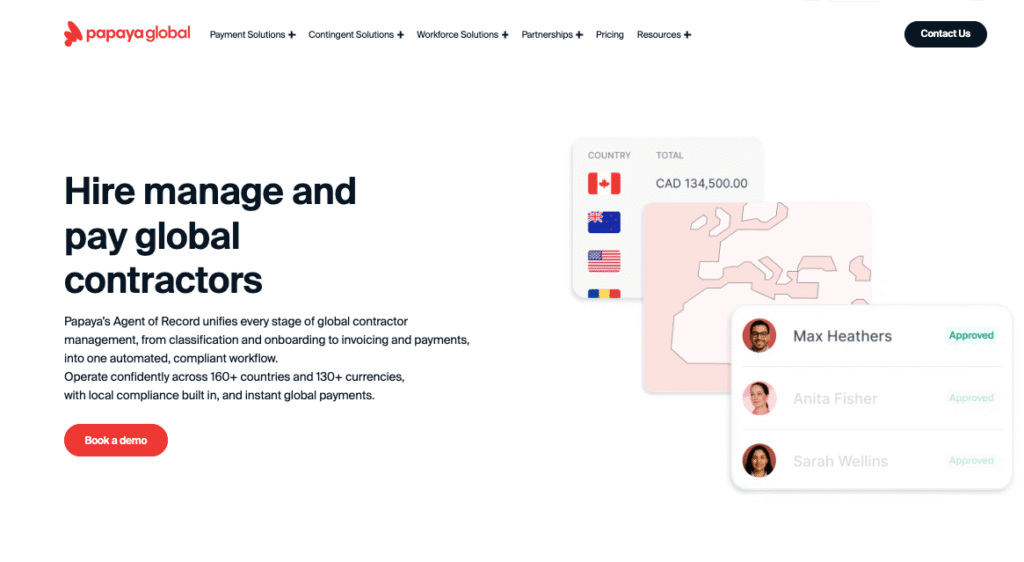
Contingent OS handles contractor and vendor workforce governance at enterprise scale, compliance, payments, and visibility for non-employee workers across 160+ countries. Native connectors with Beeline and SAP Fieldglass mean it plugs directly into existing VMS infrastructure.
For companies managing large contingent populations alongside full-time employees, this removes the need for a separate contractor management platform.
Enterprise Integrations
Nine confirmed native connectors spanning HRIS, ERP, and expense management: Workday, SAP SuccessFactors, Oracle HCM, HiBob, BambooHR, NetSuite, Expensify, Beeline, and SAP Fieldglass. The HCM Cloud Connector automates data sync and eliminates 95% of manual entry.
For teams already running enterprise HCM or ERP systems, this is the integration depth that makes Papaya worth evaluating seriously. Deel is the only EOR with broader native coverage.
Employee Benefits
Statutory benefits managed across all covered markets, tax-compliant, locally accurate, handled without manual intervention. Global benefits programs are available as an add-on. Where Papaya doesn’t compete: ESOP administration. Multiplier has it; Papaya doesn’t. For equity-heavy companies, that gap matters.
Immigration and Mobility
Visa and work permit coordination for cross-border employee relocations, managed through the platform with in-country support. Documentation and application handling are included.
Useful when relocating existing employees into new markets. Not a reason to choose Papaya on its own, it’s an add-on that removes the need for a separate immigration vendor.
Employee Self-Service Portal
Employees log in, access payslips, update personal information, and complete onboarding tasks without HR involvement. G2 reviewers note new hires can get through the initial setup quickly. The portal is functional and clean, it does what it needs to without standing out.
Customer Support
Dedicated account managers consistently earn strong reviews on G2 and Capterra, named individually, praised for their compliance expertise and responsiveness. The disconnect is at the first-line level.
During payroll processing windows, response times slow, deadlines slip on monthly reports, and Trustpilot captures it at 3.3/5. The account manager model is Papaya’s support strength. What sits behind it needs work.
How Papaya Global Connects to Your Existing Stack
Papaya’s integration depth is one of the clearest reasons enterprise teams choose it over simpler EOR platforms.
Nine native connectors span HCM, HRIS, ERP, expense management, and vendor management systems, the categories that actually matter when you’re running payroll across a complex tech stack.
The HCM Cloud Connector handles bidirectional data sync with Workday, SAP, and Oracle automatically. For teams already on these platforms, that means no manual exports, no reconciliation headaches, and payroll inputs that stay current without HR intervention. Deel is the only EOR in this comparison with broader native coverage.
Native connectors confirmed from papayaglobal.com. HCM Cloud Connector and Developer API available for custom workflows.

How Papaya Global Is Structured
Papaya’s product isn’t structured like a typical EOR. Most platforms offer a single employment layer. Papaya runs three interconnected operating systems, each handling a distinct part of the global workforce problem. Understanding which OS covers your use case is the fastest way to evaluate whether the platform fits.
Papaya structures its product across three interconnected OS layers — each handling a distinct workforce problem. Most EOR buyers need Workforce OS. Finance-heavy operations benefit from all three.
Full employee lifecycle — EOR, global payroll, onboarding, compliance, benefits, and offboarding across 160+ countries.
Same-day payments in 130+ currencies through Azimo’s regulated rails. Licensed in five Tier-1 jurisdictions. From $2.50/transaction.
Enterprise-grade contractor governance with VMS connectivity. Compliance, payments, and visibility for non-employee workers across all markets.
When to Select Papaya Global
Papaya’s buyer profile is narrower than the platform’s feature list suggests. The four personas below are where it consistently delivers, based on review patterns, pricing structure, and what the product actually does well under operational pressure.
Four buyer profiles where Papaya consistently delivers — based on review patterns, pricing structure, and documented capabilities.
Real-time cost dashboards, AI variance detection, and cross-country reporting built for CFOs. SentinelOne and Rubrik run global payroll here. The BI layer alone justifies the evaluation for teams where payroll is a finance function, not just an HR one.
Nine native enterprise connectors and an HCM Cloud Connector that eliminates 95% of manual sync. If your stack is already built on enterprise HCM or ERP, Papaya connects without workarounds — no other EOR outside Deel comes close.
Contingent OS handles contractor governance, VMS connectivity, and compliance for non-employee workers across 160+ countries — in the same dashboard as full-time payroll. Companies managing both worker types don’t need a separate contractor platform.
Azimo’s regulated rails deliver same-day disbursements in 130+ currencies from $2.50 per transaction. For companies paying large contractor networks frequently across multiple countries, the per-transaction model beats percentage-based alternatives significantly.
When to consider alternatives to Papaya Global
Papaya has clear limits. These four scenarios are where the gap between Papaya and a better-fit alternative is wide enough to redirect your evaluation before you get to a demo call.
Four scenarios where Papaya’s documented limits are wide enough to redirect your evaluation toward a better-fit platform.
$650/month per head is hard to justify at low headcount. The BI layer, payments infrastructure, and enterprise integrations that earn Papaya’s price tag only make sense at scale. Below five hires, you’re paying for infrastructure you won’t use.
→ Consider Multiplier or RemofirstPapaya’s aggregator model means third parties handle local execution in most markets. If your legal or procurement team requires direct owned-entity accountability in every country — not partner-dependent coverage — Papaya creates exposure that compounds at scale.
→ Consider Remote or DeelTrustpilot at 3.3/5 reflects what happens at busy periods — slow responses, missed deadlines on monthly reports, inconsistent follow-through. If payroll accuracy and on-time support during processing windows are baseline requirements, the risk is documented.
→ Consider Oyster HR or RivermateThree operating systems with extensive configuration options create a real learning curve. Lean HR functions without dedicated system admins will spend significant time getting up to speed. The platform rewards technical operators — it’s not built for simplicity first.
→ Consider Oyster HR or MultiplierPapaya Global vs top alternatives: A quick comparison
Papaya competes differently depending on which buyer is in the room. Against budget EORs, it loses on price every time. Against enterprise platforms, the comparison gets closer. The four attributes below map where it leads, where it trails, and by how much.
Four attributes that drive real EOR buying decisions — mapped across Papaya and six direct competitors.
At $650/month Papaya is the highest published EOR rate in this comparison. The premium tier at $770 widens that gap further.
Real-time dashboards, AI variance detection, and cross-country reporting built for finance teams. No direct competitor matches this natively.
Papaya’s enterprise HCM and ERP connectors put it ahead of every EOR in this comparison except Deel.
Papaya owns Azimo — regulated in five Tier-1 jurisdictions. Every other EOR in this comparison routes payments through third parties.
Papaya Global vs Deel
Deel starts at $599 — $51 less than Papaya — and brings 300+ native integrations, 150+ owned entities, and a product surface that extends into equity, immigration, and IT. For most mid-market buyers, Deel is the stronger all-round EOR.
Where Papaya pulls ahead is specific: payroll BI depth, the Azimo payments layer, and Contingent OS for enterprise contractor governance. If your primary need is consolidated multi-country payroll reporting with same-day payments, Papaya warrants the premium. If it isn’t, Deel covers more ground for less.
Papaya Global vs Oyster HR
Oyster HR costs $699/month — $49 more than Papaya, but leads on compliance distinction. B Corp certification, Oyster Shell’s $500K misclassification guarantee, and a CSM model built around relationship depth are things Papaya doesn’t offer.
Papaya leads on payroll infrastructure and enterprise integrations. Oyster leads on compliance ethics and employee experience. They’re not competing for the same buyer, Oyster suits mission-driven mid-market teams, Papaya suits finance-led enterprise operations.
Papaya Global vs Multiplier
Multiplier at $400/month is $250 cheaper and covers 150+ countries with solid G2 scores. For companies that don’t need Papaya’s BI layer or payments infrastructure, that gap is difficult to justify.
Multiplier also has ESOP administration, Papaya doesn’t. For equity-heavy companies, that tips the decision quickly. Papaya wins on reporting depth and enterprise integrations. Outside those two factors, Multiplier is the better value for most buyers.
Papaya Global vs Pebl
Pebl operates at enterprise scale with custom pricing and a decade-plus compliance audit history. In procurement conversations where vendor longevity and multi-year audit trails matter, Pebl’s track record carries weight Papaya can’t yet match, it was founded in 2016, Pebl’s predecessor was considerably earlier.
Where Papaya differentiates: the native payments layer and BI reporting are more modern. Pebl’s platform feels more traditional by comparison.
The decision usually comes down to whether your procurement team weights audit history or technology currency more heavily.
Papaya Global vs Remofirst
The gap here is $451/month per employee. Remofirst at $199 handles the compliance job, contracts run, payroll processes, local regulations are followed. No BI layer, no regulated payments infrastructure, no enterprise integrations. For early-stage companies hiring a handful of international employees, Remofirst is a rational choice.
For finance teams running payroll across 10+ countries who need consolidated reporting and same-day disbursements, it isn’t. These two platforms aren’t competing for the same buyer at the same stage.
Papaya Global vs Remote
Remote runs a 100% owned-entity model across 90+ countries, full compliance accountability with no partner dependency. At $599/month it’s $51 cheaper than Papaya and removes the aggregator risk that shows up in Papaya’s reviews from teams hiring across 15+ markets.
Papaya counters with broader country coverage, the Azimo payments layer, and finance-grade BI that Remote doesn’t match. The decision hinges on one trade-off: owned-entity certainty in fewer markets versus aggregator breadth with deeper payroll intelligence across more.
Six head-to-head verdicts based on pricing, payroll depth, integration breadth, and documented user experience.
vs
Deel wins on integrations, entity depth, and all-round EOR value at $599. Papaya wins on payroll BI and regulated payments. The $51 gap matters less than the use-case gap.
Use-case dependent
vs
Oyster costs $49 more but leads on B Corp certification and CSM depth. Papaya leads on payroll infrastructure and enterprise integrations. Different buyers entirely.
Different buyer profiles
vs
$250/month cheaper with Multiplier. Papaya wins on BI depth and payments infrastructure. Multiplier’s ESOP administration tips it for equity-heavy teams.
Depends on reporting needs
vs
Pebl’s audit history and enterprise track record win procurement conversations. Papaya’s payments layer and BI are more modern. Vendor longevity versus technology currency.
Enterprise favours Pebl
vs
$451/month cheaper with Remofirst. Compliance runs, payroll processes. No BI, no regulated payments, no enterprise integrations. Not the same product for the same buyer.
Papaya at scale
vs
Remote’s owned-entity model removes the aggregator risk Papaya carries. Papaya wins on payroll BI and payments depth. $51 cheaper with Remote. Entity certainty versus reporting intelligence.
Depends on entity priorityReal-world use cases for Papaya Global
Papaya’s pricing and platform depth only make sense in specific operational contexts. These four scenarios map where the product genuinely fits, with honest headcount, geography, and cost estimates based on published pricing.
Four scenarios with specific headcount, geography, and honest fit verdicts based on published pricing and documented capabilities.
The scenario Papaya is built for. Workforce OS handles EOR markets, Global Payroll handles entity markets, and the BI layer gives finance one consolidated view across all worker types and countries. Within3 ran this exact model and grew their workforce fourfold.
Workday integration runs bidirectionally through the HCM Cloud Connector. Contingent OS handles contractors in the same dashboard as full-time EOR employees. Same-day payments through Azimo across multiple European currencies. No manual exports, no separate contractor platform.
Payments OS at $2.50 per transaction through Azimo’s regulated rails. For 200 contractors paid monthly that’s $500 in payment fees versus percentage-based alternatives that compound fast at volume. One G2 reviewer described the Workforce Payments product as a “game-changer” for their 500+ contractor network.
$650/month per head for three hires is $1,950/month before employer taxes. The BI layer, Azimo payments, and Contingent OS add no value at this scale. A lean HR team will also feel the platform’s configuration depth without a dedicated system admin. Multiplier or Remofirst close the compliance gap at a fraction of the cost.
Papaya Global User Sentiments
Review scores across G2 and Capterra tell a consistent story. Trustpilot tells a different one. Both matter; the gap between them is where the honest evaluation happens.
Aggregated from verified reviews across G2, Capterra, and Trustpilot — approximately 117+ data points.
Consolidated dashboards, real-time cost data, and clean reporting praised consistently by finance and HR teams managing multi-country payroll. The BI layer is the most cited reason enterprise buyers stay.
G2 reviewers consistently cite intuitive navigation and a unified dashboard. One HR BP called it “easy to use, clear, and easy to navigate” as the primary reason she chose it over competitors.
Reviewers on G2 and Capterra name their account managers specifically. Compliance questions resolved fast, multi-country rollouts managed proactively. The white-glove support model works when it’s applied consistently.
HiBob, Workday, SAP integration praised for eliminating manual data entry. One reviewer described the HiBob connection as a “total game-changer” — data flows into Papaya automatically with a single action.
The most consistent Trustpilot complaint. Response times slow during processing windows, monthly report deadlines missed, follow-through inconsistent at scale. The gap between account manager quality and first-line support is wide.
$650/month compounds fast. Reviewers with growing headcounts flag the cost directly — particularly those who came from lower-cost EORs and find the BI and payments features underused relative to what they’re paying.
Teams hiring across 15+ countries flag data mismatches and uneven compliance execution in specific markets. The central platform is reliable — local partner quality varies, and the platform doesn’t make that visible until you hit a problem.
New administrators take time to configure the platform correctly. G2 reviewers note the depth of options creates friction early on. Not a dealbreaker for dedicated ops teams — a genuine consideration for lean HR functions.
How much does Papaya Global cost?
Papaya publishes its core plan rates openly, which is less common at this price tier than it should be. The $650 EOR rate is a starting point, employer taxes, statutory contributions, and optional benefits layer on top and vary by country. The modular structure also means total cost depends on which OS layers your operation actually needs.
Five modular products covering EOR, global payroll, contractor management, workforce payments, and workforce management. No setup fees on core plans.
Legal employment across 160+ countries without entity setup. Includes compliant contracts, payroll, tax filings, statutory benefits, and onboarding. In-country compliance experts included.
Get StartedEverything in Standard plus dedicated HR support, priority compliance review, and enhanced onboarding. The $120/month gap between tiers buys a higher service level — worth evaluating against your team’s actual support needs.
Get StartedFor companies with existing legal entities who need consolidated multi-country payroll processing. Automated calculations, local compliance, real-time BI dashboards, and HRIS integrations included.
Get StartedCompliant contractor engagement across 160+ countries. Automated invoicing, bulk payments, misclassification risk management, and AOR services. Connects with Contingent OS for enterprise VMS workflows.
Get StartedStandalone cross-border payment infrastructure through Azimo’s regulated rails. Same-day disbursements in 130+ currencies. For high-volume contractor networks, the flat per-transaction fee beats percentage-based alternatives significantly.
Get StartedSaaS-only workforce management platform for companies that handle employment through their own entities. HR data consolidation, compliance tracking, employee portal, and BI reporting without the EOR layer.
Get StartedOur Final Verdict on Papaya Global
Our overall assessment based on 117+ verified reviews, independent platform analysis, and direct vendor research.
Best-in-class payroll BI and payments — premium priced, enterprise focused
The deepest payroll reporting and the only native regulated payments layer in this comparison. Built for finance-led operations at scale — not the right fit for lean teams or early-stage companies.
Bottom Line: Papaya Global earns its place on enterprise shortlists through payroll intelligence and payments infrastructure that no direct competitor matches natively. At $650/month it’s a deliberate investment — one that pays off for finance-led operations managing complexity at scale, and one that’s hard to justify for everyone else.
Papaya Global is not trying to be the most accessible EOR on the market. At $650/month it’s making a different bet that finance and HR teams managing payroll across 10+ countries need infrastructure, not just employment compliance.
The payroll BI layer, the Azimo payment rails, and the enterprise integration depth are genuine category advantages. No other EOR in this comparison delivers all three natively.
The limitations are equally genuine. The aggregator model creates service inconsistency that compounds as you add countries.
And the platform’s depth, the same thing that makes it powerful for enterprise ops teams, creates real friction for lean HR functions without dedicated system admins.
The buyer this works for is specific: a finance-led operation managing multi-country payroll at scale, already running enterprise HCM tools, and willing to invest time in platform configuration upfront to get clean consolidated reporting on the other side. Within3, SentinelOne, and Rubrik fit that profile. Most Series A startups don’t.
For budget-first buyers, Multiplier at $400 or Remofirst at $199 close the compliance gap without the overhead. For owned-entity certainty, Remote’s model removes the aggregator risk Papaya carries. For all-round EOR depth at a lower price, Deel is the harder comparison to overcome.
Frequently Asked Questions
Papaya Global FAQs
Papaya Global is a workforce management platform built around payroll infrastructure, cross-border payments, and enterprise integrations. It serves as an Employer of Record in 160+ countries, manages global payroll and contractor payments, and runs on a proprietary payments layer through its Azimo subsidiary.
Its primary buyers are mid-market and enterprise finance and HR teams managing distributed workforces across multiple countries simultaneously — not early-stage companies making their first international hire.
EOR Standard starts at $650 per employee per month. The Premium tier runs $770, adding dedicated HR support and priority compliance review. Global Payroll for companies with existing entities costs $25 per employee per month. Contractor management runs $30 per contractor per month. Workforce Payments through Azimo starts at $2.50 per transaction.
Enterprise contracts typically carry annual minimums. The modular structure across five products makes total cost hard to model without a sales conversation.
Azimo is a regulated payments business that Papaya Global owns outright. It holds money transfer licenses in five Tier-1 jurisdictions, which means Papaya processes cross-border disbursements through its own regulated rails rather than routing through third-party payment providers.
This delivers same-day payments in 130+ currencies with full liability on Papaya’s side. No other EOR in this comparison owns its payments infrastructure — every competitor routes through third parties.
Yes. Papaya’s HCM Cloud Connector integrates bidirectionally with Workday, SAP SuccessFactors, and Oracle HCM, eliminating 95% of manual data sync per vendor documentation. Additional native connectors cover HiBob, BambooHR, NetSuite, Expensify, Beeline, and SAP Fieldglass.
For teams already running enterprise HCM or ERP systems, this is the integration depth that puts Papaya on the shortlist. Deel is the only EOR with broader native coverage.
Papaya Global covers 160+ countries across EOR, payroll, and contractor services. Unlike Remote or Deel which operate owned entities in key markets, Papaya uses an aggregator model — third-party partners handle local execution in most countries. This works well for consolidated reporting across many markets but creates service inconsistency that shows up in reviews from teams hiring across 15+ countries simultaneously.
It’s the strongest in this comparison. Real-time cost dashboards, AI-powered variance detection, custom cross-country reporting, and DE&I metrics are all built natively. Finance teams at SentinelOne and Rubrik run global payroll on Papaya specifically for this BI layer.
No other EOR — Deel, Remote, Oyster, or Multiplier — builds payroll analytics at this depth natively. If your CFO needs consolidated finance reporting across 10+ countries, this is the product built for that problem.
Remote runs 100% owned entities across 80–90+ countries and costs $599/month — $51 less than Papaya’s standard tier. Remote’s owned-entity model removes the aggregator risk that shows up in Papaya’s reviews from teams hiring across many markets.
Papaya counters with broader country coverage, the Azimo payments layer, and finance-grade BI reporting that Remote doesn’t match. The decision comes down to one trade-off: owned-entity compliance certainty in fewer markets versus aggregator breadth with deeper payroll intelligence across more.
Not typically. At $650/month per employee, the BI layer, Azimo payments infrastructure, and enterprise integrations that justify Papaya’s price tag only deliver real value at scale — typically 10+ countries and meaningful payroll complexity. Below that threshold, you’re paying for infrastructure you won’t use.
For smaller teams, Multiplier at $400 or Remofirst at $199 close the compliance gap without the overhead. Papaya is built for finance-led operations managing complexity — not companies making their first few international hires.