

Quick Summary: What You Need to Know About ITES
Put simply, ITES is the category of work that couldn’t be done efficiently without modern IT systems underneath it. A customer support center handling thousands of calls through cloud telephony, a medical transcription unit processing physician recordings into structured records, a financial firm running 24/7 compliance monitoring across multiple geographies, all of this qualifies.
The IT systems aren’t the product being sold; they’re what makes the service delivery possible in the first place.
The term gained prominence in the late 1990s and early 2000s, largely driven by India’s rise as an outsourcing hub. Since then, it has evolved to cover an expansive range of services, from basic data entry to AI-assisted legal research and knowledge analytics.
What is ITES?
Definition: Business services delivered using information technology as the backbone, where IT infrastructure, software systems, and digital connectivity make it possible to perform, manage, and scale those services remotely or at high volume. The IT systems aren’t the product being sold — they’re what makes the service delivery possible.
| Example | What’s Happening | ITES Type |
|---|---|---|
| Hospital outsources medical billing to a remote team using healthcare software | The IT system isn’t the service — it’s what makes the service run | Healthcare ITES / BPO |
| Bank routes customer complaints through a third-party contact center on cloud telephony | The provider’s team handles the service; the bank manages outcomes | Customer Experience / BPO |
| Law firm sends contract review to a qualified legal team in another country | Domain expertise delivered remotely via secure document platforms | Legal Process Outsourcing / KPO |

What Falls Under ITES?
People use ITES, BPO, KPO, and outsourcing almost interchangeably, and that tends to cause problems down the line. They’re not the same thing, and treating them as synonyms leads to poor vendor selection and misaligned expectations.
ITES is the parent category. It covers any service delivery model where IT infrastructure is the critical backbone. Within that umbrella sit several distinct subcategories based on the nature and complexity of the work being performed.
Pure IT Services cover system integration, software development, and cloud infrastructure management. These are a separate category. The distinction matters because in pure IT services, the product is the technology itself. In ITES, technology is the means of delivering a business service, not the deliverable.
BPO (Business Process Outsourcing) sits inside ITES. It refers to outsourcing standardized, repeatable business processes such as payroll, billing, customer service, and logistics coordination.
These are rule-driven workflows where the processes are well-defined and the work can be optimized and scaled.
KPO (Knowledge Process Outsourcing) is a more sophisticated tier within ITES, where the work requires domain expertise, analytical judgment, and professional knowledge.
Equity research, legal services, medical diagnostics support, and market intelligence all fall here. KPO providers aren’t following a script; they’re applying professional judgment to complex problems.
LPO (Legal Process Outsourcing) is a specialization within KPO, focused specifically on legal work: contract review, patent research, due diligence, and litigation support.
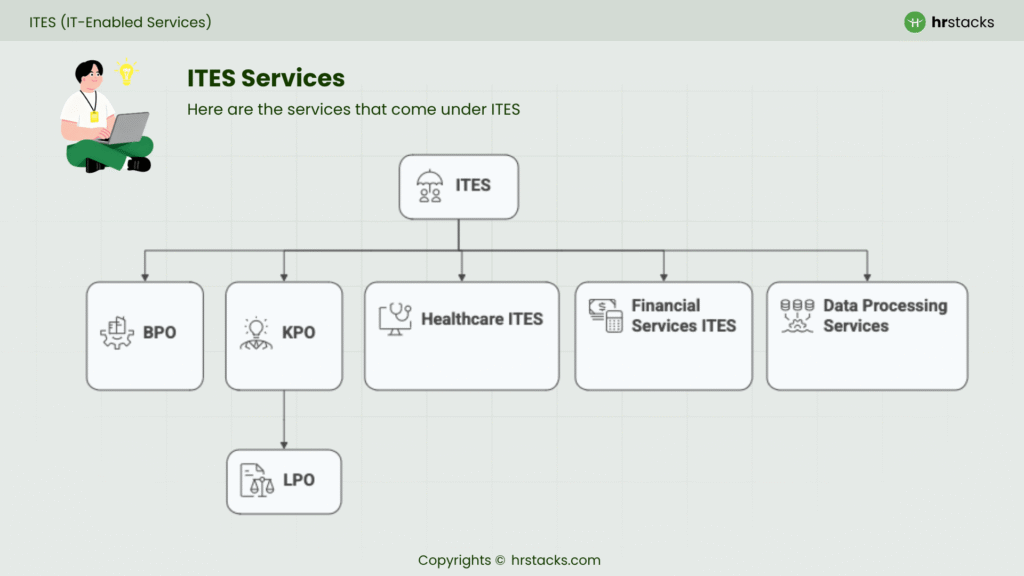
When evaluating an ITES partner, being clear about which tier of service you actually need matters a great deal, because the skills, governance models, and pricing structures differ significantly across these categories.
Types of ITES
| ITES Category | Description | Common Services | Typical Industries |
|---|---|---|---|
| BPO (Business Process Outsourcing) | Outsourcing of standardized, repeatable operational processes supported by IT systems | Customer support, payroll processing, HR administration, billing and invoicing, supply chain coordination | Retail, telecom, BFSI, manufacturing, logistics |
| KPO (Knowledge Process Outsourcing) | High-complexity work requiring professional expertise and analytical judgment | Equity research, market analysis, actuarial services, clinical research, competitive intelligence | Finance, pharma, consulting, insurance |
| LPO (Legal Process Outsourcing) | Legal tasks handled remotely by qualified legal professionals | Contract drafting and review, patent searches, regulatory compliance research, litigation support, due diligence | Law firms, corporate legal departments, PE/VC firms |
| Customer Support Services | Multi-channel customer interaction management via voice, chat, email, and social | Technical helpdesk, complaint resolution, order management, loyalty program management | eCommerce, SaaS, banking, telecom, travel |
| Data Processing Services | High-volume data capture, conversion, cleansing, and management | Data entry, document digitization, image processing, database management, OCR processing | Insurance, healthcare, publishing, government |
| Healthcare ITES | IT-enabled services specific to healthcare operations and clinical documentation | Medical transcription, medical coding (ICD/CPT), revenue cycle management, claims processing, telemedicine support | Hospitals, clinics, insurance companies, pharma |
| Financial Services ITES | Specialized financial operations delivered through technology-enabled remote teams | Accounting and bookkeeping, financial reporting, tax preparation, audit support, mortgage processing | Banks, NBFCs, accounting firms, fintech companies |
ITES vs EOR vs PEO vs RPO: Which Model Do You Actually Need?
The biggest source of confusion in outsourcing conversations isn’t what ITES means. It’s what it doesn’t cover.
In any ITES or BPO arrangement, the provider’s employees do the work. You manage the output, not the people. The moment you need a specific individual working inside your team, reporting to your managers, using your tools, that stops being an ITES problem. That’s an employment relationship, and it needs a different structure.
An Employer of Record is the right model when you want to hire someone in a country where you have no legal entity. The EOR becomes the formal employer on paper and handles payroll, taxes, and contracts. The person works for you in every practical sense. If you’re comparing EOR providers, the evaluation criteria look nothing like a BPO vendor assessment.
A PEO is similar but assumes you already have a local entity. An RPO provider runs your hiring process but doesn’t employ anyone. How you then employ the candidates they source is a separate question entirely.
ITES vs EOR vs PEO vs RPO: Which Model Do You Need?
The practical test: If you’re describing a specific person (“we need a developer in Poland on our engineering team”), you need an EOR. If you’re describing a function (“we need a team handling our support tickets”), you need ITES. Different problems, different vendors.
How ITES Works: The Operational Model
The mechanics of ITES are more nuanced than most people expect. Handing work to a vendor and receiving output back is the simplified version. The actual operational model involves delivery decisions, SLA architecture, tooling choices, and transition management that directly determine whether an engagement succeeds or fails.
Delivery Models
Offshore delivery is the classic model, where work is performed in a geographically distant country primarily to capture cost arbitrage and access deep talent pools. India, the Philippines, Eastern Europe, and increasingly Latin America are the major offshore destinations. For many service categories, offshore delivery costs 40 to 60 percent less than equivalent onshore operations.
Nearshore delivery places operations in a geographically proximate country, such as a US company using a Mexico-based center or a UK company partnering with Poland. Cost savings are smaller than offshore, but time zone alignment and cultural proximity reduce friction considerably.
Onshore delivery keeps operations in the same country as the client, often at specialized locations that offer some cost advantage over major metro areas. Regulatory requirements or data sovereignty rules sometimes make this the only viable option regardless of cost.
Many mature ITES relationships now use a hybrid model, where core oversight functions are handled nearshore or onshore while high-volume or specialized work is performed offshore.
Typical ITES Engagement Workflow
- Needs Assessment and Scoping. The client defines what processes are candidates for ITES. Not everything should be outsourced; this requires an honest analysis of which functions are core competencies versus operational support.
- Vendor Selection and RFP Process. Shortlisted providers submit proposals. Evaluation covers technical capability, domain expertise, security certifications, pricing model, and cultural fit.
- Contracting and SLA Definition. This is where the relationship is actually structured. Service Level Agreements define what will be delivered, at what quality threshold, with what turnaround time, and what remedies apply if those targets are missed.
- Transition and Knowledge Transfer. Often the most underestimated phase. A proper transition involves documentation of existing processes, training of the ITES team, shadow operations, and a formal go-live milestone. Poorly managed transitions are the most common cause of early-stage ITES failures.
- Steady-State Operations. Day-to-day service delivery governed by weekly reviews, dashboards, and escalation protocols that keep quality in check.
- Continuous Improvement. Mature ITES relationships don’t stay static. Regular process reviews, automation opportunities, and expanded scope are expected parts of a healthy long-term engagement.
Tools Typically Used in ITES Environments
ITES operations run on a thick layer of enabling technology: CRM platforms (Salesforce, Zendesk), ticketing systems (ServiceNow, JIRA), cloud telephony and omnichannel platforms (Genesys, Avaya), RPA tools (UiPath, Automation Anywhere), data management platforms, and increasingly, AI-assisted quality monitoring tools.
Key Benefits of ITES
Cost Efficiency — But Think Beyond Labor Arbitrage
Offshore ITES can cut operational costs by 40 to 65 percent for many service categories. But reducing ITES to “cheaper labor” misses the bigger picture. When you outsource through ITES, you also eliminate capital expenditure on infrastructure, reduce HR overhead for recruiting and training, and convert fixed costs into variable ones.
That last point has real strategic value for companies navigating uncertain demand cycles, where a fixed headcount becomes a liability rather than an asset.
Scalability That Internal Teams Can’t Match
Building an internal team to handle 200 support tickets per day is one challenge. Scaling that to 2,000 tickets during a product launch or seasonal peak is an entirely different problem.
ITES partners, particularly larger ones, can absorb demand spikes without the lead time or cost of internal hiring. That elasticity is operationally invaluable for businesses with variable or fast-growing workloads.
Access to Deep, Specialized Talent
For functions like medical coding, financial research, or multilingual customer support, finding qualified professionals in-house and actually retaining them is genuinely difficult in most markets. ITES providers have built specialist talent pools over years.
When you partner with a well-established KPO, you’re not just getting a team; you’re accessing an institutional knowledge base that took years to build.
Focus on Core Business
Every hour your management team spends on payroll, compliance reporting, or Level 1 technical support is an hour not spent on product strategy, customer relationships, or market expansion. Redirecting ITES-eligible work to a partner returns that attention to where it creates differentiated value.
What the Headline Saving Actually Delivers
The 40 to 65 percent cost reduction figure in ITES sales materials is real but incomplete. It compares the provider’s per-seat rate to your in-house labor cost. It doesn’t include transition costs, the internal management overhead required to govern the relationship, technology licensing, or the cost of rework during the early months.
Companies that model the full picture typically find realized savings at 30 to 45 percent rather than 60 percent. That’s still a strong business case. It just requires going in with accurate numbers.
24/7 Operations Without the Overhead
Global customers don’t observe your working hours. ITES partners, especially those operating across multiple time zones, enable round-the-clock operations at a fraction of what it would cost to staff night shifts domestically.
For SaaS companies, eCommerce businesses, and financial services firms, that coverage is a meaningful competitive advantage.
Challenges and Risks of ITES
Any honest discussion of ITES has to cover where these engagements go wrong, and they do go wrong, regularly, for predictable reasons.
Data Security and Privacy Risk
When you share customer data, financial records, or proprietary business information with an external ITES provider, you are creating an extended attack surface. Breaches can occur through third-party vendor systems, disgruntled employees, or inadequate access controls on the provider’s end.
In regulated industries such as healthcare, financial services, and legal, the compliance stakes are especially high. GDPR, HIPAA, PCI-DSS, and other frameworks all have specific provisions around third-party data handling.
Rigorous vendor due diligence is the mitigation: SOC 2 certification, ISO 27001 compliance, right-to-audit clauses in contracts, and regular security assessments. Accepting a vendor’s self-reported security posture without verification is a mistake.
Quality Control and Consistency
What looks great during the sales process and the pilot phase doesn’t always hold at scale. Quality drift is common in ITES operations, particularly when high attrition rotates in inexperienced staff, or when the provider wins new clients and stretches their best team members thin.
Without robust monitoring through regular sampling, SLA adherence tracking, and calibration sessions, quality problems compound quietly before they surface in damaging ways.
Communication and Cultural Gaps
Time zone differences, language barriers, and different professional communication norms create friction in ITES relationships. None of this is insurmountable, but it requires active management.
The expectation that you can hand off a process and simply receive outputs with minimal ongoing communication is a recipe for misalignment. The best ITES relationships are collaborative, with shared accountability for outcomes rather than a pure client-vendor dynamic.
Vendor Dependency and Lock-In
Once you’ve transitioned a function to an ITES provider and your internal muscle for that work has atrophied, you’re in a structurally dependent position. If the relationship deteriorates, contract renewal negotiations become heavily weighted toward the vendor.
The mitigation involves maintaining institutional knowledge of outsourced processes, investing in thorough documentation, and including transition assistance clauses in your contracts from day one.
Regulatory and Compliance Complexity
Operating across jurisdictions introduces compliance complexity that ITES providers don’t always handle consistently. Cross-border data flows, labor law differences, and sector-specific regulations all require careful structuring of the engagement, ideally with legal counsel familiar with both the home jurisdiction and the delivery location.
Do You Actually Need ITES?
ITES works well when the process is documented, the work isn’t a core competency, and volume justifies a vendor relationship. It works poorly when companies treat it as a way to hand off a problem they haven’t figured out internally.
Three quick checks before contacting a provider: Can you write down exactly how the process works today? Is this function something a competitor could replicate without any meaningful disadvantage to you? Is the volume large or consistent enough to sustain a formal engagement? If any of those answers is no, resolve it first.
ITES Decision Framework: Go or No-Go?
ITES by Industry: What Companies Actually Outsource
Company size determines whether ITES makes financial sense. Industry determines which type you need and what compliance requirements apply. Most buyers conflate the two.
Financial services and banking outsource KYC processing, AML screening, transaction reconciliation, claims adjudication, and financial reporting. Providers without BFSI-specific credentials and audit trails aren’t viable here regardless of price.
Healthcare outsources medical billing and coding, revenue cycle management, clinical data management, and patient scheduling. Any provider handling US healthcare data must demonstrate HIPAA compliance. For EU clients, GDPR processing agreements are mandatory before data moves anywhere.
eCommerce and retail outsource omnichannel customer support, returns processing, order management, and content moderation. The dependency is structural: a retailer with customers in 20 countries can’t build in-house support operations in each market.
SaaS and technology outsource L1 and L2 technical support, QA testing, data annotation for AI and ML model training, and content moderation. The specific challenge here is that technical support requires agents who understand the product, which puts a heavier burden on knowledge transfer at the start.
Legal outsources contract review, patent research, e-discovery, and litigation support. This is the highest-value end of the ITES spectrum. Providers without qualified legal professionals and systems that meet privilege and confidentiality requirements aren’t appropriate for this work.
Education outsources LMS administration, content localisation, student enrolment processing, and EdTech platform support. Provider specialisation is still developing in this sector, so domain experience matters more here than in established verticals.
Manufacturing outsources IoT data analytics, predictive maintenance, supply chain management, and ERP support. This is KPO-level work: providers need analysts who can interpret machine data, not just process it.
ITES Use Cases by Industry
ITES Industry Trends
Automation and AI Integration
This is the most significant structural shift happening in ITES right now. Robotic Process Automation has already automated large portions of high-volume, rule-based work such as data entry, invoice processing, and form completion.
The next wave, driven by generative AI and machine learning, is moving into tasks that previously required human judgment: drafting responses, summarizing documents, flagging anomalies in financial data, and triaging complex customer interactions.
ITES companies that deliver primarily low-skill, high-volume work are under real margin pressure as a result. The ones adapting well are using AI to handle more volume with fewer people, and redeploying their workforce into higher-value analytical and oversight roles.
Shift to Knowledge-Based Services
The center of gravity in ITES is moving up the value chain. KPO services are growing faster than traditional BPO. Clients want providers who can not just process information but interpret it, synthesize it, and derive insights from it. The ITES providers winning new business today aren’t competing on headcount; they’re competing on domain expertise and analytical capability.
Rise of Global Capability Centers (GCCs)
One of the most consequential trends in the sector, and one that often gets overlooked: large multinationals are increasingly building their own Global Capability Centers, which are captive delivery centers in low-cost locations rather than outsourcing to third-party providers.
India alone has over 1,600 GCCs, operated by companies like JPMorgan, Goldman Sachs, Walmart, and Google. This is ITES internalized. The operational model is similar to outsourcing, but the governance, talent development, and institutional loyalty are fundamentally different.
Remote and Hybrid Service Delivery
The pandemic proved that ITES work could be delivered from distributed, work-from-home environments, not just consolidated delivery centers. Post-pandemic, most providers operate hybrid models, which has expanded their talent acquisition geography considerably.
Maintaining culture, oversight, and data security in fully distributed ITES teams is meaningfully harder than in a centralized delivery center, and that challenge hasn’t been fully solved yet.
Cybersecurity as a Differentiator
As ITES providers handle increasingly sensitive data, cybersecurity capability has moved from a compliance checkbox to a competitive differentiator.
Clients in regulated sectors are demanding deeper security certifications, conducting their own vendor security audits, and in some cases requiring that data processing occur only in country-specific, physically secured facilities.
ITES Industry Benchmarks
| Metric | Typical Benchmark Range | Notes |
|---|---|---|
| Cost Savings vs. In-House Operations | 35-65% | Higher savings for offshore; nearshore typically 20-35% |
| SLA Compliance Rate (Tier 1 Providers) | 95-99% | Below 95% is a red flag in mature engagements |
| First Contact Resolution (Customer Support) | 70-85% | Varies significantly by industry and complexity |
| Average Handle Time (Voice Support) | 4-8 minutes | Depends heavily on service type; technical support runs higher |
| Data Entry Error Rate (Manual Processing) | 0.5-2% | Best-in-class providers target sub-1% with QC layers |
| Document Processing Turnaround | 24-72 hours | Faster for standardized, lower-complexity documents |
| Medical Coding Accuracy | 95-98% | AHIMA standards set 95% as minimum acceptable threshold |
| Attrition Rate (ITES Industry Average) | 25-40% annually | High attrition is a persistent structural challenge in the sector |
| Transition Period (Process Migration) | 3-6 months | Complex, high-volume processes may take longer |
| Training Ramp-Up Time (New Agents) | 4-12 weeks | Knowledge-intensive roles take longer |
ITES in India: Why It’s a Different Category Entirely
India isn’t just the largest ITES destination in the world. It’s the country that effectively built the global ITES industry as it exists today. Understanding why requires looking at a specific confluence of factors that no other country has replicated at the same scale.
The Talent Advantage
India produces approximately 1.5 million engineering graduates annually, along with hundreds of thousands of commerce, science, and humanities graduates equipped for knowledge work.
More importantly, India has a deep reservoir of experienced professionals who have now spent 20 to 25 years working in ITES environments, meaning the supervisory, managerial, and quality-assurance talent is seasoned in ways that newer outsourcing destinations simply aren’t.
English language proficiency at scale is another factor that’s easy to underestimate. India is the world’s second-largest English-speaking country by volume, and for business process work, that eliminates an enormous friction point that competitors in Southeast Asia and Eastern Europe still wrestle with.
The Cost Structure
Despite significant salary inflation over the past decade, India still offers meaningful cost advantages over Western markets for skilled work.
A mid-level financial analyst or a trained medical coder in Bangalore or Hyderabad commands compensation that is a fraction of equivalent roles in the US or UK, even after accounting for infrastructure costs and vendor margins.
Infrastructure and Ecosystem Maturity
The IT parks, Special Economic Zones, and dedicated ITES infrastructure built in Indian cities over the past three decades represent a genuine and difficult-to-replicate asset. Cities like Bangalore, Hyderabad, Pune, Chennai, Gurgaon, and Mumbai have ecosystems covering recruitment channels, training institutes, and professional communities that newer outsourcing destinations can’t yet match.
The Major ITES Cities
Bangalore remains the flagship, with the deepest talent pool and strongest ecosystem, particularly for high-value technology and KPO services. Most major ITES and IT companies maintain significant operations here.
Hyderabad has aggressively positioned itself as a technology and ITES hub, with substantial state government investment in infrastructure and a strong presence of global GCCs and ITES providers.
Pune is particularly strong in engineering services, BFSI-oriented KPO, and manufacturing-sector ITES. Its proximity to Mumbai and a large university ecosystem support steady talent supply.
Gurgaon/NCR is the dominant hub for customer experience, voice-based BPO, and financial services ITES, with a large working-age population and well-developed commercial infrastructure.
Chennai specializes in BFSI, healthcare ITES, and automotive sector services, with a historically strong reputation for process quality and lower attrition than some other markets.
Government Policy and SEZs
The Indian government’s STPI (Software Technology Parks of India) scheme and SEZ framework provide tax incentives, infrastructure support, and regulatory facilitation that make India financially attractive for both foreign companies setting up GCCs and domestic ITES companies scaling their operations.
NASSCOM, India’s ITES industry body, has been an effective advocate for policy environments that support the sector’s global competitiveness.
ITES Beyond India: The Global Delivery Map
India dominates, but the right delivery location depends on time zone requirements, language needs, data sovereignty rules, and service type. The landscape has diversified enough that defaulting to India without evaluating alternatives is no longer best practice.
The Philippines is the second-largest BPO market globally. Its advantage over India is specifically in voice-based customer support: neutral English, strong US cultural familiarity, and a workforce built around customer-facing roles. Manila, Cebu, and Davao are the main delivery centers.
Eastern Europe (Poland, Romania, Bulgaria, Czech Republic) is the default nearshore option for European clients. EU membership means GDPR compliance is built into the operating environment. Finance, IT support, and legal process outsourcing are the strongest categories.
Latin America (Mexico, Colombia, Costa Rica) offers US time zone alignment, which matters for real-time collaboration and voice support. Spanish-English bilingual capability is a natural fit for US companies with Hispanic customer bases.
Southeast Asia and Malaysia are viable for APAC-focused clients. Malaysia’s multilingual environment (English, Malay, Mandarin) suits regional ITES well. Vietnam has competitive costs and growing capability in data processing and software testing.
South Africa targets UK and European clients, with English proficiency and time zone overlap as the primary advantages. Government incentives have supported BPO sector development.
Global ITES Delivery Hubs at a Glance
ITES vs. BPO vs. KPO: Clearing Up the Confusion
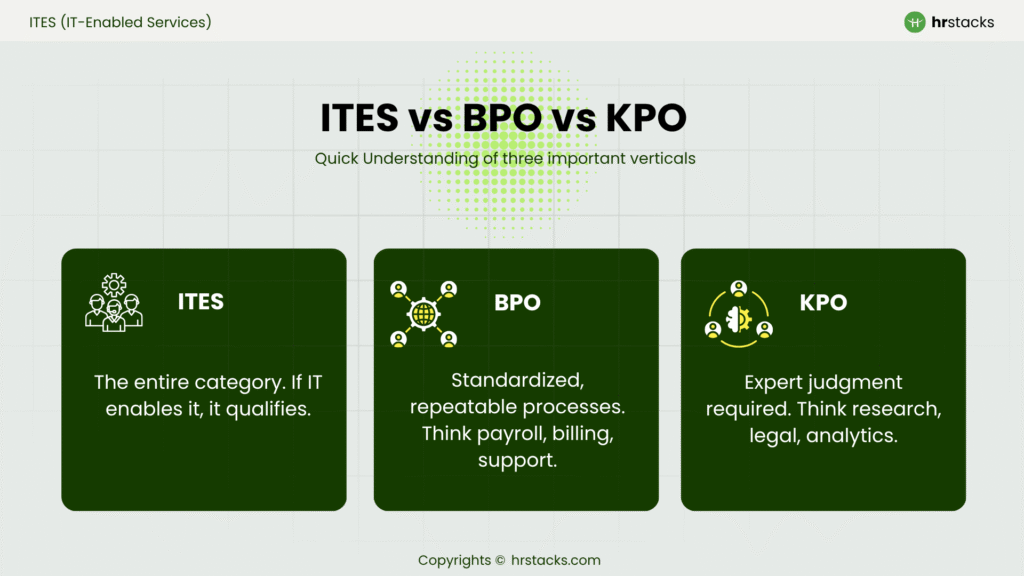
| Parameter | ITES | BPO | KPO |
|---|---|---|---|
| Scope | Broad, encompasses all IT-enabled business services | Specific subset of ITES focused on business process execution | Specific subset of ITES focused on knowledge and expertise |
| Work Complexity | Varies from simple processing to high-expertise analysis | Low to medium, process-driven and standardized | High, requires professional judgment and domain expertise |
| Primary Skill Required | Depends on sub-category | Process adherence, speed, communication | Domain knowledge, analytical thinking, professional qualification |
| Typical Examples | Customer support, data processing, medical coding, legal research, financial analysis | Payroll, billing, customer service, data entry | Equity research, legal services, clinical research, actuarial work |
| Value Driver | Scale, technology leverage, cost efficiency | Cost reduction, operational efficiency | Quality of output, domain expertise, insight generation |
| Pricing Model | Varies by type | FTE-based, per-transaction | Retainer, project-based, per-output |
| Risk Profile | Moderate to high depending on data sensitivity | Moderate, with volume and consistency as main risks | High, where quality and expertise risks dominate |
| Automation Vulnerability | High for lower tiers, lower for high-complexity work | High, as many BPO tasks are strong RPA candidates | Low, as judgment-intensive work resists automation |
| Growth Trajectory | Expanding, shifting upmarket | Slowing as automation captures low-complexity work | Growing, particularly in BFSI, healthcare, and legal sectors |
How to Choose the Right ITES Partner
Vendor selection in ITES is where a lot of businesses get burned. The process is too often driven by price and a polished sales presentation, when it should be driven by a much more rigorous operational assessment.
What to Evaluate
Domain expertise, not just general capability. A provider who delivers excellent customer support for a telecom company may not have the institutional knowledge to handle medical coding or financial research. Ask for client references specifically in your industry and verify them directly, not through the vendor’s curated list.
Security and compliance posture. Don’t accept security certifications at face value. Ask what certifications they hold (SOC 2 Type II, ISO 27001, HIPAA, PCI-DSS as applicable), when they were last audited, and whether you have the right to conduct your own security assessment. For high-sensitivity work, that right should be non-negotiable.
Attrition rates and talent stability. High attrition is endemic to ITES, but providers vary significantly. Ask for actual attrition data, not just overall company averages, but for the specific delivery center and team type you’ll be working with. High attrition translates directly to quality inconsistency.
Technology infrastructure. What platforms and tools do they use? Are their systems compatible with yours? Do they use modern quality management and analytics tools, or are they still running operations on spreadsheets?
SLA structure and remedies. What happens when they miss targets? Are there financial remedies, or just conversations? A well-structured SLA with real consequences signals a provider who is confident in their performance.
Transition capability. Ask how many clients they’ve transitioned in the past year. Request a written transition plan. Providers who have done this many times have a methodology; those who haven’t will improvise, and that improvisation is often where problems begin.
Financial stability. Building a critical operational dependency on a provider who might face financial distress is a real risk. Review their financials where possible, or at minimum check for any red flags in their corporate history and ownership structure.
Red Flags to Watch
- Pricing that seems too good to be true. It usually is, often the result of understaffed teams, undertrained agents, or hidden costs that emerge post-contract.
- Reluctance to share references. Any credible provider has satisfied clients who will vouch for them. Hesitation here is telling.
- Vague SLA commitments. “We aim for high quality” is not an SLA. Real commitments have specific numbers and defined remedies.
- No right-to-audit clause. If a provider resists your right to audit their operations, that’s a significant warning sign.
- Over-promising during the sales process. Providers who promise unrealistic ramp times, cost savings, or quality targets are either inexperienced or telling you what you want to hear.
Major ITES Companies
The provider landscape runs from global conglomerates with hundreds of thousands of employees to specialist boutiques focused on a single vertical. Understanding how the market is structured helps frame vendor conversations and set realistic expectations.
The largest players are Indian IT conglomerates that built ITES as an extension of their core technology businesses. TCS, Infosys, Wipro, HCL, Tech Mahindra, Cognizant, and Mphasis operate global delivery networks with broad BPO and KPO capability. These are the right fit for complex, multi-function, multi-country engagements where scale and process maturity matter most.
Pure-play BPO specialists occupy a different position. Genpact, originally spun out of GE’s internal operations, has one of the strongest finance and accounting outsourcing practices globally. EXL Service is well regarded in insurance and healthcare analytics. WNS has strong BFSI and travel sector depth.
On the customer experience side, Concentrix and Teleperformance are the two largest CX providers by headcount, with delivery across dozens of countries. For high-volume, multi-language customer support, these are the dominant options.
For specialist KPO needs in research, analytics, or legal work, sector-specific boutiques often outperform generalist providers on quality, even when they can’t compete on price or scale. Evalueserve and Acuity Knowledge Partners are well established in research and financial KPO. QuisLex and Integreon are recognized names in legal process outsourcing.
Major ITES Providers by Category
Who Should Use ITES?
Startups and High-Growth Companies
Early-stage companies often make the mistake of building internal teams for every function from day one.
ITES gives startups access to capabilities — technical support, financial operations, data management — without the capital expenditure of building those functions internally. The variable cost model also matches better with uncertain growth trajectories.
Mid-Market Enterprises
This is arguably the most underserved segment in ITES. Mid-market companies are often too large to operate leanly across all functions but too small to invest in world-class internal operations across the board. ITES gives them the ability to operate at scale in functions where they otherwise couldn’t compete with larger players.
Large Enterprises
Enterprise ITES is well-established. Large companies have been outsourcing back-office operations for decades. The current trend is moving these relationships up the value chain, with less basic data entry and more analytics, research, and AI-augmented knowledge work.
Specific Industry Verticals
Healthcare: Revenue cycle management, medical coding, clinical documentation, and patient support are significant ITES opportunities given the complexity, volume, and specialized expertise required.
Financial Services: KYC processing, compliance monitoring, financial reporting, and customer onboarding are areas where ITES delivery is both cost-efficient and quality-viable at scale.
eCommerce: Customer support at scale, returns processing, content moderation, and data catalog management are natural ITES applications for high-volume online retail businesses.
SaaS and Technology: Technical support, customer onboarding, and data operations are the most common ITES applications in the tech sector.
Legal: Contract management, intellectual property research, and litigation support are growing LPO opportunities, particularly for law firms and corporate legal departments managing high-volume, repeatable legal work.
Conclusion: When Does ITES Actually Make Sense?
ITES makes sense when the work is real, the process can be documented, and you’re willing to manage the relationship properly over time.
Too many businesses have been burned by outsourcing because they approached it as a way to offload a problem rather than optimize a process. ITES works best when the client knows exactly what they need, has invested in defining the process, and treats the vendor relationship as an operational partnership rather than a transactional arrangement.
If your business is spending meaningful management time on functions that aren’t your core differentiation — customer interactions, data operations, financial processing, compliance work, research — and those functions are large enough to warrant dedicated resources, ITES deserves a serious evaluation.
The cost savings are substantial. The scalability advantages are real. The access to specialized talent is a legitimate differentiator. But none of that materializes automatically.
The businesses that extract the most value from ITES are the ones who invest as much in vendor governance, transition quality, and SLA design as they do in negotiating price. That rigor is what separates the success stories from the cautionary tales.
What is ITES FAQs
What is ITES with an example?
ITES is any business service that runs on IT infrastructure as its backbone, where the technology makes the service possible rather than being the thing you’re selling.
A hospital outsourcing medical billing to a remote team using healthcare software is ITES. So is a bank routing customer complaints through a third-party contact center on cloud telephony, or a law firm sending contract review work to a qualified legal team in another country. The IT layer is what makes all of it work at scale.
Is ITES the same as BPO?
No. BPO is one category within ITES, not a synonym for it. ITES also covers KPO (research and analytics), LPO (legal services), healthcare informatics, and financial operations. Calling all ITES “BPO” is like calling all vehicles “sedans.”
What are ITES jobs?
The range is wider than most people expect. Entry level covers customer support agents, data entry operators, and document processors. Mid-level includes medical coders, financial analysts, compliance reviewers, and legal researchers. Senior roles span process managers, quality leads, client delivery heads, and transition architects.
In India, the sector directly employs several million people. The career ladder is real — many senior operations leaders at large global companies started on the floor of a delivery center.
Why is India so dominant in ITES?
Three factors that are genuinely hard to replicate at the same scale: English fluency across a large working population, over two decades of institutional experience running delivery operations, and a graduate pipeline producing millions of candidates annually across engineering, commerce, and humanities.
The ecosystem piece is often underestimated. Recruitment networks, training infrastructure, and management depth built in cities like Bangalore, Hyderabad, and Pune over 25 years are not something a newer outsourcing destination builds quickly.
What industries use ITES most heavily?
BFSI has historically been the largest consumer, driven by high transaction volumes and compliance-heavy processes. Healthcare is growing fast, particularly in medical coding and revenue cycle management.
Telecom, eCommerce, and SaaS companies are large buyers of customer experience ITES. On the knowledge services side, legal, consulting, and market research firms are where KPO growth is most concentrated.
What is the future of ITES?
Automation is taking over the low end. Data entry, basic form processing, and rule-based customer queries are already being handled by RPA and AI tools, and that will accelerate.
What’s growing is the analytical, judgment-intensive tier: research, compliance interpretation, AI-assisted knowledge work, and cybersecurity operations. Providers investing in that shift will do well. Those still competing primarily on the cost of repetitive human labor are in a structurally difficult position.
What is the difference between ITES and IT services?
In IT services, technology is the product — you’re buying software, infrastructure, or a technical solution. In ITES, technology is the delivery mechanism for a business service, not the deliverable itself. When a company buys a CRM system, that’s IT services. When they outsource the customer support team that runs on that CRM, that’s ITES.
How much can a business realistically save with ITES?
Offshore ITES is typically quoted at 40 to 65 percent savings versus equivalent in-house operations in the US or UK. The realistic figure, once you account for transition costs, internal governance overhead, and early-stage quality issues, is closer to 30 to 45 percent.
That’s still a strong business case. The problem is companies that budget on the headline figure tend to encounter unpleasant surprises in months two through six of the engagement.
What certifications should I look for in an ITES vendor?
SOC 2 Type II and ISO 27001 are the baseline for any vendor handling sensitive data. HIPAA is mandatory for healthcare work. PCI-DSS applies to financial data. ISO 9001 signals quality management maturity.
Don’t just ask if they hold these certifications — ask when the last audit was conducted and whether you can see the report. A logo on a website tells you very little without the date behind it.
What is the difference between ITES and EOR?
An ITES or BPO provider delivers a service using their own employees. You manage the output, not the people. An Employer of Record is a different model entirely — the EOR becomes the legal employer of a specific person who works for you, handling their payroll, contracts, taxes, and statutory compliance.
If you want a team processing invoices on your behalf, that’s ITES. If you want to hire a finance manager in Germany who reports to your CFO and sits inside your team, that’s EOR.
Do I need to document my processes before approaching an ITES provider?
Yes — and this is the step that gets skipped most often. A provider can only deliver consistently what is clearly defined. If your internal process isn’t documented, the ITES team will improvise, and what they produce may not match what you actually need. Document and standardise before vendor conversations begin, not after you’ve signed a contract.