


What is Rippling?
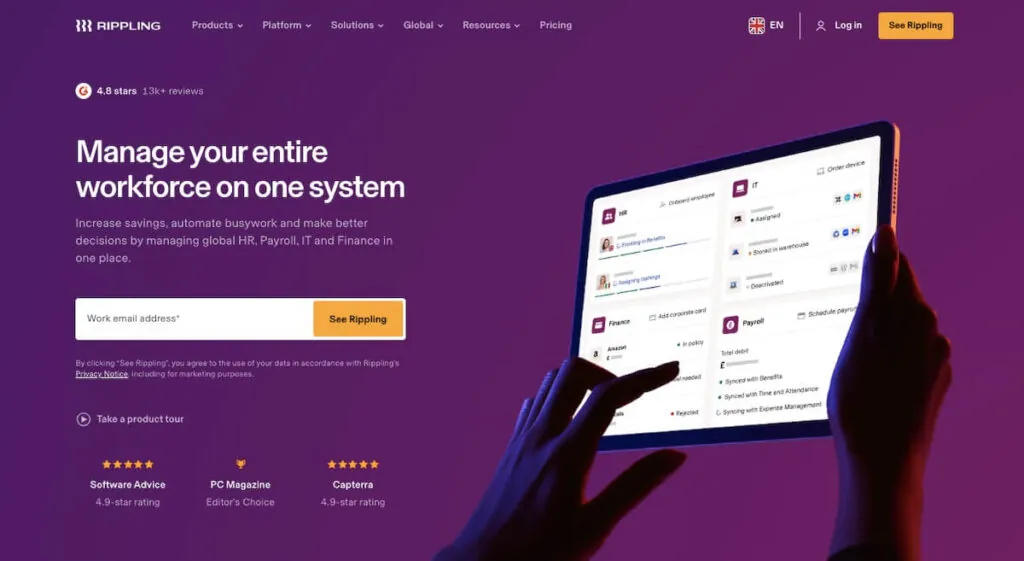
Rippling is a workforce management platform that brings HR, IT, and finance into a single system. It also offers Employer of Record (EOR) services across 80+ countries, allowing companies to hire, pay, and manage international employees without setting up local entities or juggling multiple vendors.
The platform is primarily used by US-based companies that want one place to manage payroll, benefits, compliance, device management, and global hiring, instead of stitching together separate tools.
Rippling was founded in 2016 in San Francisco by Parker Conrad and Prasanna Sankar, following Conrad’s earlier role at Zenefits. Since then, the company has raised $1.85 billion across multiple funding rounds from investors including Kleiner Perkins, Founders Fund, Goldman Sachs Growth, and Sequoia Capital.
Its Series G round in May 2025 valued the company at $16.8 billion. By early 2026, Rippling had surpassed $1 billion in annualized revenue and serves more than 20,000 customers globally.
The product goes well beyond payroll. Rippling includes HRIS, global and domestic payroll, an applicant tracking system, benefits administration, expense management, corporate cards, and IT tools like device management and identity access control. All of these are connected through a unified employee data layer called Rippling Unity.
For global hiring, Rippling offers EOR coverage in 80+ countries and contractor payments in 185+ countries with support for 50+ currencies. It also runs native payroll in the US, UK, Canada, Australia, and India, so companies can hire directly in those markets without using EOR.
Customers include companies like Stacklet, LightForce, Clay, and Cursor, along with thousands of startups using its Startup Stack program.
Rippling does not publish EOR pricing. Based on third-party estimates, fees typically range from $499 to $599 per employee per month, plus a required platform fee starting at $8 per user. With additional modules like device management, total costs can reach $625 or more per employee monthly.
Unlike some competitors, there’s no broad startup discount program, although selected YC-backed companies may receive limited-time incentives.
On security, Rippling holds SOC 1, SOC 2, and SOC 3 certifications, along with ISO 27001, ISO 27018, ISO 42001, and CSA STAR Level 2. It also introduced Rippling AI in 2026, which allows users to query and act on HR, IT, and finance data using natural language.
One area where Rippling stands apart from most EOR providers is IT. It can procure, configure, and ship company laptops with pre-installed software and device management to employees in over 30 countries, and handle remote locking or wiping during offboarding.


Editor’s Rating for Rippling
Rippling’s 4.5 on platform integration and 4.4 on device management reflect a structural advantage no pure-play EOR can replicate. One employee record drives payroll, app access, and laptop provisioning simultaneously. That’s not a feature, it’s a different architecture.
The 3.2 on support and 3.4 on pricing are the honest costs. No published rate means no pre-sales benchmark. No phone line and business-hours-only coverage means urgency gets a chatbot.
How Rippling Scores Across 8 Key Parameters
Based on G2, Capterra, and Trustpilot reviews, vendor documentation, and independent platform analysis.
The only EOR platform with native IT device management. Unified HR, IT, payroll, and EOR in one system. Pricing opacity and a younger EOR module are the real trade-offs.
No published rate. Estimated $499–$599/month plus mandatory $8/user base fee. Total can exceed $650 with add-ons. Implementation runs 5–15% of annual contract — not disclosed upfront.
80+ EOR countries, 185+ for contractors. Native payroll in the US, UK, Canada, and Australia removes EOR need there entirely. Deel covers 160+, Oyster 180+ — gaps show fast in APAC and Africa.
SOC 1, SOC 2, ISO 27001, ISO 42001, CSA STAR Level 2 — broadest cert stack in the category. Partner entities handle most EOR markets. Module launched 2023; those relationships are newer than Deel’s or Remote’s.
650+ app integrations — more than any EOR competitor. One employee record connects payroll, app access, device provisioning, and benefits. Hiring in Berlin triggers all four simultaneously.
Category exclusive. Ships configured laptops with MDM to 30+ countries on day one. Remote wipe and return on offboarding. Deel uses third-party partners. Remote doesn’t touch devices.
Stacklet cut onboarding from 60 minutes to 6. Clay automated 80% of onboarding tasks while scaling 5x. EOR onboarding is slower through partner markets — that’s structural, not a platform flaw.
M–F business hours only. No phone line. Chatbot-gated, admin-only. Employees can’t contact support about their own payslips. Oyster gives every customer a named Hiring Success Manager. Rippling doesn’t.
NPS of 90 — well above the Core HR average of 59. G2’s most-mentioned positive theme across 14,000+ reviews. Initial admin setup is complex. Once running, it doesn’t need hand-holding.
Rippling is the right call for companies already running it domestically who need to extend into international hiring without a second platform. The device management advantage is real and exclusive. But custom pricing, business-hours support, and a 2023-vintage EOR module mean it’s not the right first EOR for teams starting from scratch with global hiring as the primary brief.
Those scores hold up under scrutiny. The highs, 4.4 on device management, 4.5 on integrations, reflect capabilities no pure-play EOR competitor matches. The lows are just as honest. Opaque pricing and business-hours-only support are documented friction points, not edge cases. They’re detailed in the limitations below.
Rippling Review: Strengths & Limitations
Based on G2, Capterra, and Trustpilot reviews, vendor documentation, and independent platform research.
Strengths
Rippling Unity keeps one employee record across every module. When you hire someone internationally, payroll, app access, device provisioning, and benefits enrolment trigger from the same action. No CSV exports, no syncing between tools, no manual handoff between People and IT.
Configured laptops shipped to 30+ countries on day one — pre-installed apps, MDM enrolled, security policies applied. Remote wipe and return handled at offboarding. Deel uses third-party partners for device procurement. Remote doesn’t offer it at all.
More than twice Deel’s 300+ and thirteen times Remote’s 50+. Covers enterprise HCM tools including SAP SuccessFactors and Oracle HCM that most EOR competitors can’t connect to natively.
Stacklet reduced onboarding time by 90% — from 60 minutes to 6. Clay automated 80% of onboarding tasks and scaled headcount 5x in 18 months. The no-code Workflow Studio handles the complexity without engineering involvement.
US, UK, Canada, and Australia run on native payroll rails. Employees there don’t need EOR. If most of your headcount is domestic with a handful of international hires, you’re only paying EOR fees for the countries that genuinely need it.
Limitations
Every competitor in this comparison — Deel, Remote, Oyster, Multiplier — publishes its EOR rate. Rippling doesn’t. Estimated at $499–$599/month plus mandatory platform fees, with implementation running 5–15% of annual contract. You can’t benchmark it without engaging sales first.
Monday to Friday, 9am–5pm. No phone line for standard customers. Employees can’t contact support about their own payslips — all queries route through an admin. When a payroll issue needs same-day resolution, a chatbot queue is the first stop. Oyster HR assigns a named Hiring Success Manager at the same price point.
Rippling owns entities in the US, UK, Canada, and Australia. Everywhere else uses local partner firms. That model works for standard hires. For complex terminations or labor disputes in Germany, France, or Brazil, the partner relationships are newer and less tested than Deel’s (built since 2019) or Remote’s owned-entity infrastructure.
Multiple Capterra reviewers flag steep learning curves configuring multiple modules simultaneously. Implementation fees of 5–15% of annual contract aren’t disclosed upfront. For teams under 50 employees or those buying Rippling specifically for EOR, the setup cost and complexity rarely justify the platform breadth.
Top Rippling Features
Rippling started as an HR and IT platform. The EOR module came later, in 2023. That origin matters. Every feature below sits inside a unified system where payroll, device management, compliance, and people data share one record. That’s the lens to evaluate it through.
10 Core Capabilities
Evaluated against G2 and Capterra review patterns, vendor documentation, and independent platform analysis.
Employer of Record
80-plus countries via partner entities. Module launched 2023 — newer than Deel or Remote. Standard hires work cleanly; complex markets need verification.
IT & Device Management
Category exclusive. Configured laptops shipped MDM-enrolled to 30-plus countries on day one. Remote wipe at offboarding. No EOR competitor does this natively.
Global & Domestic Payroll
Native payroll in US, UK, Canada, Australia, India — no EOR fee in those markets. Global payroll across 90-plus countries in 180-plus currencies.
Workflow Automation
No-code Workflow Studio chains payroll, app provisioning, device ordering, and benefits from one hire event. Stacklet cut onboarding from 60 minutes to 6.
Contractor Management
185-plus countries, same dashboard as EOR. Contractor of Record handles onboarding, tax, and misclassification risk. Convert to full-time without switching vendors.
HRIS & HCM
Records, time off, performance, ATS, and headcount planning localised across 100-plus countries. Strongest HRIS layer attached to any EOR platform in this comparison.
Spend & Finance
Corporate cards, expense management, bill pay, and real-time spend visibility — all connected to payroll. No other EOR platform bundles finance at this depth.
Benefits Administration
US benefits connect directly to hundreds of insurance carriers. International benefits via EOR plans. Depth varies by country — verify specific markets during demo.
Compliance & Security
SOC 1, SOC 2, SOC 3, ISO 27001, ISO 42001, CSA STAR Level 2 — broadest cert stack in the category. Automated Compliance launched 2026 for SOC 2 readiness.
Rippling AI
Launched March 2026. Natural language querying across HR, IT, and finance data. Permission-aware responses. Early-stage but backed by the deepest cross-functional data layer in the category.
1. Employer of Record
Rippling’s EOR covers 80+ countries, functional for standard international hires across most of Europe and North America. The compliance chain relies on partner entities in most markets outside the US, UK, Canada, and Australia, where Rippling runs native payroll directly.
The module launched in 2023. For routine hires it works cleanly. For complex terminations in tightly regulated markets like Germany or France, verify your specific countries with the sales team before committing.
2. IT and Device Management
This is Rippling’s clearest category advantage. No other EOR provider procures, configures, and ships company laptops with pre-installed apps, MDM enrollment, and security policies to 30+ countries — device ready on day one.
At offboarding, the same system remotely wipes the device and arranges return shipping. For companies managing distributed teams across regulated industries, this removes an entire vendor from the stack.
3. Global and Domestic Payroll
Native payroll engines run in the US, UK, Canada, Australia, and India, employees there skip EOR entirely. Global payroll extends to 90+ countries with automated tax calculations and 180+ currency support. LightForce achieved 6x faster payroll runs after switching to Rippling. Minfy cut payroll management time by 2–3 days per month across multiple countries.
4. Workflow Automation
Workflow Studio is a no-code trigger-action builder that chains HR, IT, and finance actions together. One hire event triggers payroll creation, app provisioning, device ordering, and benefits enrolment simultaneously, without engineering involvement.
Stacklet reduced onboarding from 60 minutes to 6. Clay automated 80% of its onboarding tasks while scaling headcount 5x in 18 months. The automation depth is what separates Rippling from every EOR-only platform in this comparison.
5. Contractor Management
Contractor payments and management across 185+ countries sit in the same dashboard as EOR employees, one view of the full workforce. The Contractor of Record service handles onboarding, tax management, and payments directly, reducing misclassification exposure for companies running large contractor networks.
6. HRIS and HCM
Employee records, time off, performance reviews, recruiting (ATS), and headcount planning, all localised across 100+ countries in a single platform. It’s the strongest HRIS layer attached to any EOR product reviewed here, and it doesn’t cost extra if you’re already on Rippling for payroll.
7. Spend and Finance
Corporate cards, expense management, bill pay, and real-time spend visibility connect directly to payroll data. No other EOR platform bundles finance management at this depth. For finance teams wanting workforce spend and payroll in one report, this removes a separate tool entirely.
8. Benefits Administration
US benefits — health, dental, vision, 401(k), commuter, connect directly to hundreds of insurance carriers. International benefits run through EOR-administered local plans. Depth varies by country; verify specific markets during your demo rather than assuming parity with US coverage.
9. Compliance and Security
SOC 1, SOC 2, SOC 3, ISO 27001, ISO 27018, ISO 42001, and CSA STAR Level 2, the broadest published security stack of any EOR competitor. Rippling Automated Compliance, launched in 2026, helps customers achieve SOC 2 readiness using data already in the platform, without additional tooling.
10. Rippling AI
Natural language querying across HR, IT, and finance data launched in March 2026. Permission-aware responses mean employees only see data they’re authorised to access. It’s early-stage, but the unified data layer underneath it gives the AI more to work with than any single-function competitor could offer.
Rippling Integrations
Rippling connects with 650+ apps through its App Shop, the deepest integration library of any platform in this comparison. The mid-market and enterprise stack is well covered: Salesforce, Slack, QuickBooks, NetSuite, Xero, Greenhouse, Workday, BambooHR, HiBob, Okta, and SAP SuccessFactors all connect natively.
The practical difference from Deel’s 300+ or Remote’s 50+ isn’t just the count. Rippling’s integrations trigger cross-functional automation — a hire in Greenhouse can chain through payroll, device provisioning, and app access without a second system. A REST API covers custom workflows beyond the App Shop.
650+ native connections confirmed from rippling.com. REST API available for custom workflows beyond the App Shop.

The Buyer Profile Rippling Is Built For
Rippling fits a specific buyer profile. The four scenarios below reflect where the platform genuinely delivers, not where the marketing says it does.
Four buyer profiles where Rippling consistently delivers — based on review patterns, pricing structure, and documented capabilities.
Adding EOR to an existing Rippling stack is the lowest-friction international hiring path available. Same dashboard, same workflows, same employee record. No second vendor, no data reconciliation, no manual handoff between People and IT.
If company laptops need to arrive configured, MDM-enrolled, and locked down on day one — in São Paulo, Singapore, or Stockholm — no other EOR platform handles it natively. Security-conscious tech companies and regulated industries are the natural fit.
Running separate tools for HRIS, payroll, ATS, expense management, and EOR is a common mid-market problem. Rippling replaces all five. For teams paying for three or four point solutions, the platform economics often justify the switch.
Native US payroll is Rippling’s strongest product. If 80% of your team is in the US and you need EOR for a handful of international hires, the per-employee EOR fee only applies to those few. The domestic platform value justifies the cost on its own.
Before You Book a Demo
Four scenarios where a better-fit platform exists before you get to a demo call.
Four scenarios where Rippling’s documented limits are wide enough to redirect your evaluation.
Rippling’s EOR covers 80+ countries through partner entities. If global hiring — not platform consolidation — is the core brief, Deel’s 160+ and Oyster’s 180+ give you more room without hitting coverage gaps mid-expansion.
Consider Deel or Oyster HREvery major competitor publishes its EOR rate. Rippling doesn’t. If your procurement process requires a written estimate or budget approval before a demo, you’ll hit a wall immediately. Remote, Multiplier, and Oyster all let you model costs upfront.
Consider Remote or MultiplierNo named CSM at any standard tier. Support is business-hours-only, chatbot-gated, and restricted to admins. Oyster HR assigns a Hiring Success Manager to every account. Remote offers live chat. Rippling offers a queue.
Consider Oyster HRPartner entities mean compliance accountability isn’t fully direct in most EOR markets. For legal teams that require a clean, uninterrupted employer chain — particularly in France, Germany, or Brazil — Remote’s 100% owned-entity model is the cleaner argument.
Consider Remote.comCompare Rippling With Alternatives
Rippling competes differently depending on which buyer is in the room. The comparison below maps where it leads, where it trails, and where the gap is wide enough to matter for your specific situation.
Four attributes that drive real EOR buying decisions — mapped across Rippling and six direct competitors.
Rippling is the only platform in this comparison without a published EOR rate. Estimated at $499–$599/month plus platform fees — total can exceed $650 with add-ons.
Rippling is the only EOR platform with native device procurement, MDM enrollment, and remote wipe. No competitor — Deel, Remote, Oyster, or Multiplier — does this without a third-party vendor.
650+ integrations via Rippling App Shop — more than twice Deel’s 300+ and thirteen times Remote’s 50+. Includes SAP SuccessFactors and Oracle HCM that most EOR competitors don’t connect to natively.
Rippling owns entities in the US, UK, Canada, and Australia. Partner entities handle all other EOR markets. The module launched in 2023 — those partner relationships are newer than Deel’s or Remote’s.
Rippling vs Deel
Deel covers 160+ EOR countries. Rippling covers 80+. That gap alone disqualifies Rippling for companies building distributed teams across APAC, Africa, or Latin America; you’ll hit the coverage ceiling within months and need a second provider anyway.
Where Rippling pulls clear: 650+ integrations versus Deel’s 300+, native device management Deel can’t replicate, and a unified domestic and international dashboard that removes the reconciliation work entirely.
For teams already running Rippling for US payroll and IT, adding Deel as a separate EOR vendor means two systems, two invoices, and manual data syncing. That’s the trade-off Deel doesn’t advertise.
Rippling vs Remote.com
Remote owns its legal entities in every EOR market it covers. Rippling uses partner firms outside the US, UK, Canada, and Australia. In a routine hire that distinction rarely surfaces. In a disputed termination in Germany or a labor inspection in France, it does, and Remote’s direct accountability is the cleaner position.
Rippling does things Remote simply can’t. Device management, spend management, a full ATS, and 650+ integrations aren’t part of Remote’s product. If your hardest operational problem is a fragmented HR tech stack rather than compliance purity, Rippling solves more of it.
Rippling vs Oyster HR
Three things Oyster does that Rippling doesn’t: publishes its pricing ($699/month), assigns a named Hiring Success Manager to every account, and covers 180+ countries. For HR teams that want a specialist who lives and breathes global employment, Oyster is built for exactly that buyer.
Rippling’s device management, automation depth, and integration library aren’t close comparisons in the other direction. These are different products for different problems. The question is whether you’re buying a global employment specialist or a unified workforce platform that happens to include EOR.
Rippling vs Multiplier
Multiplier starts at $400/month, the lowest published rate in this comparison and $199 cheaper per employee than Rippling’s estimated floor. For a team of 10 international hires, that’s $23,880 annually before a single add-on. The gap is real.
Rippling’s IT management, workflow automation, and integration depth are structural advantages Multiplier can’t replicate. But for lean teams buying EOR and nothing else, those advantages don’t justify the premium or the implementation complexity.
Rippling vs RemoFirst
RemoFirst is a leaner, simpler platform, broader country coverage, accessible pricing, no mandatory base platform fee on top of the EOR cost. For teams that want compliant international hiring without buying into a full workforce stack, it’s a more direct fit than Rippling.
Rippling wins on everything beyond EOR. If automation, device management, and a unified HR and IT system are on the brief, RemoFirst doesn’t compete. If they’re not, Rippling’s complexity and opaque pricing are harder to justify.
Rippling vs Pebl
Pebl has a compliance audit history that predates Rippling’s EOR module by years. In enterprise procurement conversations where legal teams scrutinise vendor longevity and audit depth, that track record carries weight a 2023-vintage EOR module can’t match on paper.
Rippling’s platform is objectively more modern, with better automation, far deeper integrations, IT management Pebl doesn’t offer.
For companies that don’t need a decade-long compliance trail and want a platform that does more than employment, Rippling is the stronger product.
Rippling vs Alternatives at a Glance
Where Rippling wins, loses, and draws against six direct competitors across four buying attributes.
| Platform | EOR Price | IT & Device Mgmt | Integrations | Entity Ownership | Overall Edge |
|---|---|---|---|---|---|
|
Rippling
|
|
|
|
|
|
|
Deel
|
|
|
|
|
|
|
Remote.com
|
|
|
|
|
|
|
Oyster HR
|
|
|
|
|
|
|
Multiplier
|
|
|
|
|
|
|
Remofirst
|
|
|
|
|
|
|
Pebl
|
|
|
|
|
|
Real-World Use Cases for Rippling
Pricing tables tell you what Rippling costs. These four scenarios tell you whether it will actually work for your situation, with specific headcount, geography, and honest fit verdicts.
Four scenarios with specific headcount, geography, and honest fit verdicts based on Rippling’s documented capabilities and pricing structure.
Both markets run on native Rippling payroll — no EOR fee required. New hires slot into the same dashboard as domestic employees. Device provisioning, app access, and payroll activate from one onboarding flow. This is the scenario Rippling was built for.
Separate tools for HRIS, payroll, ATS, expense management, and EOR create reconciliation overhead at this headcount. Rippling replaces all five. The automation layer — Workflow Studio — eliminates the manual handoffs between People and IT that compound as headcount grows. Clay grew 5x in 18 months on this exact setup.
Both markets are covered through Rippling’s partner entity network — functional for standard employment contracts and routine payroll. The EOR module only launched in 2023, so those partner relationships are less battle-tested than Remote’s owned entities in Germany or Deel’s in Singapore. For a clean first hire with no compliance complexity, it works. For anything involving complex local labour law, verify partner depth before committing.
Rippling’s 80+ EOR country list runs out fast at this scale. APAC, Africa, and parts of Latin America create coverage gaps that force a second EOR provider — which defeats the unified platform argument entirely. Custom pricing with no published rate makes multi-country budget modelling a guessing game before sales engagement. Deel at 160+ countries or Oyster at 180+ are the more direct fit.
What Users Say About Rippling
We analysed 17,000+ verified reviews across G2, Capterra, and Trustpilot. We also did our independent research, the pattern is consistent, high scores on usability and automation, recurring frustration on pricing complexity and support access.
Aggregated from verified reviews across G2, Capterra, and Trustpilot — 17,000+ data points.
G2’s most-mentioned theme across 14,000+ reviews. Payroll, PTO, benefits, and device management accessible from one login. Admins and employees both cite it as the primary reason they’d recommend the platform.
Onboarding, offboarding, and approval workflows that trigger without manual intervention. Stacklet cut onboarding from 60 minutes to 6. Reviewers on Capterra and TrustRadius consistently cite workflow automation as the feature that justified the switch.
NPS of 90 against a Core HR category average of 59. Non-HR admins navigate without training. Employees access payslips, time off, and benefits without raising a ticket. The usability score holds even among reviewers frustrated with other aspects of the platform.
Reviewers running distributed teams highlight app provisioning and device management as the features that removed a separate IT vendor entirely. LightForce managing 80+ hourly employees across two countries cites Rippling’s scheduling and attendance tools as instrumental to their expansion.
The most consistent complaint among Capterra reviewers scaling internationally. Modular billing, peak-headcount charges, and undisclosed implementation fees make total spend difficult to forecast. Multiple reviewers describe discovering the real cost only after signing.
Business-hours chatbot for payroll issues that need same-day resolution. Gartner reviewers describe agents as slow on complex problems. The support model works for routine queries — it breaks down when timing matters.
Multiple BBB complaints and Capterra reviews describe botched migrations and unresponsive account managers post-sale. For teams coming from simpler tools, configuring multiple modules simultaneously creates a steep initial curve.
Reviewers building teams across APAC and Africa consistently hit the 80-country ceiling before their hiring plan is complete. The need for a second EOR provider undermines the unified platform value that justified choosing Rippling in the first place.
How Much Does Rippling Cost?
Rippling doesn’t publish its EOR rate. Every figure below is sourced from third-party analysis, verified comparison sources, and documented add-on structures. The base Unity platform fee applies to every plan; factor it into any cost model before comparing against competitors with all-in published rates.
Modular pricing across three core plans. EOR and Global Payroll rates are custom — figures below reflect verified third-party estimates. Unity base fee applies to all plans.
Our Final Verdict on Rippling
Our overall assessment based on 17,000+ verified reviews, independent platform analysis, and direct vendor research.
Best HR platform with EOR — not the best EOR with an HR platform
Device management, 650+ integrations, and a unified domestic and international dashboard no pure-play EOR replicates. Custom pricing, a 2023-vintage EOR module, and business-hours-only support are the honest costs of that depth.
Bottom line: Rippling is the right answer for a specific buyer — one already invested in the platform who needs international hiring without a second vendor. For everyone starting from scratch with EOR as the primary need, the coverage gaps, opaque pricing, and younger compliance infrastructure make Deel, Remote, or Oyster the more direct path.
Rippling works best as an extension, not an entry point. If you’re already running it domestically, adding international hiring is a natural next step — same dashboard, same workflows, no second vendor. The device management advantage is real and nothing else in the category touches it.
Starting fresh with EOR as the primary need is a different calculation. Custom pricing, partner entities in most markets, and business-hours support are friction points that matter more when Rippling isn’t already solving five other problems for you. At that stage Deel or Multiplier give you a cleaner starting position.
The platform earns its 4.1. The limitations are specific enough that most buyers will know which side of the line they fall on before they book a demo.
Frequently Asked Questions
Rippling EOR FAQs
Rippling is a workforce management platform that combines HR, IT, and finance into one system. EOR is one module inside that system — not a standalone product. When you hire someone internationally through Rippling, it becomes the legal employer in that country, handling contracts, payroll, taxes, and statutory benefits while the employee works directly for you.
The difference from a pure-play EOR is context. Your international hire shows up in the same dashboard as your US team, with the same onboarding flow, the same IT provisioning, and the same payroll visibility. No second system, no manual data transfer between platforms.
Good question, and there’s no flattering answer. Every major competitor — Deel, Remote, Oyster, Multiplier — publishes its EOR rate on its website. Rippling doesn’t. Third-party analysis puts the EOR fee at $499 to $599 per employee per month, on top of the mandatory $8 per user Unity platform base fee. Implementation runs an additional 5 to 15% of annual contract value, also not disclosed upfront.
If your procurement process requires a budget figure before engaging sales, Rippling will frustrate you at the first step.
80+ countries for EOR. Contractor payments extend to 185+. The number is a bit misleading though — in the US, UK, Canada, Australia, and India, Rippling runs native payroll directly, so those employees don’t go through EOR at all. That’s actually a practical advantage if most of your team is in those markets.
Outside that core group, partner firms handle the compliance work. If your hiring is concentrated in APAC, Africa, or parts of Latin America, ask Rippling specifically about those countries before signing. The 80+ headline covers a lot of markets, but depth varies.
Outside the US, UK, Canada, and Australia, Rippling uses local partner firms to handle EOR compliance. It’s a hybrid model — owned entities in its core markets, partners everywhere else. The EOR module only launched in 2023, so those partner relationships are younger than most competitors’ infrastructure.
For standard employment contracts and routine payroll that’s fine. Where it matters is edge cases — a labor inspection in France, a disputed termination in Germany, a benefit dispute in Singapore. In those situations, Remote’s 100% owned-entity model means clearer accountability. Rippling’s doesn’t.
Almost certainly yes, if your international hiring is limited to well-covered markets. Adding EOR to an existing Rippling deployment is the lowest-friction international hiring path available. Your new hire in London or Toronto slots into the same system as your San Francisco team — same onboarding flow, same IT provisioning, same reporting. No second vendor, no reconciliation work.
The calculation changes if you need 10+ countries or if several of those are in markets where Rippling’s partner depth is thin. At that point you’ll likely need a second EOR provider anyway, which defeats the unified platform argument entirely.
Device management. Full stop. Rippling procures, configures, and ships company laptops to 30+ countries with pre-installed apps, MDM enrollment, and security policies applied before the device leaves the warehouse. At offboarding it remotely wipes and recovers them. No other EOR platform does this natively. Deel uses third-party partners for device procurement. Remote doesn’t offer it.
Beyond that, 650+ integrations versus Deel’s 300+ and a unified domestic and international dashboard that removes the reconciliation work that comes with running two systems.
Honestly, it’s the weakest part of the product. Support runs Monday to Friday during business hours only, gated behind a chatbot, and restricted to admin users. If one of your employees has a question about their own payslip, they can’t contact Rippling directly. It has to go through an admin first.
For routine queries that’s manageable. For a payroll error that needs same-day resolution on a Thursday afternoon, a chatbot queue is a real operational risk. Oyster HR assigns a named Hiring Success Manager to every account. Rippling gives you a ticket number.
It depends entirely on what problem you’re solving. If you need a full workforce platform and EOR is one part of that, Rippling’s Startup Stack offers six months free for qualifying companies and already works with 15,000+ startups including Cursor, Clay, and Sierra.
If EOR is your only need at this stage, the mandatory platform fee, implementation complexity, and opaque pricing are hard to justify. Multiplier at $400/month or Remote at $599 with no hidden fees are simpler starting points. Buy the platform when you need the platform, not before.
Pricing surprises come up most. Capterra and Trustpilot reviewers consistently describe discovering the real total cost only after contracts are signed — modular billing, undisclosed implementation fees, and peak-headcount charges that weren’t part of the initial conversation.
After that, implementation weight. Teams coming from simpler tools find the multi-module setup steep, and several BBB complaints describe unresponsive account managers post-sale once the contract is in place. Support limitations are a close third — the business-hours-only chatbot model frustrates teams managing payroll across time zones where problems don’t wait until Monday morning.