


What is Multiplier?
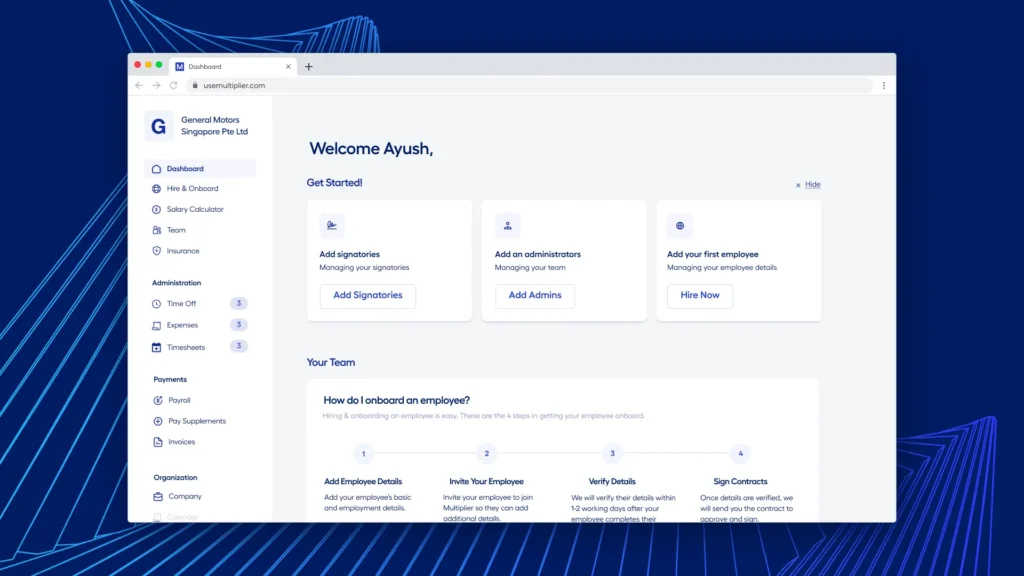
Multiplier is a global employment platform that lets companies hire, pay, and manage full-time employees in 150+ countries without setting up local entities. It takes care of contracts, payroll, taxes, and statutory benefits, so teams can expand internationally without building out legal infrastructure first.
It’s typically used by startups and distributed teams that need to hire quickly across multiple markets.
The company was founded in 2020 in Singapore by Sagar Khatri, Amritpal Singh, and Vamsi Krishna. The company raised a $4M seed round pre-launch and went on to secure $60M in Series B funding in 2022, led by Peak XV Partners and Tiger Global. Total funding stands at $77.2M, with a team of over 1,200 employees across Singapore, New York, and India.
Multiplier supports EOR hiring in 150+ countries through a mix of owned entities and local infrastructure. This matters, platforms that rely heavily on third-party partners often introduce delays or inconsistencies at the compliance layer. Contractor management runs across the same markets, with payments supported in 120+ currencies.
Its customer base includes companies like Amazon, PwC, Uber, Korn Ferry, and The Economist. In April 2026, Multiplier introduced Global Payroll Payments, extending the platform beyond EOR into payroll and cross-border payments within a single system.
Pricing is where Multiplier stands out most. EOR is priced at $400 per employee per month, with no setup or offboarding fees. Contractor management is $40 per contractor per month, while global payroll and immigration are custom priced.
Compared to Deel and Remote at $599, and Oyster at $699, the gap is significant. For a team of 10 employees, that difference adds up to nearly $24,000 annually versus Deel. Larger teams can reportedly negotiate rates closer to $300 per employee.
On compliance and security, Multiplier holds SOC 2 Type I and Type II certification, along with a SOC 3 report and GDPR compliance. It also performs particularly well in Asia-Pacific markets, especially Singapore, India, Australia, and the Philippines, where its local infrastructure and timezone-aligned support tend to be stronger than US- or Europe-first platforms.
Multiplier is a strong fit for companies that want predictable pricing, solid APAC coverage, and less reliance on third-party entities. The trade-off is that it’s still building depth in some Western markets compared to more mature platforms, which is where the differences start to show.

Editor’s Rating for Multiplier
The 3.4 on integrations is the number to watch. BambooHR, Greenhouse, and Workday are covered, but if your finance team needs payroll costs syncing automatically to NetSuite or QuickBooks, Multiplier won’t get you there without manual work.
The 3.6 on support reflects a platform that handles routine queries well but has documented cases of payroll errors taking weeks to resolve.
How Multiplier Scores Across 8 Key Parameters
Based on G2, Capterra, and Trustpilot reviews, vendor documentation, and independent platform analysis.
The price-transparent mid-market EOR with 100+ owned entities and the fastest onboarding in the category. Integration depth and payroll consistency are the honest trade-offs.
$400/month flat. Published on the website, no sales call required. No setup or offboarding fees — something Deel and Remote don’t match. FX markups are the one opaque variable; push for written confirmation by currency pair before signing.
150+ EOR countries backed by 100+ owned entities. Beats Remote and Oyster on total count. APAC depth — Singapore, India, Australia, Philippines — is where Multiplier’s infrastructure genuinely outperforms Western-founded competitors. Africa and parts of LATAM are thinner.
SOC 2 Type I and II, SOC 3, GDPR, AWS-hosted. The October 2025 NRE Payroll launch covers 10 European markets without requiring a full EOR arrangement — no competitor offers this. One documented compliance error in Germany flagged by independent reviewers at Employsome.
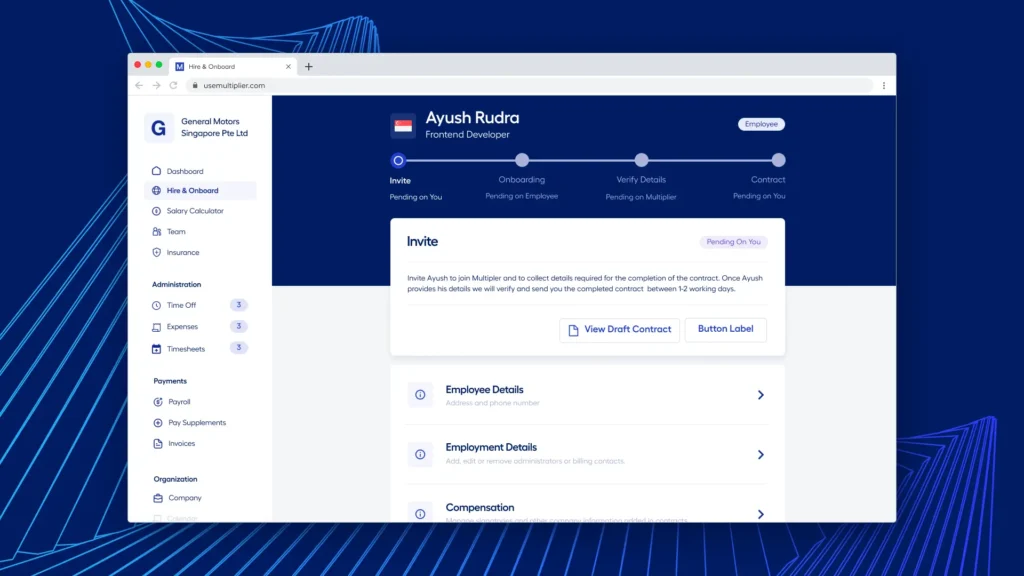
G2’s #1 Most Implementable EOR, ranked ahead of 44 competitors across multiple quarters. Contracts generated in minutes. Employees ready within 24 hours in most owned-entity markets. The fastest in the category on this metric — it’s not close.
BambooHR, Greenhouse, and Workday connect natively. That’s roughly it. Deel has 130+ integrations including QuickBooks, Xero, NetSuite, and Slack. No mobile app as of late 2025. The API works but lacks the depth finance teams typically need for automated payroll cost reconciliation.
24/5 live chat and email — not 24/7. No phone line. APAC-hours support is genuinely strong. Outside those hours, response times drop. Capterra carries documented cases where employees received conflicting answers from different reps on the same payroll issue.
Multi-currency across 120+ currencies, generally accurate and on time. The Global Payroll Payments launch in April 2026 adds end-to-end payment infrastructure via Navro. Capterra has documented multiple-payroll failures at one account — short payments across three consecutive cycles.
Clean dashboard, straightforward workflows. Non-HR admins navigate without a manual. G2 and Trustpilot reviewers consistently cite the interface as a reason they’d recommend it. The one friction point: advanced hiring paths in non-standard markets involve extra steps.
Multiplier hits the mid-market sweet spot better than anything else at this price. The $400 flat rate, 100+ owned entities, and 24-hour onboarding are genuine structural advantages — not marketing. The integration library and payroll consistency issues are real, documented, and worth pressure-testing during your demo. For teams between 5 and 100 international employees who don’t need a full HR platform, this is the strongest value in the EOR category.
Multiplier’s 4.5 on onboarding and 4.4 on pricing are the scores that win deals. A flat published rate, 24-hour employee setup, and 100+ owned entities put it ahead of every competitor in its price band on those two dimensions.
The 3.4 on integrations and 3.8 on payroll reliability are where the honest conversation starts; both are documented, not theoretical, and both are detailed in the limitations below.
Multiplier Review: Strengths & Limitations
Based on G2, Capterra, and Trustpilot reviews, vendor documentation, and independent platform research.
Strengths
Deel, Remote, and Oyster all charge $599–$699 and make you call sales first. Multiplier puts $400 on its website — no setup fee, no offboarding fee, no ambiguity. For a team of 10 international employees, that’s $23,880 saved annually against Deel alone.
Owned entities mean Multiplier is the direct legal employer in those markets, not a partner firm acting on its behalf. That matters when something goes wrong. Most competitors at this price point rely far more heavily on third-party networks.
G2’s #1 Most Implementable EOR across multiple consecutive quarters, ranked ahead of 44 competitors. In owned-entity markets, a new hire can have a compliant contract and be ready to start within a single business day.
Singapore-headquartered with large in-country teams across India, the Philippines, and Australia. Same-timezone support, owned entities in the region’s key hiring markets, and compliance expertise built from day one in markets where most competitors added coverage as an afterthought.
Launched October 2025. Covers 10 European markets including Germany, France, and the Netherlands — letting companies run compliant payroll without setting up a local entity or paying full EOR fees. No competitor offers this middle path.
Limitations
Deel connects to 130+ tools including QuickBooks, Xero, NetSuite, and Slack. Multiplier covers the basics and stops there. If your finance team needs automated payroll cost sync to your accounting platform, you’re doing it manually.
Sales teams are reluctant to give exact figures by currency pair. At scale, an 8% FX spread on a $500K annual payroll costs $40,000 — enough to erase most of the pricing advantage over Deel. Get written confirmation before signing.
24/5 live chat and email only. A payroll issue that surfaces on a Friday afternoon in New York — Saturday morning in Singapore — waits until Monday. For teams managing employees across multiple time zones, that gap is an operational risk.
Top Featured of Multiplier
Multiplier isn’t trying to be your HR system. It’s built to get employees hired and paid in other countries, fast, compliantly, without entity setup. Ten features sit inside that scope. Two are category-leading. One is a documented gap.
Evaluated against G2 and Capterra review patterns, vendor documentation, and independent platform analysis.
1. Employer of Record
Multiplier acts as the direct legal employer in 150+ countries, handling contracts, payroll, taxes, and statutory benefits. With 100+ owned entities, most markets don’t route through a third-party partner chain.
Standard hires onboard within 24 hours. Complex terminations in heavily regulated markets, Germany, France, Brazil, are where you want to verify entity ownership before committing.
2. Global Payroll
Multi-currency payroll runs across 120+ currencies with automated tax calculations and statutory deductions built in per jurisdiction. The April 2026 Global Payroll Payments launch, powered by Navro, adds end-to-end cross-border payment infrastructure. One dashboard, one invoice, one payroll calendar for every market you operate in.
3. Contractor Management
Contractors and full-time EOR employees share the same dashboard at $40 per contractor per month. Compliant contracts, payments in 120+ currencies, and a Contractor of Record service that handles misclassification risk directly. Converting a contractor to a full-time employee happens inside the same platform without switching vendors.
4. NRE Payroll
The October 2025 Non-Resident Employer Payroll launch is Multiplier’s most distinctive product addition. Ten European markets, including Germany, France, and the Netherlands, are now available for compliant payroll without a local entity or full EOR arrangement.
Teams testing a market before committing to entity setup get a legitimate compliance path no competitor currently matches.
5. Benefits Administration
Statutory benefits are handled in every EOR market as part of the base service. Supplementary health insurance, pension, and local mandatory contributions are managed per jurisdiction.
Depth varies; APAC markets are well-covered, European supplementary benefits less so. Confirm your specific market requirements during the demo rather than relying on the headline coverage number.
6. Compliance Engine
Locally compliant employment contracts are auto-generated per jurisdiction using Multiplier’s in-house legal teams. SOC 2 Type I and II, SOC 3, GDPR, and AWS hosting cover the data security layer. One independent reviewer flagged a compliance error on German AUG licensing, worth raising directly during your evaluation if Germany is a target market.
7. ESOP and Equity
Stock option management for international employees covers the local tax and compliance layer around equity grants. It’s a practical tool for growth-stage companies offering equity across distributed teams, not a full cap table or 409A management platform. Useful for what it is; don’t expect it to replace dedicated equity software at scale.
8. Immigration Support
Visa and work permit services across 140+ countries, handled by local immigration specialists in each market. Eligibility checks, paperwork, and processing are managed end-to-end. Priced separately from EOR.
Most relevant for companies relocating senior hires internationally or bringing in talent that requires specific work authorization before starting.
9. HRIS and Employee Management
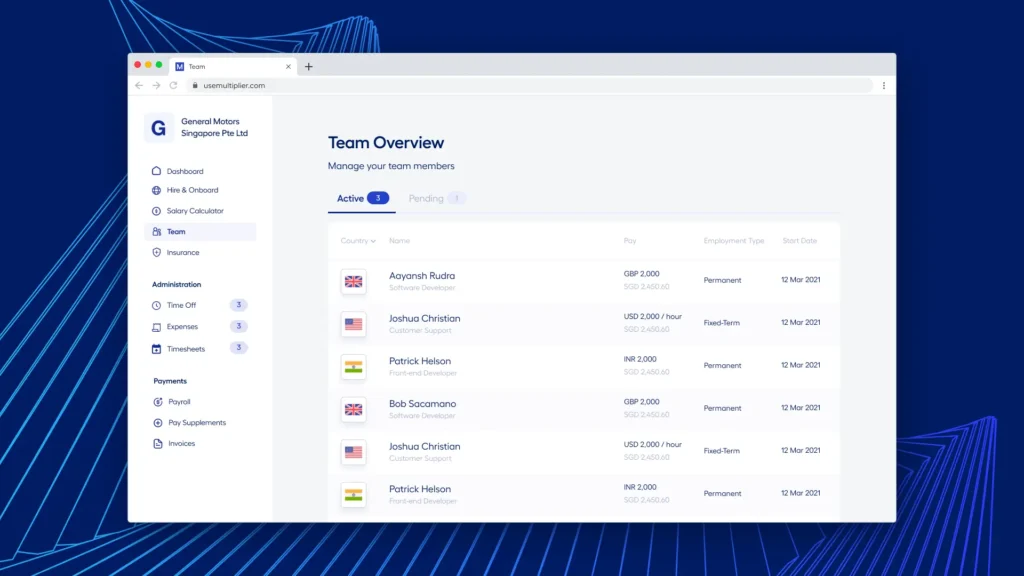
The centralised dashboard handles employee records, time off tracking, expense management, and payslip access. It covers the operational basics a distributed team needs without adding a separate tool.
Performance management, advanced reporting, and recruiting sit outside its scope, Multiplier is designed to sit alongside your existing HRIS, not replace it.
10. Platform and API
The API is functional but limited compared to Deel’s. Native integrations cover BambooHR, Greenhouse, and Workday, the essentials for most mid-market stacks. Finance teams needing automated payroll cost sync to QuickBooks, Xero, or NetSuite will hit a gap. No mobile app as of late 2025 means all management is browser-based.
11. Multiplier Integrations
The native integration library covers the most common mid-market connections. BambooHR syncs employee records bidirectionally. Greenhouse and Workday handle ATS and HCM data.
Beyond those three, the list drops off quickly, no QuickBooks, no Xero, no NetSuite, no Slack natively. A REST API covers custom connections for teams with engineering resource. If your stack runs on tools outside the core three, confirm integration depth before signing.
Native connections confirmed from usemultiplier.com. REST API available for custom workflows beyond the core library.

When to Choose Multiplier?
Not every EOR buyer is the right Multiplier buyer. The four profiles below are where the fit is genuine, built from pricing data, entity coverage, and what actual users report, not the sales deck.
Four buyer profiles where Multiplier consistently delivers — based on pricing structure, entity coverage, and documented user patterns.
At $400 flat with no setup or offboarding fees, the savings compound fast. A 20-person international team saves $47,760 annually against Deel and $71,760 against Oyster. That’s real budget — enough to fund another hire.
Singapore HQ, owned entities in India, Philippines, Australia, and key APAC markets, plus same-timezone support. Most Western-founded EOR platforms added APAC coverage later. Multiplier built from there.
G2’s #1 Most Implementable EOR for a reason. Compliant contract in minutes, employee ready within 24 hours in most owned-entity markets. When a competitor offer is on the table, speed matters.
NRE Payroll covers Germany, France, Netherlands, and 7 more European markets. Run compliant payroll without a local entity or full EOR fees. No other platform at this price offers a legitimate middle path into Europe.
When to Avoid Multiplier?
Some EOR platforms get oversold on country count and undersold on what breaks at the edges. These four situations are where Multiplier’s limits are specific enough to redirect your evaluation before a demo.
Four scenarios where Multiplier’s documented limits are wide enough to redirect your evaluation.
Multiplier doesn’t connect to any of them natively. If your finance team needs payroll costs syncing automatically to your accounting platform, you’ll be doing it manually or building a custom API connection.
Consider Deel or Remote24/5 chat and email only. No phone line, no named CSM at standard tiers. Oyster HR assigns a Hiring Success Manager to every account. If a payroll issue needs same-day resolution on a weekend, Multiplier won’t get you there.
Consider Oyster HRCoverage exists but entity depth in these regions is thinner. Remofirst covers 185+ countries and Deel has stronger on-the-ground infrastructure in LATAM specifically. Multiplier’s edge is APAC — not every region gets the same depth.
Consider Deel or RemofirstMultiplier handles employment and payroll — it doesn’t do performance management, recruiting, or advanced headcount planning. Teams consolidating a fragmented HR stack into one system need Rippling, not Multiplier.
Consider RipplingHow Multiplier Compares to the Alternatives
The EOR market clusters around two or three price bands. Multiplier sits in the middle, not the cheapest, not the most full-featured. Where it wins and loses depends on which dimension your team cares about most.
Four attributes that drive real EOR buying decisions — mapped across Multiplier and six direct competitors.
Multiplier is the lowest published rate among full-featured EOR platforms. Flat, no setup fees, no offboarding charges. Remofirst is cheaper but trades features and entity depth for the headline number.
G2’s #1 Most Implementable EOR across multiple quarters. Contracts in minutes, employees live within 24 hours in most owned-entity markets. No competitor at this price point matches this on implementation speed.
Multiplier’s integration library is the clearest weakness in a head-to-head comparison. BambooHR, Greenhouse, and Workday covered — then a significant drop-off. Deel’s 130+ includes the full finance and accounting stack most mid-market teams run on.
100+ owned entities gives Multiplier direct legal employer status in most markets — not through a partner chain. Stronger than Remofirst and most mid-market competitors. Remote’s model is fully owned across its covered markets but covers fewer countries overall.
Multiplier vs Deel
Deel costs $199 more per employee monthly. On 10 hires that’s $23,880 annually, before a single add-on. For APAC-heavy teams, Multiplier also has the stronger on-the-ground infrastructure. Singapore HQ, owned entities in India, Philippines, and Australia mean same-timezone support built from day one, not bolted on later.
The honest case for Deel is integrations. Its 130+ native connections cover QuickBooks, Xero, NetSuite, and Slack. Multiplier covers BambooHR, Greenhouse, and Workday, then stops. If your finance team needs automated payroll cost reconciliation to your accounting platform, Deel is the easier answer.
Multiplier vs Remote.com
Remote owns every legal entity it covers. No partner firms, no shared accountability. That matters most in edge cases, a labor dispute in France, an employment audit in Germany, where the chain of legal responsibility becomes visible. Remote’s answer to those situations is cleaner on paper.
Multiplier covers 150+ countries at $400. Remote covers fewer markets at $599. For teams where compliance purity isn’t a procurement requirement, that’s a $199/month gap that’s hard to justify paying.
Multiplier vs Oyster HR
The $299/month gap is the starting point. At 15 employees, Oyster HR costs $53,820 more annually. What that buys is a named Hiring Success Manager on every account and 180+ country coverage.
For first-time international hirers who want a human guiding every step, that model is genuinely valuable.
Experienced HR operators running a straightforward multi-country hire rarely need it. Multiplier’s 24-hour onboarding and flat rate win that buyer every time.
Multiplier vs Rippling
These aren’t the same product. Rippling bundles HR, IT, finance, and EOR into one platform. If the problem is a fragmented tech stack, separate tools for HRIS, payroll, expenses, and devices, Rippling solves it. Multiplier doesn’t touch IT or finance.
For companies buying EOR and nothing else, Rippling’s complexity and custom pricing are hard to justify. Multiplier gets you to compliant international employment faster and cheaper without the platform overhead.
Multiplier vs Remofirst
Remofirst at $199 is the budget play. It covers 185+ countries and gets employees onboarded fast. For a team’s first one or two international hires where cost is the only variable, that argument holds.
Scale changes it. Multiplier has 100+ owned entities versus Remofirst’s partner-heavy model, a verified review base of 4,300+ versus Remofirst’s 290+, and deeper APAC infrastructure where most APAC hiring concentrates.
Teams managing 10 or more employees across multiple countries will feel that difference operationally.
Multiplier vs Pebl
Pebl is built for enterprise procurement, custom pricing, compliance audit history that predates most competitors, and a sales process designed around formal RFPs. In that context, Pebl’s track record carries real weight.
Outside it, Multiplier’s published $400 rate changes the conversation immediately. Any procurement process requiring a written cost estimate before engagement goes to Multiplier first.
Multiplier vs Alternatives at a Glance
Where Multiplier wins, loses, and draws against six direct competitors across four buying attributes.
| Platform | EOR Price | Onboarding Speed | Integrations | Owned Entities | Overall Edge |
|---|---|---|---|---|---|
|
Multiplier
|
|
|
|
|
|
|
Deel
|
|
|
|
|
|
|
Remote.com
|
|
|
|
|
|
|
Oyster HR
|
|
|
|
|
|
|
Rippling
|
|
|
|
|
|
|
Remofirst
|
|
|
|
|
|
|
Pebl
|
|
|
|
|
|
Real-World Use Cases for Multiplier
Four situations. Specific markets, specific headcount, honest verdicts.
Four scenarios with specific headcount, geography, and honest fit verdicts based on Multiplier’s documented capabilities and pricing.
All three markets sit inside Multiplier’s owned-entity network. Contracts generated in minutes, employees live within 24 hours. Same-timezone support from Singapore HQ means issues don’t wait for a US morning standup. At $400/month per employee, total EOR cost for 5 hires runs $24,000 annually — $35,940 less than the same team on Deel.
The annual saving at 20 employees switching from Deel is $47,760. From Oyster, it’s $71,760. If the current EOR is working operationally and cost is the driver, Multiplier is the most direct alternative with equivalent country coverage and a larger owned-entity base than most competitors at this price.
NRE Payroll covers both markets without a full EOR arrangement — a genuine differentiator for companies testing European demand before committing to entity setup. Standard EOR is also available in both countries. One independent reviewer flagged a compliance error on German AUG licensing, so verify that specific requirement directly if it applies to your hires.
Multiplier doesn’t connect to NetSuite natively. Manual reconciliation across 8 countries at this headcount creates real overhead — the kind that compounds every payroll cycle. Deel handles it natively. The $199/month saving per employee doesn’t offset the finance team hours spent on manual cost allocation at scale.
What Users Say About Multiplier
Multiplier’s Trustpilot score sits at 4.9, the highest of any major EOR platform. Its G2 score is 4.7 across 1,868 reviews. The gap between those numbers and the Capterra complaints isn’t a contradiction. It reflects who’s reviewing and when. The pattern across all three platforms is consistent enough to be useful.
Verified reviews from G2, Trustpilot, and Capterra — 2025 and 2026 only. Positive and negative themes sourced independently.
In APAC markets especially, G2 reviewers flag same-day contracts as the reason they chose Multiplier when a competing offer was already in play. No other platform at this price point matches it consistently.
Multiple Trustpilot reviewers who switched from other EOR providers specifically mention no surprise fees at offboarding. After getting burned elsewhere, that predictability is the thing they highlight first.
Locally compliant contracts generating automatically per jurisdiction — no back-and-forth with legal. Noted most in markets where employment law shifts frequently. Short, direct observation in most of these reviews.
Small team operators — often CEOs or ops leads — cite being able to manage payroll, time off, and employee documents without dedicated HR staff. The self-serve experience is the highest-rated dimension on G2 for sub-50 employee companies.
A Capterra reviewer documented being billed for five Italian hires before any of them had started. Multiplier issues invoices up to a month in advance with 7-day payment windows — no flexibility on timing even when the delay is on the client’s side.
Offboarding disputes and insurance questions are where the third-party partner layer becomes visible. G2 reviewers describe inconsistent answers across markets — fine for routine hires, friction when anything unusual surfaces.
QuickBooks, Xero, NetSuite — none connect natively. One G2 reviewer managing 15 employees across 6 countries reported two full days per month reconciling payroll costs manually. That’s the real cost of the integration gap.
24/5 only. US and European reviewers are the ones flagging this — APAC teams rarely mention it. When a payroll discrepancy surfaces Friday afternoon in New York, there’s no escalation path until the Singapore office opens.
Multiplier Pricing Details
Multiplier publishes two of its four prices directly on its website. EOR at $400/month and contractors at $40/month, flat, confirmed, unchanged since 2024. Global Payroll and Immigration are custom-quoted.
The $400 excludes statutory employer contributions, which vary by country and add 15–40% on top of gross salary in markets like Germany and France. Factor that in before comparing against competitor headline rates.
Two published flat rates. Two custom-quoted services. No setup fees, no offboarding charges, no minimum headcount.
Full legal employer in 150+ countries. Flat rate regardless of country, seniority, or salary level. Cancel anytime.
Per active contract only. Inactive contractors in a given month aren’t billed. Same dashboard as EOR employees.
For companies with existing entities that need managed payroll across multiple countries. Requires local entity ownership.
Standalone visa and work permit service across 140+ countries. Available to EOR and non-EOR clients.
Should You Choose Multiplier?
Based on 4,300+ verified reviews, independent platform analysis, and direct vendor research.
The strongest mid-market EOR for APAC hiring and cost-disciplined teams
Flat $400 rate, 100+ owned entities, and the fastest onboarding in the category. Integration depth and FX opacity are the two trade-offs worth pressure-testing before you sign.
Transparent pricing, real entity depth, verified onboarding speed. Get the FX markup confirmed in writing before you sign.
Multiplier’s $400 flat rate is the most transparent pricing in the serious EOR tier. The 100+ owned entity network is a structural advantage over most competitors at this price. The onboarding speed, contracts in minutes, employees live within 24 hours in APAC markets.
The integration gap is the limitation that compounds over time. Finance teams running QuickBooks, Xero, or NetSuite reconcile payroll manually. At 5 employees that’s manageable. At 30 across 6 countries it becomes a real monthly overhead that quietly erodes the pricing advantage over Deel.
If your accounting stack is one of those three tools, factor in that labour cost before the $199/month saving looks as clean as it does on paper.
The FX markup question deserves a direct answer from sales before you sign. Independent reviewers document markups reaching 8% in specific corridors. At volume, that number matters more than the headline platform fee. Ask for it in writing, by currency pair, before you move forward.
For cost-disciplined teams hiring across APAC, or companies testing European markets without entity setup, Multiplier is the strongest option at this price. The integration and FX gaps are real. For most teams in that profile, neither one changes the decision.
Frequently Asked Questions
Multiplier EOR — Common Questions
The $400 covers Multiplier’s service fee — employment contracts, payroll processing, compliance, benefits administration, and offboarding. It does not include the employee’s gross salary or statutory employer contributions. Those contributions vary by country and can add 15–40% on top of gross salary in markets like Germany, France, or Brazil.
There are also FX conversion fees on top of that, which Multiplier doesn’t publish upfront. They’re quoted at around 2% but reported as high as 8% in some currency corridors. Ask for that figure in writing before you sign.
Multiplier is $199/month cheaper per employee. On a 10-person international team that’s $23,880 annually. The savings are real and compound fast at scale.
Deel’s advantage is integrations — 130+ native connections versus Multiplier’s handful. If your finance stack runs on QuickBooks, Xero, or NetSuite, Deel connects to all three natively. Multiplier doesn’t. For APAC-heavy hiring, Multiplier’s owned-entity infrastructure and same-timezone support are the stronger argument. The right answer depends on which limitation matters more to your team.
Multiplier operates 100+ owned entities globally — one of the strongest entity networks in the EOR category. That means in most markets, Multiplier is the direct legal employer, not a local partner acting on its behalf.
Some markets still route through third-party partners. That’s where the friction shows — specifically in complex offboarding or insurance disputes, where coordination between Multiplier and a local partner slows things down. For standard hires in owned-entity markets, it’s not a visible issue.
In owned-entity markets — Singapore, India, Australia, Philippines — employees can be live within 24 hours of accepting an offer. Contract generation takes minutes. G2 consistently ranks Multiplier as the #1 Most Implementable EOR, ahead of 44 competitors.
Partner-entity markets take longer, typically 3–7 days. If you’re hiring in a market you haven’t used before, confirm during the demo whether it’s owned or partner before setting expectations with your new hire.
NRE stands for Non-Resident Employer Payroll. Launched in October 2025, it lets companies run compliant payroll in 10 European markets — including Germany, France, and the Netherlands — without setting up a local entity or paying full EOR fees.
EOR makes Multiplier the legal employer. NRE lets you stay the legal employer while Multiplier manages the payroll compliance layer. It’s useful for companies testing a European market before committing to entity setup, or those that want to hire a small number of people without the overhead of a full EOR arrangement. No competitor at this price point offers an equivalent product.
Three things come up consistently. First, invoicing timing — Multiplier bills up to a month in advance with short 7-day payment windows, and one Capterra reviewer was invoiced for five Italian hires before onboarding had started. Second, integration gaps — no native QuickBooks, Xero, or NetSuite connection, which creates manual reconciliation work for finance teams at scale. Third, support outside APAC hours — 24/5 coverage with no phone line means weekend payroll issues wait until Monday.
The overall scores are still high. G2 is 4.7, Trustpilot is 4.9. The complaints are concentrated in specific use cases, not spread across the platform.
Yes, for standard EOR hiring across Europe and North America. The platform works well in those markets and the compliance infrastructure is solid for routine hires. The APAC advantage is real — same-timezone support, deeper local expertise, owned entities in the region’s key markets — but it doesn’t mean the platform underperforms elsewhere.
Where non-APAC buyers feel the gap is support hours and integration depth. US and European teams hitting a payroll issue on a Friday afternoon don’t have an escalation path until Monday. That’s a structural limitation worth factoring in regardless of where you’re hiring.
No. Neither onboarding nor offboarding carries an additional fee. That’s confirmed on Multiplier’s pricing page and consistently noted by reviewers who switched from providers that charged for both. The $400/month EOR rate is the total platform fee — no hidden charges on either end of the employment lifecycle.