


What is RecruitGo
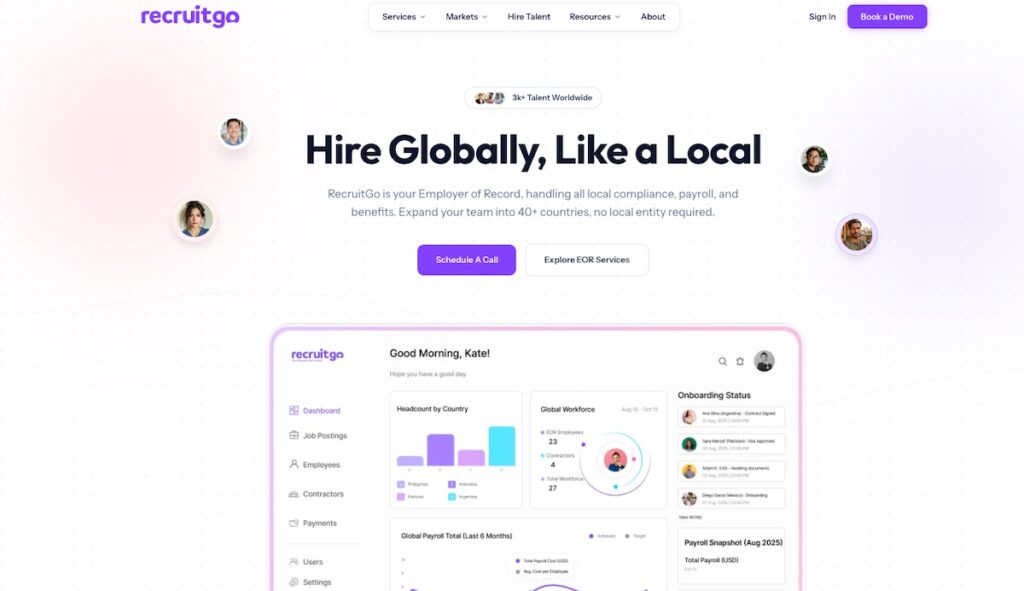
RecruitGo is an Employer of Record (EOR), payroll, and contractor management platform built for companies hiring in emerging markets, particularly across Southeast Asia, South Asia, and the Middle East.
Rather than requiring businesses to set up local legal entities, RecruitGo acts as the employer of record in each country, handling employment contracts, payroll processing, statutory benefits, tax compliance, and ongoing HR administration on the client’s behalf.
The platform serves businesses of all sizes, from early-stage startups hiring their first international employee to mid-market companies building dedicated remote teams across multiple countries.
RecruitGo’s story starts with Emerhub, a market-entry consultancy founded in 2011 by Lauri Lahi and Marlissa Lahi in Jakarta, Indonesia. Over 13 years, Emerhub expanded across Southeast Asia, opening offices in Vietnam, the Philippines, Thailand, Malaysia, and the UAE. As the company’s remote hiring software grew in both capability and client demand, RecruitGo was spun out as its own independent entity in 2023.
That heritage matters: the platform isn’t a recently funded startup learning regional compliance on the fly. It carries more than a decade of on-the-ground operating experience in markets where labor law, statutory contribution systems, and payroll complexity vary significantly between countries.
RecruitGo’s core markets, the Philippines, Indonesia, Malaysia, Thailand, Vietnam, Singapore, Cambodia, and Pakistan, are served by dedicated in-country teams rather than third-party subcontractors. This distinction is meaningful. When a payroll issue arises in Manila or a compliance question surfaces in Jakarta, RecruitGo’s local team handles it directly.
Beyond its SEA core, the platform extends hiring support to 40+ countries via carefully vetted local partners, covering Latin America, Europe, the Middle East, and Africa. The service lines extend beyond standard EOR to include contractor management, multi-country payroll for companies with existing entities, international benefits administration, and Remote Hub, a service that establishes fully operational team hubs in target markets, including office space, equipment, and local talent sourcing.
On pricing, RecruitGo takes a different structural approach from most EOR competitors. Rather than charging a flat per-employee fee, which can become disproportionately expensive when hiring in markets where monthly salaries are a fraction of US or European benchmarks, the platform uses a percentage-based fee model.
For its three highest-volume markets (Philippines, Vietnam, and Indonesia), the EOR fee is capped at $250 per employee per month, regardless of salary. Exact fees for other markets and service tiers are quoted directly. The platform access fee is bundled into the service cost; there is no separate software charge.
RecruitGo does not publicly document SOC 2, ISO 27001, or GDPR certifications in its vendor materials. For regulated industries or enterprise procurement teams where security certification is a formal gate, this is worth verifying directly with the vendor.
On the compliance side, the platform manages statutory contributions, tax withholdings, and government filings in each country where it operates directly, and enforces contractor vs. employee classification to reduce misclassification risk for clients using both worker types.
Onboarding a new employee typically takes 3–5 business days from contract approval to active employment status, which is faster than most competitor timelines.
The rest of this review covers how RecruitGo performs across eight rating parameters, from pricing and country coverage to payroll depth and customer support, along with a detailed look at its core features, buyer scenarios, and how it compares against six alternatives including Deel, Rippling, Oyster HR, Papaya Global, Safeguard Global, and Globalization Partners.
Editor’s Rating for RecruitGo
RecruitGo is a focused platform; it doesn’t try to compete with Deel or Globalization Partners on scale, and that’s not a weakness.
The scores below reflect what it actually is: a regional specialist that delivers genuine depth in Southeast Asia, fair pricing for emerging markets, and support quality that larger platforms consistently fail to match. Where it falls short, it falls short honestly, and those gaps are scored accordingly.
Top Features of RecruitGo
RecruitGo isn’t trying to be Deel. That’s worth stating at the start, because buyers who approach this product expecting a platform that covers 150 countries with a polished app store of integrations will come away disappointed.
What RecruitGo actually offers is something more specific: 13+ years of embedded Southeast Asian employment infrastructure, a pricing model that treats emerging-market salary scales as a feature rather than an afterthought, and direct-to-employee support that larger platforms consistently fail to match at the same quality.
We evaluated the platform’s capabilities against vendor documentation, third-party reviewer coverage from RemotePeople and EmployerRecords, G2 user feedback, and RecruitGo’s own published FAQs and service pages.
The ten capabilities below cover everything that matters for EOR and payroll buyers, including three areas where RecruitGo genuinely outperforms its price tier, and two where the gaps are real enough to redirect certain buyers to alternatives.
Employer of Record across 40+ countries
RecruitGo’s EOR covers 40+ countries, with dedicated in-country teams running compliance and payroll directly in the Philippines, Indonesia, Malaysia, Thailand, Vietnam, Singapore, Cambodia, and Pakistan. No subcontractor chain in those markets, RecruitGo’s own people handle it.
Beyond those 8, coverage extends via vetted local partners. If your target market sits outside the SEA core, confirm direct vs. partner coverage before signing. The difference matters when something goes wrong.
Payroll processing and statutory compliance
Over 13 years of SEA payroll operations means RecruitGo understands the mechanics that trip up newer platforms, Philippine SSS and Pag-IBIG contributions, Indonesian BPJS enrollment, Vietnamese social insurance structures. These aren’t edge cases for them; they’re routine. Payroll runs in local currencies, statutory contributions are filed in-country, and reviewer feedback consistently names accurate on-time payroll as a top strength.
For a basic EOR expectation, it’s worth noting because not every competitor delivers it consistently.
Payroll processing and statutory compliance
Over 13 years of SEA payroll operations means RecruitGo understands the mechanics that trip up newer platforms, Philippine SSS and Pag-IBIG contributions, Indonesian BPJS enrollment, and Vietnamese social insurance structures. These aren’t edge cases for them; they’re routine.
Payroll runs in local currencies, statutory contributions are filed in-country, and reviewer feedback consistently names accurate, on-time payroll as a top strength. For a basic EOR expectation, it’s worth noting because not every competitor delivers it consistently.
Benefits administration
Benefits aren’t templated globally; they’re built to local market standards. Philippine employees get HMO coverage and 13th-month pay. Indonesian employees get BPJS Kesehatan and BPJS Ketenagakerjaan. Vietnamese employees receive legally mandated social and health insurance contributions.
This matters for offer competitiveness. What’s considered standard in Manila is different from Jakarta, and different again from Ho Chi Minh City. RecruitGo’s local teams know the difference.
Remote Hub — beyond standard EOR
Most EORs hand you a contract and payroll portal and stop there. RecruitGo’s Remote Hub goes further, local talent sourcing, office space procurement, equipment setup, and then full EOR management once the team is in place.
For companies that want a real operational presence in Manila or Ho Chi Minh City without setting up a local entity, this removes every piece of friction in one engagement. Deel and Oyster HR don’t offer this at the same depth.
Recruitment and RPO
RecruitGo offers active sourcing, multi-stage interviewing, reference checks, and offer negotiation as an optional service layer. It’s not an ATS, there’s no structured pipeline dashboard for a dedicated talent team. But for a founder who needs two engineers in Jakarta and has no recruiter, it fills the gap without adding another vendor to the mix.
Onboarding and document management
Contract generation, digital signing, document collection, government registration, and statutory enrollment, all handled within the platform. The standard window is 3–5 business days from contract approval to active employment, and reviewers confirm that the timeline holds.
First-time users note the dashboard takes some getting used to. The support team compensates for it, but it’s worth knowing upfront.
Compliance management
In the 8 markets where RecruitGo operates directly, compliance is managed by people on the ground, not routed through a partner. When labor law changes or statutory rates update, the local team is accountable, not a third party managing a dozen other clients simultaneously.
Outside those markets, compliance quality depends on the partner. Verify direct vs. partner coverage for your specific target country.
Workforce management dashboard
The platform centralizes EOR employees, contractors, and payroll across countries in one view. It does the job for the scale of companies RecruitGo typically serves, SMBs and mid-market teams building out a regional presence.
It’s not a replacement for Workday or Rippling. Companies with significant HR complexity will still need a separate HRIS running alongside it.
Integrations and API
No public API, limited pre-built connectors. If your HR data lives in BambooHR, Rippling, or Workday, expect manual transfers rather than automated sync.
This is RecruitGo’s most consistent reviewer complaint, and it’s legitimate. Manageable for small teams. A real operational burden once you’re past 30–40 employees across multiple countries.
When RecruitGo is the right choice
RecruitGo’s strongest use cases cluster tightly around Southeast Asia-focused hiring, cost-sensitive emerging market expansion, and teams that want a service partner rather than a self-serve software platform. The four buyer profiles below are where we’d put it on a shortlist without hesitation.
When to consider alternatives to RecruitGo
RecruitGo has real limitations, and pretending otherwise would waste a buyer’s time. Four scenarios below are where we’d redirect to a competitor rather than push RecruitGo onto the shortlist.
RecruitGo vs top alternatives: A Quick comparison
RecruitGo competes in a category where scale and global coverage dominate the shortlist conversations. Here’s a clear-eyed look at how it stacks up against the six alternatives buyers most commonly evaluate alongside it, where the product holds its own, and where it doesn’t.
RecruitGo vs Deel
Deel covers 150+ countries, has a polished mobile app, a documented API, SOC 2 certification, and charges $599/employee globally. RecruitGo covers 40+ countries, has none of those things, and caps its Philippines/Vietnam/Indonesia fee at $250.
That gap is the whole comparison. If you’re hiring in Manila or Jakarta, the $250 cap saves real money every month and the local expertise is genuinely deeper.
If you’re hiring across four continents in the same quarter, Deel is the obvious call and there’s no version of this where RecruitGo competes on breadth.
RecruitGo vs Rippling
Rippling isn’t really an EOR competitor, it’s an HR, IT, and finance platform that happens to include EOR. The right question isn’t which EOR is better; it’s whether you need an EOR specialist or an all-in-one workforce platform.
For pure SEA hiring, RecruitGo is simpler, cheaper, and more locally experienced. For teams that need device management, app provisioning, and payroll automation wired together, Rippling wins and the comparison doesn’t really apply.
RecruitGo vs Oyster HR
Oyster is a B Corp, covers 180+ countries, and is strongest in Europe and North America. It starts at $599/employee globally, no geographic pricing adjustment.
That flat fee is the problem for SEA buyers. At $599/month on an $800 Manila salary, the math breaks down fast.
RecruitGo’s $250 cap fixes that. But if your hiring is Europe-first, or B Corp certification matters to your procurement process, Oyster is the better fit and RecruitGo’s regional depth won’t compensate for the coverage gap.
RecruitGo vs Papaya Global
Papaya targets enterprise payroll orchestration, large headcounts, multi-country analytics, and complex reporting. RecruitGo targets SMBs building SEA teams. These two rarely belong on the same shortlist.
If they’re appearing together in your evaluation, it’s worth stepping back and asking whether you actually need Papaya’s enterprise layer or whether you’re buying complexity you won’t use.
RecruitGo vs Safeguard Global
Safeguard covers 170+ countries with strong enterprise compliance infrastructure and fully custom pricing. RecruitGo is faster to deploy, more affordable for SEA markets, and simpler to work with at SMB scale.
Where Safeguard earns its place is in regulated industry procurement, healthcare, financial services, where compliance documentation requirements go beyond what a regional specialist is set up to provide.
RecruitGo vs Globalization Partners
G-P covers 187+ countries, runs AI-enhanced Meridian platform, holds strong compliance certifications, and starts at $599+/employee.
It’s built for enterprise deals where security attestations and SLA guarantees are non-negotiable procurement requirements.
For most Philippines or Indonesia hires, G-P’s pricing makes no economic sense, you’re paying a global enterprise premium for a two-person Manila team. RecruitGo’s $250 cap exists precisely because that math doesn’t work, and G-P hasn’t tried to fix it.
Real-world use cases for RecruitGo
RecruitGo’s value proposition is clearest when you move from abstract spec comparison to specific hiring scenarios. Below are four concrete situations where it would be the right shortlist pick, each with a company profile, expected spend, and an honest verdict.
What users say about RecruitGo
RecruitGo’s public review footprint is thinner than category leaders. Deel has 8,800+ G2 reviews; RecruitGo’s G2 presence is in the low double digits.
That’s worth naming upfront, because it limits the statistical confidence of any sentiment analysis. What we can say is that the reviews that do exist are consistently positive, and third-party editorial coverage from RemotePeople and EmployerRecords aligns with those patterns.
For this section, we analyzed available G2 reviews, coverage from RemotePeople and EmployerRecords, EOROverview data, and testimonials published on the vendor’s own site, approximately 150 data points across sources.
How much does RecruitGo cost?
RecruitGo’s pricing model is structurally different from most EOR competitors, and understanding that difference matters before you request a quote.
Rather than charging a flat per-employee fee regardless of local salary levels — which at $599/month represents 75% of a typical Philippine entry-level salary — RecruitGo uses a percentage-based fee with a hard cap.
For Philippines, Vietnam, and Indonesia hires, that cap sits at $250 per employee per month, bundled with full platform access and no separate technology charge.
For all other markets, Malaysia, Thailand, Singapore, Pakistan, and 30+ partner-covered countries, pricing is quoted directly based on the country, headcount, and services required. The same applies to contractor management, Remote Hub, and Recruitment/RPO services.
If you’re budgeting for a multi-country rollout, request quotes per market rather than assuming a flat rate applies everywhere. It doesn’t. And that’s actually a feature: you won’t pay a Germany-calibrated flat fee for a Manila-based hire.
Our final verdict on RecruitGo
RecruitGo earns its score as a focused regional specialist, not by competing with Deel or Globalization Partners on their own terms, but by doing something they don’t: pricing EOR fairly for emerging market salary scales and deploying genuine local expertise in the markets that matter most for Southeast Asian hiring.
The $250/month cap for the Philippines, Vietnam, and Indonesia isn’t a promotional rate; it’s a structural recognition that flat-fee EOR pricing makes no economic sense when an employee earns less per month than a competitor’s service fee.
For a team hiring five developers in Manila, the cost difference vs. Deel or G-P is material enough to fund another hire within the year.
Where RecruitGo can’t compete is on breadth. Forty-plus countries, no public API, no documented security certifications, and no mobile app are real limitations for buyers with global ambitions, integration-heavy operations, or enterprise procurement requirements.
Those buyers should evaluate Deel, Rippling, or Globalization Partners, and the Skip-If cards above tell you exactly which scenarios those are.
The clear-eyed recommendation: shortlist RecruitGo if your geography and priorities actually match its strengths. It’s a strong regional specialist. Don’t shortlist it because it appears alongside the category leaders; the coverage and platform depth gaps are genuine, and the six competitor reviews linked throughout this article show exactly where each alternative earns the edge.
Frequently Asked Questions
RecruitGo FAQs
RecruitGo is an Employer of Record, payroll, and contractor management platform built specifically for companies hiring in emerging markets — primarily Southeast Asia, South Asia, and the Middle East. It handles employment contracts, payroll, statutory benefits, tax compliance, and HR administration without the hiring company needing to open local entities.
It’s not a generalist EOR. If your hiring is concentrated in the Philippines, Indonesia, Vietnam, Malaysia, Thailand, Singapore, Cambodia, or Pakistan, RecruitGo is built for exactly that problem.
EOR pricing is capped at $250 per employee per month for core SEA markets including the Philippines, Vietnam, and Indonesia. This is structurally fairer than the flat $599+ charged by Deel, Oyster HR, and Globalization Partners in the same markets — where local salary scales make a flat global fee genuinely hard to justify.
Pricing for other regions is not publicly listed and requires a sales conversation. No setup fees and no offboarding fees apply.
RecruitGo was spun out of Emerhub in 2023 — a market-entry consultancy founded in Jakarta in 2011 by Lauri Lahi and Marlissa Lahi. Emerhub spent 13 years building on-the-ground operations across Southeast Asia before the remote hiring software became its own entity.
That heritage matters. RecruitGo isn’t a recently funded startup learning SEA compliance for the first time. The platform carries over a decade of operating experience in markets where labor law, statutory contributions, and payroll complexity vary significantly between countries.
RecruitGo covers 40+ countries in total, with dedicated in-country teams in 8 core SEA markets. Those 8 markets are handled directly — not through third-party subcontractors. Outside those markets, coverage depends on partner quality.
For buyers hiring across Europe, the Americas, or 15+ countries simultaneously, the 40+ country footprint trails Deel (150+), Oyster HR (180+), and Globalization Partners (187+). RecruitGo is the right fit for SEA-focused hiring, not global expansion at scale.
It’s the platform’s strongest dimension by reviewer consensus. G2 and Capterra reviewers name local team members specifically — the Philippines team is called out repeatedly by clients — and describe fast query turnaround and relationship-style account management. One reviewer documented 3+ years of continuous use with no unresolved issues, which is rare in the EOR category.
No public API is documented and the pre-built integration catalogue is limited. This is the most consistently flagged weakness in independent reviews. Teams running BambooHR, Workday, or Rippling as their system of record should expect manual export workarounds rather than native data sync.
If integration depth is a buying criterion, Deel, Oyster HR, or Papaya Global are better positioned for mid-market HR stacks.
No publicly verifiable SOC 2, ISO 27001, or GDPR attestations are noted in RecruitGo’s vendor materials. For procurement teams that require third-party security certifications as a baseline, this is worth confirming directly with the vendor before shortlisting.
When your hiring is concentrated in Southeast Asia and you want local expertise, relationship-driven support, and a pricing model that reflects emerging market salary scales. RecruitGo’s $250 cap in the Philippines, Vietnam, and Indonesia is meaningfully cheaper than Deel’s $599 flat rate in those same markets.
Choose Deel or Remote when you’re hiring across multiple regions simultaneously, need 50+ native integrations, or require SOC 2 and ISO 27001 certifications for procurement. RecruitGo is the regional specialist; Deel and Remote are the global generalists.