


SynkPay EOR is an India-specialist Employer of Record operated by Synk Consulting Group Pvt Ltd, built for foreign startups that want to hire engineers and remote professionals in India without registering a local entity.
The service covers compliant employment contracts, monthly payroll, statutory filings (PF, ESI, TDS, professional tax), and HR administration, all under a single flat fee of $349 per employee per month. Its primary client base is early to mid-stage companies in Australia, the US, and the UK making their first or second India hire.
The parent entity has run Indian payroll operations since 2016, predating most India-focused EOR brands by several years. SynkPay is the customer-facing brand of Synk Consulting Group Pvt Ltd, which has operated in India through a directly owned entity since 2016. It positions against global EOR platforms like Deel and Remote on cost and India depth.
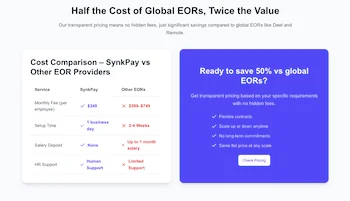
The core argument is straightforward: global platforms charge $599–749/month for India hiring, require a salary deposit, and route support through ticket queues. SynkPay charges $349, holds no deposit, and assigns a human HR and payroll specialist to each account.
Beyond EOR, SynkPay offers IT recruitment (12% of annual salary, one-time), RPO, payroll outsourcing, HR outsourcing, PEO, and contract staffing, making it one of the few India-focused providers where you can source a candidate and employ them through the same vendor.
Recruitment and background verification ($300 per employee, one-time) are priced separately and not bundled into the EOR fee.
SynkPay operates through a directly owned India entity, which matters for compliance reliability. Providers that fulfil India EOR through third-party local partners introduce an additional layer in the employment chain, which can slow issue resolution and dilute accountability on statutory filings.
With a directly owned entity, SynkPay bears the employment liability itself. That structure has been in place since 2016, through GST reform, PF threshold changes, and several cycles of labour code updates.
The service covers hiring across all major Indian states, Karnataka, Maharashtra, Delhi NCR, Tamil Nadu, Telangana, and beyond, handling the state-specific variation in professional tax rates, minimum wages, and leave policies that trips up companies managing India compliance on their own.
Standard contracts include IP assignment, confidentiality, non-solicitation, and return-of-materials clauses enforceable under Indian law, included at no additional cost.
Editor’s Rating for SynkPay
SynkPay occupies a specific and defensible position in the India EOR market: the lowest published flat fee ($349/month), no deposit requirement, and a directly owned India entity that has been running payroll since 2016.
For a startup making its first or second India hire, particularly one based in Australia, the US, or the UK, those three factors address the most common objections to India EOR: cost unpredictability, working capital lockup, and compliance reliability. No other provider in the India specialist segment publicly combines all three at this price point.
Strong on cost, compliance heritage and onboarding speed, capped by India-only scope and undisclosed security certifications.
Flat $349 per employee monthly, no deposit, no setup fee, no salary tiers. Deel’s true India cost runs $649 to $749 once its surcharge lands, plus a month’s gross salary held upfront. Nothing cheaper is published.
Directly owned entity running India payroll since 2016, across GST rollout, PF ceiling revisions and the labour code consolidation. PF, ESI, TDS and professional tax are covered in every state.
One business day is the published standard. Most global platforms quote two to four weeks for India. Pactify’s CTO scaled from 2 to 15 engineers in three months, so the pace holds past the first hire.
No minimum headcount, no lock-in, no termination fee. Exit management covers notice periods, final settlements and experience letters at no extra charge.
A named HR and payroll specialist per account rather than a shared queue. Early third-party reviews echo the responsiveness point. Twelve reviews posted inside one July window is too thin to confirm consistency at scale.
Recruitment, RPO, payroll outsourcing, PEO and contract staffing sit alongside EOR, uncommon among India specialists. The limit is geography, so a second country means a second vendor and a second contract.
Full published pricing is a real differentiator in a category built on sales calls. No SOC 2, ISO 27001 or equivalent certification appears anywhere on the site, and no native integrations are listed. Ask before signing.
Testimonials describe electronic documentation and a straightforward start. No dashboard demo or screenshots are public and no reviewer describes the software layer, so we scored conservatively.
SynkPay’s 4.2 reflects a provider that does a few things very well rather than one trying to cover everything. The cap is what is still not public: security certifications, platform documentation, and a review trail deeper than 12 entries posted in a single fortnight.
SynkPay’s strengths are concentrated and deliberate. This is not a platform trying to serve every global hiring use case, it’s built around one market, one pricing model, and one support philosophy. That focus produces real advantages on cost and speed, but it also creates hard limits that matter depending on where your company is headed.
SynkPay Review: Strengths & Limitations
Based on published service specs, pricing structure, client testimonials, and competitive positioning against Deel, Remote, Multiplier, and Wisemonk.
At $349/month, SynkPay undercuts every major global EOR platform for India hiring. Deel’s true India cost lands at $649–749/month once its country surcharge is added. Remote lists $599/month. For a five-person India team, the monthly saving over Deel alone runs to $1,500 or more.
Deel requires a deposit equal to one full month’s gross salary per employee, locked upfront before the hire starts. SynkPay invoices salary plus the $349 fee at the start of each month and pays the employee at month end. On a $5,000/month engineer, that’s $5,000 of working capital you keep liquid from day one.
SynkPay operates through Synk Consulting Group Pvt Ltd, a directly owned India entity. Providers using third-party local partners introduce an extra layer in the employment chain that can slow statutory filings and dilute liability. This entity has run through GST reform, PF threshold changes, and the labour code consolidation that has occupied India compliance teams since 2019.
Most India EOR providers employ people you’ve already found. SynkPay also finds them, with IT recruitment at 12% of annual salary, alongside RPO and contract staffing. The practical benefit is a single vendor from sourcing through compliant employment, with EOR onboarding available the day a placement is confirmed.
IP assignment, confidentiality, non-solicitation, and return-of-materials clauses are standard in every employment contract, enforceable under Indian law. For technology companies hiring engineers in India, having these provisions drafted correctly under Indian law rather than copied from a US or UK template is a meaningful risk reduction.
SynkPay covers India and nothing else. Companies that start with an India team and later want to hire in the Philippines, Vietnam, or Eastern Europe will need a separate EOR vendor. Multiplier, Deel, and Remote all cover 150+ countries from a single platform, which matters if global expansion is on the roadmap within 12 to 18 months.
SOC 2 Type II, ISO 27001, and GDPR compliance documentation are absent from the SynkPay website. For startups in regulated industries or those with enterprise customers requiring vendor security reviews, this gap needs to be addressed directly with SynkPay before signing. Wisemonk publishes its compliance certifications prominently.
Top Features of SynkPay
SynkPay is narrower in scope than a full-suite HR platform, and that’s the point. The feature set is built around one workflow: getting a foreign company’s first or second India hire employed, paid, and protected compliantly, as fast as possible.
Below we break down the ten capabilities that matter most to buyers evaluating SynkPay against other India EOR options.
Synk Consulting Group becomes the legal employer on paper, absorbing statutory liability that would otherwise need a registered Indian company.
RosterGrid’s CEO reported a 60% drop in admin cost after moving payroll across, covering EPF, ESI, professional tax and TDS.
Every filing sits inside the $349 fee, with no per-filing charge, run through the same entity since 2016.
IP assignment drafted under the Indian Contract Act rather than adapted from a US template, included at no cost.
Sourcing at 12% of annual salary, charged only on placement, with a 90-day replacement guarantee attached.
One business day against the two to four weeks Deel and Remote quote for India, though it depends on client-side speed.
Statutory cover is complete, but no benefits catalogue or named insurance carrier is published anywhere on the site.
Monthly reports cover disbursements, contributions and deductions, but no reviewer or screenshot describes the interface itself.
Hiring across Bangalore, Mumbai and Hyderabad means three professional tax regimes, all handled with no geographic surcharge.
Zero native connectors published. No API access, no BambooHR, no Xero, no QuickBooks. Confirm before signing if this matters.
EOR Employment
SynkPay’s core service is legal employment in India on behalf of a foreign company. As the Employer of Record, Synk Consulting Group Pvt Ltd becomes the entity on the employment contract, absorbing the statutory compliance obligations that would otherwise require a registered Indian company.
The practical outcome for the client is straightforward: you direct the work, SynkPay handles the paperwork. That split is fully legal under Indian employment law and is the standard structure used by every EOR provider operating in the country.
What distinguishes SynkPay from global platforms here is entity ownership. Providers that fulfil India EOR through a third-party local partner add a layer of accountability that can complicate issue resolution. SynkPay’s directly owned entity removes that layer.
India Payroll Processing
Payroll in India is more complex than most foreign employers expect. State-specific professional tax rates, changing EPF wage ceilings, ESI applicability thresholds, and TDS slabs that vary by employee income level all need to be calculated correctly every month.
SynkPay handles all of it, salary processing, statutory deductions, payslip generation, and payment disbursement, on a fixed monthly cycle. RosterGrid’s CEO noted a 60% reduction in administrative costs after moving payroll to SynkPay, which tracks with what in-house India payroll management typically costs a foreign company running it manually.
Statutory Compliance
The statutory compliance layer in India covers Provident Fund (EPF), Employees’ State Insurance (ESI), professional tax, Tax Deducted at Source (TDS), gratuity, and paid leave entitlements. Each has its own filing deadlines, registration requirements, and state-level variation.
SynkPay manages all statutory filings within the $349/month EOR fee. There are no compliance add-ons, no per-filing charges.
The entity has operated through GST reform in 2017, multiple EPF wage ceiling revisions, and the ongoing consolidation of India’s 29 central labour laws into four labour codes, a process that has kept compliance teams occupied since 2019 and is still incomplete.
Employment Contracts
Every contract SynkPay issues is drafted under Indian law, not adapted from a foreign template. That distinction matters more than it sounds. IP assignment clauses that are enforceable in the US or UK may not survive a challenge under the Indian Contract Act or the Copyright Act 1957 without specific Indian law drafting.
Standard provisions in every SynkPay contract include IP assignment, confidentiality, trade secret protection, non-solicitation, and return-of-materials obligations. These are included at no additional cost. For technology companies hiring engineers in India, this is the single most overlooked risk in DIY India hiring arrangements.
IT Recruitment
SynkPay’s recruitment service operates as a separate engagement from EOR, priced at 12% of the hired candidate’s annual salary, charged once on a successful placement. There is no upfront retainer and no fee if the hire doesn’t happen.
The scope covers sourcing from what SynkPay describes as the top 1% of India’s engineering talent pool, resume and technical screening, interview coordination, salary benchmarking, and offer negotiation.
Every placement carries a 90-day replacement guarantee: if the hire leaves or doesn’t work out within that window, SynkPay sources a replacement at no additional fee. The practical value of combining recruitment with EOR is that the same vendor that finds your candidate can employ them compliantly the same day.
Employee Onboarding
Standard onboarding takes one business day from the point SynkPay receives complete candidate details and the offer is approved. Same-day onboarding has been completed for urgent cases, though that timeline depends heavily on how quickly the client side moves.
The onboarding process covers offer letter and contract issuance, electronic document signing, EPF and ESI registration, and bank detail collection.
Pactify’s CTO described scaling from 2 to 15 employees in three months, which suggests the process holds at moderate volume without degrading. No self-serve onboarding portal is publicly demonstrated, so the experience appears to be human-managed throughout.
Benefits Administration
Statutory benefits, EPF, ESI, gratuity, and paid statutory leave — are managed within the $349/month EOR fee for every employee. These are not optional and are not billed separately.
Supplementary benefits including health insurance and performance bonuses can be configured on request. SynkPay doesn’t publish a benefits catalogue or list specific health insurance carriers, so buyers with specific supplementary benefit requirements should confirm what’s available before signing.
The baseline statutory package is complete and standard across all hires regardless of salary level.
Reporting and Payroll Visibility
SynkPay includes transparent payroll reporting and payment tracking as part of the EOR service. Clients receive detailed payroll reports each month covering salary disbursements, statutory contributions, and tax deductions.
No self-serve dashboard screenshots or demo environment are publicly available, which makes it difficult to assess the depth of the reporting interface. Buyers who need real-time payroll visibility, custom reporting, or HRIS integrations should ask for a platform walkthrough during the sales process rather than assuming capability based on the website description alone.
Multi-State Coverage
India’s employment compliance is not uniform across states. Professional tax rates, minimum wage thresholds, and certain leave entitlements vary by state and are updated on irregular cycles. A company hiring engineers in Bangalore, Mumbai, and Hyderabad simultaneously is dealing with three different professional tax regimes.
SynkPay handles multi-state compliance across all major Indian tech hubs, Bangalore, Hyderabad, Pune, Mumbai, Delhi NCR, and Chennai, as well as tier-2 cities. There are no geographic restrictions within India and no additional charge for multi-state coverage.
Platform and Integrations
This is the area where SynkPay’s public documentation is thinnest. No native integrations with HRIS platforms, accounting software, or workforce management tools are listed anywhere on the site. There is no mention of API access, Slack notifications, or any connectivity with tools like BambooHR, Xero, or QuickBooks.
For early-stage startups with lean HR stacks, this may not matter. For companies that want payroll data flowing automatically into their accounting system or headcount data syncing with their HRIS, the absence of documented integrations is a genuine gap. Confirm integration capability directly with SynkPay before signing if this is a requirement.
SynkPay Integrations
The service is human-managed rather than software-led, and most clients at the 1–20 employee range won’t hit a workflow gap. That said, we’ve listed the core statutory and government platforms that SynkPay interfaces with as part of standard India EOR compliance operations.
Statutory Platforms & Tools
SynkPay does not publish a native software integration list. The platforms below reflect the statutory and government systems SynkPay interfaces with as part of standard India EOR compliance operations. For software integration requirements, confirm directly with SynkPay at synkpay.co.

When to Choose SynkPay
SynkPay is a good fit for a specific type of buyer: cost-conscious, India-focused, and moving fast. It is a poor fit for companies that need multi-country coverage, enterprise security documentation, or a self-serve software platform. The cards below make that distinction concrete.
When SynkPay Is the Right Choice
Four buyer profiles where SynkPay consistently delivers based on pricing structure, compliance depth, and onboarding speed.
1 business day onboarding, no deposit, and a flat $349/month regardless of salary level. No minimum headcount and no long-term commitment required.
At $349/month versus Deel’s true India cost of $649–749/month, a three-person team saves over $1,000 per month. Eight billing currencies including AUD, GBP, and EUR are supported.
SynkPay sources candidates at 12% of annual salary and employs them the same day a placement is confirmed. Most India EOR providers require you to arrive with a candidate already identified.
IP assignment, confidentiality, and non-solicitation clauses enforceable under Indian law are standard in every contract. These are not a paid add-on and require no additional legal engagement.
When to Consider Alternatives
Four scenarios where SynkPay’s documented limits are specific enough to redirect your evaluation.
SynkPay covers India only. If your roadmap includes the Philippines, Vietnam, or Eastern Europe within 12 to 18 months, you’ll need a platform built for multi-country coverage from the start.
Consider Multiplier or DeelNo security certifications are disclosed on the SynkPay website. If your procurement process mandates SOC 2 Type II or ISO 27001 documentation, this cannot be confirmed without a direct conversation.
Consider Wisemonk or RemoteSynkPay’s service is human-managed. No native HRIS integrations or API access are publicly documented. Confirm integration capability before signing if this is a hard requirement.
Consider Deel or MultiplierAt scale, global platforms with dedicated legal review, custom SLAs, and named account management become relevant. SynkPay’s flat model doesn’t differentiate at enterprise headcount.
Consider Deel or RemoteSynkPay Pricing
SynkPay publishes two flat fees openly, no sales call needed. EOR is $349 per employee per month at any salary level, with no setup fee, no deposit, and no offboarding charge. Recruitment is separate at 12% of annual salary, charged once on a successful hire only.
One thing to verify before signing: the EOR service page lists three tiers, Essential ($349), Professional ($750), and Enterprise ($1,000), with higher tiers adding equipment provisioning and dedicated HR support. These don’t appear on the main pricing page. Ask SynkPay which tier applies to your requirements before committing.
SynkPay Pricing: Two Services, Flat Fees
Verified from synkpay.co/pricing. No setup fees. No salary deposit. No offboarding fees.
What the $349 EOR fee covers: India-compliant employment contracts, monthly payroll processing, statutory benefits (PF, ESI, gratuity), TDS and tax filings, HR documentation, employee onboarding, and a dedicated HR/payroll specialist. Exit management — notice periods, final settlements, and experience letters — is also included at no extra charge.
Separate optional services: Background verification ($300 per employee, one-time). Recruitment is a distinct engagement and is never bundled into the EOR fee.
Billing currencies: USD, AUD, GBP, EUR, CAD, NZD, SGD, INR. Employees are always paid in INR regardless of which currency you choose for invoicing.
The EOR service page lists three tiers (Essential at $349, Professional at $750, Enterprise at $1,000) with add-ons including equipment provisioning, dedicated HR, and performance management. These tiers are not reflected on the main pricing page. Confirm which applies to your requirements directly with SynkPay before signing.
How SynkPay Compares to the Alternatives
The India EOR market splits cleanly into two camps: global platforms that cover 150-plus countries and treat India as one of many, and India specialists that go deeper on local compliance, pricing, and support. SynkPay competes in both directions.
Below we compare it against four providers buyers most commonly evaluate alongside it, Deel, Remote, Multiplier, and Wisemonk, across the factors that actually drive the decision: cost, onboarding speed, deposit requirements, support model, and geographic scope.
SynkPay vs India EOR Alternatives
Four buying attributes that separate India EOR providers at the decision stage.
SynkPay vs India EOR Alternatives
Head-to-head across the six factors that matter most when evaluating India EOR providers.
| Provider | EOR Price (India) | No Deposit | Onboarding Speed | India-Only Specialist | Integrated Recruitment | Multi-Country |
|---|---|---|---|---|---|---|
|
SynkPay
|
$349/mo |
|
1 business day |
|
|
|
|
Deel
|
$649–749/mo |
|
2–4 weeks |
|
|
|
|
Remote
|
$599/mo |
|
2–4 weeks |
|
|
|
|
Multiplier
|
$400/mo |
|
1–2 weeks |
|
|
|
|
Wisemonk
|
~$399/mo |
|
2–3 days |
|
|
|
Real-World Use Cases for SynkPay
The four scenarios below put SynkPay into specific buying contexts, real headcounts, real cost structures, and honest fit assessments. These are the situations we see most often when startups are deciding between SynkPay and a global EOR platform.
How SynkPay Performs in Practice
Four specific hiring situations evaluated honestly against SynkPay’s pricing, speed, and service structure.
This is SynkPay’s primary use case. Total EOR cost is $1,047/month across three engineers at any salary level — billed in AUD with no deposit required. Onboarding completes in 1 business day once candidate details are received. The same scenario through Deel costs $1,947–2,247/month plus a deposit equal to one month’s gross salary per employee upfront. SynkPay saves this team $900–1,200/month from day one.
Most EOR providers require a candidate before they can help. SynkPay sources the engineer at 12% of annual salary and employs them through EOR the same day the placement is confirmed. On a $60,000/year senior engineer, recruitment costs $7,200 one-time plus $349/month EOR. That’s a complete hire — sourced, screened, employed, and compliant — through one vendor relationship.
SynkPay covers the India side cleanly — 5 employees at $1,745/month with no deposit and 1-day onboarding. The Philippines hires require a separate EOR vendor entirely, which adds a second contract, second support relationship, and second invoicing cycle. The India cost saving over Deel is real, but the operational overhead of managing two EOR providers may offset it depending on the team’s capacity.
At 40 employees, SynkPay’s flat $349/month pricing saves $14,000/month versus Deel, a compelling number. But a Series B company with enterprise customers running a formal vendor security review needs SOC 2 Type II documentation that SynkPay does not currently publish. That single gap will block procurement approval regardless of the cost saving. Wisemonk or Remote are better fits at this stage.
What Users Say About SynkPay
There are limited public reviews for the product as it is relatively new in the market. The rating below is created with our independent research on the platform.
What Clients Say About SynkPay
Sentiment below combines third-party reviews on G2 and Gartner Peer Insights with three named client testimonials published on synkpay.co, cross-referenced against documented service specs. The third-party trail is recent and small, so it carries less weight here than volume alone would suggest.
RosterGrid’s CEO cited a 60% reduction in administrative costs after moving payroll to SynkPay, specifically calling out background verification and automated payroll as the key drivers.
AllegroLive’s founder described SynkPay’s sourcing-to-equipment-provisioning service as unmatched, noting it eliminated the coordination overhead of managing multiple international hiring vendors.
Pactify’s CTO scaled from 2 to 15 engineers in three months. The ease of onboarding India-based engineers at that pace was specifically noted, suggesting the 1-business-day standard holds beyond the first hire.
Several G2 reviewers describe moving existing India contractor teams onto compliant employment, with EPF, ESI, TDS and professional tax handled by SynkPay. This is a recurring use case across the third-party reviews rather than a one-off.
Testimonials and G2 reviews both describe named contacts resolving payroll, equipment and team scaling issues directly, without ticket queues. Consistent with SynkPay’s dedicated specialist model.
All 12 third-party reviews were posted within a two-week window in July 2026, and most of the G2 entries came through seller-invite rather than organically. Wisemonk carries roughly 211 G2 reviews by comparison. The signal is real but too thin and too recent to weight heavily.
Early reviews echo the responsiveness point, but all of them come from clients in the 1 to 20 employee range. There is no independent data on how support quality holds as the client base grows.
Reviewers report correct filings, but none covers more than a few payroll cycles. There is not yet enough data to assess error rates, correction turnaround times, or statutory filing accuracy across a larger client population.
No third-party review describes a dashboard or reporting interface in any detail. The software layer remains effectively unverified beyond what is visible on SynkPay’s own site.
No SOC 2, ISO 27001, or GDPR certification has been confirmed publicly. Buyers in regulated industries or with enterprise vendor review requirements cannot currently verify this independently.
SynkPay Final Verdict
SynkPay’s case is straightforward: if your hiring is concentrated in India, their $349/month flat fee with no deposit and 1-business-day onboarding is the most cost-efficient compliant path available at a published price.
The directly owned entity since 2016 gives the compliance foundation more credibility than a newer brand would carry. For early-stage companies where every dollar of working capital matters, the deposit-free model alone is worth serious consideration.
Before signing, verify three things directly with SynkPay: what security certifications are available and whether they satisfy your procurement requirements, which pricing tier applies to your specific needs given the discrepancy between the main pricing page and the EOR service page, and whether any software integrations exist for your HRIS or accounting stack.
None of these are disqualifying questions, but the answers will determine whether SynkPay is the right fit or whether a platform like Wisemonk or Remote better matches your operational requirements.
SynkPay is the cheapest fully published compliant path to an India hire for foreign startups, with a compliance track record that goes back further than most India-specialist competitors. Verify security certifications and pricing tier details directly before signing, those two conversations will tell you everything you need to know about fit.
Frequently Asked Questions
SynkPay EOR — Common Questions Answered
What does SynkPay actually do?
SynkPay is an Employer of Record for India. Foreign companies use it to hire employees in India without registering a local entity. SynkPay becomes the legal employer on paper, handling employment contracts, payroll, statutory filings, and HR administration. The client directs the work day to day.
How much does SynkPay cost?
The EOR fee is $349 per employee per month, flat. It does not change with the employee’s salary level, seniority, or location within India. There is no setup fee, no salary deposit, and no offboarding charge.
Recruitment is a separate service priced at 12% of annual salary, charged once on a successful hire only. Background verification is $300 per employee, optional, and billed separately.
Does SynkPay require a salary deposit?
No. SynkPay invoices the monthly salary plus the $349 EOR fee at the start of each month and pays the employee at month end. No working capital is held in reserve. This is a deliberate difference from deposit-based global EOR platforms like Deel, which require a full month’s gross salary per employee upfront.
How fast can SynkPay onboard a new hire?
Standard onboarding takes 1 business day once complete candidate details are received and the offer is approved. Same-day onboarding has been completed for urgent cases. The timeline depends on how quickly the client provides the required information.
Is SynkPay India-only?
Yes. SynkPay covers India only. Companies that need to hire in multiple countries will need a separate EOR vendor for markets outside India. Global platforms like Deel, Remote, and Multiplier cover 150-plus countries from a single platform.
What statutory benefits do SynkPay employees receive?
Every employee is enrolled in India’s statutory benefits including Provident Fund (PF), Employees’ State Insurance (ESI) where applicable, gratuity, and paid statutory leave. All are included within the $349/month EOR fee. Supplementary benefits like health insurance and performance bonuses can be configured on request.
Does SynkPay handle IP protection and confidentiality?
Yes. Every employment contract includes IP assignment, confidentiality, non-solicitation, trade secret protection, and return-of-materials clauses, all enforceable under Indian law. These are standard in every contract at no additional cost.
How does SynkPay compare to Deel for India hiring?
SynkPay charges $349/month flat with no deposit. Deel’s true India cost runs $649–749/month once its India country surcharge is added, plus a one-month gross salary deposit per employee upfront. On a five-person India team, SynkPay saves $1,500 or more per month before the deposit difference is counted.
Deel covers 150-plus countries and has a deeper software platform. SynkPay covers India only but goes deeper on local compliance, onboarding speed, and cost. The right choice depends entirely on whether your hiring is India-only or multi-country.