Employees who pasted confidential data into public AI tools
25-35% (2026)
Wrivio, Gartner shadow AI surveys
Organizations with a formal AI governance framework
36%
SQ Magazine shadow AI research
GDPR fine against Amazon France for excessive monitoring
€32M (2024, still the largest of its kind)
CNIL
Meta’s internal employee-tracking program (MCI)
Paused June 2026 after data leak
Wired, Engadget
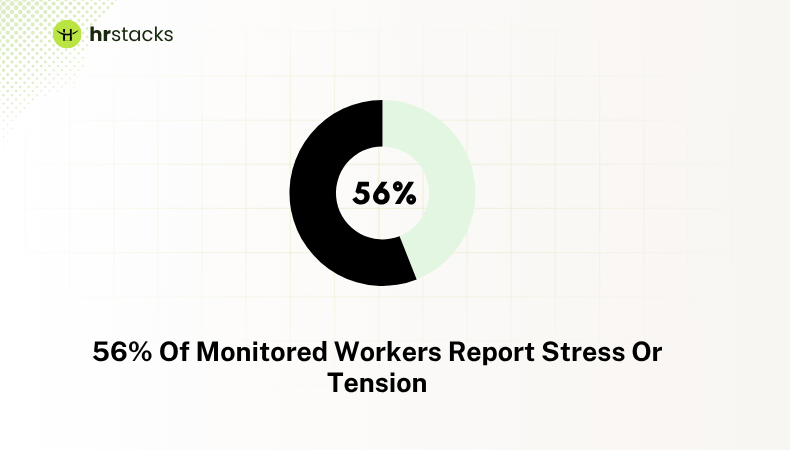
Monitored employees reporting stress or tension
56%
Industry workplace-stress survey
Key Takeaways
Monitoring adoption kept climbing after the pandemic instead of fading, with most large enterprises now doing it as standard practice.
Shadow AI has moved past isolated leaks into a structural governance gap: most companies still lack visibility into how employees actually use AI.
Regulators are shifting from one-off fines toward standing rules, with the UK consulting on binding monitoring legislation and the EU AI Act already banning workplace emotion recognition.
Even large, well-resourced employers get internal monitoring wrong, as Meta’s own tracking-program pause showed in 2026.
Disclosure remains the line between accepted oversight and employee resentment, regardless of company size or monitoring method.
Adoption of Workplace Monitoring
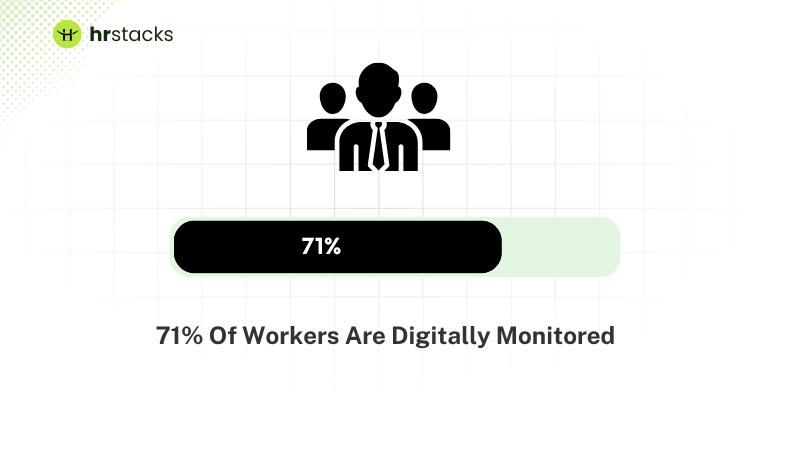
Employer monitoring stopped being a pandemic-era stopgap and settled into standard operating practice. Adoption numbers have kept climbing through 2026, large enterprises lead the shift, and the UK is now the first major market moving toward binding rules on how “bossware” gets disclosed and used.
Stat 01
73% -80%
% of employers monitor remote/hybrid staff
Most employers now monitor remote and hybrid workers
Separate 2025-2026 surveys put remote and hybrid monitoring adoption between 73% and 80%, depending on sample and definition of “monitoring.” Either figure confirms this shifted from a minority practice to the default since the pandemic.
Employer-reported monitoring of remote or hybrid staff.
MIT-cited study
80%
Companies confirmed monitoring remote or hybrid workers.
The gap reflects differing survey scope: broader definitions of monitoring (login logs, basic activity tracking) produce higher figures than surveys that ask specifically about active surveillance software.
Stat 02
70%
of large enterprises actively monitoring by 2025
Large enterprise monitoring adoption confirmed a Gartner projection
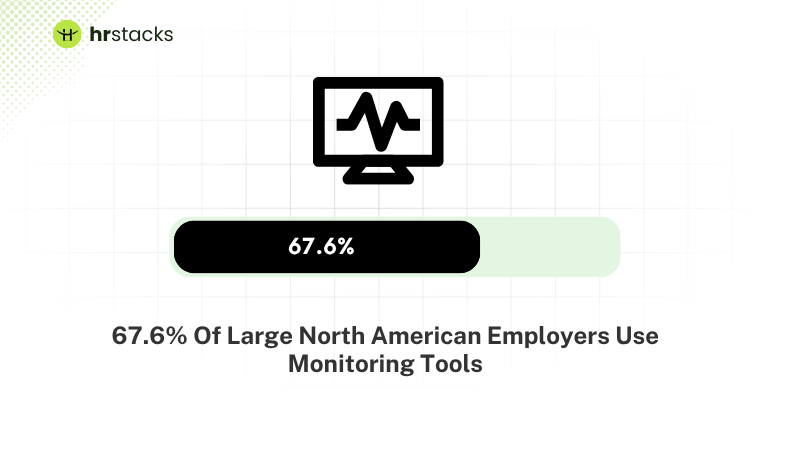
Gartner projected in 2022 that 70% of large enterprises would actively monitor employees by 2025, up from 60% in 2022. Later reporting confirms that projection held, making monitoring a mainstream large-employer practice rather than an outlier trend.
of pandemic-era adopters kept monitoring permanently
Companies that adopted monitoring in 2020 rarely dropped it
73% of companies that adopted monitoring tools during the pandemic have kept them in place permanently. That retention rate signals a structural shift rather than a temporary response, since employers found the data useful for workload distribution and burnout detection beyond the original crisis.
UK bossware use is heading toward government regulation
A third of UK employers now use bossware to track logins, browsing, email, and screen activity, and the government opened a consultation in July 2026 on whether to regulate it through guidance or binding law. The direction points toward mandatory disclosure rather than a ban.
ICO finds fewer than 1 in 5 UK workers believe they are monitored.
Sept 2025
CMI survey finds 33% of UK employers now use bossware.
July 2026
UK government opens a public consultation on regulating workplace monitoring technology.
Sept 30, 2026
Consultation closes; guidance or legislation expected to follow.
Capabilities and Intrusiveness of Tools
Monitoring tools have moved well past login logs. Screen capture, keystroke logging, and biometric checks are now standard features, and even sophisticated employers get the governance wrong, as Meta discovered with its own internal tracking tool.
Stat 05
45%
of employers log keystrokes
Monitoring has moved from logs to keystrokes and files
About 45% of employers now track keystrokes and 43% review computer files directly, well beyond basic login or browsing logs. The stated goals are catching disengagement and verifying productivity, but the depth of access has grown much faster than most workplace privacy policies.
The EU already bans emotion-reading and biometric-categorization tools at work
Article 5 of the EU AI Act has prohibited AI systems that infer employee emotions or apply biometric categorization in the workplace since February 2025, with narrow medical and safety exceptions. Any tool marketed as reading “engagement,” “mood,” or “sentiment” through facial or voice analysis is already out of bounds for EU employers.
Meta paused its own employee-tracking program after an internal leak
Meta’s Model Capability Initiative tracked employee keystrokes, mouse movements, and screen content to train AI agents. After a leak exposed private conversations and performance data company-wide, Meta paused the program in June 2026, following a 1,600-plus employee petition against it.
Employees adopted AI tools faster than most companies built policies to govern them, and 2026 data shows that gap widening rather than closing. The risk isn’t hypothetical: engineers paste source code, sales staff paste customer records, and most organizations still can’t see any of it happening.
Stat 08
30%
of employees regularly paste company data into public AI
Roughly a third of workers routinely paste confidential data into public AI tools
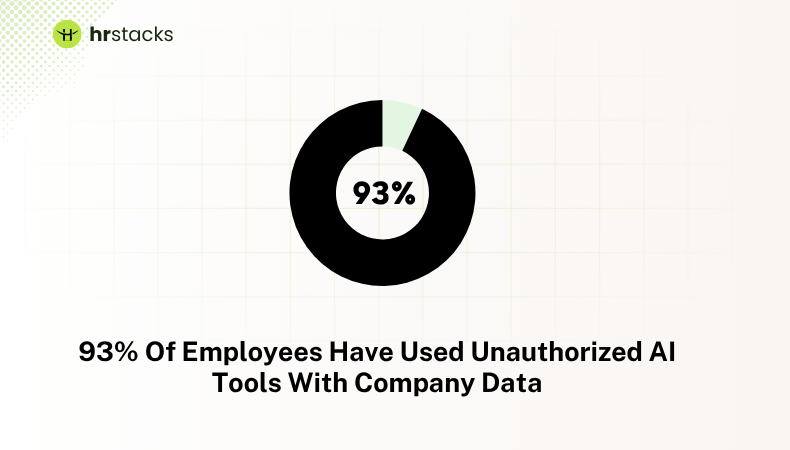
2026 surveys converge on 25-35% of enterprise employees regularly entering confidential company data, including customer records and financial figures, into public AI tools. A separate Kiteworks survey found 93% have done this at least once, a wider net that reflects a one-time lapse rather than a routine habit.
Most companies can’t see how employees are actually using AI
Only 25% of organizations report comprehensive visibility into employee AI usage. That blind spot is widely acknowledged internally: most security leaders suspect unauthorized AI use is happening, they just can’t confirm where or how much.
60% lack confidence identifying unapproved AI tools
90% of digital trust pros believe staff are using AI
Stat 10
25%
of organizations have no active AI policy
A quarter of organizations have no AI policy at all
ISACA’s 2026 research found 25% of organizations have no active AI usage policy in place, leaving employees to set their own rules on what data is safe to share with AI tools. This sits alongside a broader finding that 56% of professionals don’t know how quickly they could halt an AI system during a security incident.
Governance frameworks are rarer than usage policies
Only 36% of companies report having a formal AI governance framework in place, and just 29% regularly audit AI usage across teams. The gap between having a policy and actually enforcing it is where most shadow AI risk lives.
Employees route around IT by using their own phones and laptops
Shadow AI research consistently finds employees using personal devices to reach public AI tools specifically because it sidesteps IT monitoring. This makes detection far harder, since the activity never touches company-managed networks or endpoints.
the top data category leaked to unauthorized GenAI
Source code is the single most-leaked category into unauthorized AI tools
Verizon’s 2026 Data Breach Investigations Report found source code was the leading data category uploaded to unauthorized generative AI tools, a direct line from developer shadow AI use to intellectual property exposure. Credentials and connection strings embedded in code snippets compound the risk.
Shadow AI breaches cost significantly more than standard incidents
Breaches tied to shadow AI cost an average of $670,000 more per incident than standard breaches, with AI-involved breaches now averaging over $4.5 million globally. The premium reflects how much harder these incidents are to detect, scope, and contain.
Premium driven by detection and containment complexity.
AI, Bias, and Legal Exposure in HR Decisions
AI hiring tools are now squarely inside employment discrimination law, not adjacent to it. Litigation against vendors, not just employers, is moving forward, and states are filling the regulatory gap faster than federal guidance can keep pace.
Stat 15
Discovery
phase reached in Mobley v. Workday
A landmark case now treats an AI vendor as a potential employer under Title VII
Mobley v. Workday survived a motion to dismiss and is proceeding as a nationwide collective action. The court held that Workday’s hiring algorithm functions as a unified policy across employers, meaning an AI vendor, not just the hiring company, can be held liable for algorithmic bias under federal law.
selection-rate threshold the EEOC uses to flag bias
The EEOC applies the same adverse-impact test to algorithms as to human recruiters
The EEOC’s four-fifths rule flags a red flag for adverse impact when a protected group is selected at less than 80% of the rate of the highest-selected group. The agency has been explicit that “the algorithm did it” is not a valid defense under Title VII.
overlapping state and city AI-hiring laws in force
Employers now face a patchwork of state and city AI-hiring rules
NYC Local Law 144 requires bias audits and candidate notification for automated hiring tools, while Texas’s TRAIGA, effective January 1, 2026, prohibits AI systems built with intent to discriminate. California and New York continue expanding their own frameworks, meaning compliance now varies significantly by jurisdiction rather than following one federal standard.
Enforcement against workplace surveillance kept escalating through 2026, and regulators are increasingly moving from reactive fines to proactive rulemaking. The one thing that hasn’t changed: Amazon’s French monitoring fine is still the largest of its kind in Europe.
Stat 18
€32M
still the largest EU workplace-monitoring fine
Amazon’s €32M fine remains the benchmark case two years on
CNIL’s 2024 fine against Amazon France Logistique, for excessively granular productivity monitoring, remains the largest workplace-surveillance penalty issued by a European data protection authority. Newer, smaller cases since then have followed the same reasoning: monitoring must be proportionate to a documented business need.
CNIL enforcement has continued past the Amazon case
CNIL fined one company €100,000 for hidden video surveillance with no data protection impact assessment, and another €40,000 for disproportionate productivity tracking combined with continuous audio-visual surveillance. Both cases cited missing DPIAs and lack of proportionality, the same failures found in Amazon’s case.
EU AI Act high-risk deadline: Aug 2026 or Dec 2027
The compliance deadline for high-risk workplace AI is still being negotiated
Most AI-driven monitoring, recruitment, and performance-evaluation tools fall under the EU AI Act’s high-risk category. Obligations were set to apply from August 2, 2026, but the European Commission’s “Digital Omnibus” proposal is negotiating a delay to December 2, 2027. Employers should prepare against the earlier date regardless of how the negotiation lands.
The UK is close to becoming the first major market with binding bossware rules
The UK’s Department for Business and Trade opened a consultation on workplace monitoring technology on July 8, 2026, as part of the wider Employment Rights Act 2025 reform program. The response could take the form of guidance, a statutory code, or binding legislation requiring employers to consult staff before introducing new monitoring tools.
Employees aren’t opposed to monitoring on principle, they’re opposed to monitoring they weren’t told about. Disclosure is consistently the variable that determines whether workplace surveillance damages trust or gets accepted as routine.
56% of employees subject to electronic monitoring report stress or tension, well above unmonitored peers. Nearly half say they would consider quitting if monitoring increased, a direct line from surveillance intensity to retention risk.
say monitoring disclosure should be legally required
Disclosure, not monitoring itself, is what employees actually object to
85% of employees say disclosure of monitoring should be legally required, and separately, 90% say they’re open to data collection when it’s tied to visible career benefits. The dividing line isn’t whether monitoring happens, it’s whether employees were told about it and can see what it’s for.
Employees accept data collection tied to visible career value.
Stat 24
53%
vs 42%
Managers themselves are split on whether monitoring is worth the trust cost
53% of managers support workplace monitoring while 42% oppose it, citing concerns that it undermines trust or invades privacy. Managers are often also the ones left explaining mislabeled activity flags or false positives to their own teams, a friction point that doesn’t show up in adoption statistics.
Workplace monitoring is no longer a pandemic-era stopgap; it’s the default operating mode for most large employers, and the data shows adoption still climbing rather than leveling off.
The bigger shift this year isn’t in the monitoring itself but in what surrounds it: shadow AI has become a governance problem most companies openly admit they can’t see, regulators are moving from one-off fines toward standing rules in the UK and EU, and even Meta couldn’t run its own internal tracking program without a costly misstep.
For HR leaders, the practical lesson is consistent across every section here: employees don’t reject monitoring on principle, they reject monitoring they weren’t told about, and disclosure is the cheapest compliance investment available before the next fine or leak forces the issue.
Manjuri Dutta is co-founder and Editor at HR Stacks, where she runs the editorial process behind the site’s provider reviews and country hiring guides. She has 10+ years in content and editorial work, and has spent the last 5 years focused on Employer of Record and global employment. At HR Stacks, Manjuri focuses on clear, practical content about Employer of Record services, global payroll and international hiring.
This website uses cookies to enhance user experience and to analyze performance and traffic on our website. By continuing to browse this site you are agreeing to our use of cookies.