
Quick answer: what are the best remote team KPIs?
Remote team KPIs are a short list of measurable outcomes, such as delivery, quality and team health, that show whether distributed work is on track. Pick six to eight, spread across at least three areas, and include one survey-based measure. Measure outcomes the team controls, not hours online or status lights.
- Core setSix to eight KPIs across three or more areas
- Check firstClarity of expectations, asked in a short survey
- Main riskMeasuring hours online instead of outcomes
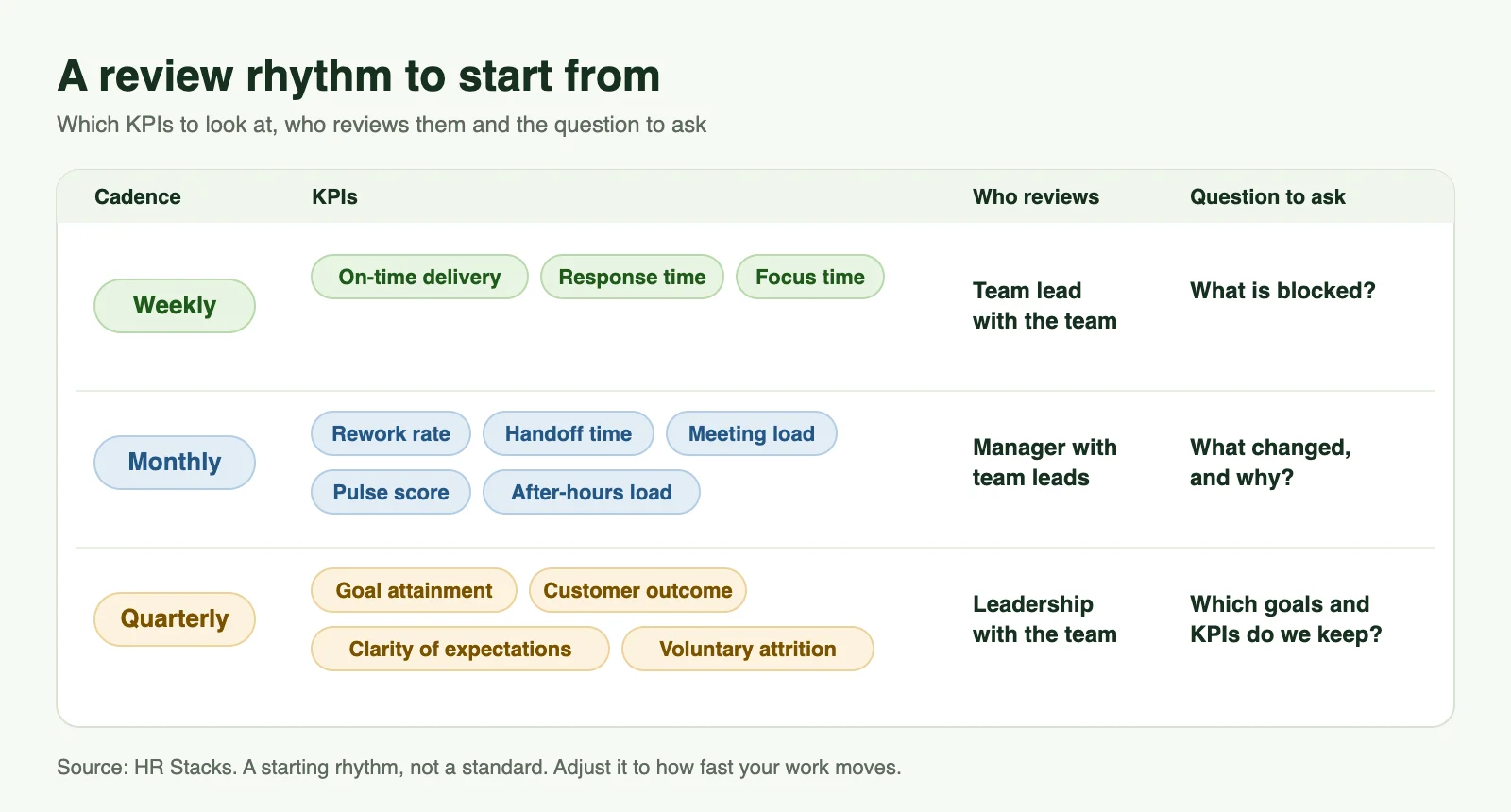
- Review rhythmWeekly for flow, monthly for health, quarterly for goals
Key takeaways
Most remote teams already collect plenty of numbers. The problem is that nobody agreed which ones decide whether the work is going well. This guide gives you twelve KPIs to choose from, with a formula and a gaming risk for each, the pairs that keep them honest and a 30-day rollout. It builds on our remote work statistics and our guide to managing a remote business.
Why remote KPIs need a reset
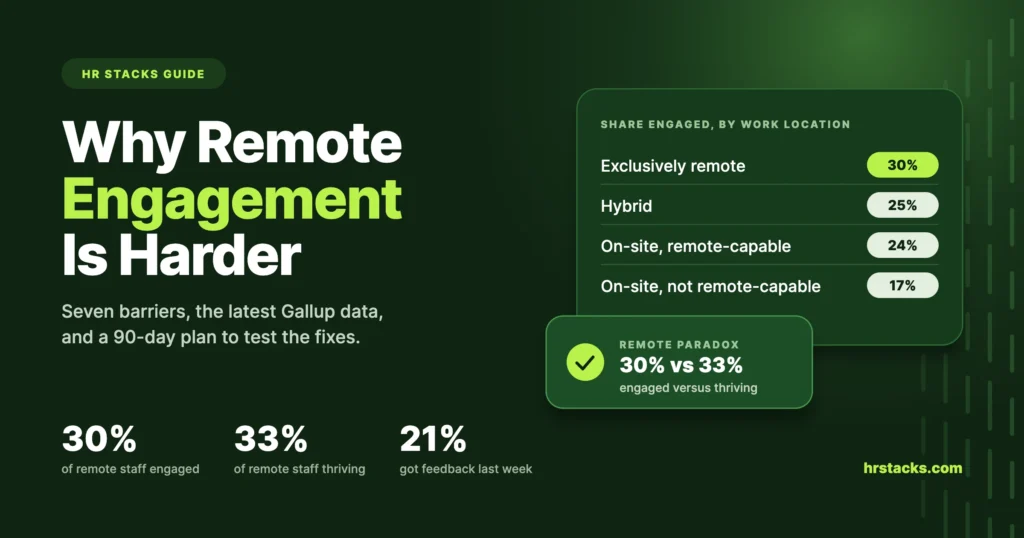
Remote KPIs need a reset because distance removes the cues managers used to read, such as who is at their desk, and leaves clear written expectations as the main signal. Gallup’s third quarter 2026 survey found that 46% of US employees strongly agree they know what is expected of them, down from 61% in 2015, and that hybrid and fully remote staff have lost more clarity since 2020 than on-site colleagues in remote-capable jobs.
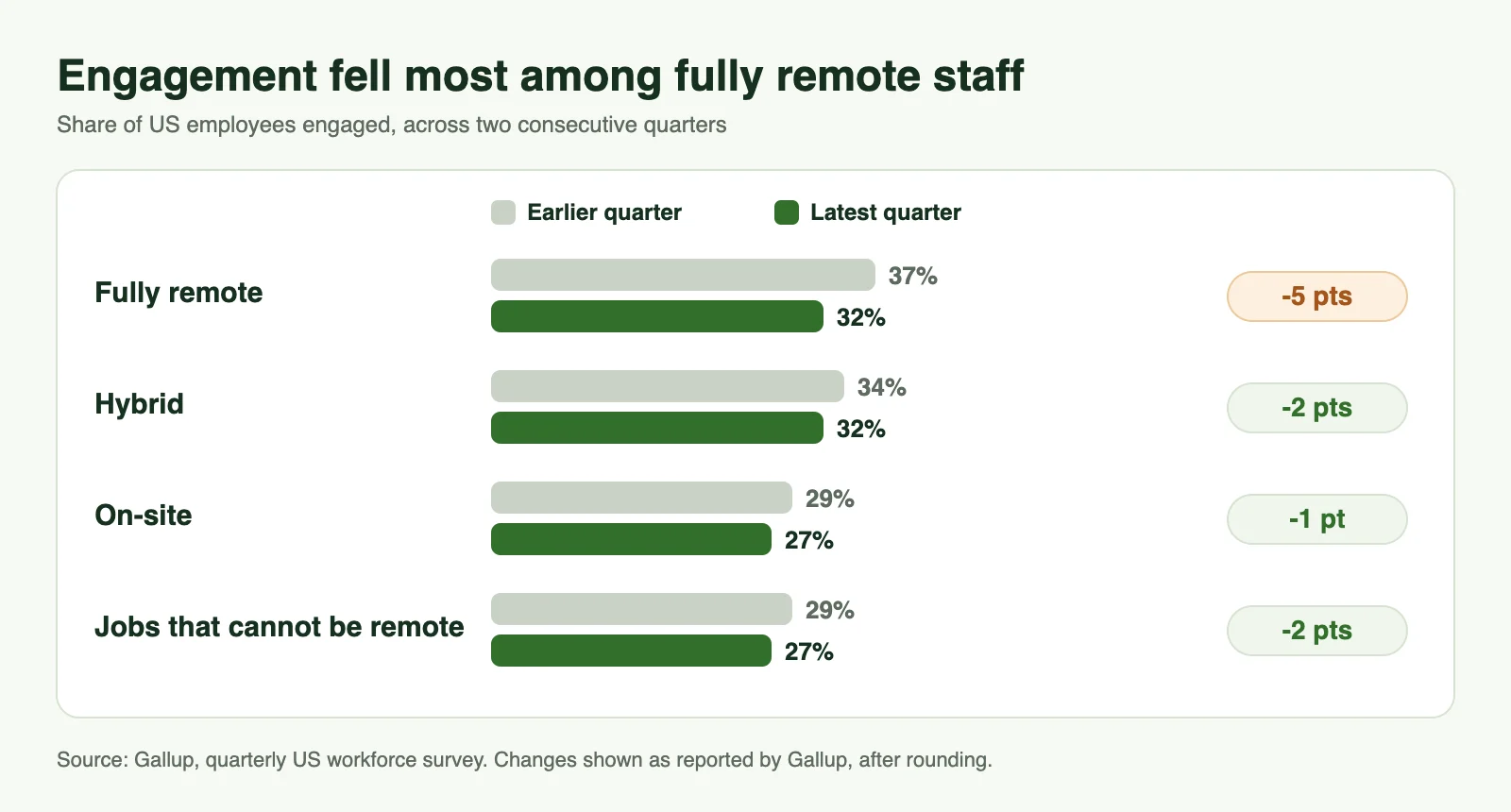
Engagement tells the same story. US engagement fell to 29% in that survey, its lowest since 2011, and fully remote employees dropped from 37% to 32%. Globally, Gallup puts engagement at 20% for 2025.
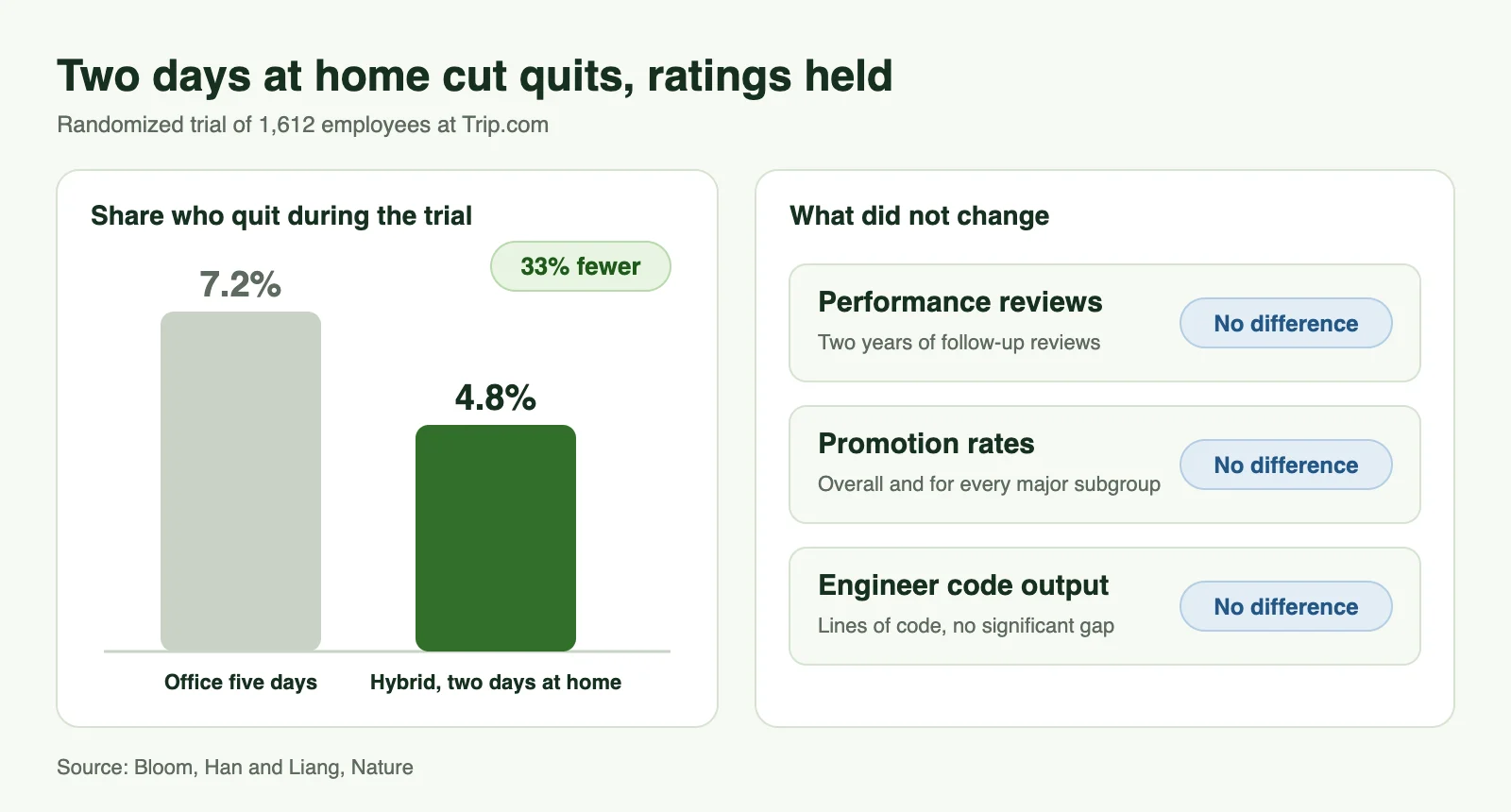
Location is not the culprit. In a randomized trial of 1,612 employees at Trip.com, two days a week at home cut quits from 7.2% to 4.8% and had no effect on performance reviews or promotions. Our read: the gap sits in how work is defined and measured, so the fix belongs in the KPI set, not in a return-to-office rule.
The first two figures come from Gallup and the third from the Trip.com trial. The last comes from Stanford SWAA data for July 2026.
KPIs for output and quality
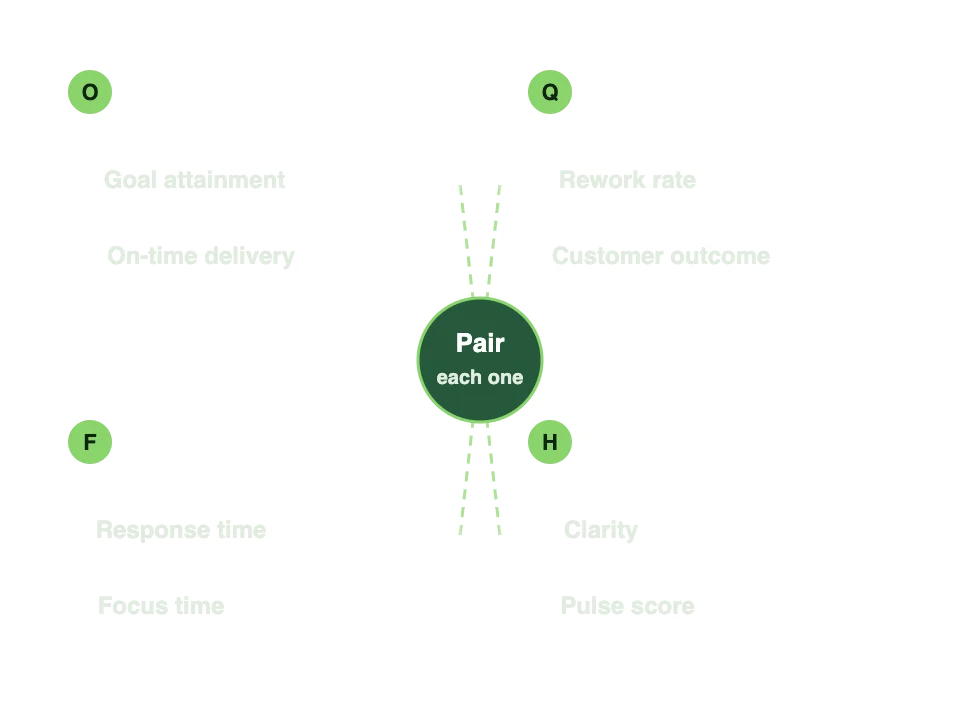
Output and quality KPIs answer two questions: did the work ship, and did it hold up? Start with goal attainment, then add delivery, rework and a customer measure so that no single number can be gamed.
Goal attainment
FormulaAverage key result score on a 0.0 to 1.0 scale, graded at the end of the quarter.
- Healthy
- Committed goals reach 1.0 and stretch goals average about 0.7, according to Google’s OKR playbook.
- Gaming risk
- Teams sandbag goals so every score lands at 1.0.
On-time delivery
FormulaItems delivered by the agreed date divided by items due.
- Healthy
- Stable or rising over a quarter, with each miss traced to a cause.
- Gaming risk
- Padding deadlines so nothing is ever late.
Rework rate
FormulaItems reopened or returned divided by items delivered.
- Healthy
- Falls as briefs and acceptance criteria get clearer.
- Gaming risk
- Reviewers stop logging defects to keep the number low.
Customer outcome
FormulaCSAT, renewal rate or an internal stakeholder score for the work shipped.
- Healthy
- Holds steady while throughput rises.
- Gaming risk
- Surveying only the customers who are already happy.
Engineering teams can replace the middle two cards with DORA’s five software delivery metrics: change lead time, deployment frequency and failed deployment recovery time for throughput, plus change fail rate and deployment rework rate for instability.
KPIs for communication and flow
Communication KPIs show whether work moves between people without stalling, so measure how long work waits rather than how much people talk. Microsoft telemetry shows employees interrupted about every two minutes by a meeting, email or notification, and half of all meetings landing between 9 and 11 am or 1 and 3 pm, when many people do their best focus work.
Our take: focus time is the KPI remote teams skip most often, and it is the cheapest to improve. Move recurring status meetings to a written update and the number moves within a month.
KPIs for team health
Team health KPIs show what output numbers cannot: whether the pace is sustainable. They are the early warning, because retention only changes after engagement has already slipped. The SPACE authors call retention a lagging measure that also reflects pay, promotion and personal moves, so pair it with surveys.
Clarity of expectations
FormulaShare of the team who strongly agree they know what is expected of them.
- Healthy
- Flat or rising each quarter, against the 46% US figure Gallup reported.
- Gaming risk
- Asking on a group call, where unclear staff stay silent.
Pulse score
FormulaAverage agreement across three to five fixed questions on a five-point scale.
- Healthy
- A steady trend, with the same questions all year.
- Gaming risk
- Rewording questions so the trend breaks.
Voluntary attrition
FormulaResignations divided by average headcount over 12 months.
- Healthy
- Stable, and not concentrated under one manager.
- Gaming risk
- Managers blocking transfers to protect their own numbers.
After-hours load
FormulaShare of team messages and meetings outside agreed hours, reported for the whole team.
- Healthy
- Flat or falling. Microsoft found meetings after 8 pm up 16% and more than 50 messages per person outside core hours.
- Gaming risk
- Tracking individuals, which teaches people to hide late work.
Pair speed with a counterweight
Every speed KPI needs a counterweight, because a number tracked alone gets optimized at the expense of everything else. The SPACE authors build their framework on metrics held in tension by design, and DORA warns that turning a metric into a goal invites teams to game it, a point it ties to Goodhart’s law.
KPIs by team type
Pick KPIs by the work the team does, not by what the dashboard offers. Start from the outcome the team is paid to produce, then add one counterweight and one health measure.
If you lead engineering
Use the five DORA metrics, then add focus time and pulse score. DORA applies its metrics to one application or service at a time, so do not blend or compare teams.
If you lead support or operations
Track median first reply time next to reopen rate, then add customer outcome score and after-hours load.
If you lead sales or marketing
Pair pipeline created with a quality measure such as win rate, then add clarity of expectations and goal attainment.
OKRs, SPACE and DORA
Three published frameworks cover most remote KPI needs, and you do not have to adopt any of them whole. OKRs set the goals, SPACE keeps the measurement balanced and DORA covers software delivery.
- OKRs
- Use for goal setting. Separate committed goals from stretch goals, write key results as outcomes rather than activities, and grade at the end of the quarter.
- SPACE
- Use for balance. It covers satisfaction and well-being, performance, activity, communication and collaboration, and efficiency and flow. The authors recommend a handful of metrics across at least three dimensions, with at least one perceptual measure such as a survey.
- DORA
- Use for engineering delivery. Five metrics in two groups, throughput and instability. Set a baseline first, and do not make any one metric a target.
In our view, OKRs plus a SPACE-style balance check cover most non-engineering teams. Skip the framework debate and spend the time writing key results as outcomes.
Metrics to stop tracking
Stop tracking any metric that measures presence instead of results, such as hours online, mouse movement, keystrokes and green status lights. The SPACE authors say activity counts should never be used in isolation to reward or penalize people, because longer hours can mean better systems or brute force, and the count cannot tell which.
Monitoring rules to know
If any KPI relies on electronic monitoring, tell people first. Several US states require notice, and the rules are widening. Our employee monitoring statistics show how common monitoring has become.
Electronic monitoring notice rules
Verified 5 Nov 2026Sources: Littler for New York and Delaware, and Jackson Lewis for Connecticut and the other states. Connecticut defines monitoring as collection of information on the employer’s premises, so ask counsel how it applies to home offices. Outside the US, check local law before collecting individual data.
Roll out KPIs in 30 days
A KPI rollout takes about a month when you baseline first and set targets later. DORA gives the same advice for delivery metrics: set a baseline, talk through the friction points, then improve.
- Days 1 to 5: name the outcomesWrite three to five outcomes the team owns, with one named owner for each.
- Days 6 to 10: pick six to eight KPIsChoose across at least three areas, include one survey question and pair each speed KPI with a counterweight.
- Days 11 to 20: baseline without targetsCollect each KPI as it stands. Fix broken data sources now, while nothing depends on the numbers.
- Days 21 to 30: share and agree the rhythmShow the team its own numbers, explain what is collected and set the review dates.
- Next quarter: set targetsSet targets only for KPIs with a stable baseline, and score committed and stretch goals separately.
Tools that support KPI tracking
Most remote KPIs already sit in tools you own, so check your stack before buying anything. Your HRIS holds headcount and attrition, your project or ticket tool holds delivery data, and an employee engagement platform runs the pulse survey. Time tracking software suits billing and contractor work but does not measure outcomes. Our HR software guide compares the categories, and talent management platforms add goals and reviews. If you hire across borders, an employer of record handles local employment while you manage the work and the KPIs.
Frequently Asked Questions
What are the best KPIs for a remote team?
Pick six to eight across at least three areas. Goal attainment, on-time delivery, rework rate, response time, clarity of expectations and after-hours load suit most teams. Include one survey-based measure, and pair every speed metric with a quality or health counterweight.
How do you measure remote employee productivity?
Measure outcomes the person or team controls: goals met, work delivered on time, quality of what shipped and customer results. Avoid hours online and keystrokes. The SPACE authors say activity counts should never be used alone to reward or penalize people.
How many KPIs should a remote team track?
Six to eight is our rule of thumb. The SPACE authors describe a good set as a handful of metrics across at least three dimensions, and warn that too many metrics lower motivation. Add a new KPI only when it answers a question you cannot answer today.
What is the difference between KPIs and OKRs?
KPIs track the ongoing health of work, such as delivery rate or response time. OKRs set time-bound goals with measurable key results, graded at the end of the quarter. Use OKRs to decide where to improve and KPIs to check that routine work stays healthy meanwhile.
Is it legal to monitor remote employees?
It depends on where they work. New York requires written notice and acknowledgment, Connecticut expanded its notice and posting rules on 1 October 2026, and Delaware requires notice. Other states and countries have their own rules, so tell employees what you collect and check local law first.
What is a good engagement benchmark for remote teams?
Compare against your own baseline first. Gallup US data put fully remote and hybrid employees at 32% engaged in its latest quarter and on-site employees at 27%, and global engagement was 20% in 2025. Treat those as context, because team results vary widely.
How often should you review remote team KPIs?
Review flow measures such as response time and on-time delivery weekly, quality and health measures monthly, and goals and attrition quarterly. This rhythm is our rule of thumb, not a standard. Share each review with the whole team so the numbers work as a tool, not a verdict.