


Multiplier vs. Papaya Global: Detailed Comparison 2026

A detailed side-by-side Multiplier vs. Papaya Global comparison to help you select the best option between these two solutions. We have considered top features, pros and cons, pricing and other details to help you choose the right solution.
usemultiplier_logo

Multiplier

HRS Score: 4.2/5
Papaya Global Logo

Papaya Global

HRS Score: 4.0/5
Featured HR Tech Solutions
Deel Logo
Deel
Company Profile Deel Built by Deel, Inc....
Pebl Logo
Pebl
Company Profile Pebl Formerly Velocity Global ·...
usemultiplier_logo
Multiplier
Company Profile Multiplier Built by Multiplier Technologies...
When I Work Logo
When I Work
Company Profile When I Work Built by...

Multiplier vs. Papaya Global: Overview

What is Multiplier?

Multiplier is one of the leading global employment and EOR solution that you may use to hire and manage international workforce.

Multiplier Company Profile

Co Name: Multiplier Technologies Pte. Ltd.
HQ: New York, United States
Est Year: 2020
Company Size
501-1000 employees
Website

What is Papaya Global?

Papaya Global is one of the most comprehensive solution to manage payroll, EOR, AOR and other workforce management related aspects.

Papaya Global Company Profile

Co Name: Papaya Global Ltd.
HQ: New York, United States
Est Year: 2016
Company Size
501-1000 employees
Website

Multiplier vs. Papaya Global: HR Stacks Score

Multiplier vs. Papaya Global HR Stacks score based on a number of data points. We check the features, user feedback, community sentiments while adding the score. The score will give you some idea about the overall quality of the products.

Multiplier Score

Ease of Use 92%
Features 94%
Value for Money 92%
Support 90%

Multiplier: Editor's Rating

Pricing & Value
3.7/5
Competitive and fairly transparent for standard EOR needs; pricing feels a bit rigid for very small teams or specialized setups.
Global Coverage
4.3/5
Strong footprint across 150+ countries; a few lesser-known markets may still require extra back-and-forth.
Compliance Strength
4.4/5
Reliable for most international hiring and statutory rules; edge-case legal scenarios may need more manual handling.
Onboarding Experience
4.2/5
Fast and straightforward for most locations; some regions still involve extra steps or slower verification.
Payroll & Benefits
3.9/5
Solid multi-currency payroll and localized benefits; not as deep as full HRIS-level benefits administration.
Integrations
3.5/5
Covers the essentials but lacks the wider app ecosystem and advanced integrations found in more mature platforms.
Customer Support
4.3/5
Generally responsive and helpful; occasional delays show up in complex or country-specific cases.
Ease of Use
4.1/5
Clean interface and simple workflows; minor learning curve when handling advanced or non-standard hiring paths.
Overall Score
4.0/5
A strong global EOR platform known for coverage, compliance and ease of use; less ideal if you need deep integrations or heavy customization.

Papaya Global Score

Ease of Use 90%
Features 91%
Value for Money 89%
Support 90%

Papaya Global: Editor's Rating

Pricing & Value
3.8/5
Papaya Global brings a powerful global-payroll + EOR + workforce-management platform, useful if you need wide coverage and compliance support. That said, users often flag that costs (especially EOR services) are on the higher side
Global Coverage
4.5/5
Papaya supports payroll and employment in 160+ countries, making it one of the stronger global options.
Compliance & Local Expertise
4.3/5
Clients appreciate that Papaya handles local labor laws, tax compliance, social contributions, and benefits administration across many jurisdictions, a major plus if you operate in multiple countries.
Payroll & Benefits
4.2/5
Payroll processing is generally smooth and reliable, with support for multi-currency payments, local compliance, and global reporting. Benefits and contractor/employee payments are also well covered.
Onboarding & Employee Experience
4.1/5
Onboarding tends to be smooth, with many users reporting fast setup and centralized management of global teams. The platform’s consolidated interface helps employees and HR teams alike.
Platform & Ease of Use
4.2/5
Papaya Global provides a unified dashboard for payroll, compliance, HR data, and global payments, making complex operations easier to manage.
Integrations
4.1/5
The platform integrates with many HRIS, accounting and payroll systems, enabling data continuity and reducing manual effort. For companies already using external HR/finance tools, this flexibility is useful.
Customer Support
3.9/5
Many users commend Papaya’s responsiveness and expertise, particularly helpful in compliance or multi-country questions.
Overall Score
4.2/5
Papaya Global stands out as a full-fledged global payroll + EOR provider, with wide coverage, reliable compliance support, and a robust platform, especially valuable for companies operating across many countries or managing remote/distributed teams.

Multiplier vs. Papaya Global: Pricing Comparison

Multiplier vs. Papaya Global pricing comparison. The pricing is one of the most important aspect to look at when we compare two products. It can be an important aspect to make a decision.

Multiplier Pricing Details

Free Version: No

Free Trail: No

Starting Price: $40/Month

Papaya Global Pricing Details

Free Version: No

Free Trail: No

Starting Price: $15/Employee

Multiplier vs. Papaya Global: Pros & Cons

Multiplier Pros & Cons

Pros of Multiplier

Strong global employment coverage
The platform enables companies to hire and manage employees across many countries without establishing local entities, simplifying international workforce expansion.
Centralized international payroll management
HR teams can process multi-country payroll, taxes, and payments from one dashboard, reducing manual coordination across regional payroll vendors.
Clear compliance and contract support
Localized employment contracts and compliance guidance help organizations navigate labor laws, lowering the risk of legal or payroll compliance mistakes.
Structured onboarding workflows
Built-in onboarding processes guide HR teams through required documentation, contracts, and compliance steps when hiring employees in new countries.
Fast international hiring setup
Companies can onboard international employees relatively quickly without establishing legal entities, which helps teams scale hiring in new markets faster.
Multi-currency payment handling
The system supports payments in multiple currencies, helping finance and HR teams manage global payroll without coordinating separate banking workflows.

Cons of Multiplier

Limited broader HR management features
The platform focuses primarily on global employment and payroll, so organizations may still need a separate HRIS for performance, engagement, or workforce planning.
Integration ecosystem still developing
While integrations exist, the selection is smaller than mature HR platforms, sometimes requiring manual data transfers between systems.
Benefits options vary by country
Employee benefits availability and customization can differ across regions, which may limit flexibility when designing consistent global benefits packages.

Papaya Global Pros & Cons

Pros of Papaya Global

Strong global payroll coverage
Supports payroll processing across numerous countries, helping HR teams manage distributed workforces without needing multiple local payroll providers.
Robust compliance management
Provides localized compliance expertise that helps organizations navigate complex labor laws and reduce legal risks in international hiring.
Automated cross-border payments
Streamlines international salary payments and contractor payouts, reducing manual effort and minimizing delays in multi-currency transactions.
Centralized workforce management
Brings payroll, contractors, and employee data into one platform, giving HR teams better visibility and control over global operations.
Scalable for growing teams
Adapts well as companies expand into new regions, allowing HR teams to onboard employees globally without rebuilding their payroll infrastructure.
Advanced reporting capabilities
Offers detailed reporting and analytics that help finance and HR teams track payroll costs and workforce metrics across multiple countries.
Flexible employment models support
Supports employees, contractors, and EOR arrangements, making it easier for companies to manage different workforce types in one system.

Cons of Papaya Global

Higher pricing for smaller teams
Costs can feel steep for smaller organizations or those with limited global hiring needs compared to simpler payroll solutions.
Implementation can be time-intensive
Initial setup often requires coordination and data alignment, which can slow down onboarding for companies with complex structures.
Support response time variability
While knowledgeable, support teams may take longer to respond during peak times or when handling more complex regional issues.

Multiplier vs. Papaya Global: Demo

Understand the products better by checking the demo videos listed below. 

Multiplier Demo Video

Youtube video

Papaya Global Demo Video

Youtube video

Multiplier vs. Papaya Global Comparison Summary

When you’re hiring across borders, both Multiplier and Papaya Global promise to simplify the mess of compliance, payroll, and contracts. But they take slightly different routes to get there.

This comparison breaks down how each platform actually works in practice, where they feel different day to day, and which one tends to fit better depending on how your team operates.

Product Overview

At a high level, both platforms sit in the same category: global employment infrastructure. They let you hire employees and contractors internationally without setting up local entities. But the way they approach that job feels quite different once you’re inside the product.

Multiplier leans into a product-led, automation-first experience. It’s built for teams that want speed, control, and minimal back-and-forth. You can onboard employees, generate compliant contracts, and run payroll with relatively little manual intervention.

In practice, we’ve seen startups and mid-sized companies gravitate toward Multiplier when they already have internal HR or ops teams and want a system that doesn’t slow them down.

Multiplier-Review

Papaya Global, on the other hand, comes across as more service-supported and payroll-centric. The platform is strong, but there’s a noticeable emphasis on guided workflows, compliance assurance, and regional expertise.

Larger organizations, especially those dealing with complex payroll structures or multiple employment models, often prefer Papaya because it feels more like a managed system than a self-serve tool.
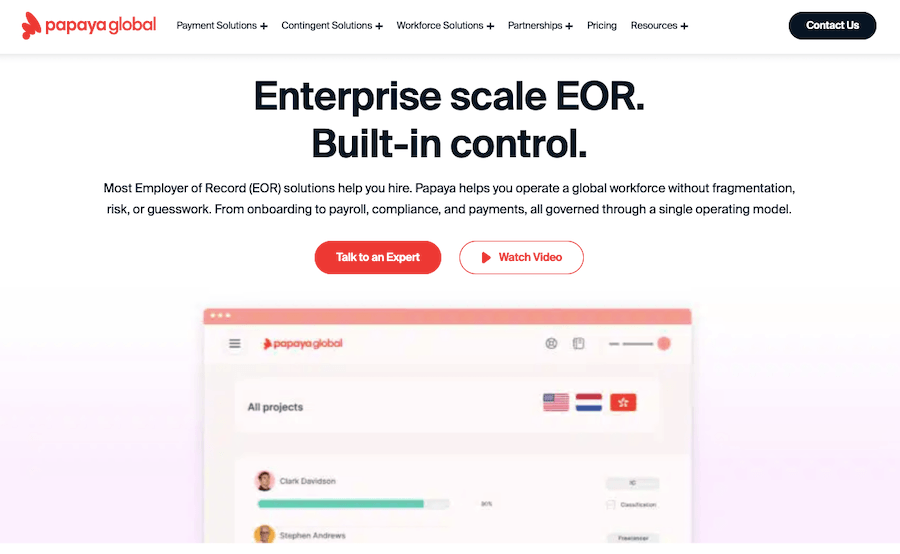
Papaya Global EOR

Multiplier vs. Papaya Global: Feature Comparison

FeatureMultiplierPapaya Global
Global Coverage150+ countries (EOR + contractors)160+ countries (EOR + payroll + contractors)
Platform TypeUnified global employment platformPayroll-first global workforce platform
Onboarding SpeedFast, self-serve (often a few days)Structured onboarding with compliance checks
Contractor SupportYes – fully self-serveYes – managed within platform
Payroll EngineCentralized, automated multi-country payrollStrong localized payroll with compliance layers
BenefitsStandardized global packagesCustomized, country-specific benefits
Compliance & IP ProtectionBuilt-in compliance workflows + IP protectionCompliance oversight with local expertise
UX / UIClean, modern, product-drivenFunctional, slightly more process-heavy
IntegrationsAPI + integrations (HR, finance tools)Integrations with ERP, HRIS, finance systems
Customer SupportDedicated manager + chat/email24/7 support + regional experts
PricingTransparent, per employee/contractorCustom pricing based on scope
Security CertificationsGDPR, SOC 2 alignedGDPR, ISO-aligned frameworks
ScalabilityIdeal for startups to mid-market scalingBuilt for mid-market to enterprise complexity

Where It Actually Feels Different

Onboarding & Time-to-Hire

With Multiplier, onboarding is quick and largely self-driven. You input details, generate contracts, and move forward without waiting on multiple approvals.

For a fast-moving team hiring across, say, Southeast Asia and Eastern Europe, this speed makes a difference. No bottlenecks. No chasing updates.

Papaya Global takes a more structured approach. There’s typically more validation, especially around compliance and payroll setup.

That slows things slightly, but it also reduces the risk of misclassification or payroll errors. If you’re operating in stricter jurisdictions, that trade-off can be worth it.

Payroll Execution

This is where Papaya Global really stands out.

Its payroll engine is deeply localized. It handles tax calculations, filings, and statutory nuances in a way that feels closer to traditional enterprise payroll systems. If you’ve ever dealt with multi-country payroll inconsistencies, you’ll appreciate that level of control.

Multiplier keeps payroll simpler and more centralized. It works well for standard employment setups, but it doesn’t go as deep into country-specific payroll complexity.

So the question becomes:
Do you need precision at a granular level, or consistency across regions?

Compliance & Risk Management

Both platforms cover compliance, but they approach it differently.

Multiplier embeds compliance directly into workflows. Contracts, IP protection, and employment terms are baked into the system. You don’t think about compliance as a separate step; it’s just part of the process.

Papaya Global feels more advisory. There’s stronger visibility into compliance checks, and often more human involvement in edge cases.

We’ve seen legal and finance teams prefer Papaya for this reason. It gives them confidence, especially when entering new markets.

User Experience & Daily Use

Multiplier is easier to navigate. The interface is clean, and most actions take fewer steps.

If your team values autonomy, this matters more than you’d expect.

Papaya Global is functional but slightly heavier. There are more steps, more checks, and more structured workflows.

It’s not friction for the sake of it. It’s there to support accuracy.
Still, some teams will feel the difference.

Support & Customer Experience

Here’s where the gap narrows.

Multiplier offers responsive support and a dedicated account manager. It’s efficient, but still largely product-driven.

Papaya Global leans harder into high-touch support. You’ll often interact with regional experts who understand local labor laws and payroll nuances.

And that shows up in retention. Users frequently stick with Papaya because of the support layer, not just the software.

Multiplier vs. Papaya Global: Editor’s Note

If you step back, the distinction is pretty clear.

Multiplier is built like a modern SaaS product. It assumes you want speed, visibility, and control. You log in, get things done, and move on.

Papaya Global feels closer to a hybrid between software and service. It’s not just about executing tasks, it’s about getting them right across different jurisdictions.

We’ve seen mid-sized, fast-scaling companies lean toward Multiplier because it keeps hiring friction low.

Meanwhile, enterprises or finance-heavy teams often prefer Papaya Global, especially when payroll complexity starts creeping in.

Neither approach is better across the board.
It depends on how much support you actually need.

Multiplier vs. Papaya Global: Final Recommendation

Choose Multiplier if you:

  • Want a fast, self-serve platform for global hiring
  • Prefer automation over manual coordination
  • Have an internal HR or ops team handling compliance oversight
  • Need to onboard talent quickly across multiple countries

Choose Papaya Global if you:

  • Need deep payroll accuracy across multiple jurisdictions
  • Value hands-on support and compliance guidance
  • Operate in complex regulatory environments
  • Want a more structured, risk-aware approach to global hiring

Verdict

If speed, control, and simplicity matter most, Multiplier has the edge. It’s built for teams that don’t want to wait around.

If your priority is payroll accuracy, compliance depth, and guided support, Papaya Global delivers more reassurance.

In the end, it’s not about which platform is better. It’s about how your team prefers to operate when things get complicated.


Multiplier vs. Papaya Global Comparison FAQs

Multiplier is built around speed and self-serve workflows, making it easier for internal teams to hire and manage employees without heavy external involvement. Papaya Global takes a more guided approach, combining software with hands-on support and compliance oversight. In practice, this means Multiplier feels faster, while Papaya Global feels more structured and support-driven.
Papaya Global generally offers stronger payroll depth, especially when dealing with country-specific tax rules, filings, and compliance requirements. Multiplier handles payroll efficiently for standard use cases, but Papaya Global goes further in terms of localization and financial precision, which becomes important for larger or more complex organizations.
In most cases, Multiplier is easier to use because of its clean interface and fewer steps for completing tasks like onboarding or payroll runs.
Multiplier is typically a better fit for startups and fast-growing companies that need to hire quickly across multiple countries without slowing down operations. Papaya Global is often chosen by more mature organizations that are willing to trade some speed for added compliance assurance and operational stability.
Papaya Global tends to align better with enterprise needs, particularly when payroll complexity, regulatory requirements, and internal governance are priorities. Multiplier can still support larger teams, but its strength lies in operational efficiency rather than deep enterprise-level payroll control.
Multiplier usually offers clearer, fixed pricing per employee or contractor, which makes it easier to forecast costs. Papaya Global follows a more customized pricing model based on services, regions, and complexity, which can be less predictable but more tailored to specific organizational needs.
Both platforms are designed to scale, but they do so differently. Multiplier scales well for companies that want to maintain speed and operational control as they expand. Papaya Global scales more comfortably in environments where complexity increases, especially in payroll and compliance management.

Our Comparison Methodology: How We Research & Evaluate

Every HR Stacks comparison is built on structured independent research — not sponsored placements or vendor influence.
Independent Research
No sponsored placements — affiliate links never affect our verdicts
Hands-On Product Testing
Demos, trials, and live walkthroughs — not marketing material
User Review Analysis
We analyze real user reviews in publicly available platforms
Feature Verification
Every claim verified against live platforms or official documentation
Pricing Transparency Check
Public pricing vs. sales-only costs — hidden fees flagged clearly
Compliance & Legal Assessment
How each platform handles local law, tax, and buyer risk exposure
Support Experience Evaluation
Response times, availability, and support model tested directly
Regular Content Updates
All comparisons reviewed periodically as products and pricing change
Source: HR Stacks Editorial Standards © HR Stacks
Manjuri Dutta
Article By: Manjuri Dutta

Manjuri Dutta is the co-founder and Content Editor of HR Stacks, a leading HR tech and workforce management review platform, and EmployerRecords.com, specializing in Employer-of-Record services for global hiring. She brings a thoughtful and expert voice to articles designed to inform HR leaders, practitioners, and tech buyers alike.

HR Stacks offers comprehensive, data focused and unbiased solutions. We may earn a referral fee when you visit a vendor through our links

Related Comparisons

Oyster HR Vs Papaya Global
Deel vs Remote Comparison

Deel vs Remote

Remofirst vs. Papaya Global Comparison

Remofirst vs. Papaya Global

Remofirst vs. Oyster HR

Remofirst vs. Oyster HR

Pebl Vs Remote

Pebl Vs Remote

Pebl Vs Rippling

Pebl Vs Rippling

Deel Vs Pebl

Deel Vs Pebl

Remofirst vs. Pebl

Remofirst vs. Pebl

This website uses cookies to enhance user experience and to analyze performance and traffic on our website. By continuing to browse this site you are agreeing to our use of cookies.