

Head-to-Head Comparison 2026
RemoFirst vs. Oyster HR: Which EOR Fits Your Hiring Plan?
Same 4.1/5 overall score, a $500 monthly price gap per employee, and two very different service models underneath.
Product A
RemoFirst
Budget-first EOR covering 180+ countries with EOR from $199/month.
Product B
Oyster HR
Compliance-first EOR and the only B Corp-certified platform in the category, from $699/month.
Choose RemoFirst if
Choose Oyster HR if
Both platforms land at 4.1/5 in our scoring, and that tie is misleading. We analyzed 530 RemoFirst reviews and 1,380+ Oyster HR reviews across public review platforms, and the two products earn that score in opposite ways.
RemoFirst wins on price. Its EOR plan starts at $199 per employee per month, the lowest published rate among the EOR platforms we track, and it scores 4.2/5 on pricing and value.
Oyster HR wins on depth. It charges $699 per employee per month, scores 4.5/5 on compliance strength, and remains the only B Corp-certified EOR on the market.
The $500 monthly gap per employee is the real decision point. This comparison shows exactly what that money buys, and when it isn’t worth paying.
Company Profile
RemoFirst
Lean, budget-first EOR built by Remofirst, Inc.
Company Profile
Oyster HR
B Corp-certified global employment platform by Oyster HR Inc.
Remofirst vs. Oyster HR: Product Overview
These two platforms solve the same problem, hiring internationally without setting up local entities, but they are built around different priorities.
RemoFirst optimizes for speed and cost. Oyster HR optimizes for compliance depth and service quality. Where you land depends on how much complexity you are actually dealing with.
About Remofirst
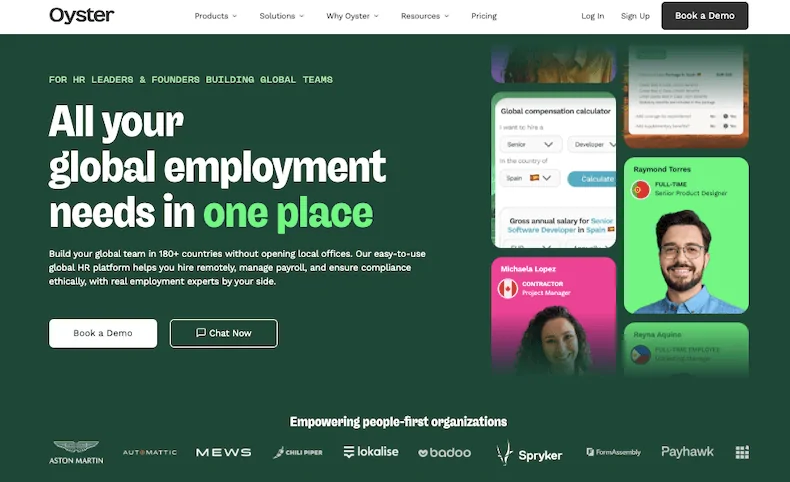
RemoFirst launched in 2021 with a clear positioning: make international hiring affordable for companies that can’t justify $500+ per employee per month. Its EOR plan starts at $199, contractor management at $25, and the platform covers 180+ countries through a partner network.
The interface is intentionally lean. Onboarding moves fast, payroll runs reliably in straightforward markets, and the pricing is transparent with no setup fees. The trade-off is visible at the edges: limited native integrations, standardized benefits packages, and support that works well for routine queries but can slow down on complex compliance questions.

About Oyster HR
Oyster HR was founded in 2020 and has raised $286 million, reaching a reported $1.2 billion valuation. It is the only B Corp-certified EOR on the market, and that distinction shapes the entire product.
EOR starts at $699 per employee per month, covering 180+ countries with 120+ through its Direct+ owned infrastructure. Every account gets a dedicated CSM. Compliance certifications include SOC 2, GDPR, ISO 27001, and Oyster Shell misclassification protection up to $500K.
The documented weak points are the highest base price in the category, partner-dependent APAC coverage, and payroll invoices that are hard to reconcile month to month.
Quick Facts: RemoFirst vs. Oyster HR
RemoFirst vs. Oyster HR: Rating Comparison
Both products score 4.1/5 overall, but the parameter breakdown tells a more useful story. RemoFirst scores higher on pricing and value (4.2 vs 3.4) by a significant margin. Oyster HR leads on compliance strength (4.5 vs 4.1), ease of use (4.5 vs 4.1), and customer support (4.2 vs 3.9).
The two products tie on global coverage (4.3 each) and are separated by just 0.1 on payroll and benefits. Integrations is the weakest category for both.
Editor’s Rating Breakdown
RemoFirst vs. Oyster HR: Parameter Scores
RemoFirst vs. Oyster HR: Pricing
Pricing is where this comparison makes its clearest statement. RemoFirst’s EOR plan starts at $199 per employee per month. Oyster HR starts at $699. That $500 gap compounds fast at any meaningful headcount. Both platforms publish their rates openly and charge no setup or offboarding fees, which is still uncommon in this category.
Contractor pricing is closer: $25 per month with RemoFirst against $29 with Oyster HR. The model difference matters too: RemoFirst charges a flat rate while Oyster’s total cost varies with employer taxes and statutory contributions layered on top.
Pricing Comparison
RemoFirst vs. Oyster HR: Plans & Costs
Both platforms publish pricing openly and charge no setup or offboarding fees. RemoFirst uses flat-rate billing. Oyster HR’s total monthly cost varies — employer taxes, statutory contributions, and optional benefits layer on top of the base plan fee.
Contractor payments and management in 150+ countries. Includes compliance, local contracts, and multi-currency payouts.
Full EOR coverage in 180+ countries. Includes payroll, compliance, benefits administration, and onboarding support. No setup fee.
Add-on international health insurance for employees hired through RemoFirst. Available in select countries.
Instant contracts in 180+ countries. Includes identity verification, invoice management, misclassification analyzer, and Oyster Shell protection. First 30 days free.
Full EOR in 180+ countries via Direct+ infrastructure. Includes compliant contracts, payroll, statutory benefits, dedicated CSM, and onboarding specialists. Annual discounts available.
Consolidated payroll for companies with existing local entities. Covers automated calculations, local payroll experts, and HR tech integrations.
Co-employment across all US states. Covers payroll, benefits, HR admin, and compliance. Useful for teams managing both domestic and global headcount under one vendor.
Project-based HR advisory from senior Oyster experts. Covers people strategy, complex employment situations, and hands-on execution for lean HR teams.
RemoFirst vs. Oyster HR: Pros & Cons
No EOR platform is without trade-offs, and these two make that especially clear. RemoFirst’s strengths are almost entirely about cost and speed.
Oyster HR’s strengths are almost entirely about depth and service quality. The weaknesses on both sides are consistent across review platforms and worth taking at face value.
Strengths & Limitations
RemoFirst vs. Oyster HR: Pros & Cons
Lowest published EOR rate
At $199/month, RemoFirst scores 4.2/5 on pricing — the highest value rating in this comparison by a significant margin.
Fast international onboarding
Users consistently report same-day to next-day onboarding in standard markets, with minimal back-and-forth during setup.
Transparent, flat-rate billing
No setup fees, no offboarding fees, and no variable cost surprises — reviewers cite predictable invoices as a clear operational advantage.
Clean, intuitive platform
G2 reviewers rate ease of setup and navigation highly; non-HR admins get up to speed without training.
Reliable payroll in standard markets
Payroll execution is consistent across straightforward hiring markets, with timely local-currency payments cited across 530 analyzed reviews.
Limited native integrations
Scores 3.8/5 on integrations; reviewers frequently flag missing connectors for common HRIS and finance tools, leading to manual data handling.
Standardized benefits packages
Benefits flexibility is limited; companies hiring competitive senior talent find the offering too rigid to customize meaningfully by region.
Support slows on complex cases
Basic queries resolve quickly, but compliance questions in edge-case jurisdictions regularly surface as a pain point across G2 and Capterra reviews.
Only B Corp-certified EOR
No competitor holds B Corp certification — for procurement teams and mission-driven organizations, that is third-party verified, not self-reported.
48-hour onboarding across 180+ countries
Automated contracts, e-signatures, and payroll activation in one flow; G2 reviewers consistently validate the speed claim across multiple markets simultaneously.
Dedicated CSM on every account
One named contact from day one, praised across 1,040+ G2 reviews as the single biggest reason teams stay with Oyster long-term.
No setup or offboarding fees
Published rates, refundable deposit, nothing hidden — reviewers switching from quote-gated EORs consistently flag this as a meaningful differentiator.
Oyster Shell misclassification cover
Financial protection up to $500K for contractor misclassification — no other EOR in this comparison backs compliance with a financial guarantee.
Highest base price in category
At $699/month, Oyster costs $500 more per employee than RemoFirst and $100 more than Deel — the most unprompted complaint across all three review platforms.
APAC coverage runs through partners
Tripartite employment arrangements in parts of Asia-Pacific slow communications and reduce direct accountability; reviewers hiring primarily in APAC flag this consistently.
First-line support is inconsistent
Generic support often cannot resolve issues without CSM escalation — one Sr. Director of People Ops called it “hard on me and unfair to them.”
Payroll variance hard to forecast
Month-to-month invoice fluctuations frustrate finance teams; at $699 per head, unpredictable totals create real budget forecasting friction across Capterra reviews.
RemoFirst vs. Oyster HR: Top Features
The core EOR feature set overlaps significantly between these two platforms. The differences show up in depth, not breadth. Oyster HR adds compliance infrastructure, localized benefits, and a more guided platform experience. RemoFirst covers the essentials cleanly and at a fraction of the cost. The table below maps where each product leads, matches, or trails.
Feature Breakdown
RemoFirst vs. Oyster HR: Feature Comparison
RemoFirst vs. Oyster HR: Key Differences
The feature table shows what each platform covers. This section focuses on where the gap between them is wide enough to actually change a buying decision. Every point below is backed by a specific score, certification, price figure, or documented review pattern rather than a general impression.
What Sets Them Apart
RemoFirst vs. Oyster HR: Key Differences
EOR starts at $199 vs. Oyster’s $699. For a team of 10 employees, that is a $5,000 monthly difference before any add-ons.
B Lab independently audits and certifies Oyster’s governance, labor practices, and social impact standards. No other EOR in this comparison holds this certification.
RemoFirst scores 0.8 points higher than Oyster on pricing and value (4.2 vs. 3.4) — the widest gap of any parameter in this comparison.
Oyster backs contractor compliance with a financial guarantee up to $500K through Oyster Shell. RemoFirst offers compliance guidance but no equivalent financial protection.
RemoFirst charges a flat $199 per employee. Oyster’s total monthly cost varies with employer taxes and statutory contributions, which Capterra reviewers flag as a budget forecasting problem.
Every Oyster EOR account gets a named Customer Success Manager from day one. RemoFirst provides email and chat support but no equivalent dedicated contact model.
RemoFirst’s contractor plan is $4 cheaper per head than Oyster’s $29 rate and covers 150+ countries with local contracts and multi-currency payouts.
Oyster scores 4.5/5 on both compliance strength and ease of use, against RemoFirst’s 4.1/5 on each. It also holds G2 Easiest Admin Mid-Market recognition for Spring 2026.
International health insurance is available as a standalone add-on for $55 per employee per month, giving budget-conscious teams a modular benefits option without mandatory bundling.
Oyster’s built-in benchmarking tool covers compensation data for 130+ countries. RemoFirst has no equivalent feature, which matters when building competitive offers in unfamiliar markets.
RemoFirst vs. Oyster HR: Use Cases
Choosing between these two platforms is less about which is better overall and more about which fits your situation right now. Company stage, hiring geography, headcount trajectory, and budget constraints all shift the answer. The four scenarios below cover the most common decision points we see among EOR buyers, with a specific verdict on each.
Early-stage startup making first international hires on a tight budget
At $199 per employee per month versus Oyster’s $699, RemoFirst saves a 10-person team $60,000 annually on platform fees alone. For straightforward hiring markets where the compliance requirements are well-understood, the added depth Oyster provides does not justify that gap. RemoFirst scores 4.2/5 on pricing and value, and its fast onboarding means roles can be filled without weeks of setup.
Mid-market company hiring full-time employees across Europe with compliance accountability
All four markets sit inside Oyster’s Direct+ infrastructure, meaning full compliance accountability with no partner chain in the middle. Oyster scores 4.5/5 on compliance strength and holds G2 Europe Regional Leader recognition for Spring 2026. For companies hiring senior full-time roles in markets like Germany where employment law is strict and termination rules are non-trivial, the dedicated CSM model and localized benefits depth are worth the premium over RemoFirst’s partner-based approach.
Growth-stage company hiring across both budget-friendly and compliance-heavy markets simultaneously
RemoFirst handles Southeast Asia cost-effectively at $199 per head, but its partner-based compliance model and 4.1/5 compliance score become a real consideration when the same team is hiring in Germany or France where labor law is strict. Oyster’s Direct+ coverage in Western Europe and 4.5/5 compliance score reduce risk in those markets meaningfully. The honest answer here is that the right platform depends on which market carries the higher legal exposure for your specific roles.
Company converting an existing contractor base to full-time employment at scale
Oyster’s contractor-to-employee conversion pathway is built directly into the platform with no new contract cycle required and no vendor switch. Oyster Shell adds $500K misclassification protection during the transition period, which no competitor in this comparison matches financially. RemoFirst supports contractor management at $25 per head and handles basic conversions, but the absence of a financial misclassification guarantee is a meaningful gap when converting at scale across multiple jurisdictions.
RemoFirst vs. Oyster HR: User Sentiment
Our analysis covers 530 RemoFirst reviews and 1,380+ Oyster HR reviews across G2, Capterra, and Trustpilot. The volume difference is worth noting: Oyster’s review base is more than 2.5 times larger, which gives its sentiment patterns more statistical weight.
Both products show consistent positive and negative themes across platforms, which is generally a sign that the feedback reflects real usage rather than outlier experiences.
User Sentiment Analysis
RemoFirst vs. Oyster HR: What Reviewers Say
The $199 EOR rate is the most cited reason users choose and stay with RemoFirst. Reviewers consistently describe it as the most affordable option they evaluated.
Users praise same-day to next-day onboarding in standard markets. The setup process is described as straightforward, with live support available during initial configuration.
G2 reviewers consistently rate the support team highly for speed and patience on standard questions, especially during the onboarding phase.
The interface scores well for simplicity. Non-HR users report being able to manage payroll and documents without training or IT involvement.
Missed payment dates and salary discrepancies appear most frequently in reviews from companies managing 30 or more employees across multiple countries simultaneously.
Reviewers managing hiring in high-complexity jurisdictions report slower resolution times and less confident answers compared to the experience during standard onboarding.
The limited native connector library means finance and HR teams frequently handle data transfers manually, which shows up as a recurring frustration across G2 and Capterra.
G2 and Capterra reviewers from 2025 to 2026 report instances of outdated contract templates and salary calculation errors that required manual correction before signing.
A named point of contact who knows the account is the most consistently praised aspect of Oyster across all three platforms. Reviewers name their CSMs specifically and credit them with resolving complex situations quickly.
Multiple reviewers document going from zero to payroll-active across multiple countries simultaneously without friction. The speed claim holds up across G2 and Capterra independently.
Reviewers switching from quote-gated EOR providers consistently highlight Oyster’s published rates as a meaningful differentiator. What is listed is what gets charged for the platform fee.
G2 awarded Oyster Easiest Admin Mid-Market for Spring 2026. Non-HR admins navigate expenses, time-off, and documents without support tickets, which shows up unprompted across Capterra reviews.
The most unprompted complaint across all three platforms. Reviewers with growing headcounts describe the cost compounding fast, particularly when comparing against Multiplier at $400 or RemoFirst at $199.
Tripartite employment arrangements in parts of Asia-Pacific slow communication and reduce accountability. Reviewers hiring primarily in APAC flag this more than any other region-specific issue.
Generic support frequently cannot resolve issues independently. One Sr. Director of People Ops described needing CSM involvement for routine queries as hard on both sides of the relationship.
Finance teams at Capterra describe significant month-to-month fluctuation in what is owed, and the platform’s reporting does not make reconciliation straightforward at $699 per head.
RemoFirst vs. Oyster HR: Final Verdict
These two platforms share an overall score of 4.1/5, but they earn it in ways that point to completely different buyers.
RemoFirst wins on price, speed, and simplicity. At $199 per employee per month, it is the most affordable EOR option we track, and it delivers on the core promise: hire internationally, run payroll, stay compliant, without heavy process or overhead.
For startups and lean teams testing new markets, that is often all that is needed. The trade-offs, limited integrations, standardized benefits, and partner-dependent compliance, become relevant only when complexity increases.
Oyster HR wins on compliance depth, service quality, and employee experience. The B Corp certification, Oyster Shell misclassification cover, dedicated CSMs, and Direct+ European infrastructure are genuine differentiators backed by 1,380+ reviews.
At $699 per employee per month, it is a deliberate purchase. For mid-market companies hiring full-time employees across Europe, or teams converting contractors at scale, that premium is defensible. For budget-first buyers, it is not.
Frequently Asked Questions
RemoFirst vs. Oyster HR: FAQs
Yes, significantly. RemoFirst starts at $199 per employee per month for EOR services. Oyster HR starts at $699. That is a $500 gap per employee per month, which compounds to $6,000 per employee annually before any add-ons or benefits.
The price difference reflects two different service models. RemoFirst keeps costs low by running a lean platform, relying on a partner network for local compliance, and offering standardized benefits packages. Oyster HR charges more because it builds in a dedicated Customer Success Manager on every account, Direct+ owned infrastructure across 120+ countries, B Corp certification, Oyster Shell misclassification protection up to $500,000, and country-tailored benefits with salary benchmarking across 130+ countries.
For budget-first buyers, RemoFirst delivers the core EOR job at a fraction of the cost. For teams that need the compliance depth and service model Oyster provides, the premium is defensible.
Oyster HR is stronger on compliance by a measurable margin. It scores 4.5/5 on compliance strength in our analysis versus RemoFirst’s 4.1/5. Oyster holds SOC 2, GDPR, and ISO 27001 certifications, is the only B Corp-certified EOR on the market, and backs contractor compliance with Oyster Shell financial protection up to $500,000.
RemoFirst holds SOC 2 certification and handles compliance through a partner network across 180+ countries. That model works well in straightforward markets. Where it shows its limits is in high-complexity jurisdictions like Germany, Brazil, or France, where the absence of direct-scope infrastructure can mean less visibility into local employment requirements.
It depends on the buyer. For most companies making a pure cost or feature decision, B Corp certification does not change the outcome. For mission-driven organizations, nonprofits, impact-first companies, or procurement teams that vet vendors against ESG or ethics standards, it carries real weight.
B Corp certification is independently audited by B Lab, not self-reported. It verifies governance practices, labor standards, and social and environmental accountability at a third-party level. Oyster is the only EOR on the market that holds this certification. If your company holds or pursues B Corp status itself, vendor alignment becomes a genuine factor rather than a preference.
Both platforms support contractor-to-employee conversions, but the experience is meaningfully different. Oyster HR has a built-in conversion pathway that requires no new contract cycle and no vendor switch. The transition happens inside the same platform, and Oyster Shell adds misclassification protection up to $500,000 during the conversion period.
RemoFirst supports contractor management at $25 per contractor per month and can handle conversions, but there is no equivalent financial misclassification guarantee. For companies converting at scale across multiple jurisdictions where misclassification exposure is a real legal risk, Oyster’s built-in pathway and financial backing make it the stronger choice.
Oyster HR is the stronger choice for European hiring. Its Direct+ infrastructure covers the UK, Germany, France, Netherlands, Spain, Portugal, and Poland with full compliance accountability and no partner chain in the middle. Oyster holds G2 Europe Regional Leader recognition for Spring 2026 and scores 4.5/5 on compliance strength.
RemoFirst covers European markets through its partner network and scores 4.1/5 on compliance. For hiring in markets like Germany where employment law governs termination rights, notice periods, and works council obligations, the difference between direct-scope and partner-based coverage is not trivial.
Oyster Shell is a contractor misclassification protection program that covers financial liability up to $500,000. When a company hires contractors through Oyster and a misclassification claim arises, Oyster Shell provides a financial backstop at that level. It also includes a built-in misclassification analyzer inside the contractor management workflow.
RemoFirst does not have an equivalent program. It provides compliance guidance on contractor classification through its partner network, but there is no financial guarantee attached. For companies with a large contractor base or those converting contractors to full-time employees across multiple jurisdictions, Oyster Shell is a specific and financially material differentiator.
Some do, but it is not a universal pattern. The switch tends to happen when one or more of three things changes: the company starts hiring in markets with stricter labor laws where partner-based compliance creates real risk, headcount grows to the point where standardized benefits are no longer competitive for the talent being hired, or the HR team needs more structured support than email and chat can provide.
RemoFirst works well for early-stage companies and continues to work well for teams whose hiring stays in straightforward markets. The move to Oyster is less about hitting a feature limit and more about the compliance and service requirements that come with organizational maturity. Most teams that switch do so because their situation changed, not because RemoFirst stopped working.