


HR Tech global market worth about $42.5 billion in 2025-26, and for many organizations it now sits at the center of how they hire, pay, manage, and retain people. Adoption is already high; roughly 85% of organizations use some form of HR technology, and core tools like payroll reach around 93% penetration. On the surface, it looks like HR’s digital transformation is well underway.
But the numbers tell a more nuanced story. Even with widespread adoption, only about 35% of HR leaders say their technology is clearly helping achieve business goals.
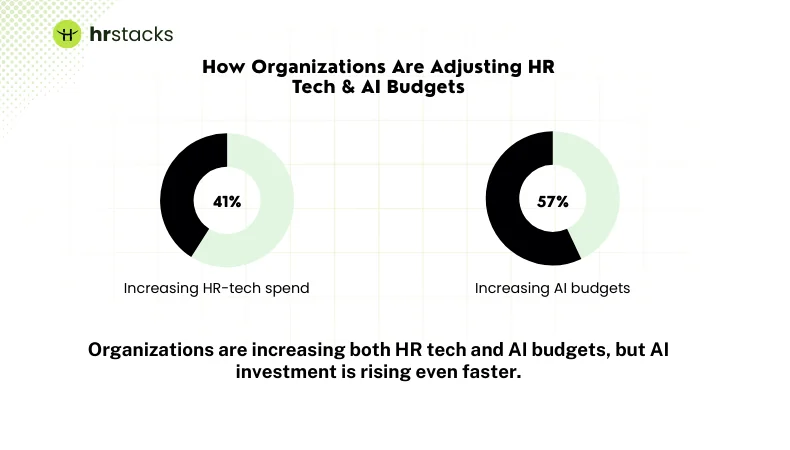
At the same time, 41% of organizations plan to increase HR tech spending, and AI budgets are rising fast, despite the fact that only a minority of HR teams have fully embedded AI into daily workflows. In other words, companies are still investing, but many are not yet confident they’re getting full value.
That tension between spending, adoption, and real impact is exactly why these statistics matter. They show which tools are now baseline, where priorities are shifting, and where gaps remain between owning technology and using it well. For HR leaders, founders, and decision makers, these figures offer more than trivia; they provide benchmarks for planning, budgeting, and setting realistic expectations.
This article compiles current HR tech spending and adoption statistics in one place, organized by market size, usage, AI, payroll, and value realization. Whether you’re evaluating vendors, defending a budget, or mapping your HR roadmap, these numbers give you a clearer view of where the market actually stands and where it’s heading next.
Important Stats: At a Glance
- Global HR-tech market (2025): $42.5B. Market analysts estimate HR tech at $42.5 billion in 2025-26, with strong growth to 2030.
- HR analytics market (2025): $5.03B. Specialist analytics tools are a distinct multibillion-dollar segment.
- 85% of organizations use HR technology. Adoption climbs with company size (≈79% of small firms → ≈90% of mid/large).
- Payroll system penetration: 93%. Payroll is essentially universal among survey respondents.
- Only 35% of HR leaders say their HR-tech approach helps business goals. A huge gap between ownership and impact.
- Generative / workplace AI: wide interest, lower current usage. Many leaders prioritize AI even while fewer teams use it broadly today.
Global HR Tech Market Expected To Reach $42.5 Billion
Mordor Intelligence values the global HR-technology market at $42.5 billion in 2025 and forecasts a 12.8% CAGR through 2030.
The projection reflects accelerating cloud migration, modular SaaS adoption, and AI embedded across talent, payroll, and analytics toolsets. Enterprises prioritize platforms that unify workflows, enable faster deployments, and deliver measurable HR outcomes such as reduced time-to-hire and lower turnover.
Vendors that couple strong APIs, prebuilt integrations, and professional services to drive adoption tend to capture procurement attention and procurement dollars. Source: Mordor Intelligence
HR Analytics Market: $5.03B (2025, Mordor Intelligence)
Mordor sizes HR analytics at roughly $5.03 billion in 2025, propelled by demand for real-time dashboards, predictive attrition models, and strategic workforce planning.
Organizations invest to shorten time-to-hire, forecast talent gaps, and optimize internal mobility decisions. Vendors are adding predictive capabilities, low-code data pipelines, and natural-language reporting to democratize insights.
The market’s growth reflects rising data maturity and demand for actionable analytics that map directly to retention, hiring efficiency, and workforce cost optimization.
HR Tech Market Forecasts Vary Widely By Methodology
Market estimates diverge: IMARC places HR-tech near $36 billion in 2024 while Fortune Business Insights projects $69.6 billion by 2033.
The spread stems from methodological choices, whether adjacent services (benefits administration, staffing services), regional coverage, or professional services are included, and from differing time horizons and revenue definitions.
For strategists, parsing each report’s scope is essential: some measure pure software license revenue, others fold in services and managed offerings. This affects competitor benchmarking, go-to-market focus, and investment models.
Applicant Tracking Systems Market Around $17 Billion
Applicant tracking systems are a meaningful market, roughly $17-17.2 billion in 2025 with an 8.5% CAGR to 2032.
Demand is driven by persistent volume hiring, the need for pipeline automation, and analytics that identify sourcing bottlenecks and reduce time-to-hire. Vendors differentiate on candidate experience, integrations with assessment and HRIS platforms, enterprise scalability, and compliance features.
Enterprises increasingly require bias-mitigation controls, audit trails, and configurable workflows so ATS vendors must provide robust APIs, data governance, and measurable hiring outcomes. Source: Fortune Business Insights
41% Of Organizations Plan To Increase HR-Tech Spending
Approximately 41% of organizations plan to increase HR-tech spend in 2025, signaling sustained market demand tempered by procurement scrutiny.
Buyers now insist on well-defined KPIs, staged pilots, and governance frameworks to de-risk purchases. Practical procurement favors pilots with measurable outcomes rather than full rollouts without evidence.
Vendors that provide modular pricing, implementation support, and clear ROI measurements, plus roadmaps for integration and change management, are most likely to convert pilot success into enterprise agreements and long-term adoption. Source: People Matters
57% Report AI Budget Growth
Organizations are increasing AI budgets in 2025 to invest in model licensing, data engineering, and governance needed to operationalize ML responsibly.
HR teams allocate funds toward sourcing automation, predictive attrition modeling, talent-matching, and personalized learning experiences. With budget growth comes heightened expectations for transparency on data lineage, bias mitigation, and measurable business outcomes.
Vendors that surface explainability, secure data pipelines, and practicable governance frameworks stand a better chance of adoption by cautious procurement and legal teams. Source: TrustRadius
Global IT Spend Expected To Hit $5.43T
Global IT expenditure is projected near $5.43 trillion in 2025, enlarging available funding but intensifying competition across functions.
HR leaders must therefore frame HR-tech initiatives as enterprise priorities, quantifying cross-functional benefits such as finance reconciliation savings, operational productivity gains, or compliance risk reduction.
Winning budget increasingly requires pilot evidence, strong integration plans with IT and finance, and demonstrable ROI. Vendors benefit when they position HR projects as enterprise transformation efforts rather than isolated point solutions.
Applicant Tracking Systems (Fortune 500 – 97.8%)
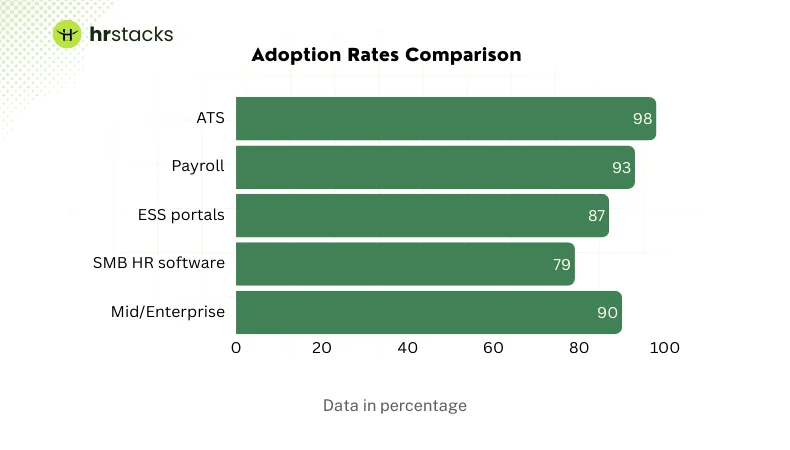
By 2025, roughly 97.8% of Fortune 500 companies use a detectable ATS, making applicant tracking a baseline enterprise capability.
ATS platforms now orchestrate high-volume hiring, employer-brand touchpoints, and compliance recordkeeping across jurisdictions. Their ubiquity forces innovation on candidate experience, bias mitigation, and enterprise integrations with HRIS, background check vendors, and assessment providers.
Procurement expects mature reporting, audit trails, and SLAs, so ATS vendors must deliver enterprise-grade reliability, configurability, and professional services to support complex implementations. Source: Jobscan
Payroll Adoption (93%)
Payroll technology is nearly universal, about 93% adoption, shifting focus from possession to orchestration. Organizations judge payroll by how well it integrates with benefits administration, time and attendance systems, tax engines, and ERP finance workflows.
Expectations include automated tax-compliance updates, multi-jurisdiction consolidation, and APIs for real-time reconciliation.
Vendors that reduce manual intervention, lower error rates, and deliver auditable runs with configurable controls become strategic partners rather than commodity providers, especially for multinational employers balancing localization and standardization.
Employee Self-Service Portals (87.3%)
Employee self-service portals are mainstream: roughly 87% of U.S. workers can access pay, benefits, and personal HR records online.
ESS reduces routine HR inquiries, accelerates transactional processes like benefits enrollment, and empowers employees with on-demand transparency. High-value ESS implementations combine mobile access, single sign-on, clear UX, and secure identity controls to lower HR workload and improve satisfaction.
Organizations see ESS adoption correlate with fewer administrative tickets and improved employee experience metrics when portals are well integrated with back-end payroll and HRIS systems. Source: HR Dive
Analytics Usage Is Uneven
Possessing analytics modules does not equal effective use: adoption quality is uneven across organizations. Smaller firms often underutilize embedded reporting, while only a subset of enterprises exploit advanced analytics fully.
Common blockers include fragmented data sources, weak governance, and dashboards designed without stakeholder input. Consequently, HR teams frequently export data to external BI tools for deeper analysis.
Realizing analytics value requires data inventory, hygiene, role-based dashboards, and investment in analytics literacy so insights translate into operational decisions. Source: Oracle
Spreadsheets Remain Central
Despite modern HR platforms, spreadsheets remain central: over half of HR teams still use Excel or Sheets for reporting and ad-hoc analysis.
Their flexibility and ubiquity make them practical for bridging system gaps and rapid hypothesis testing. However, long-term reliance introduces versioning, auditability, and security risks.
Best practice treats spreadsheets as temporary orchestration layers with governance controls, migrating repeatable, high-risk processes into integrated reporting, automated pipelines, or low-code analytics to reduce manual effort and data integrity issues. Source: Crunchr
HR Leaders Say AI Is A Priority; Reported Usage Trails Intent
AI has become a clear strategic priority among HR leaders, yet real deployments trail intent. Surveys show many professionals elevating AI on their agendas while fewer have operationalized it in production workflows.
Causes include data readiness gaps, governance concerns, and resistance to changing decision processes.
Bridging the ambition-execution gap requires small, measurable pilots, explicit KPIs, governance committees, and vendor partners who prioritize explainability, privacy safeguards, and human-in-the-loop designs to build trust and scale responsibly. Source: SHRM
Generative AI At Work: ~75% Of Knowledge Workers Using It
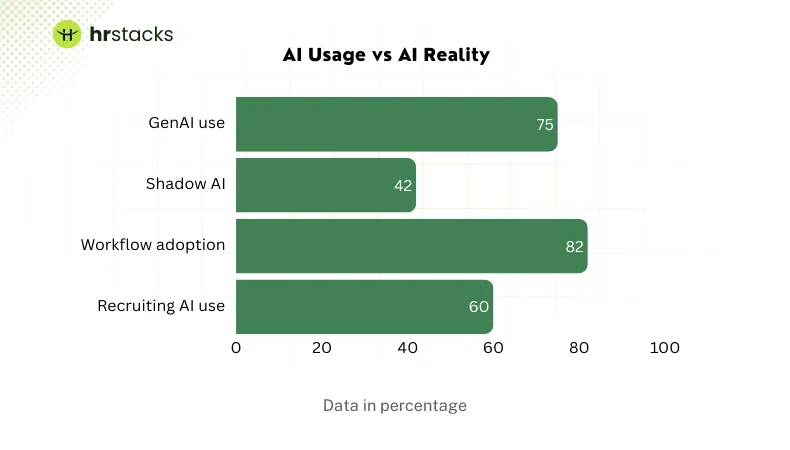
Studies indicate about 75% of knowledge workers now use generative AI in their roles, with rapid adoption in the prior months for drafting, summarization, and coding.
This proliferation boosts productivity but raises concerns around data governance, IP, and information security. HR must update acceptable-use policies, provide sanctioned tools, and train employees on safe prompts and data handling.
Vendors that offer enterprise controls, audit logs, and model-safety features will be favored as organizations seek productivity gains without compromising compliance. Source: Microsoft
Practical TA Uses: ATS Functions, Seeing 40-80% AI Use
In talent acquisition, AI proves most effective for operational tasks, writing job descriptions, initial resume screening, candidate outreach, scheduling, and screening triage.
Surveyed adoption ranges from 40% to 80% depending on region and function, because these tasks scale and produce quick ROI. The practical benefits include faster time-to-fill and greater recruiter throughput, but organizations must maintain human oversight to check for bias and false negatives.
ROI is optimized when AI automates repetitive tasks and recruiters focus on high-value candidate engagement.
Only 28% of HR Teams Report Using Generative AI In Workflows
Despite heavy interest, only about 28% of HR teams say generative AI is embedded in everyday workflows.
Barriers include integration complexity, concerns about handling sensitive employee data, and limited internal expertise for model governance.
Successful adoption needs secure APIs, privacy-first configurations, access controls, and measurable KPIs linked to outcomes like reduced recruiter hours or faster onboarding. Organizations that pair pilots with training and governance are more likely to scale pilots into operational tools that deliver sustained value. Source: UNLEASH
Shadow AI: Employees Using AI Quietly, Governance Risk
Shadow AI is widespread: studies report roughly 42% of workers using external AI tools at work, with a significant share doing so covertly.
Unmanaged usage risks data leakage, privacy violations, and regulatory exposure when sensitive HR or customer data is processed outside sanctioned systems. Mitigation requires collaboration between HR and IT to detect shadow use, implement clear acceptable-use policies, and offer approved, secure alternatives with training.
Monitoring, employee education, and simpler sanctioned tooling reduce the incentive to use unauthorized tools. Source: Axios
ATS And Screening Automation Are Omnipresent At Scale
At enterprise scale, ATS platforms coupled with automated screening and outreach have become standard. Large employers layer AI-assisted parsing, scoring, and messaging on top of ATS workflows to triage thousands of applicants efficiently.
This reduces manual inbox sorting and speeds candidate movement through the funnel, but mandates continuous validation to avoid bias and false negatives.
Best practice includes human review checkpoints, routine model testing, and transparent scoring so organizations balance velocity with fairness and quality of hire.
AI In Recruiting: Usage Ranges From 40 % Up To 80 %, Depending On Task And Region
AI adoption in recruiting varies by task and geography, spanning roughly 40% to 80%. Regions with higher HR-tech investment and better data maturity tend to adopt faster, especially for repeatable tasks like ad drafting, resume screening, and outreach personalization.
Strategic activities such as candidate assessment and relationship building remain primarily human. The most effective deployments combine AI for repetitive work with human judgment for selection, and prioritize monitoring for bias and compliance across different regulatory environments. Source: boterview.com
Unified Global Payroll Systems Rising
Consolidation toward unified global payroll providers is increasing, with adoption moving from roughly 44% to about 57% year-over-year.
Centralized payroll simplifies reconciliation, standardizes reporting across jurisdictions, and streamlines vendor management for multinational employers. However, consolidation requires providers to offer strong localization, tax rules, statutory reporting, and country-specific calculations, and robust data protection.
Multinationals weigh the trade-off between administrative simplicity and the need for local specificity when choosing global payroll partners. Source: Lano
Payroll Automation And Compliance Still Top Priorities
Payroll automation and compliance remain top organizational priorities as firms seek higher accuracy and auditability.
While cloud-based payroll reduces manual tasks, many organizations still struggle to maintain accuracy above 90%, underscoring the need for validation controls, embedded tax engines, and continuous regulatory updates.
Vendors that provide end-to-end automation, real-time reconciliation, and compliance workflows address core pain points. Continuous testing, scenario audits, and strong documentation are critical for minimizing payroll exceptions and regulatory exposure. Source: PayrollOrg
Only About 24% Of HR Leaders Say They’re Getting Full Value From Their HR Tech Investments
Only about 24% of HR leaders report they are getting full value from HR-tech investments, pointing to a major delivery gap.
Typical causes include poor adoption, misaligned vendor selection, weak executive sponsorship, and insufficient post-implementation optimization. To lift value realization, organizations should prioritize consolidating platforms, define measurable KPIs, invest in adoption programs, and reallocate budget toward high-impact integrations.
Vendors offering professional services and continuous optimization support are better positioned to help clients realize sustained value. Source: SHRM
Between 25% And 60% Of Respondents Say Their HR Tech Rollouts Failed To Meet Expectations.
Surveys indicate 25%–60% of HR-tech rollouts fall short of expectations due to missed timelines, cost overruns, low user adoption, and data migration issues.
Common failure drivers include limited stakeholder alignment, underinvestment in change management, and unclear success criteria. Recovery typically involves staged re-prioritization, formation of governance boards, renewed executive sponsorship, and vendor accountability for integration and adoption milestones.
Planning for behavioral change and allocating budget for training are essential to turn rollouts into measurable outcomes. Source: Taap
Skills Gaps & AI Upskilling (ETHRWorld, 58%)
Around 58% of L&D leaders cite widening skills gaps and slow AI deployment as top concerns. Addressing these gaps requires role-based reskilling initiatives, micro-learning, and certification tracks that align with business outcomes.
Effective programs blend hands-on practice, mentorship, and competency assessments tied to measurable performance improvements.
Vendors that integrate personalized learning journeys, skills assessments, and demonstrable learning transfer help organizations accelerate AI adoption and close critical capability shortfalls across teams. Source: The Times of India
AI In Learning & Coaching (Betterworks)
Vendor research indicates AI can meaningfully personalize learning and coaching, auto-generated practice scenarios, adaptive learning paths, and targeted coaching nudges, but benefits depend on design.
Overreliance on automation can erode human mentorship and contextual nuance. Best practice pairs AI recommendations with manager-led coaching, continuous feedback loops, and explicit measures of learning transfer to the job.
When combined, AI and human coaching accelerate capability development while preserving the relational and contextual aspects of learning. Source: Betterworks
Small-Business Adoption (65-79%)
Small-business adoption of HR software ranges between roughly 65% and 79% depending on survey definitions. SMBs prioritize payroll, compliance, and simple onboarding automation but may delay investment due to cost or limited IT capacity.
Low-touch, modular SaaS packages with guided onboarding and prebuilt integrations lower the barrier to entry. For vendors, the SMB opportunity centers on clear pricing, minimal implementation friction, and bundled services that minimize time to value for resource-constrained founders and HR generalists. Source: HiBob
Mid-Market & Enterprise Adoption (90%+)
For mid-market and enterprise organizations, HR software adoption exceeds 90% for core modules such as payroll, ATS, and HRIS.
The strategic challenge shifts from buying to integrating, governing, and extracting measurable outcomes across finance, IT, and HR.
Buyers demand enterprise capabilities; SSO, role-based access, SLAs, and professional services for change management, and focus on unifying data flows to enable strategic workforce planning. Value is captured through improved process efficiency, compliance, and better decisioning enabled by integrated data.
Payroll & Compliance Lead Feature-Demand
Feature demand clusters around payroll and compliance: roughly 46% of buyers prioritize payroll and about 31% emphasize compliance.
These priorities reflect the desire to reduce audit friction, automate statutory filings, and minimize manual corrections. Procurement favors vendors with robust tax engines, localized regulatory content, and complete audit trails that streamline both operational processing and external audits.
Demonstrating these capabilities, along with reliable reconciliation workflows, is often decisive in procurement evaluation. Source: Software Finder
Cloud & Services Outpace On-Prem HR Spend
Cloud solutions dominate HR budgets: about 70% of spend moved to cloud platforms in 2024, while services; integrations, professional services, and change management, are growing faster than core software.
The shift reduces capital expenditure and enables continuous feature delivery, but success depends on vendor-led integration and adoption support.
Organizations now purchase not just software but outcomes: partners that combine technology with hands-on services to manage integrations, train users, and drive behavior change are capturing a larger share of HR spend.
Conclusion
The big picture from these statistics is straightforward but important. HR tech is widely adopted, budgets are still growing, and the market itself is expanding at a healthy pace.
Payroll, ATS, and core HR systems are already standard in most organizations, and AI is quickly moving from experimentation to real use cases. On paper, HR has more technology than ever before.
Yet the value story is less automatic. A meaningful share of leaders still question whether their systems truly drive business outcomes. Many teams own powerful tools but use only a fraction of their capabilities. Others invest in new platforms before fixing adoption, data quality, or integration issues in the ones they already have.
That’s the real signal behind the numbers. The next phase of HR tech is less about adding more software and more about using technology with intention. Clear KPIs, strong change management, clean data, and realistic use cases often matter more than chasing the latest feature.
For HR leaders and founders, these benchmarks are a practical reference point. They help answer simple but critical questions: Are we behind, on par, or over-invested? Are we buying tools, or building capability? Are we measuring success in logins and licenses, or in retention, productivity, and risk reduction?
Organizations that treat HR tech as a long-term capability, not a quick fix, are the ones most likely to see real returns. The market will keep growing and vendors will keep innovating, but the advantage will go to teams that turn technology into outcomes, not just infrastructure.