

Most people have written at least one leave application that felt off. Too formal, too casual, too vague, or just long enough to make the manager ask follow-up questions that could have been avoided.
The application itself is rarely the problem. The problem is that nobody explains what a good one looks like from the other side of the desk.
This guide covers the full picture: the right format, the professional etiquette that actually matters, 12 ready-to-use templates across realistic scenarios, the mistakes that quietly delay approvals, and when email-based leave requests stop working at scale.
Quick Summary: Leave Applications Done Right
What a Leave Application Actually Does
A leave application is not just a courtesy notice. The moment you submit one, it sets off a chain of actions most employees never see. Your manager needs to assess coverage. Payroll needs a record of your absence type to calculate pay correctly.
HR needs documentation in case the leave falls under a statutory entitlement. And if your company is ever audited for attendance or labour compliance, that record is what stands between a clean outcome and a problem.
For the employee, a well-written application does something simpler but equally important: it removes ambiguity. A vague request creates a conversation. A clear one gets processed.
The difference between “I need some time off next week” and a properly formatted application with dates, reason, and a handover note is often the difference between same-day approval and a back-and-forth that drags on for days.
This matters more in Indian workplaces than most. Under the Factories Act, 1948 and various state-level Shops and Establishments Acts, employers are required to maintain leave records for every employee.
A leave application, whether submitted by email or through an HR portal, is the starting point of that record. Sending a WhatsApp message to your manager and assuming it counts is a common mistake, and one that creates payroll discrepancies that are painful to unwind later.
Generate a Leave Application in Seconds
Most people spend more time worrying about what to write than the application itself takes to send. Fill in your details below and the tool builds a ready-to-send application for you. Edit anything that needs personalising before you hit send.
Leave Application Generator
Fill in your details and get a ready-to-send application in seconds
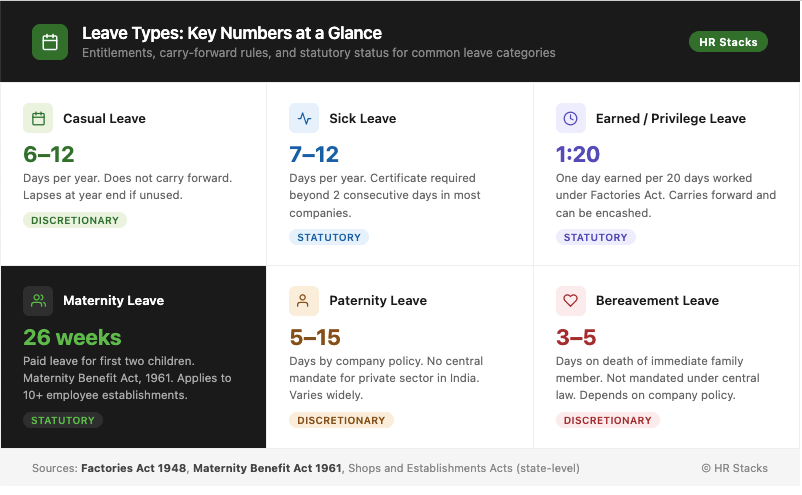
Types of Leave in the Workplace
Not every absence is the same, and the type of leave you cite in your application affects how it gets recorded, whether it counts against your balance, and in some cases whether it is paid or unpaid.
Using the wrong category is one of the most common errors in leave applications, and it creates extra work for HR to correct after the fact.
Here is a breakdown of the leave types you will encounter in most Indian and global workplaces.
Casual Leave (CL)
Short, unplanned absences for personal matters. Most companies allow 6 to 12 casual leave days per year. It is generally not carried forward to the next year, so unused casual leave lapses. Use this for one-off personal errands, minor illness, or family obligations that do not require extended time off.
Sick Leave (SL)
Reserved for illness or medical appointments. Some companies ask for a medical certificate if sick leave extends beyond two or three consecutive days.
Sick leave is statutory in many states under the Shops and Establishments Act, though the entitlement varies by state. Do not use casual leave when the reason is medical, as it affects how HR codes the absence.
Earned Leave / Privilege Leave (EL/PL)
Leave that accrues over time based on days worked. Under the Factories Act, workers earn one day of leave for every 20 days worked. This is the leave type to use for planned vacations and extended personal time. Unlike casual leave, earned leave can typically be carried forward and encashed.
Maternity Leave
Governed by the Maternity Benefit Act, 1961, amended in 2017. Female employees in establishments with 10 or more workers are entitled to 26 weeks of paid maternity leave for the first two children. The application should be submitted well in advance with the expected delivery date.
Paternity Leave
Not yet mandated by central law in India for private sector employees, though several state governments and public sector organisations provide it. Many private companies offer 5 to 15 days as part of their HR policy. Check your company’s leave policy before applying.
Bereavement Leave
Granted on the death of an immediate family member. Most companies allow 3 to 5 days. It is not separately mandated under Indian central labour law, so entitlement depends entirely on company policy. Your application should state the relationship to the deceased clearly, as HR will need this for records.
Emergency Leave
For situations that arise without notice, an accident, a sudden hospitalisation, or a family crisis. Most companies treat emergency leave as a sub-category of casual or sick leave depending on the circumstance. The key is to notify your manager as early as possible, even if the formal application follows later.
Half-Day Leave
Covers either the first or second half of a working day. Counted as 0.5 against your leave balance. Specify clearly whether you need the morning or afternoon session, and name a point of contact for anything urgent during your absence.
Types of Leave at a Glance
The Leave Application Format That Works
A leave application does not need to be long. It needs to be complete. Most applications that get pushed back are missing one of six elements, and the manager ends up chasing information that should have been in the original message. Here is what every application needs, and what each element actually does.
Subject Line
If you are applying by email, the subject line determines how fast your request gets opened. Be specific: “Leave Application: 18 to 20 June 2026” or “Sick Leave Request: 16 June 2026.”
A subject that just says “Leave” or “Time Off” sits in the inbox while your manager decides whether it is urgent enough to open now. It usually is not, and your application waits.
Salutation
Address your direct manager by name. If your company routes leave through HR, address HR but copy your manager in the same email. Sending the application only to HR and leaving your manager out is one of the most common etiquette mistakes in Indian workplaces. HR may approve the leave, but your manager discovers your absence on the morning itself with no handover, no context, and no warning.
Reason for Leave
You do not need to share medical details, but you need to give enough context for your manager to understand the nature of the absence. The difference between a good reason and a bad one is not length, it is specificity without oversharing.
Too vague: “I need to take leave for personal reasons.”
Better: “I am unwell and my doctor has advised two days of rest.”
Better: “I need to attend to a family matter that requires my presence out of the city.”
“Personal reasons” works for casual leave when the situation is genuinely private. For anything medical, one line about the nature of the illness or the doctor’s advice is enough. Avoid being so vague that the reason reads as evasive, and avoid being so detailed that you share information you later wish you had not.
Leave Duration
State the start date, end date, total number of days, and your expected return date in the same sentence. Do not make your manager calculate it.
Unclear: “I would like to take leave from Monday for a few days.”
Clear: “I am requesting leave from Monday 22 June to Wednesday 24 June 2026, three working days, and will return on Thursday 25 June.”
For a half-day, specify morning or afternoon, and name the time you will be absent or present. Half-day applications that only say “half day on Friday” create confusion about which half, especially in teams spread across time zones.
Work Handover Plan
This is the element most employees skip and most managers remember. It does not need to be a project plan. Two sentences that answer two questions are enough: who will handle anything urgent while you are away, and what is the status of anything time-sensitive.
Example: “Priya has agreed to cover client queries on the Axis project while I am away. The quarterly report is complete and submitted, and there are no pending deadlines before my return.”
That is it. Those two sentences tell your manager everything they need to know and signal that you thought about your team before thinking about your time off.
Closing and Contact
End with a polite sign-off and, for leave longer than two days, a note on your availability. You do not need to promise to be reachable around the clock.
Being clear is enough: “I will have limited availability during this period but can be reached by email for anything urgent” is more useful than either silence or an open-ended offer to stay connected.
Anatomy of a Leave Application
Professional Etiquette: What Managers Actually Notice
The format gets your application processed. The etiquette determines how it is received. Two employees can submit identical leave requests on the same day, and one gets approved within the hour while the other sits in a manager’s inbox until end of day. The difference is almost never the reason for leave. It is everything around it.
Timing your request
For planned leave, apply at least one week in advance for absences of one to three days, and two to three weeks in advance for anything longer. This is not about asking permission early enough to be polite. It is about giving your team enough time to redistribute work without it becoming someone else’s emergency.
For sick leave and genuine emergencies, notify your manager as early in the day as possible, ideally before the working day starts or within the first hour. A message at 11am saying you are unwell and will not be coming in today is significantly more disruptive than the same message sent at 7am. Your manager has already planned the morning around your presence.
How you phrase the request matters more than you think
There is a difference between informing and requesting. “I am taking leave on Friday” is an inform. “I would like to request leave on Friday, subject to your approval” is a request. In most workplaces, especially in India where reporting hierarchies carry real weight, framing your application as a request rather than a notification signals awareness of the process and respect for your manager’s role in it.
This does not mean being overly deferential. A confident, clear request reads better than an apologetic one. “I would like to request two days of casual leave” is stronger than “I was hoping I might possibly be able to take some time off if that is okay.”
Do not negotiate in the application itself
Some employees pre-emptively offer alternatives in the application: “If this date does not work, I can take leave the following week instead.”
This seems considerate but often creates more back-and-forth than it prevents. Submit your request for the dates you actually need. If there is a conflict, your manager will flag it and you can discuss alternatives then.
Follow up, but only once
If you have not received a response within 24 hours for a planned leave request, a single follow-up is appropriate. Keep it short: “Hi [Name], just following up on my leave request for 22 to 24 June. Please let me know if you need any additional information.”
Do not send multiple follow-ups. Do not escalate to HR before speaking to your manager. And do not assume silence means approval.
The handover conversation is separate from the application
Mentioning a handover plan in your application is good practice, as covered in the previous section. But the actual handover, briefing a colleague, updating task trackers, setting your out-of-office, should happen before you leave, not in the application email.
An application that says “I will brief Rahul before I leave” is not the same as actually briefing Rahul before you leave. Managers know the difference.
Leave Application Templates
Twelve templates covering the scenarios employees actually face, not just the obvious ones. Each includes a short note on what makes it work from a manager’s perspective.
1. Same-Day Sick Leave
Why this works: Sent early, states the medical nature clearly without oversharing, names a colleague for coverage, and gives a realistic return expectation.
Subject: Sick Leave Request: [Your Name], [Date]
Dear [Manager’s Name],
I woke up with a high fever this morning and my doctor has advised me to rest for the day. I am requesting sick leave for today, [Date].
Arun has agreed to handle any urgent queries on the Axis account while I am away. I expect to be back tomorrow but will update you if that changes.
Apologies for the short notice. I am reachable by phone for anything critical.
Regards,
[Your Name]
2. Planned Personal Leave
Why this works: Submitted in advance, reason is stated without unnecessary detail, handover is specific, and return date is clear.
Subject: Leave Application: [Your Name], 24 to 26 June 2026
Dear [Manager’s Name],
I would like to request three days of casual leave from Wednesday 24 June to Friday 26 June 2026. I need to attend to a personal family matter that requires me to travel out of the city.
I will complete the pending client report before I leave on Tuesday and have briefed Sneha on the open tasks for the week. I will return on Monday 29 June.
Please let me know if you need any further information.
Regards,
[Your Name]
3. Emergency Family Situation
Why this works: Sent immediately, explains urgency without excessive detail, sets a realistic expectation on when more information will follow.
Subject: Emergency Leave: [Your Name], [Date]
Dear [Manager’s Name],
I am writing to inform you that I need to take emergency leave today due to a family medical emergency. I am currently at the hospital and am unable to come in.
I will keep you updated on the situation and let you know my expected return date as soon as I can. Priya is aware of my pending tasks and can handle anything urgent in the meantime.
I apologise for the disruption and will be in touch shortly.
Regards,
[Your Name]
4. Bereavement Leave
Why this works: States the relationship clearly for HR records, requests the specific number of days the company policy allows, and keeps the tone dignified without being overly formal.
Subject: Bereavement Leave Request: [Your Name]
Dear [Manager’s Name],
I am writing to request bereavement leave following the passing of my father. I would like to request five days of leave from [Start Date] to [End Date] and will return on [Return Date].
I have informed [Colleague Name] of my pending work and they have agreed to cover in my absence.
Thank you for your understanding.
Regards,
[Your Name]
5. Planned Medical Procedure
Why this works: Gives adequate advance notice, mentions documentation without being asked, and provides a clear return timeline.
Subject: Medical Leave Application: [Your Name], [Date Range]
Dear [Manager’s Name],
I am scheduled for a minor surgical procedure on [Date] and my doctor has advised five days of rest following the procedure. I am requesting medical leave from [Start Date] to [End Date] and expect to return on [Return Date].
I will have my doctor’s certificate available and can share it with HR before I leave. I plan to complete the [specific task] before my leave begins and will brief [Colleague Name] on anything outstanding.
Please let me know if you need any additional documentation.
Regards,
[Your Name]
6. Mental Health Day
Why this works: Does not over-explain or under-explain. Uses casual leave correctly, keeps the reason professional, and does not invite unnecessary follow-up questions.
Subject: Casual Leave Request: [Your Name], [Date]
Dear [Manager’s Name],
I would like to request one day of casual leave on [Date] for personal health reasons. I have no urgent deadlines that day and have checked with [Colleague Name] who is available to cover if anything comes up.
I will return on [Next Working Day].
Regards,
[Your Name]
7. Half-Day Leave
Why this works: Specifies exactly which half, names a contact for the absent hours, and is short enough to read in ten seconds.
Subject: Half-Day Leave Request: [Your Name], [Date], Afternoon
Dear [Manager’s Name],
I would like to request a half-day leave for the afternoon of [Date] to attend a personal appointment. I will be available as usual until 1pm and will return the following morning.
[Colleague Name] is aware and can handle anything that comes up after 1pm.Regards,
[Your Name]
8. Remote or Async Team Notification
Why this works: Acknowledges the time zone or async dynamic, gives a clear window of unavailability, and sets expectations on response times rather than leaving the team guessing.
Subject: Out of Office: [Your Name], [Date]
Hi [Manager’s Name],
I am taking a personal leave day on [Date] and will be offline for the full day. I have updated my status on Slack and set an out-of-office reply on email.
The [Project Name] update is in the shared doc and [Colleague Name] has context on anything time-sensitive. I will pick up all messages on my return on [Next Working Day].
Thanks,
[Your Name]
9. Maternity Leave
Why this works: Submitted well in advance, includes the relevant dates and statutory entitlement reference, and outlines a transition plan so the manager is not left managing the handover alone.
Subject: Maternity Leave Application: [Your Name]
Dear [Manager’s Name] and [HR Contact],
I am writing to formally apply for maternity leave under the Maternity Benefit Act, 1961. My expected delivery date is [Date], and I would like to begin my leave from [Start Date], returning on [Return Date] after 26 weeks.
I would like to begin a structured handover from [Date, four weeks before leave starts]. I am happy to document all ongoing projects and brief the team on open responsibilities over that period.
Please let me know the next steps from HR’s side so we can plan the transition smoothly.
Regards,
[Your Name]
10. Paternity Leave
Why this works: States the reason clearly, references company policy rather than assuming entitlement, and gives the manager enough notice to plan coverage.
Subject: Paternity Leave Application: [Your Name]
Dear [Manager’s Name],
My wife is expecting our child around [Expected Date] and I would like to apply for paternity leave as per our company’s leave policy. I am requesting [X] days of leave from [Start Date] to [End Date].
I will ensure all my current deliverables are on track before the leave begins and will brief [Colleague Name] on anything that needs attention in my absence.
Please confirm the leave details with HR at your convenience.
Regards,
[Your Name]
11. Leave for Exam Preparation
Why this works: States the purpose without apologising for it, gives enough notice for planning, and shows awareness of team impact.
Subject: Leave Application: [Your Name], [Date Range]
Dear [Manager’s Name],
I would like to request [X] days of earned leave from [Start Date] to [End Date] to prepare for [Exam Name], which is scheduled on [Exam Date]. I have been planning this for some time and want to ensure I can give it adequate preparation.
I have no pending client deliverables during this period and have spoken with [Colleague Name] about coverage for routine tasks. I will return on [Return Date].
Regards,
[Your Name]
12. Leave for Marriage or Personal Event
Why this works: Gives maximum advance notice for a planned event, specifies the full duration including travel days, and frames the handover proactively.
Subject: Leave Application: [Your Name], [Date Range]
Dear [Manager’s Name],
I am getting married on [Date] and would like to request [X] days of earned leave from [Start Date] to [End Date], including travel days. I will return on [Return Date].
I am submitting this well in advance to allow adequate time for planning. I will complete [specific deliverable] before my leave begins and will brief the team fully before I go. Please let me know if any dates conflict with critical project timelines so we can plan around them.
Regards,
[Your Name]
What to Include and What to Skip by Leave Type
Common Mistakes That Get Applications Delayed or Rejected
Most leave applications that get pushed back are not rejected because the reason is unacceptable. They are delayed because the application itself creates work for the person approving it. Here are the six mistakes that cause this most often.
Using the wrong leave type
Applying for casual leave when the reason is medical is one of the most common errors in Indian workplaces, and it creates a downstream problem most employees never see. Payroll systems code sick leave and casual leave differently for statutory compliance.
When the wrong type is used, HR has to identify the error, correct the record, and reconcile it against the leave balance. This takes time and creates avoidable back-and-forth. If you are unwell, use sick leave.
If you are attending a medical appointment, sick leave still applies. Casual leave is for personal reasons unrelated to health.
Notifying too late in the day for sick leave
A sick leave message sent at 11am is significantly more disruptive than the same message sent at 7am. By mid-morning, your manager has already assigned tasks, scheduled meetings, and made plans that assume your presence.
Notifying early, even before the working day starts, gives the team time to redistribute. If you wake up unwell, the first thing you send should be to your manager, before you do anything else.
Sending the application only to HR
HR approves leave on record. Your manager manages the actual work. When an employee routes their leave application exclusively through HR and skips their direct manager, the manager finds out about the absence either from HR or on the morning itself.
Neither is acceptable in a functioning team. Always address your manager directly and copy HR, or address HR and copy your manager. The two should never be in separate email threads on the same absence.
Vague dates and missing return information
“I will be out for a few days” is not a leave application. Neither is “from Monday for about a week.” Your manager needs to know the exact start date, end date, total number of working days, and when you will be back.
Without a return date, the manager cannot close the loop on coverage or plan for your reintegration into ongoing work. This single omission is responsible for more approval delays than any other formatting issue.
Assuming silence means approval
In many workplaces, especially where leave is submitted by email rather than through an HRIS portal, employees assume that not hearing back means the leave has been approved. It usually means the email has not been read yet, or is sitting in a queue.
If you have not received confirmation within 24 hours for planned leave, follow up once. Do not start your leave without explicit approval. Showing up absent without confirmed approval is a compliance issue in companies that maintain statutory leave records, and it puts your manager in a difficult position.
Over-explaining the reason
The opposite problem is less common but equally damaging to how an application reads. Employees who write three paragraphs justifying a personal day, or who share detailed medical information in a leave email, create discomfort for the reader and signal insecurity about whether the request is legitimate.
A leave application is not a defence. One clear sentence stating the reason is enough for any leave type short of maternity or extended medical leave. More than that rarely helps and often backfires.
Leave Documentation Across Global Workplaces
Formal leave applications are not an India-specific formality. In almost every employment framework worldwide, the act of requesting and documenting leave in writing serves a legal and operational function that a verbal notice or a chat message cannot replicate.
United States
The US has no federal mandate for paid leave, but the Family and Medical Leave Act (FMLA) requires employers with 50 or more employees to provide up to 12 weeks of unpaid, job-protected leave for qualifying reasons. FMLA leave must be requested in writing and documented.
Beyond FMLA, an increasing number of states have their own paid family and medical leave laws, each with their own notice and documentation requirements. California, New York, and Washington all have active paid leave programs with specific application procedures.
An employee who fails to submit a written request risks losing their statutory protections even if the underlying reason for absence is legitimate.
United Kingdom
Under the Working Time Regulations 1998, full-time workers in the UK are entitled to 28 days of paid annual leave. Statutory Sick Pay kicks in after four consecutive days of absence, and employers are entitled to require written evidence of illness, typically a fit note from a GP, for absences exceeding seven days.
Most UK employers have formal leave request procedures built into their employment contracts, and deviating from those procedures can affect an employee’s right to pay during absence.
European Union
The EU Working Time Directive guarantees a minimum of four weeks of paid annual leave across all member states, with individual countries adding to this floor. Germany mandates 20 days minimum, France 25, and the Nordic countries go significantly higher.
In most EU jurisdictions, leave must be requested in advance and approved by the employer, with written records maintained for payroll and labour inspection purposes. Works councils in countries like Germany and the Netherlands also have co-determination rights over leave scheduling, adding another layer of formal documentation to the process.
Australia
Under the Fair Work Act 2009, full-time employees are entitled to four weeks of paid annual leave and 10 days of paid personal or carer’s leave per year. Employees are required to notify their employer as soon as reasonably practicable when taking sick leave, and employers can request evidence such as a medical certificate.
Casual employees have no paid leave entitlement, which makes documentation of any absence more important for classification and compliance purposes.
India
India’s leave framework is among the most layered of any major economy. Central legislation including the Factories Act, 1948 and the Maternity Benefit Act, 1961 set minimum entitlements, but each state’s Shops and Establishments Act adds its own rules on leave types, notice periods, and record-keeping.
Employers operating across multiple states are effectively managing several overlapping frameworks simultaneously. A company with offices in Maharashtra, Karnataka, and Tamil Nadu is subject to three different state-level acts in addition to central law.
Despite the availability of leave management software, many mid-size Indian companies still run leave through email or WhatsApp, with HR reconciling manual records at the end of each month. The compliance risk this creates is real.
Labour inspectors can and do ask for leave registers during inspections, and a reconstructed email trail is not the same as a properly maintained leave record.
What this means regardless of where your team is based
The specifics differ by country, but the underlying principle is consistent: written leave documentation protects both the employee and the employer. For the employee, it creates a record of an approved absence that cannot be disputed later.
For the employer, it satisfies statutory record-keeping obligations and provides the data HR needs to run payroll accurately. A Slack message, a WhatsApp notification, or a verbal heads-up to a manager does not do either of those things reliably.
Whether your team uses email or an HRIS platform to manage leave, the written record is the non-negotiable part.
Frequently Asked Questions
How far in advance should I submit a leave application?
For planned leave of one to three days, apply at least one week in advance. For longer absences, two to three weeks is standard. For sick leave or emergencies, notify your manager as early in the day as possible, ideally before the working day starts.
Can I use casual leave for a medical absence?
You should not. Sick leave and casual leave are coded differently in payroll systems. Using the wrong type creates a compliance error that HR has to correct manually, and it may affect your sick leave balance and statutory entitlements.
Do I need to give a reason for taking leave?
For casual and earned leave, a brief reason is courteous but not compulsory in most companies. For sick leave, a one-line description of the medical reason is standard. For extended medical leave or maternity leave, documentation is required by law in most jurisdictions.
What should I do if my manager does not respond to my leave application?
Follow up once after 24 hours with a short message referencing your original application. Do not assume silence means approval. Starting your leave without confirmed approval is a compliance issue in companies that maintain statutory leave records.
Is a WhatsApp message to my manager a valid leave application?
In most companies, no. A WhatsApp message may serve as an informal notification in an emergency, but it does not create a documented leave record for payroll and compliance purposes. Always follow up with a formal email or portal submission.
How detailed should my work handover note be?
Two sentences is enough for short leave. Name who is covering urgent tasks and state the status of anything time-sensitive. A detailed project plan is only necessary for extended absences of two weeks or more.