





EOR Platform Comparison
Pebl vs Multiplier: Quick Comparison
Service-led global EOR with 185+ country coverage vs the fastest-onboarding mid-market platform at a flat $400/month
Product A
Pebl
Formerly Velocity Global · Service-led EOR for complex global hiring
Product B
Multiplier
Singapore-based EOR · Flat $400/mo, 100+ owned entities, 24hr onboarding
Choose Pebl if you need
Choose Multiplier if you need
Pebl vs Multiplier: Overview
Pebl (formerly Velocity Global) and Multiplier both solve the same core problem: hiring and paying employees across borders without setting up local entities. On paper, they look nearly identical. In practice, they’re built around very different assumptions about how your team wants to operate.
Pebl scores 4.2/5 on HR Stacks across 740 reviews. It covers 185+ countries and leans heavily into service, dedicated account teams, compliance advisory, and hands-on support through complex hiring scenarios. Multiplier scores 4.0/5 across 800 reviews. It covers 150+ countries, prices at a flat $400 per employee per month, and is built for teams that want to move fast without waiting on anyone.
We compared both platforms across pricing, global coverage, compliance depth, onboarding speed, integrations, and real user sentiment to help you pick the right one.
Product A
Pebl
Formerly Velocity Global · Service-led global EOR · Denver, CO
Product B
Multiplier
Multiplier Technologies Pte. Ltd. · Flat-rate EOR · Singapore
Pebl Product Overview
Pebl, rebranded from Velocity Global in 2024, is one of the most established names in global employment. Founded in 2014 and headquartered in Denver, it operates across 185+ countries with a model built around service depth rather than self-serve speed.
Dedicated account teams guide clients through contracts, compliance, and local employment requirements at every step. That model appeals most to companies entering unfamiliar or heavily regulated markets where having expert input before things go wrong matters more than how fast the dashboard loads. Pricing is custom and reflects the service layer included.

Multiplier Product Overview
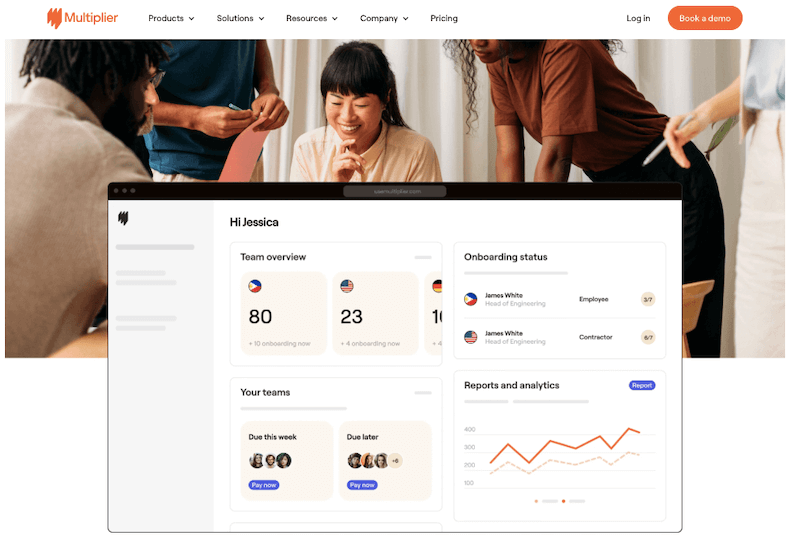
Multiplier launched in Singapore in 2020 and has grown to 1,210+ employees with $77.2M in total funding. It covers 150+ countries through 100+ owned entities and prices EOR at a flat $400 per employee per month, published on its website with no setup or offboarding fees.
The platform is product-led: contracts generate in minutes, employees go live within 24 hours in most owned-entity markets, and most workflows run without needing to contact support. It’s built for teams that want control and speed, not a managed service sitting alongside them.
Quick Facts · Pebl vs Multiplier
Pebl vs Multiplier: Rating Comparison
Pebl scores higher overall at 4.2/5 vs Multiplier’s 4.0/5, driven by stronger marks on global coverage (4.5 vs 4.2) and compliance strength (4.4 vs 4.1).
Multiplier pulls ahead on pricing and value (4.4 vs 4.1), onboarding speed (4.5 vs 4.2), and ease of use (4.3 vs 4.0). The two platforms are closest on payroll and benefits, where neither scores above 4.0. Integrations is the weakest parameter for both, with Multiplier’s 3.4 the lowest individual score in this comparison.
HR Stacks Editor’s Rating
Pebl vs Multiplier: Score Comparison
Pebl vs Multiplier: Pricing Comparison
Pricing is where these two platforms diverge most clearly. Multiplier publishes a flat $400 per employee per month on its website, with no setup or offboarding fees.
For a 10-person international team, that’s $23,880 less annually than Deel at $599. Pebl operates on custom pricing that reflects its service model, so you won’t get a number without a sales conversation. For smaller teams or budget-conscious buyers, that difference alone can decide the shortlist.
Pricing Breakdown
Pebl vs Multiplier: Pricing Comparison
Multiplier publishes two flat rates directly on its website. Pebl pricing is fully custom and requires a sales conversation. Both platforms charge no free trial and have no minimum headcount requirement.
Pebl vs Multiplier: Pros & Cons
Pebl’s strengths cluster around coverage depth and compliance expertise. Multiplier’s around pricing transparency and onboarding speed.
The weaknesses are just as telling: Pebl’s custom pricing and fragmented platform experience are consistent complaints, while Multiplier’s thin integration library and opaque FX markups show up repeatedly across public reviews.
Strengths & Limitations
Pebl vs Multiplier: Pros & Cons
185+ country coverage
One of the broadest EOR footprints in the market, covering 35 more countries than Multiplier’s 150+.
Deep compliance expertise
Scores 4.4/5 on compliance. Dedicated legal guidance helps teams navigate complex or unfamiliar labor markets before problems surface.
Service-led account model
Dedicated account teams actively support hiring, contracts, and edge cases — not just a ticketing system or live chat.
Reliable global payroll infrastructure
Scores 4.0/5 on payroll and benefits, with centralized multi-country payroll and localized compliance built in.
Fully custom pricing
No published rates. Smaller teams report difficulty justifying the cost when hiring only a handful of international employees.
Platform experience feels fragmented
Users managing payroll, onboarding, and compliance across multiple regions report a steeper learning curve than expected.
Integration ecosystem is limited
Scores 3.9/5 on integrations. Gaps in niche tool compatibility and manual configuration requirements are a recurring complaint.
Flat $400/mo published rate
The only serious EOR at this price with no setup or offboarding fees — saving a 10-person team $23,880 annually vs Deel.
Fastest onboarding in the category
G2’s #1 Most Implementable EOR across multiple quarters. Contracts in minutes, employees live within 24 hours in owned-entity markets.
100+ owned entities
Direct legal employer status in most markets — not routed through a third-party partner chain, which matters when something goes wrong.
Strong APAC infrastructure
Singapore HQ with owned entities in India, Philippines, and Australia. Same-timezone support that Western-founded EORs typically can’t match.
NRE Payroll for European markets
Launched October 2025. Covers 10 European markets including Germany and France without requiring a full EOR arrangement or local entity.
Thin integration library
Scores 3.4/5 — the lowest in this comparison. BambooHR, Greenhouse, and Workday covered; no QuickBooks, Xero, or NetSuite natively.
FX markups are opaque
Quoted at 2% but independently reported as high as 8% in some corridors. At $500K annual payroll, that gap costs $40,000.
No 24/7 support or phone line
24/5 live chat and email only. Payroll issues surfacing on a Friday in New York wait until the Singapore office opens Monday.
Pebl vs Multiplier: Top Features
Both platforms cover the core EOR stack: employment contracts, multi-country payroll, statutory benefits, and contractor management. The differences show up in depth and delivery.
Pebl leans into compliance advisory and country-specific benefits customization. Multiplier adds NRE Payroll and equity management as distinct product layers, with a cleaner self-serve interface across all of them.
Feature Breakdown
Pebl vs Multiplier: Top Features
Pebl vs Multiplier: Key Differences
The scoring gap between these two platforms is narrow at the overall level. The differences underneath it are not. Pebl wins on country reach, compliance depth, and service model. Multiplier wins on pricing transparency, onboarding speed, and platform usability. Every item below is backed by a specific score, count, or verified product detail.
What Sets Them Apart
Pebl vs Multiplier: Key Differences
Pebl covers 185+ countries vs Multiplier’s 150+. For companies hiring in frontier or less-common markets, that gap is often the deciding factor.
Flat rate, no setup or offboarding fees, confirmed on Multiplier’s website. Saves a 10-person team $23,880 annually vs Deel at $599/mo.
Pebl’s in-country legal experts provide advisory-led compliance support. Multiplier’s compliance is platform-embedded and works well until an edge case surfaces.
Ranked ahead of 44 competitors across multiple consecutive quarters. Employees live within 24 hours in most owned-entity markets. Pebl typically takes 2–4 weeks.
Pebl assigns dedicated account managers who actively guide hiring, contracts, and compliance — not tiered chat support. Scores 3.8/5 on support vs Multiplier’s 3.6/5.
Multiplier is the direct legal employer in 100+ markets, not a partner chain acting on its behalf. Most competitors at this price point rely far more heavily on third parties.
Pebl’s country-specific benefits customization goes deeper than Multiplier’s pre-configured options, particularly in markets with complex statutory requirements.
Launched October 2025. Covers Germany, France, Netherlands, and 7 more European markets with compliant payroll and no full EOR arrangement required. No competitor offers this.
Pebl connects with major HRIS and HCM systems via open API. Multiplier’s native library covers only BambooHR, Greenhouse, and Workday before dropping off significantly.
Multiplier’s clean dashboard and straightforward workflows mean non-HR admins can navigate without a manual. Pebl’s interface requires more reliance on account teams to operate effectively.
Pebl vs Multiplier: Use Cases
Choosing between these two platforms comes down to how your team operates and where you’re hiring. Pebl fits companies that need breadth of coverage and don’t mind trading speed for compliance certainty.
Multiplier fits teams that want to move fast, keep costs predictable, and aren’t dependent on a managed service layer. The four scenarios below cover the most common buyer situations we see in the EOR category.
Hiring across complex or frontier markets where compliance mistakes are costly
Pebl’s compliance score of 4.4/5 and 185+ country coverage make it the stronger fit when hiring in markets where labor law complexity is high and getting it wrong is expensive. Dedicated account teams actively guide contracts and local requirements before anything goes live — a meaningful advantage over Multiplier’s platform-embedded compliance model when non-standard situations arise. For teams without strong internal legal resources entering unfamiliar regions, that service layer changes the risk profile significantly.
Fast-scaling startup hiring across APAC with a tight budget and no dedicated HR team
Multiplier’s Singapore HQ and owned entities across India, Philippines, and Australia give it genuine infrastructure advantages in APAC that most Western-founded EORs added as an afterthought. At $400/month flat with 24-hour onboarding in owned-entity markets, a 10-person APAC team costs $48,000 annually — $23,880 less than the same team on Deel. The self-serve platform scores 4.3/5 on ease of use, meaning a founder or ops lead can run payroll, onboarding, and compliance without a dedicated HR function.
Testing European markets before committing to local entity setup
Multiplier’s NRE Payroll, launched October 2025, covers Germany, France, and the Netherlands without requiring a full EOR arrangement or local entity — a path no competitor currently offers at this price point. For companies testing European demand before committing, that’s a meaningful advantage. Pebl can cover the same markets through its standard EOR model with deeper compliance advisory, which makes more sense if hiring volume is higher or the regulatory complexity in those markets warrants hands-on legal input. If you’re placing two or three test hires, Multiplier’s NRE is the lighter and cheaper entry point. If you’re placing ten or more with complex structures, Pebl’s service model earns its premium.
Enterprise team splitting hiring across APAC speed markets and complex compliance markets simultaneously
Some enterprise teams run Multiplier for APAC hiring, where its owned entities, 24-hour onboarding, and $400 flat rate deliver genuine operational efficiency — while routing complex EMEA or LATAM hires through Pebl’s service-led model. This isn’t a theoretical scenario. It reflects how larger distributed teams actually split EOR providers by region when speed and compliance requirements don’t align across markets. The overhead of managing two vendors is real, but so is the operational advantage of matching the right tool to each hiring context.
Pebl vs Multiplier: User Sentiment
Multiplier’s review volume is significantly larger, 4,300+ cross-platform reviews vs Pebl’s 740 analyzed on HR Stacks. That gap matters when reading sentiment patterns: Multiplier’s themes are drawn from a deeper, more diverse sample.
Pebl’s public review cores are not published on its HRS review page, so platform-level scores below reflect Multiplier only. What both sets of reviews agree on: support consistency and integration depth are the most common friction points on either platform.
Review Analysis
Pebl vs Multiplier: User Sentiment
Compliance guidance that catches problems early
Users in complex markets consistently cite Pebl’s in-country expertise as the reason they avoided costly compliance mistakes. Scores 4.4/5 on compliance strength.
Dedicated account teams that actually show up
Reviewers highlight access to named account managers who guide hiring end-to-end, rather than routing every question through a generic support queue.
Broadest country coverage in the category
185+ countries is the most cited reason for choosing Pebl over alternatives. Particularly relevant for companies with hiring plans in frontier or less-common markets.
Reliable payroll across complex jurisdictions
Finance teams managing multi-country payroll note consistent accuracy and strong local knowledge, especially in markets with frequent regulatory changes.
Custom pricing makes budgeting difficult
Smaller companies report frustration with the lack of published rates. Getting a cost estimate requires a full sales engagement before any comparison is possible.
Platform feels fragmented across workflows
Users managing payroll, onboarding, and compliance simultaneously report a steeper learning curve than expected, particularly across multiple regions.
Integration gaps require manual workarounds
Scores 3.9/5 on integrations. Teams using niche HRIS or finance tools report manual data transfers and occasional setup complexity when connecting systems.
Support consistency varies by region
Scores 3.8/5 on customer support. Reviewers note slower turnaround and inconsistent follow-through in less-mature markets compared to core regions.
Employees live within 24 hours in APAC markets
G2 reviewers cite same-day contracts as the reason they chose Multiplier when a competing offer was already in play. No other platform at this price matches it consistently.
No surprise fees at offboarding
Multiple Trustpilot reviewers who switched from other EOR providers specifically highlight the absence of hidden offboarding charges — something they’d been burned by previously.
Locally compliant contracts generated correctly first time
Reviewers note contracts appear per jurisdiction with no back-and-forth with legal. Cited most in markets where employment law changes frequently.
Founders and ops leads run it without an HR team
The self-serve experience is the highest-rated dimension on G2 for sub-50 employee companies. CEOs and ops leads manage payroll, time off, and documents without dedicated HR staff.
Invoiced before onboarding starts
A Capterra reviewer documented being billed for five Italian hires before any had started. Multiplier issues invoices up to a month in advance with 7-day payment windows.
Partner handoffs slow down edge cases
Offboarding disputes and insurance questions surface the third-party partner layer. G2 reviewers describe inconsistent answers across markets when anything unusual arises.
No accounting integrations — manual reconciliation at scale
No QuickBooks, Xero, or NetSuite natively. One G2 reviewer managing 15 employees across 6 countries reported two full days per month reconciling payroll costs manually.
Weekend payroll issues wait until Monday
24/5 only — no phone line. US and European reviewers flag this most. A payroll discrepancy surfacing Friday afternoon in New York has no escalation path until Singapore opens.
Pebl vs Multiplier: Final Verdict
Pebl scores higher overall at 4.2/5 vs Multiplier’s 4.0/5, and that gap reflects a real structural difference. Pebl wins on global coverage (4.5 vs 4.2), compliance strength (4.4 vs 4.1), payroll and benefits (4.0 vs 3.8), and customer support (3.8 vs 3.6). For companies hiring across complex or unfamiliar markets, those numbers translate into fewer surprises and less risk.
Multiplier wins where it matters most to a different buyer. Pricing and value (4.4 vs 4.1), onboarding speed (4.5 vs 4.2), and ease of use (4.3 vs 4.0) are the three parameters that decide deals for cost-conscious, fast-moving teams.
A flat $400/month with no setup fees, 24-hour onboarding, and a self-serve platform that non-HR admins can actually run, that combination is hard to match at this price.
Neither platform is a compromise pick. They serve genuinely different operational profiles. The right answer depends entirely on whether your team needs a compliance partner or a fast, predictable tool.
HR Stacks Final Verdict
Pebl edges ahead overall, but Multiplier wins on the three parameters that matter most to fast-moving teams
Pebl scores 4.2/5 vs Multiplier’s 4.0/5 across 8 parameters. The difference isn’t about quality — it’s about operational fit. Pebl is built for companies that need a compliance partner. Multiplier is built for teams that need a fast, predictable tool at a price they can actually see before signing.
Common Questions
Pebl vs Multiplier: FAQs
Yes, in almost every scenario. Multiplier publishes a flat $400 per employee per month with no setup or offboarding fees. Pebl uses custom pricing that requires a sales conversation before you see any numbers.
For a 10-person international team, Multiplier saves $23,880 annually compared to Deel at $599, and the gap versus Pebl will depend on your specific contract. Smaller teams consistently report Pebl’s pricing is harder to justify when hiring only a few international employees.
Multiplier. It is headquartered in Singapore and operates owned entities in India, the Philippines, and Australia. Same-timezone support, 24-hour onboarding in most APAC markets, and infrastructure built from day one in the region give it a structural advantage that Western-founded EOR platforms cannot easily replicate.
Pebl covers APAC markets too, but APAC is not where its service model is strongest.
Multiplier operates 100+ owned entities globally, meaning it acts as the direct legal employer in most markets rather than routing through a local partner firm. That matters most when something goes wrong — a labor dispute, a complex termination, or an employment audit — where the chain of legal responsibility becomes visible.
Some markets still use third-party partners, and that is where friction occasionally surfaces, specifically in complex offboarding or insurance disputes. For standard hires in owned-entity markets, the distinction is not visible in day-to-day operations.
Within 24 hours in most owned-entity markets. Contracts generate in minutes. G2 ranks Multiplier as the #1 Most Implementable EOR ahead of 44 competitors across multiple consecutive quarters.
Partner-entity markets take longer, typically 3 to 7 days. Confirm during the demo whether your target market is owned or partner before setting expectations with a new hire. Pebl typically runs 2 to 4 weeks due to its compliance-first review process.
No. Multiplier does not connect to QuickBooks, Xero, or NetSuite natively. Native integrations cover BambooHR, Greenhouse, and Workday, then drop off significantly. A REST API is available for custom connections if you have engineering resource.
If your finance team needs automated payroll cost reconciliation to your accounting platform, Deel is the more practical choice with 130+ native integrations. One G2 reviewer managing 15 employees across 6 countries reported spending two full days per month on manual reconciliation because of this gap.
NRE stands for Non-Resident Employer Payroll. Multiplier launched it in October 2025 across 10 European markets including Germany, France, and the Netherlands.
With standard EOR, Multiplier becomes the legal employer. With NRE Payroll, your company stays the legal employer while Multiplier handles the payroll compliance layer. It is designed for companies testing a European market before committing to entity setup or paying full EOR fees. No other EOR platform at this price currently offers an equivalent product.
Multiplier. The flat $400 rate, published pricing, self-serve platform, and 24-hour onboarding match how most startups actually operate: lean HR function, tight budget, no appetite for multi-week timelines.
Pebl’s service-led model and custom pricing make more sense once a company is scaling across many markets with genuine compliance complexity. If you are placing your first 5 to 10 international hires and APAC is a core market, Multiplier is the stronger starting point.