



Quick Summary: Minimum Wage in Vietnam (2026)
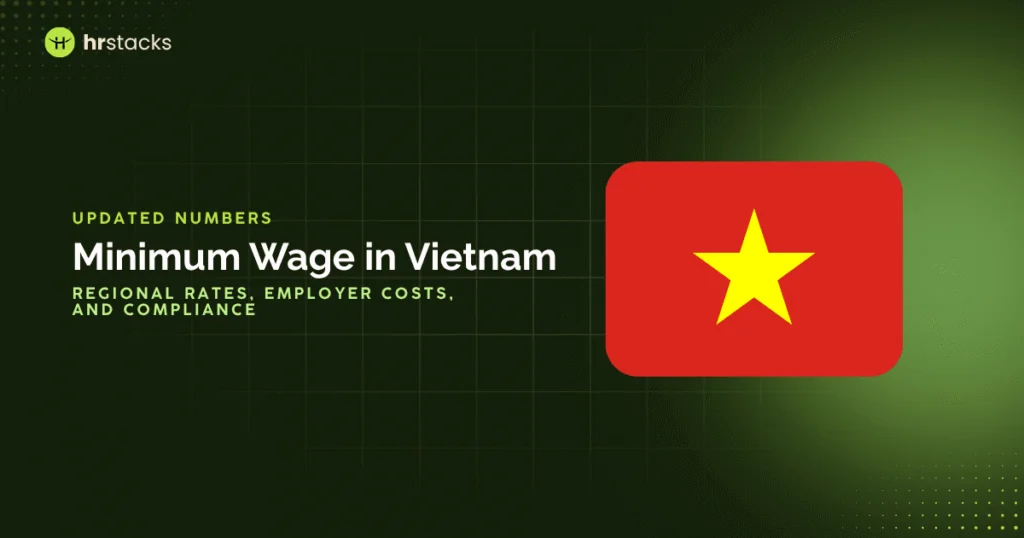
From 1 January 2026, Vietnam’s regional minimum wage increased by an average of 7.2% under Decree 293/2025/ND-CP, with monthly rates now ranging from VND 3,700,000 in rural Region IV to VND 5,310,000 in Hanoi and Ho Chi Minh City.
For foreign companies hiring in Vietnam, the regional rate is only the starting point: mandatory SHUI contributions, vocational training uplifts, and a trade union fee add another 23.5% on top of gross salary.
This page covers every regional rate, what each mandatory uplift means in practice, the real total employer cost, and what enforcement looks like on the ground.
EOR guide
Vietnam
10 providers reviewed
Compare the top EOR providers for Vietnam
Independent rankings by payroll compliance depth, Vietnam SHUI handling, regional rate accuracy, and onboarding speed. Updated for 2026.
How Vietnam’s Regional Minimum Wage Works
Vietnam operates two parallel wage systems, and confusing them is a common mistake for first-time hirers in the country.
The first is the common minimum wage (also called the statutory base salary), set at VND 2,340,000 per month in 2026. This applies to state sector employees and is used as the reference level for calculating social and health insurance contribution ceilings.
The second is the regional minimum wage, which governs all employees working under labor contracts in the private sector, including foreign-invested companies, cooperatives, and household employers. If you are hiring through an EOR or setting up a direct entity in Vietnam, the regional minimum wage is the number that sets your payroll floor.
The legal basis sits in Vietnam’s Labour Code 2019, Articles 90 to 92, which mandate that wages cannot fall below a government-set minimum and establish the National Wage Council as the body that recommends annual adjustments. The government then formalises those recommendations by decree.
Decree 293/2025/ND-CP, issued on 10 November 2025 and effective from 1 January 2026, is the current operative instrument, replacing Decree 74/2024/ND-CP from July 2024.
The regional minimum wage applies to everyone working under a labor contract in Vietnam, regardless of nationality. Vietnamese employees, foreign nationals on 12-month-plus contracts, part-time workers, and piecework or task-based workers whose converted monthly or hourly rate falls below the floor are all covered.
The one group it does not reach is genuinely self-employed contractors with no labor contract, though Vietnam’s labour inspectors scrutinise contractor arrangements closely where the working relationship resembles employment. For a full overview of how Vietnam structures employment obligations beyond wages, see our best EOR in Vietnam guide.
2026 Regional Minimum Wage Rates
Vietnam’s four regions reflect differences in cost of living and economic development. Region I covers the most urbanised commercial centres. Region IV covers rural and mountainous provinces. The gap between them is VND 1,610,000 per month, or roughly 43% more at the top end than the bottom.
The table below shows both monthly and hourly rates for all four regions under Decree 293/2025/ND-CP. Hourly rates matter for part-time, shift-based, or task-based contracts: any arrangement that converts to monthly terms must not fall below the applicable monthly minimum.
The 2026 increase was 7.1% in Region I (VND 350,000 added), 7.3% in Regions II and III, and 7.2% in Region IV, as confirmed by Baker McKenzie’s analysis of Decree 293.
Key cities by region for international employers: Region I covers Hanoi and Ho Chi Minh City urban core districts, Hai Phong, and Da Nang. Region II covers most of Binh Duong, Dong Nai, and Can Tho. Region III includes parts of Hai Duong, Khanh Hoa, and Long An.
Region IV covers rural and mountainous provinces. For the full province and commune-level list, the Vietnam Briefing regional classification guide has the complete appendix from Decree 293.
2026 Regional Minimum Wage Rates: Monthly and Hourly
What Region Applies to Your Business?
The regional rate is determined by where your employer entity or branch operates, not where the employee lives or works remotely. A software developer who lives in a Region II district but works under a contract with your Hanoi-registered office is subject to the Region I rate.
This distinction is where international employers make the most expensive classification errors, and it is one of the first things MOLISA inspectors cross-check against social insurance filings.
Three specific rules matter for foreign-invested companies:
Multi-location rule. If you have offices or branches across different regions, each location applies its own regional rate independently. You cannot apply a single blended or lowest rate across all staff.
Industrial zone rule. Employers operating in industrial parks, export processing zones, high-tech zones, or centralized digital technology zones that span areas with different regional rates must apply the highest applicable rate for all workers at that location.
This catches manufacturers who assume their industrial park address qualifies for a lower surrounding region’s rate.
Administrative restructuring rule. Following Vietnam’s June 2025 two-level local government reform, some communes and wards were renamed or merged. Until the government issues updated guidance for a specific area, employers apply the minimum wage rate that applied to that area before the restructuring took effect.
One further edge case worth knowing: if your business operates in an area that undergoes a name change or administrative division after Decree 293 takes effect, you temporarily continue applying the rate of the pre-change area. This is not a loophole, it is a transitional rule, and updated classifications will follow.
Regional Rate Misclassification: Risk Level by Error Type
Mandatory Pay Uplifts Above the Minimum
The regional rate is a floor, not a complete pay specification. Two statutory uplifts apply on top of it and are checked during routine labour inspections. Neither is optional, and neither requires a separate agreement with the employee, they are legal minimums that apply automatically based on the employee’s role classification.
Vocational training uplift: +7%. Any employee who holds officially certified vocational training credentials must be paid at least 7% above the applicable regional minimum.
This covers a broader range of roles than most international employers expect: it is not limited to trade apprentices or factory workers. Technicians, certified accountants, qualified nurses, IT professionals with formal credentials, and many mid-level administrative roles can all qualify.
In Region I, the adjusted floor is VND 5,681,700 per month rather than VND 5,310,000. In Region IV, it becomes VND 3,959,000 rather than VND 3,700,000. MOLISA labour inspections consistently identify this as the most common underpayment error among foreign-invested employers.
Hazardous or arduous work uplift: +5% to +7%. Jobs classified as particularly hazardous, dangerous, or physically demanding under MOLISA’s official occupational list must be paid at least 5% above the regional minimum, with certain categories requiring 7%.
Employers in manufacturing, construction, chemical handling, and logistics need to verify which roles on their payroll qualify against the official classification. This uplift applies regardless of whether the employee also holds vocational training credentials.
One clarification that catches employers out: if both uplifts apply to the same employee, you do not stack them. The higher of the two applies. A certified technician doing hazardous work gets +7%, not +12%.
These uplifts are separate from overtime premiums and night shift allowances, which are calculated on the employee’s contractual wage rate and sit on top of whichever pay floor applies.
Region I Minimum Wage: Base Rate vs. Statutory Uplifts (2026)
What Counts Toward the Minimum Wage and What Does Not
Vietnam’s Labour Code 2019 compares the minimum wage against the employee’s basic salary only, not their total monthly compensation package. Allowances paid for meals, accommodation, travel, shift patterns, seniority, or role-specific conditions do not count toward meeting the minimum. Neither do performance bonuses, Tet payments, or any other variable or one-off payment.
This matters because structuring packages with a low basic salary supplemented by allowances is common practice in Vietnam, particularly in manufacturing and hospitality. The intent is usually to reduce the SHUI contribution base, since social and health insurance contributions are calculated on a salary base that excludes certain allowances.
That approach is not automatically illegal, but if the basic salary line sits below the applicable regional minimum, the employer is in violation regardless of what the total package adds up to. DOLISA inspectors look at the basic salary figure in the employment contract, not the sum of all payments.
There is also a second consequence beyond compliance. SHUI contributions for social and health insurance are capped at 20 times the statutory base salary (VND 46,800,000/month in 2026), as confirmed by Vietnam Briefing’s social insurance guide.
Unemployment insurance uses a separate cap of 20 times the regional minimum wage. Artificially suppressing the basic salary line to reduce SHUI liability is one of the patterns MOLISA has explicitly flagged as an audit trigger since the Social Insurance Law 2024 took effect in July 2025.
What Counts Toward the Minimum Wage in Vietnam
Total Employer Cost at Minimum Wage
The regional minimum wage tells you the gross salary floor. It does not tell you what hiring that employee actually costs. In Vietnam, mandatory employer contributions add 23.5% on top of every employee’s gross salary, and that percentage applies from the first day of employment with no size threshold or sector exemption for foreign-invested companies.
The three mandatory employer contributions are:
Social insurance (SI): 17.5% of gross salary. Covers retirement pensions, maternity leave, sickness benefits, and occupational injury compensation. Applies to both Vietnamese and foreign employees on contracts of 12 months or longer.
The contribution base is capped at 20 times the statutory base salary, currently VND 46,800,000 per month, per Indochina Link’s 2026 SHUI employer guide. At minimum wage levels no cap applies.
Health insurance (HI): 3% of gross salary. Grants access to public healthcare at registered facilities. Applies to all employees regardless of nationality. Capped at the same VND 46,800,000 ceiling as social insurance.
Unemployment insurance (UI): 1% of gross salary. Applies to Vietnamese employees only. Foreign nationals are currently exempt. The contribution base is capped separately at 20 times the regional minimum wage: VND 106,200,000 for Region I in 2026, per Acclime Vietnam’s HR and payroll guide.
The 7.2% minimum wage increase in 2026 automatically raised this UI cap, which means employers needed to adjust unemployment insurance calculations from 1 January regardless of whether any individual employee’s salary changed.
Trade union fee: 2% of total payroll used for social insurance. This is an employer-only cost, paid to the Vietnam General Confederation of Labor regardless of whether your company has an internal trade union. It is one of the most commonly overlooked costs by new FDI entrants and is a separate enforceable obligation from SHUI.
If employees have established an in-house trade union board, they also contribute 1% of their own salary (capped at VND 180,000/month), but that is a deduction from the employee’s pay, not an additional employer burden.
At minimum wage levels, where no contribution cap applies, the maths is straightforward: gross salary multiplied by 1.235 gives your total monthly employment cost per hire.
Total Employer Cost at Minimum Wage: Region I vs. Region IV (2026)
Overtime, Night Shift, and Pay Period Rules
Overtime in Vietnam is calculated as a percentage of the employee’s contractual wage rate for the hours type in question, not against the minimum wage floor.
This distinction matters: if you pay above the minimum, overtime is calculated on the actual agreed rate, not on the regional minimum. The rules are set by Labour Code 2019, Articles 94 to 97 and 107.
Standard overtime rates. Normal working day overtime pays at 150% of the standard hourly rate. Weekly rest day overtime pays at 200%. Public holiday overtime pays at 300%, and that 300% is on top of the base holiday pay already owed to the employee for that day.
These are minimums: collective bargaining agreements or individual contracts can set higher rates but cannot go below them.
Night shift premium. Work performed between 10 pm and 6 am carries an additional 30% premium on top of whatever the standard rate is for those hours. If an employee works overtime during night hours, a further 20% is added on top of both the overtime multiplier and the night shift premium.
The compounding nature of this calculation catches employers who calculate night overtime as simply 150% rather than working through the full stack.
Overtime hour limits. Maximum overtime is 40 hours per month and 200 hours per year under the standard rule. This extends to 300 hours per year in specific sectors under Decree 145/2020/ND-CP, including electronics assembly, garments, footwear, seafood processing, and electricity generation.
Exceeding the annual cap is a separate labour violation from underpayment and carries its own penalty schedule under Decree 12/2022/ND-CP.
Annual leave and public holidays. Employees with at least 12 months of service are entitled to a minimum of 12 paid working days of annual leave per year, increasing by one day for every five years with the same employer. Vietnam has 11 public holidays per year, including five days for Lunar New Year (Tet).
Employees working on public holidays are entitled to the 300% overtime rate noted above, plus the base holiday pay.
Pay period and late payment rules. Salaries must be paid on the date agreed in the employment contract. If payment is delayed by more than 15 days, the employer must pay interest on the outstanding amount calculated at the highest demand deposit rate of state-owned commercial banks at the time of payment.
There is no grace window that makes a late payment cost-free, and this obligation applies equally to EOR providers acting as the legal employer. Under Decree 12/2022/ND-CP, Article 17, administrative fines for late salary payment range from VND 5,000,000 to VND 50,000,000 depending on the number of employees affected.
Enforcement and Penalties
Minimum wage compliance is not self-reported. MOLISA enforces at the national level, with provincial DOLISA offices conducting inspections on the ground.
Inspections can be routine or complaint-triggered. DOLISA cross-references payroll declarations against social insurance filings electronically, so underpayment patterns are detectable without a physical site visit. Vietnamese employees are well aware of their statutory rights, and a complaint to DOLISA costs nothing to file.
The penalty framework is set by Decree 12/2022/ND-CP, Article 17. Fines for companies are doubled compared to individual employer rates and scale with the number of affected employees.
On top of the fine, employers must separately repay full back wages to every affected employee plus interest at the highest demand deposit rate of state-owned commercial banks at the date the penalty is imposed. There is no cap on the back-wage component.
Penalty Schedule: Minimum Wage Violations in Vietnam
| Employees affected | Individual employer fine | Company fine (doubled) |
|---|---|---|
| 1 to 10 employees | VND 20M to VND 30M | VND 40M to VND 60M (~$1,580 to $2,370) |
| 11 to 50 employees | VND 30M to VND 50M | VND 60M to VND 100M (~$2,370 to $3,950) |
| 51 or more employees | VND 50M to VND 75M | VND 100M to VND 150M (~$3,950 to $5,930) |
Minimum Wage vs. Market Salary
The minimum wage is a legal floor, not a hiring benchmark. Vietnam’s national average wage sat at approximately VND 8,684,000 per month as of Q4 2025, according to ILO Vietnam labour market data and the General Statistics Office.
That figure is pulled down by agricultural and rural workers. For knowledge-based roles in Hanoi or Ho Chi Minh City, the gap widens considerably: a mid-level software engineer typically earns 8 to 10 times the Region I minimum, and even a junior operations hire at an FDI company rarely lands at the statutory floor.
Paying at the minimum wage for any skilled position will not attract competitive candidates in urban Vietnam. It may also signal to local talent that the employer is not benchmarking against the market, which compounds retention risk.
For sector-level salary benchmarks by city and seniority, see our average salary in Vietnam guide.
Region I Minimum Wage vs. National Average (2026)
Historical Minimum Wage Trend
Vietnam has increased the regional minimum wage almost every year for the past decade. The only exceptions were 2020 and 2021, when increases were deferred due to COVID-19. Since resumption, the trajectory has accelerated.
Foreign employers building multi-year headcount plans in Vietnam should model annual wage increases of 6 to 8% as a baseline assumption.
Vietnam Minimum Wage: Key Legislative Milestones (2022 to 2026)
How an EOR Manages Minimum Wage Compliance
For companies hiring in Vietnam without a registered entity, an employer of record handles all minimum wage obligations directly. That means applying the correct regional rate for each employee’s work location, calculating and remitting SHUI contributions monthly, paying the trade union fee, and applying vocational training uplifts where the employee’s credentials require it.
The EOR is the legal employer on record and carries the compliance liability if any of those calculations are wrong.
This matters specifically for the regional classification issue. A competent EOR confirms the correct region for each hire at onboarding rather than applying a blanket rate across all Vietnam staff. It also absorbs the annual contract amendment and payroll update work each time Decree rates change, which under the current trajectory means every January.
For a ranked comparison of EOR providers with strong Vietnam payroll compliance capabilities, see our best EOR in Vietnam guide. For how compensation benchmarks sit relative to the minimum wage floor by role and sector, see the Vietnam average salary guide.
Broader hiring context, including entity setup, onboarding timelines, and termination rules, is in our Vietnam hiring hub.
Frequently Asked Questions
What is the minimum wage in Vietnam in 2026?
Under Decree 293/2025/ND-CP, effective 1 January 2026, monthly rates range from VND 3,700,000 (~$146) in Region IV to VND 5,310,000 (~$210) in Region I, covering Hanoi, Ho Chi Minh City, Hai Phong, and Da Nang. The average increase across all four regions was 7.2%.
Which regional rate applies if my company has offices in multiple Vietnam regions?
Each office or branch applies the minimum wage for the region where it operates. You cannot use a single rate across all locations. For industrial parks or special economic zones spanning different regions, the highest applicable rate must be used for all workers at that site.
Do allowances and bonuses count toward meeting the minimum wage?
No. Vietnam’s Labour Code 2019 compares the minimum wage against basic salary only. Meal allowances, travel subsidies, shift premiums, seniority bonuses, and Tet payments are all excluded. A low basic salary padded with allowances does not satisfy the legal requirement.
What are the penalties for paying below the minimum wage in Vietnam?
Under Decree 12/2022/ND-CP, fines for companies range from VND 40 million (1 to 10 employees) to VND 150 million (51 or more employees). Employers must also repay all underpaid wages plus interest at the highest demand deposit rate of state-owned commercial banks at the time the penalty is imposed.
Is the Tet bonus or 13th month salary legally required in Vietnam?
No. A Tet bonus equivalent to one month’s salary is not a legal requirement, but it is near-universal market practice across professional and FDI employers in Vietnam. Companies that do not offer it face a clear retention disadvantage in the weeks before Lunar New Year.
Does the Vietnam minimum wage apply to foreign employees?
Yes. The Labour Code 2019 applies equally to Vietnamese and foreign nationals on Vietnam labor contracts. Foreign employees must be paid at least the applicable regional minimum and are subject to the same social and health insurance contribution rates as local employees, though they are currently exempt from unemployment insurance contributions.