

EOR Platform Comparison
Deel vs Remote: Quick Comparison
Same $599 price. Opposite trade-offs. We analyzed 26,800+ Deel reviews and 4,000+ Remote reviews to show you exactly where each platform wins — and where it doesn’t.
Product A
Deel
Full-platform EOR — 250 owned entities, 130+ integrations, IT and immigration included
Product B
Remote
100% owned-entity EOR — zero deposit, IP Guard in every contract, clean mid-market platform
Choose Deel if
Choose Remote if
Deel and Remote share the same $599 EOR starting price and both founded in 2019. The similarity ends there.
Deel has built the broadest global employment platform in the category, 250 owned entities, 130-plus native integrations, and a product surface that now covers IT management, immigration, and AI-powered HR tools alongside EOR and payroll.
Remote built in the opposite direction: fewer countries, no partner firms anywhere in the compliance chain, zero deposit, and IP protection written into every employment contract.
We analyzed thousands of Deel and Remote reviews to map exactly where each platform earns its scores and where it falls short. The review volume gap alone tells part of the story. Deel’s 13,922 G2 reviews against Remote’s 800-plus reflects a scale difference that shows up in integration depth, entity count, and platform maturity. Both platforms belong on the shortlist for different buyers.
Product A
Deel
Built by Deel, Inc. · San Francisco, CA
Product B
Remote
Built by Remote Technology, Inc. · San Francisco, CA
Deel vs Remote Comparison: Learn More
Deel and Remote are two popular global human resources platforms that help your HR team manage the international workforce. Though these two HR platforms may offer similar functionalities, but their approach varies.
About Deel
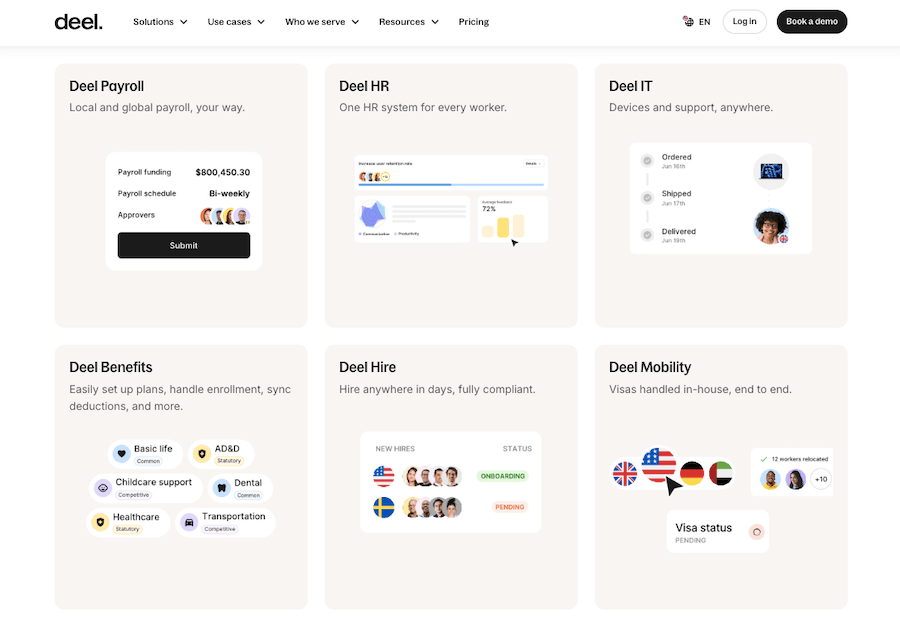
Deel launched in 2019 and has since become one of the most recognized names in global workforce management. It is not a narrow EOR tool, it is a full HR platform covering contractor management, global payroll, equity, immigration, IT provisioning, and more. That breadth is both its greatest strength and the reason some teams find it more than they need.
What separates Deel from most competitors is the scale of its entity network. With owned legal entities in over 100 countries and partner coverage beyond that, Deel gives companies the ability to hire almost anywhere without depending on third-party intermediaries for compliance.
For fast-scaling teams hiring across multiple regions simultaneously, that infrastructure matters.
The trade-off is cost and complexity. Deel is not the cheapest option, and teams that only need basic EOR services may find themselves paying for functionality they never use. But for companies that are growing quickly and need a platform that can grow with them, Deel is one of the few that genuinely scales without requiring a platform switch later.
About Remote
Remote was built with a specific philosophy: own the entities, own the compliance. Every country Remote operates in is covered by a fully owned legal entity, not a partner network. This means Remote takes on direct legal responsibility for employment in every market it serves, which gives HR and legal teams a cleaner risk profile than platforms that rely on third parties.
The platform is designed as an all-in-one system for distributed teams, combining EOR, contractor management, payroll, compliance, and HR tools in one place.
Remote’s IP protection framework is particularly strong, which makes it a preferred choice for tech companies hiring engineers internationally, where intellectual property ownership is a genuine concern.
Remote costs less for contractor management than Deel and offers a free trial, which makes it easier to evaluate before committing. The platform is a stronger fit for companies that prioritize compliance depth and want a single trusted provider rather than a broad feature set with partner dependencies.

Quick Facts · Deel vs Remote 2026
Deel Vs Remote: Rating Comparison
Deel scores higher on six of eight parameters. The gaps on global coverage (4.7 vs 4.2) and integrations (4.6 vs 3.6) reflect structural differences, not opinion. Remote’s only lead is compliance strength (4.4 vs 4.6, close, but genuine) and pricing value (4.1 vs 3.6), where the zero-deposit policy does most of the work.
Both platforms score within 0.2 of each other on ease of use and onboarding. Support is the shared weak point; neither platform has solved urgent payroll escalation at the standard tier.
Editor’s Rating · HRStacks 2026
How Deel and Remote Score Across 8 Parameters
Deel Vs Remote: Price Comparison
The headline EOR rate is identical: $599 per employee per month on annual billing. What sits beneath that number is where the real comparison happens.
Deel requires a deposit of 1 to 1.5 times total monthly employment cost before the first payroll runs. That doesn’t appear on the pricing page.
On a 10-person team it locks up $6,000 to $9,000 in working capital before a contract goes live. Remote charges no deposit, no setup fee, and no offboarding fee on any plan.
Deel’s platform breadth means more line items: IT management from $45 per user per month, Core HR from $5, Full HR suite at $56, immigration custom-priced separately.
Remote’s pricing is structurally simpler, EOR at $599, contractor management at $29, a Contractor Management Plus tier at $99 with $100K misclassification indemnity, and HR Management free for up to 12 direct employees.
Verified Pricing · May 2026
Deel vs Remote: What You Actually Pay
Both platforms publish their core rates. Deel’s deposit requirement — 1 to 1.5× total monthly employment cost, not listed on the pricing page — is the number to resolve before you sign. Remote charges no deposit on any plan.
Full legal employment in 110+ countries. Payroll, tax filings, benefits, compliant contracts. 24/7 in-app chat support.
All Standard features plus dedicated onboarding manager, in-app redlining, legal response guarantees, dedicated Slack/Teams channel, SSO/SAML.
Compliant contracts, automated invoicing, payments in 120+ currencies. Misclassification liability stays with the client.
Deel acts as legal contracting entity. Owns compliance, classification, and misclassification risk directly.
For companies with existing entities. Multi-currency payroll, local tax and statutory filing, accounting integrations.
Employee records, time off, org charts, compliance insights, people analytics. Entry-level HRIS tier.
Includes Core HR, performance cycles, compensation planning, headcount forecasting, and anonymous reporting.
Co-employment across all 50 US states. Payroll, benefits, compliance. Best for teams already on Deel EOR internationally.
Device lifecycle management, MDM, and endpoint protection. No other EOR platform offers IT management natively.
EOR across 80–90+ countries through 100% owned entities. Payroll, tax, statutory benefits, IP Guard, self-serve onboarding. $699 month-to-month.
Localized contracts, invoice management, multi-currency payments across 180+ countries. Fair Price Guarantee — only pay for active contractors.
Adds robust indemnity protection and compliance coverage up to $100,000 per contractor for misclassification penalties.
Remote takes on full legal responsibility for contractor onboarding, tax management, and payments. Uncapped indemnity protection.
For companies with existing entities. Implementation fee applies on setup; recurring payroll delivery fee applies per cycle.
Employee records, time off, expenses, document management, performance reviews. No payroll processing included.
Hire and manage employees across all US states. Payroll, compliance, benefits access, dedicated HR and compliance experts.
Equity grants across 70+ countries via Easop acquisition. Tax handling, compliance documentation, for Delaware C-Corps.
Pre-seed through Series A companies. Brings EOR effective rate to ~$509/month. Applies to EOR and contractor management.
Deel Vs Remote: Pros & Cons
Deel’s strengths are structural, entity count, integration depth, platform breadth. Its weaknesses are equally structural: the highest published price in the category, a deposit that surfaces after you’ve started, and support that hasn’t scaled with the platform.
Remote’s case rests on three specific things it does that Deel doesn’t: zero deposit, IP protection in every contract, and a fully owned compliance chain with no partner firm in the middle.
Based on 26,800+ Deel reviews and 4,000+ Remote reviews
Strengths & Limitations
250 owned entities — direct legal employer in most markets
Not a partner network. Compliance disputes go to Deel’s in-house legal team, not a subcontractor you’ve never spoken to.
130+ native integrations — QuickBooks, Xero, NetSuite, Workday
Finance teams running any of these get native payroll cost sync. Remote covers Xero and QuickBooks but stops well short of Deel’s depth at NetSuite and Workday.
EOR, HRIS, IT, immigration, and payroll in one login
No other EOR platform covers all five without stitching vendors. Device management alone — across 130+ countries — has no equivalent in this category.
Certified Workday Global Payroll Cloud partner since 2026
Removes the manual reconciliation step finance teams at 50+ employee companies run every payroll cycle. Remote has no certified equivalent.
Core HRIS at $5/mo replaces tools most teams pay for separately
Records, PTO, org charts, and compliance insights. For teams already paying BambooHR on top of an EOR, the consolidation math is real.
$599 base plus a deposit that isn’t on the pricing page
1–1.5× monthly cost locked up before payroll one. On 10 employees that’s up to $9,000. Remote charges none of it at the same headline price.
No named CSM at standard tier — chatbot routes before humans do
During peak payroll periods, response times stretch. The dedicated Slack channel is Enterprise-only at $899. Documented consistently across G2 and Capterra.
Platform breadth creates a real onboarding curve for new admins
Help docs skew toward contractors, not company-side admins. At $599 per employee, the internal onboarding experience should be sharper than it is.
100% owned entities — no partner anywhere in the compliance chain
Every EOR market Remote covers is backed by a legal entity it owns outright. When something goes wrong in Germany or Singapore, there’s no third party to redirect blame to.
Zero deposit, zero setup fee, zero offboarding charge
At the same $599 headline rate as Deel, Remote removes the cash-flow friction entirely. For a 10-person team that’s up to $9,000 that stays in your account.
IP Guard built into every EOR contract — not a policy document
Your code and product stay legally anchored to your company regardless of where the engineer is based. No other EOR in this comparison makes IP protection contractual by default.
Clean platform — employees self-serve without raising tickets
The one thing G2, Capterra, and Trustpilot reviewers agree on regardless of their other frustrations. Payslips, time off, expenses — all handled without HR involvement.
Benefits layer caught up fast — Kota and Easop both landed in 2024
Global health insurance via Kota, equity management across 70+ countries via Easop. Remote’s benefits were thin for years. That gap has closed meaningfully.
Ticket-based support — no CSM at standard tier
A payroll issue that needs same-day resolution sits in a queue that Trustpilot’s 3,078 reviews describe as running 24–48 hours. Oyster HR at the same price gives you a named contact.
Integration depth stops at mid-market — SAP and Oracle need workarounds
50+ native connections covers BambooHR, HiBob, Greenhouse, Xero. Enterprise stacks running SAP SuccessFactors or Oracle HCM will be doing manual exports from day one.
Payroll reporting is too basic for finance teams managing 10+ markets
Payslips and headcount summaries work. Cross-country variance analysis and cost drill-down need an external BI tool. Papaya Global built an entire finance intelligence layer for exactly this problem.
Deel Vs Remote: Top Features
The feature gap between Deel and Remote is widest on two dimensions: integration depth and platform scope. Deel covers ground Remote doesn’t touch, IT management, immigration, AI agents, and a US PEO alongside EOR. Remote’s feature advantage is narrower but specific: IP Guard at the contract level and a fully owned compliance chain in every covered market.
Where the two platforms genuinely overlap, EOR, global payroll, contractor management, and HRIS, the difference comes down to depth of coverage and how well each handles the markets you’re actually hiring in.
Feature Comparison · Deel vs Remote 2026
How the Two Platforms Compare on Core Capabilities
Deel Vs Remote: Integration Ecosystem
This is the clearest gap in the comparison. Deel’s 130-plus native connections cover the full finance and HR stack, accounting, HCM, ATS, and payroll all connect without middleware. Remote’s 50-plus connections handle the mid-market well but stop at enterprise systems. SAP SuccessFactors and Oracle HCM users hit manual export workarounds from day one.
The practical consequence shows up every payroll cycle. Finance teams on NetSuite or Workday get automated cost sync with Deel. With Remote, that reconciliation is a manual step.
Integration Ecosystem · Verified May 2026
Deel vs Remote: Native Connections by Category
Deel Vs Remote: Key Differences
At $599 each, the headline price tells you nothing useful. The real separation is integration depth, entity model, and what each platform includes by default. Deel wins on breadth, more countries, more integrations, more platform surface.
Remote wins on specifics, no deposit, full entity ownership in every covered market, and IP protection that’s written into the contract rather than left to policy.
Where Each Product Genuinely Wins
Key Differences
Remote covers Xero and QuickBooks then stops. Finance teams on NetSuite or Workday get automated payroll cost sync with Deel. With Remote, that reconciliation is manual every cycle.
Deel operates 250 owned entities but some partner markets still exist. Every country Remote covers for EOR is a legal entity it owns outright. No partner to redirect to when something goes wrong.
For teams hiring in markets outside Europe and North America, Deel’s broader entity footprint is the deciding factor. Remote’s coverage thins in parts of APAC and LATAM.
Deel requires 1–1.5× monthly employment cost upfront. Remote requires none of it. At $599 per head, that’s a real cash-flow difference before a single contract goes live.
Remote covers EOR and payroll. Deel adds device management across 130+ countries, immigration case management, and 7 AI agents — without switching tools or vendors.
Built into every EOR contract. Code, designs, and product stay legally anchored to the hiring company. Deel has no equivalent structural default — it’s a policy gap that matters for engineering teams.
Direct bidirectional sync between Deel and Workday — no export, no middleware. Remote has no certified equivalent. For enterprises already running Workday as their HCM, this removes a recurring manual step.
Pre-seed through Series A companies get 15% off EOR for 12 months. Deel publishes no equivalent. For early-stage teams where every dollar compounds, that gap is $1,080 per employee per year.
Deel Vs Remote: Use Cases
Deel and Remote serve genuinely different buyers despite the identical price tag. The four scenarios below are built from pricing data, entity coverage, integration depth, and documented review patterns, not hypotheticals.
The clearest Deel use case is a finance-led team on NetSuite or Workday hiring across 10-plus countries who needs payroll costs synced automatically. The clearest Remote use case is a tech company hiring engineers internationally where IP ownership can’t be an afterthought.
The two nuanced scenarios are where the decision gets harder and where the wrong choice is more expensive than it looks.
Series B company hiring across UK, Germany, and Brazil with a NetSuite or Workday finance stack
Deel connects to NetSuite and Workday natively — payroll costs sync without a manual export step. Remote covers both tools but Deel’s certified Workday Global Payroll Cloud partnership since 2026 removes a reconciliation step finance teams at this scale run every single cycle. Germany and Brazil are heavily regulated markets where Deel’s in-house legal teams carry compliance accountability directly. At 20-plus employees, volume discounts bring the effective rate to $400–$500 per employee — closing the gap with cheaper alternatives while the integration depth stays intact.
US tech company hiring software engineers across UK, Germany, and India — IP ownership is non-negotiable
Remote IP Guard is built into every EOR contract — code, product, and designs stay legally anchored to the hiring company from day one. Deel has no structural equivalent. On a 10-person engineering team, Remote also removes up to $9,000 in deposit requirements that Deel locks up before payroll one. All three markets are covered through Remote’s fully owned entities, meaning compliance accountability sits with Remote directly — no partner chain involved. For a Series A company where both working capital and IP ownership matter, this is Remote’s most straightforward use case.
Mid-market company consolidating EOR, HRIS, and IT management — currently running 3 separate vendors
Deel consolidates all three into one login — EOR, Core HR at $5 per employee per month, and IT device management from $45 per user per month. Remote covers EOR and a free HRIS for up to 12 direct employees, but device management is not natively integrated. If IT management is part of the consolidation brief, Deel is the only platform in this comparison that handles it. If the brief is EOR plus basic HRIS only, Remote’s free HR Management tier and zero deposit make it the leaner choice.
Early-stage startup making first 3–5 international hires in Europe with a tight runway
Remote’s 15% startup discount brings EOR to approximately $509 per employee per month for the first 12 months. No deposit, no setup fee. On 5 employees that’s roughly $5,400 saved against Deel’s standard terms in year one before salaries are counted. Deel works in all three markets and the compliance is solid, but the platform depth — IT management, immigration tools, 130-plus integrations — won’t get used at this headcount. Remote is the more efficient starting point. Revisit Deel when headcount crosses 15 and integration requirements start to matter.
Deel Vs Remote: User Sentiments
Deel’s 26,800-plus reviews across public review platforms make its patterns statistically reliable. Remote’s 4,000-plus is a meaningful sample but thinner. Trustpilot’s 3,078 Remote reviews carry most of the weight, and that’s where support complaints concentrate most visibly.
The scores tell a consistent story on both sides. What users praise about each platform is specific and recurring. What they complain about is equally specific and maps directly to the scores on customer support and integrations.
User Sentiments
What real users say — review platform scores
Deel Vs Remote: Final Verdict
Deel and Remote are the only two platforms in the EOR category that charge $599 per employee per month and own their legal entities directly. The similarity ends there.
Deel is the right choice for teams where integration depth and platform breadth drive the decision. If your finance stack runs on NetSuite, Workday, or SAP, if you need IT management alongside EOR, or if you’re hiring across 10-plus countries and want one vendor covering the full employment lifecycle, nothing in this comparison matches what Deel has built.
Remote is the right choice when the deposit is a problem, when IP protection needs to be contractual rather than assumed, and when your hiring is concentrated in Europe or North America where its owned-entity model is strongest.
The one scenario where Remote wins unconditionally: any tech company hiring engineers internationally where IP ownership is non-negotiable. At the same $599 price, Remote IP Guard alone changes the evaluation.
Neither platform is the wrong answer. They’re answers to different questions.
Final Verdict
Same price, opposite strengths — the right choice depends on what you’re actually solving for
Deel wins on platform breadth, integration depth, and country coverage. Remote wins on compliance purity, zero deposit, and IP protection built into every contract. At $599 each, the decision comes down to your finance stack, your hiring region, and whether IP ownership needs to be contractual from day one.
Frequently Asked Questions
Deel vs Remote — Common Buyer Questions
Remote. Pre-seed through Series A companies get 15% off EOR for the first 12 months, bringing the effective rate to approximately $509 per employee per month. No deposit, no setup fee, no minimum headcount. On 5 employees that saves roughly $5,400 against Deel’s standard terms in year one.
Deel works fine at early stage but the platform depth — IT management, 130-plus integrations, immigration tools — won’t get used at 3 to 5 employees. Remote is the more efficient starting point. Revisit Deel when headcount crosses 15 and stack complexity starts to matter.
No. Remote charges no deposit on EOR or contractor management. Deel requires a refundable deposit of 1 to 1.5 times total monthly employment cost before the first payroll runs. On a 10-person team at $599 per employee that locks up $6,000 to $9,000 before a single contract goes live. It does not appear on Deel’s pricing page — confirm the exact amount in writing before signing.
Both hold SOC 2 Type 2, ISO 27001, and GDPR certification. The structural difference is the entity model. Remote operates 100% owned entities in every EOR market it covers — no third-party partners anywhere in the compliance chain. Deel operates 250 owned entities but some partner markets still exist.
For legal and procurement teams where the chain of compliance accountability matters, Remote’s fully-owned model is the cleaner argument. Deel scores 4.6 on compliance vs Remote’s 4.4 on HRStacks — reflecting its broader certification depth including the certified Workday Global Payroll Cloud partnership since 2026.
Yes — and it is the clearest reason tech companies choose Remote over Deel. Remote IP Guard is built into every EOR contract by default. Your code, designs, and product stay legally anchored to your company regardless of where the engineer is based. Deel has no structural equivalent. For any company hiring software engineers internationally where IP ownership is non-negotiable, this alone changes the evaluation.
Deel covers 110-plus countries for EOR versus Remote’s 80 to 90-plus. For contractor payments the gap reverses — Remote covers 180-plus countries, Deel covers 150-plus.
The more useful question is which platform covers your specific markets through owned entities. Remote’s coverage is strongest in Europe and North America. If your primary hiring is in APAC or LATAM, verify country-level availability with both platforms before committing — Remote’s coverage thins in those regions.
Both score closely — Deel at 4.4 and Remote at 4.3 on HRStacks. Remote edges ahead for employees: the self-serve portal handles payslips, time off, and expenses without raising a ticket, and reviewers on all three platforms agree on this regardless of their other frustrations.
Deel’s platform breadth creates a steeper learning curve for new company-side admins. Help documentation skews toward contractors rather than HR teams. At $599 per employee, that onboarding experience should be sharper than it is.
Deel — and it is not close. 130-plus native connections versus Remote’s 50-plus. Deel connects natively to QuickBooks, Xero, NetSuite, Workday, SAP SuccessFactors, Greenhouse, and Lever. Remote covers Xero, QuickBooks, NetSuite, BambooHR, HiBob, and Greenhouse — solid for mid-market teams, but SAP and Oracle users hit manual export workarounds immediately.
Deel became a certified Workday Global Payroll Cloud partner in early 2026, removing a manual reconciliation step for finance teams already running Workday as their HCM. Remote has no certified equivalent. If your stack includes enterprise HCM or ERP systems, Deel is the only realistic option in this comparison.