





Multiplier vs. Papaya Global Comparison Summary
When you’re hiring across borders, both Multiplier and Papaya Global promise to simplify the mess of compliance, payroll, and contracts. But they take slightly different routes to get there.
This comparison breaks down how each platform actually works in practice, where they feel different day to day, and which one tends to fit better depending on how your team operates.
Product Overview
At a high level, both platforms sit in the same category: global employment infrastructure. They let you hire employees and contractors internationally without setting up local entities. But the way they approach that job feels quite different once you’re inside the product.
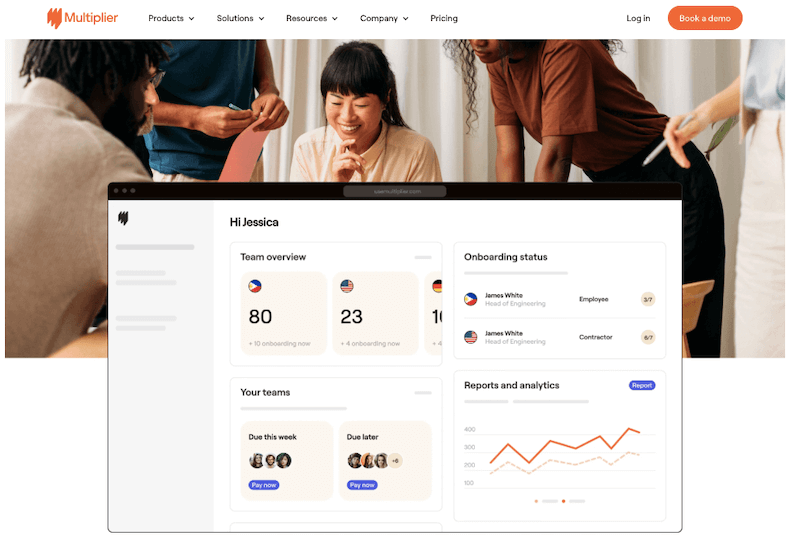
Multiplier leans into a product-led, automation-first experience. It’s built for teams that want speed, control, and minimal back-and-forth. You can onboard employees, generate compliant contracts, and run payroll with relatively little manual intervention.
In practice, we’ve seen startups and mid-sized companies gravitate toward Multiplier when they already have internal HR or ops teams and want a system that doesn’t slow them down.
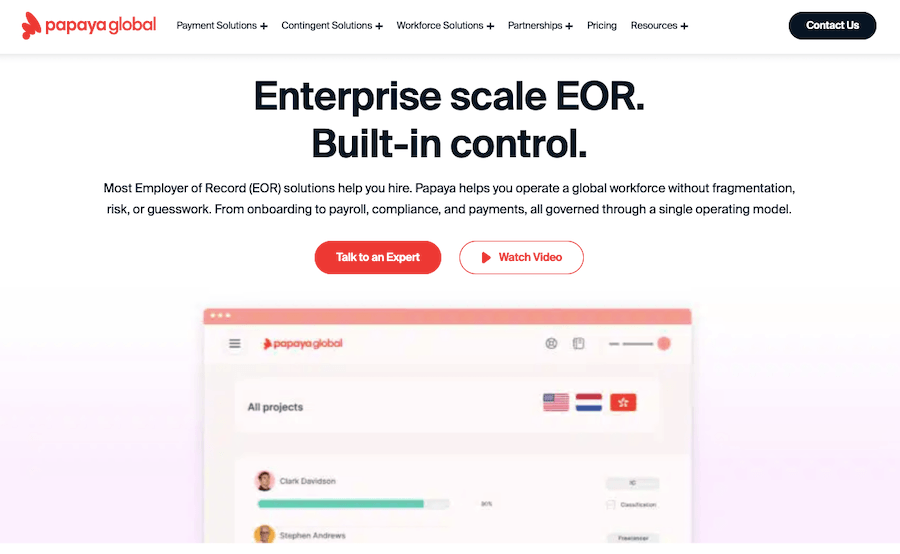
Papaya Global, on the other hand, comes across as more service-supported and payroll-centric. The platform is strong, but there’s a noticeable emphasis on guided workflows, compliance assurance, and regional expertise.
Larger organizations, especially those dealing with complex payroll structures or multiple employment models, often prefer Papaya because it feels more like a managed system than a self-serve tool.
Multiplier vs. Papaya Global: Feature Comparison
| Feature | Multiplier | Papaya Global |
|---|---|---|
| Global Coverage | 150+ countries (EOR + contractors) | 160+ countries (EOR + payroll + contractors) |
| Platform Type | Unified global employment platform | Payroll-first global workforce platform |
| Onboarding Speed | Fast, self-serve (often a few days) | Structured onboarding with compliance checks |
| Contractor Support | Yes – fully self-serve | Yes – managed within platform |
| Payroll Engine | Centralized, automated multi-country payroll | Strong localized payroll with compliance layers |
| Benefits | Standardized global packages | Customized, country-specific benefits |
| Compliance & IP Protection | Built-in compliance workflows + IP protection | Compliance oversight with local expertise |
| UX / UI | Clean, modern, product-driven | Functional, slightly more process-heavy |
| Integrations | API + integrations (HR, finance tools) | Integrations with ERP, HRIS, finance systems |
| Customer Support | Dedicated manager + chat/email | 24/7 support + regional experts |
| Pricing | Transparent, per employee/contractor | Custom pricing based on scope |
| Security Certifications | GDPR, SOC 2 aligned | GDPR, ISO-aligned frameworks |
| Scalability | Ideal for startups to mid-market scaling | Built for mid-market to enterprise complexity |
Where It Actually Feels Different
Onboarding & Time-to-Hire
With Multiplier, onboarding is quick and largely self-driven. You input details, generate contracts, and move forward without waiting on multiple approvals.
For a fast-moving team hiring across, say, Southeast Asia and Eastern Europe, this speed makes a difference. No bottlenecks. No chasing updates.
Papaya Global takes a more structured approach. There’s typically more validation, especially around compliance and payroll setup.
That slows things slightly, but it also reduces the risk of misclassification or payroll errors. If you’re operating in stricter jurisdictions, that trade-off can be worth it.
Payroll Execution
This is where Papaya Global really stands out.
Its payroll engine is deeply localized. It handles tax calculations, filings, and statutory nuances in a way that feels closer to traditional enterprise payroll systems. If you’ve ever dealt with multi-country payroll inconsistencies, you’ll appreciate that level of control.
Multiplier keeps payroll simpler and more centralized. It works well for standard employment setups, but it doesn’t go as deep into country-specific payroll complexity.
So the question becomes:
Do you need precision at a granular level, or consistency across regions?
Compliance & Risk Management
Both platforms cover compliance, but they approach it differently.
Multiplier embeds compliance directly into workflows. Contracts, IP protection, and employment terms are baked into the system. You don’t think about compliance as a separate step; it’s just part of the process.
Papaya Global feels more advisory. There’s stronger visibility into compliance checks, and often more human involvement in edge cases.
We’ve seen legal and finance teams prefer Papaya for this reason. It gives them confidence, especially when entering new markets.
User Experience & Daily Use
Multiplier is easier to navigate. The interface is clean, and most actions take fewer steps.
If your team values autonomy, this matters more than you’d expect.
Papaya Global is functional but slightly heavier. There are more steps, more checks, and more structured workflows.
It’s not friction for the sake of it. It’s there to support accuracy.
Still, some teams will feel the difference.
Support & Customer Experience
Here’s where the gap narrows.
Multiplier offers responsive support and a dedicated account manager. It’s efficient, but still largely product-driven.
Papaya Global leans harder into high-touch support. You’ll often interact with regional experts who understand local labor laws and payroll nuances.
And that shows up in retention. Users frequently stick with Papaya because of the support layer, not just the software.
Multiplier vs. Papaya Global: Editor’s Note
If you step back, the distinction is pretty clear.
Multiplier is built like a modern SaaS product. It assumes you want speed, visibility, and control. You log in, get things done, and move on.
Papaya Global feels closer to a hybrid between software and service. It’s not just about executing tasks, it’s about getting them right across different jurisdictions.
We’ve seen mid-sized, fast-scaling companies lean toward Multiplier because it keeps hiring friction low.
Meanwhile, enterprises or finance-heavy teams often prefer Papaya Global, especially when payroll complexity starts creeping in.
Neither approach is better across the board.
It depends on how much support you actually need.
Multiplier vs. Papaya Global: Final Recommendation
Choose Multiplier if you:
- Want a fast, self-serve platform for global hiring
- Prefer automation over manual coordination
- Have an internal HR or ops team handling compliance oversight
- Need to onboard talent quickly across multiple countries
Choose Papaya Global if you:
- Need deep payroll accuracy across multiple jurisdictions
- Value hands-on support and compliance guidance
- Operate in complex regulatory environments
- Want a more structured, risk-aware approach to global hiring
Verdict
If speed, control, and simplicity matter most, Multiplier has the edge. It’s built for teams that don’t want to wait around.
If your priority is payroll accuracy, compliance depth, and guided support, Papaya Global delivers more reassurance.
In the end, it’s not about which platform is better. It’s about how your team prefers to operate when things get complicated.