

Pebl Vs Multiplier: Detailed Comparison 2026

A detailed side-by-side Pebl Vs Multiplier comparison to help you select the best option between these two solutions. We have considered top features, pros and cons, pricing and other details to help you choose the right solution.
Pebl Logo

Pebl

HRS Score: 91%
usemultiplier_logo

Multiplier

HRS Score: 92.5%

HR Stacks offers comprehensive, data focused and unbiased solutions. We may earn a referral fee when you visit a vendor through our links

Pebl Vs Multiplier: Overview

What is Pebl?

Pebl is a global employment solution for organizations to streamline their overall HR operations right from onboarding, managing & paying employees

Pebl Company Profile

Co Name: Velocity Global LLC
HQ: Denver, Colorado, United States
Est Year: 2014
Company Size
501-1000 employees
Website

What is Multiplier?

Multiplier is one of the leading global employment and EOR solution that you may use to hire and manage international workforce.

Multiplier Company Profile

Co Name: Multiplier Technologies Pte. Ltd.
HQ: New York, United States
Est Year: 2020
Company Size
501-1000 employees
Website

Pebl Vs Multiplier: HR Stacks Score

Pebl Vs Multiplier HR Stacks score based on a number of data points. We check the features, user feedback, community sentiments while adding the score. The score will give you some idea about the overall quality of the products.

Pebl Score

Ease of Use 90%
Features 92%
Value for Money 92%
Support 90%

Pebl: Editor's Rating

Pricing & Value
4.1/5
Users feel Pebl offers strong value for large-scale global hiring and complex compliance needs; some smaller companies note the premium cost may be harder to justify given overlapping services.
Global Coverage
4.5/5
Pebl supports hiring in 185+ countries and positions itself as one of the most globally capable EORs in the market.
Compliance & Local Expertise
4.4/5
Reviewers frequently highlight Pebl’s deep regulatory know-how, especially in complex markets. Some feedback indicates service consistency varies depending on region.
Payroll & Benefits
4.0/5
The payroll and benefits support is solid for many users, but there are mentions of limitations in benefit customization and employee experience in certain jurisdictions.
Onboarding & Employee Experience
4.2/5
Many clients report smooth onboarding with dedicated account teams and strong support. Some slower responses or localized friction occur when non-standard workflows are required.
Platform & Ease of Use
4.0/5
The platform interface is described as clean and intuitive by many users, although a few feel that deeper integrations or bespoke configurations could be easier to handle.
Integrations
3.9/5
Pebl offers meaningful integrations with HRIS/HCM systems and global payroll tools, yet there are customer comments pointing to gaps in niche tool compatibility and setup complexity.
Customer Support
3.8/5
Feedback is mixed: support teams get good marks for responsiveness and expertise in many regions, but some clients report inconsistent follow-through or slower turnaround in less-mature markets.
Overall Score
4.2/5
Pebl stands out as a top-tier global Employer of Record solution, particularly well suited for companies scaling into many countries with complex compliance demands. If your hiring footprint is very broad and you value regulatory certainty, it’s a strong fit.

Multiplier Score

Ease of Use 92%
Features 94%
Value for Money 92%
Support 90%

Multiplier: Editor's Rating

Pricing & Value
3.7/5
Competitive and fairly transparent for standard EOR needs; pricing feels a bit rigid for very small teams or specialized setups.
Global Coverage
4.3/5
Strong footprint across 150+ countries; a few lesser-known markets may still require extra back-and-forth.
Compliance Strength
4.4/5
Reliable for most international hiring and statutory rules; edge-case legal scenarios may need more manual handling.
Onboarding Experience
4.2/5
Fast and straightforward for most locations; some regions still involve extra steps or slower verification.
Payroll & Benefits
3.9/5
Solid multi-currency payroll and localized benefits; not as deep as full HRIS-level benefits administration.
Integrations
3.5/5
Covers the essentials but lacks the wider app ecosystem and advanced integrations found in more mature platforms.
Customer Support
4.3/5
Generally responsive and helpful; occasional delays show up in complex or country-specific cases.
Ease of Use
4.1/5
Clean interface and simple workflows; minor learning curve when handling advanced or non-standard hiring paths.
Overall Score
4.0/5
A strong global EOR platform known for coverage, compliance and ease of use; less ideal if you need deep integrations or heavy customization.

Pebl Vs Multiplier: Pricing Comparison

Pebl Vs Multiplier pricing comparison. The pricing is one of the most important aspect to look at when we compare two products. It can be an important aspect to make a decision.

Pebl Pricing Details

Free Version: No

Free Trail: No

Starting Price: Custom Pricing

Multiplier Pricing Details

Free Version: No

Free Trail: No

Starting Price: $40/Month

Pebl Vs Multiplier: Pros & Cons

Pebl Pros & Cons

Pros of Pebl

Extensive global employment coverage
The platform supports hiring, payroll, and compliance in many countries, helping companies expand internationally without establishing local legal entities.
Strong compliance expertise
HR teams benefit from built-in legal guidance and localized employment support, reducing risks when navigating complex labor regulations across multiple jurisdictions.
Reliable global payroll processing
The system centralizes payroll across countries, helping finance and HR teams manage payments, taxes, and reporting more consistently.
Handles complex international hiring
Organizations managing distributed teams appreciate the ability to onboard employees in different countries while maintaining compliant employment structures.

Cons of Pebl

Premium pricing compared to competitors
Smaller companies sometimes find the service expensive, especially when hiring only a few international employees through the platform.
Platform interface can feel fragmented
Some users report the interface requires time to learn, particularly when managing payroll, onboarding, and compliance tasks across multiple regions.
Integration ecosystem is somewhat limited
Compared to newer HR platforms, integration options with HRIS and finance systems are fewer and occasionally require manual configuration.

Multiplier Pros & Cons

Pros of Multiplier

Strong global employment coverage
The platform enables companies to hire and manage employees across many countries without establishing local entities, simplifying international workforce expansion.
Centralized international payroll management
HR teams can process multi-country payroll, taxes, and payments from one dashboard, reducing manual coordination across regional payroll vendors.
Clear compliance and contract support
Localized employment contracts and compliance guidance help organizations navigate labor laws, lowering the risk of legal or payroll compliance mistakes.
Structured onboarding workflows
Built-in onboarding processes guide HR teams through required documentation, contracts, and compliance steps when hiring employees in new countries.
Fast international hiring setup
Companies can onboard international employees relatively quickly without establishing legal entities, which helps teams scale hiring in new markets faster.
Multi-currency payment handling
The system supports payments in multiple currencies, helping finance and HR teams manage global payroll without coordinating separate banking workflows.

Cons of Multiplier

Limited broader HR management features
The platform focuses primarily on global employment and payroll, so organizations may still need a separate HRIS for performance, engagement, or workforce planning.
Integration ecosystem still developing
While integrations exist, the selection is smaller than mature HR platforms, sometimes requiring manual data transfers between systems.
Benefits options vary by country
Employee benefits availability and customization can differ across regions, which may limit flexibility when designing consistent global benefits packages.

Pebl Vs Multiplier: Top Features

Pebl Vs Multiplier top features. In this list of features, we haven’t included all the features that the products has to offer. However, we tried to add the important ones to give you a competitive idea.

Top Features of Pebl

Global payroll processing
Employer of Record (EOR)
Centralized Employee Records
Contractor & Freelancer Management
Compensation & Pay Schedules
Global Benefits Enrollment
Time-Off Tracking
User Roles & Permissions
Custom Reporting & Analytics
Talent Sourcing & Onboarding

Top Features of Multiplier

Global Payroll Management
HR Lifecycle Management
Employee Stock Ownership Plan
Hire & Onboard Freelancers
Global Compliance Management
Reporting Capabilities
Tax Management
Contract Management
Expense & Leave/PTO Management
Employee Database management

Pebl Vs Multiplier: Demo

Understand the products better by checking the demo videos listed below. 

Pebl Demo Video

Multiplier Demo Video

Featured HR Tech Solutions
Deel Logo
Deel
Deel is a well-recognized all-in-one HR solution...
Pebl Logo
Pebl
Pebl (formerly Velocity Global) is a leader...
usemultiplier_logo
Multiplier
Multiplier is an emerging global employment platform...
Monday.com Logo
monday.com
monday.com is a work operating system that...

If you’re hiring across borders, both Pebl and Multiplier will get you there. They solve the same problem on paper. In practice, they feel quite different to run.

Pebl leans heavily into guidance and compliance support. Multiplier is faster, more product-driven, and built for teams that prefer to move without waiting. That’s really the core difference, and it shows up everywhere once you start using them.

Pebl Vs Multiplier: Product Overview

Both platforms cover EOR, contractor management, and global payroll. But they’re built with different assumptions about how you want to operate.

Pebl (formerly Velocity Global)

Pebl is still best understood through its roots as Velocity Global. The rebrand is new, but the model hasn’t changed much. It’s service-first. You’re not just using software; you’re working with a team that actively helps you navigate local employment laws, contracts, and edge cases.

This tends to resonate with companies entering unfamiliar markets or dealing with complex hiring structures. You’re not expected to figure everything out yourself. In fact, most customers don’t.

Pebl Review

Multiplier

Multiplier comes at the same problem from the opposite angle. It’s built like a product you can actually run with. You log in, onboard employees, generate contracts, run payroll. Done.

There’s support when you need it, but the default experience is self-serve. That’s why it’s become popular with startups and mid-sized teams scaling quickly. You don’t want friction when you’re hiring across five countries in a quarter.
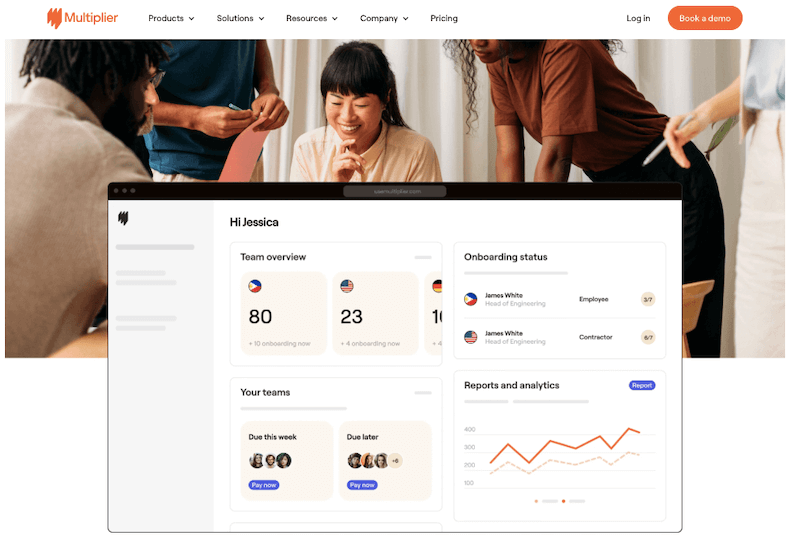
Multiplier-Review

Pebl Vs Multiplier: Feature Comparison

FeaturePebl (Velocity Global)Multiplier
Global Coverage185+ countries (mix of owned + partner entities)150+ countries (owned + partner network)
Platform TypeService-led EOR with platform supportProduct-led EOR + contractor platform
Onboarding SpeedTypically longer due to compliance checksOften within a few days in many regions
Contractor SupportYes – managed with compliance reviewYes – self-serve onboarding
Payroll EngineManaged payroll with local expertiseCentralized multi-country payroll
BenefitsTailored, country-specific packagesPre-configured + customizable options
Compliance & IP ProtectionStrong advisory + in-country expertsBuilt-in compliance workflows + IP protection
UX / UIFunctional, service-supportedClean, intuitive dashboard
IntegrationsCore HRIS + finance integrationsAPI + integrations (HR, accounting tools)
Customer SupportDedicated account teamsChat + account managers (tiered)
PricingCustom pricing, service-inclusiveTransparent pricing, lower entry point
Security CertificationsGDPR, ISO-aligned standardsGDPR, SOC 2, ISO
ScalabilityEnterprise-ready global expansionStartup to mid-market scaling

A quick note on coverage and timelines: these vary more than vendors like to admit. The country and the role matter more than the marketing line.

Where the Differences Start to Show

Onboarding: speed vs scrutiny

Multiplier is quick. In many cases, you can move from offer to onboarding in a few days. Contracts are generated, workflows are clear, and you’re not waiting on multiple approval layers.

Pebl takes longer, and not by accident.

There’s usually more back-and-forth, especially in regions with stricter labor laws. We’ve seen this play out in parts of Europe where small compliance details can delay things. Pebl tends to catch those upfront. Slower, yes. But also fewer surprises later.

That’s the trade-off.

Compliance: built-in vs guided

Pebl feels like having a compliance partner sitting next to you.

You’ll get input on contracts, hiring structures, and local requirements before things go live. For companies expanding into unfamiliar regions, this reduces a lot of uncertainty. You’re not guessing.

Multiplier handles compliance differently. It’s embedded into the platform. Contracts, IP clauses, and country-specific rules are already baked into the workflow. You follow the steps, and you’re covered in most cases.

It works well. Until you hit something unusual. Then you may want more human input.

Payroll: consistency vs flexibility

Multiplier’s payroll system is predictable. Once it’s set up, it runs cleanly across countries. Finance teams usually appreciate that. Fewer surprises, easier reporting.

Pebl’s payroll is more locally tuned. That can be helpful in countries with complex requirements, but it also means things aren’t always standardized across regions.

We’ve seen finance teams prefer Multiplier here, especially when they’re managing multiple countries at once.

Day-to-day experience

Multiplier is easier to use. The interface is clean, workflows are straightforward, and most actions don’t require external help. If your HR team likes autonomy, this matters more than you’d think.

Pebl works, but you’ll notice the difference within a week. You rely more on your account team than the platform itself.

Some teams prefer that. Others don’t.

Pricing and what you’re actually paying for

Multiplier is more transparent. You can usually understand pricing upfront, and it’s accessible for smaller teams.

Pebl is custom-priced, and typically higher. But you’re paying for the service layer, not just the software.

We’ve seen companies underestimate how much they’ll rely on support in new markets. When that happens, Pebl starts to make more sense.

Pebl Vs Multiplier: Editor’s Note

This choice usually comes down to how your team likes to operate.

If you already have strong HR and legal capabilities internally, Multiplier feels like a better fit. It gives you speed and control without slowing things down. You’re not waiting for someone to validate every step.

Pebl is different. It’s for teams that want a second layer of assurance. If you’re hiring across multiple unfamiliar jurisdictions or dealing with edge cases, having experts involved changes the experience quite a bit.

Neither approach is wrong. But they lead to very different day-to-day workflows.

Pebl Vs Multiplier: Final Recommendation

Choose Pebl (Velocity Global) if you:

  • Want hands-on compliance guidance and legal input
  • Are entering complex or unfamiliar markets
  • Prefer a service-led model with expert involvement
  • Are okay trading speed for certainty

Choose Multiplier if you:

  • Need a fast, self-serve global hiring platform
  • Prefer clear pricing and predictable workflows
  • Have internal HR/ops resources
  • Want to scale quickly across multiple countries

Verdict

If you care about speed, control, and a product that stays out of your way, Multiplier is hard to beat.

If you’d rather have guidance, especially in markets where the rules aren’t obvious, Pebl gives you that extra layer of confidence.

It really comes down to this. Do you want to move fast on your own, or move carefully with help?

Most teams already know their answer.

Pebl Vs Multiplier Comparison FAQs

In most cases, yes. Pebl includes a service layer, so pricing tends to be higher and customized. Multiplier is generally more transparent and accessible.
Multiplier is usually the easier fit for startups due to speed, pricing clarity, and ease of use.
Yes, but it’s built into the platform rather than delivered through dedicated advisors.
They can. Both platforms support EOR, contractor management, and multi-country payroll. The difference is really in how those workflows are delivered.
Pebl typically designs benefits packages country by country, often with more customization and local input. Multiplier offers structured, pre-configured options that can be adjusted, but with less back-and-forth. If you need highly tailored benefits, Pebl tends to go deeper.
Both platforms support contractor-to-employee transitions, but the experience differs. With Multiplier, the process is fairly quick and handled داخل the platform. With Pebl, there’s usually more compliance validation involved, which can take longer but reduces risk in stricter jurisdictions.
Pebl generally aligns better with enterprise use cases, especially when multiple regions, legal structures, or compliance complexities are involved. Multiplier can scale well too, but it’s more commonly used by startups and mid-sized companies.
Multiplier has been more proactive in supporting equity workflows within the platform, especially for startups offering stock options globally. Pebl can support equity structures as well, but often through advisory and manual setup rather than a built-in workflow.
Manjuri Dutta
Article By: Manjuri Dutta

Manjuri Dutta is the co-founder and Content Editor of HR Stacks, a leading HR tech and workforce management review platform, and EmployerRecords.com, specializing in Employer-of-Record services for global hiring. She brings a thoughtful and expert voice to articles designed to inform HR leaders, practitioners, and tech buyers alike.

Related Comparisons

Remofirst vs. Pebl

Remofirst vs. Pebl

Deel vs Remofirst Comparison

Deel vs Remofirst

Rippling vs. Papaya Global Comparison

Rippling vs. Papaya Global

Remote vs. Multiplier Comparison

Remote vs. Multiplier

Multiplier vs. Papaya Global Comparison

Multiplier vs. Papaya Global

Remote vs. Gusto Comparison

Remote vs. Gusto

Rippling vs. Multiplier Comparison

Rippling vs. Multiplier

Rippling vs. Darwinbox Comparison

Rippling vs. Darwinbox

Receive the latest HR news

Subscribe To Our Weekly HR Newsletter

Get the latest from the HR & AI tech industry. All your news at one place. 

HR Stacks uses cookies

This website uses cookies to enhance user experience and to analyze performance and traffic on our website. By continuing to browse this site you are agreeing to our use of cookies.