
Quick answer: what is the difference between EOR, PEO and staffing agency?
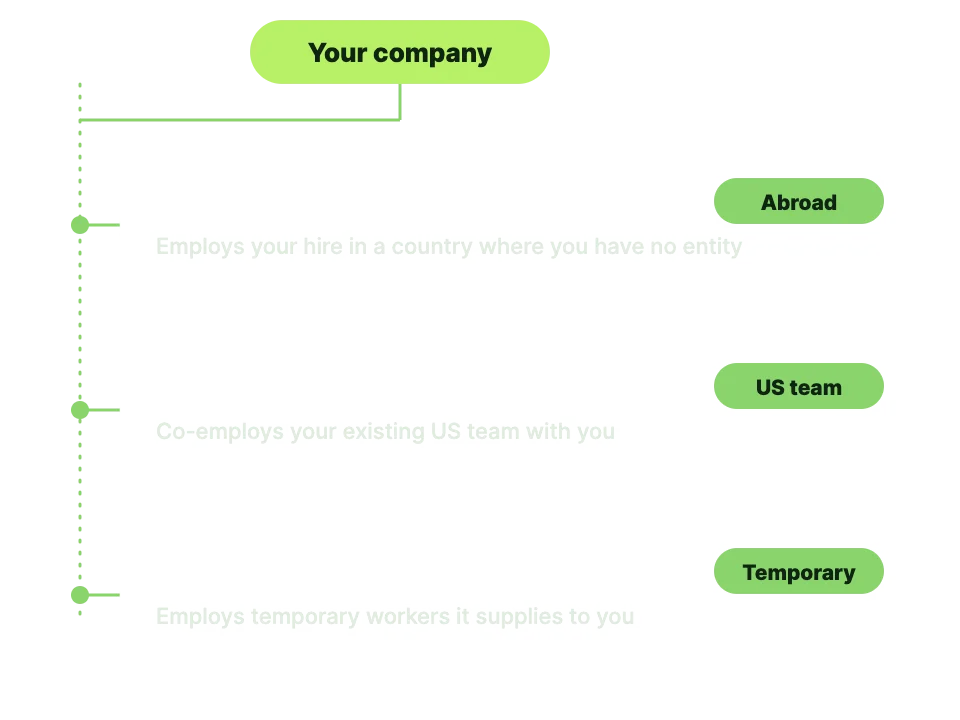
An EOR, a PEO and a staffing agency differ by who becomes your worker’s legal employer and where. An EOR employs your hire in a country where you have no entity. A PEO co-employs your existing US team. A staffing agency employs the temporary workers it supplies to you.
- Legal employerEOR alone, PEO shared, agency alone
- Typical costEOR from $599, PEO from $79 per employee monthly
- Best forHires abroad, US teams, short-term cover
- Check firstDo you have a legal entity where the worker lives?
Key takeaways
All three put a third party between you and the person doing the work. What changes is whose name is on the employment contract, who files payroll taxes, and where the arrangement is allowed to work at all. Pick the wrong one and you either cannot use it in that country or you keep liability you thought you had handed over.
EOR vs PEO vs staffing agency compared
The three differ on four points: who the legal employer is, whether you need your own entity, which countries the model covers, and how long the worker stays.
Who is the legal employer?
Under an EOR or a staffing agency, one company is the legal employer. Under a PEO, you and the PEO both are. That decides whose name is on the contract, whose tax accounts file payroll, and who answers to the labor authority when a dispute starts.
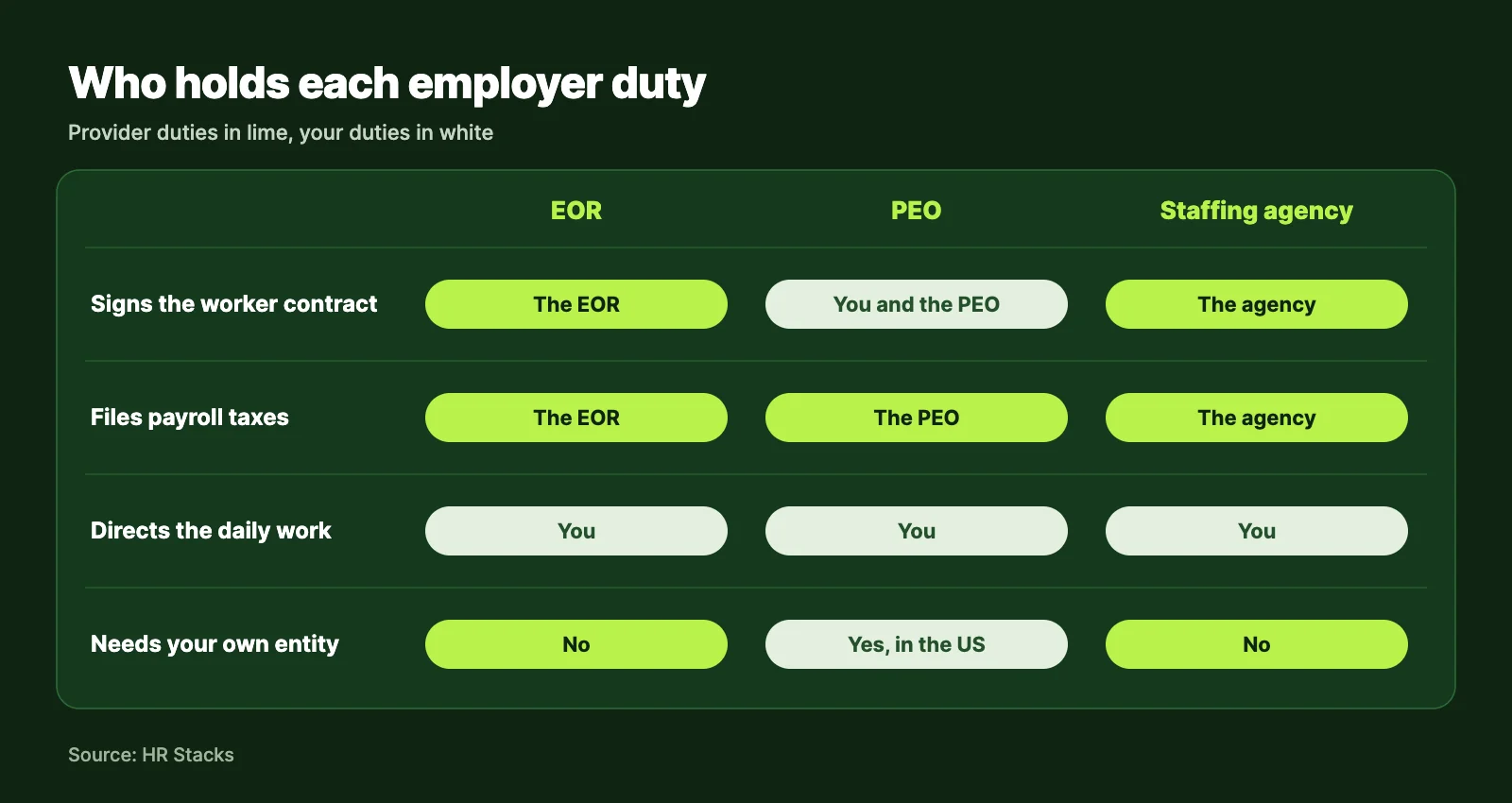
You direct the daily work in all three. That control is what keeps some liability with you whichever model you pick, covered in the risk section below.
When an EOR fits
Use an EOR when you want to employ someone in a country where you have no legal entity and the role is meant to last. The EOR signs a local employment contract, runs payroll and statutory benefits, and manages the termination process. You assign the tasks. See the EOR providers we review for country coverage.
Pros
- No local entity or tax registration to set up
- Local contract, payroll and statutory benefits handled by the provider
- Easier to exit than closing an entity if the market does not work
Cons
- A per-employee fee on top of local employer costs
- Does not reliably remove permanent establishment risk
- Can cost more than an entity as headcount in one country grows
When a PEO fits
Use a PEO when you already employ people in the US through your own entity and want payroll, benefits and compliance support without building an HR team. The PEO becomes a co-employer and runs payroll under its own accounts. Our PEO guide covers what the package includes.
- Needs
- Your own US entity
- Works in
- The United States
- Contract
- A client service agreement; you stay a co-employer
- Check first
- The PEO’s status on the IRS CPEO list
- Not for
- Employees outside the US
The CPEO check matters. The IRS updates its list of certified PEOs every quarter, and if a certification is revoked, customers may become liable for federal employment taxes the PEO remitted. Compare options on our best PEO companies list.
When a staffing agency fits
Use a staffing agency when you need temporary or project labor quickly and the worker does not need to become your employee. The agency recruits, employs and pays the worker, and you pay an hourly bill rate. The American Staffing Association reports about 2.0 million temporary and contract employees working for US staffing companies in an average week of 2025, and 64% say they use the work to bridge a gap between jobs.
What each model costs
EOR providers list from $599 per employee per month, PEOs from $79 to $125, and staffing agencies publish no list price because they charge a markup on the worker’s pay rate. Salary, employer taxes and benefits come on top in every model.
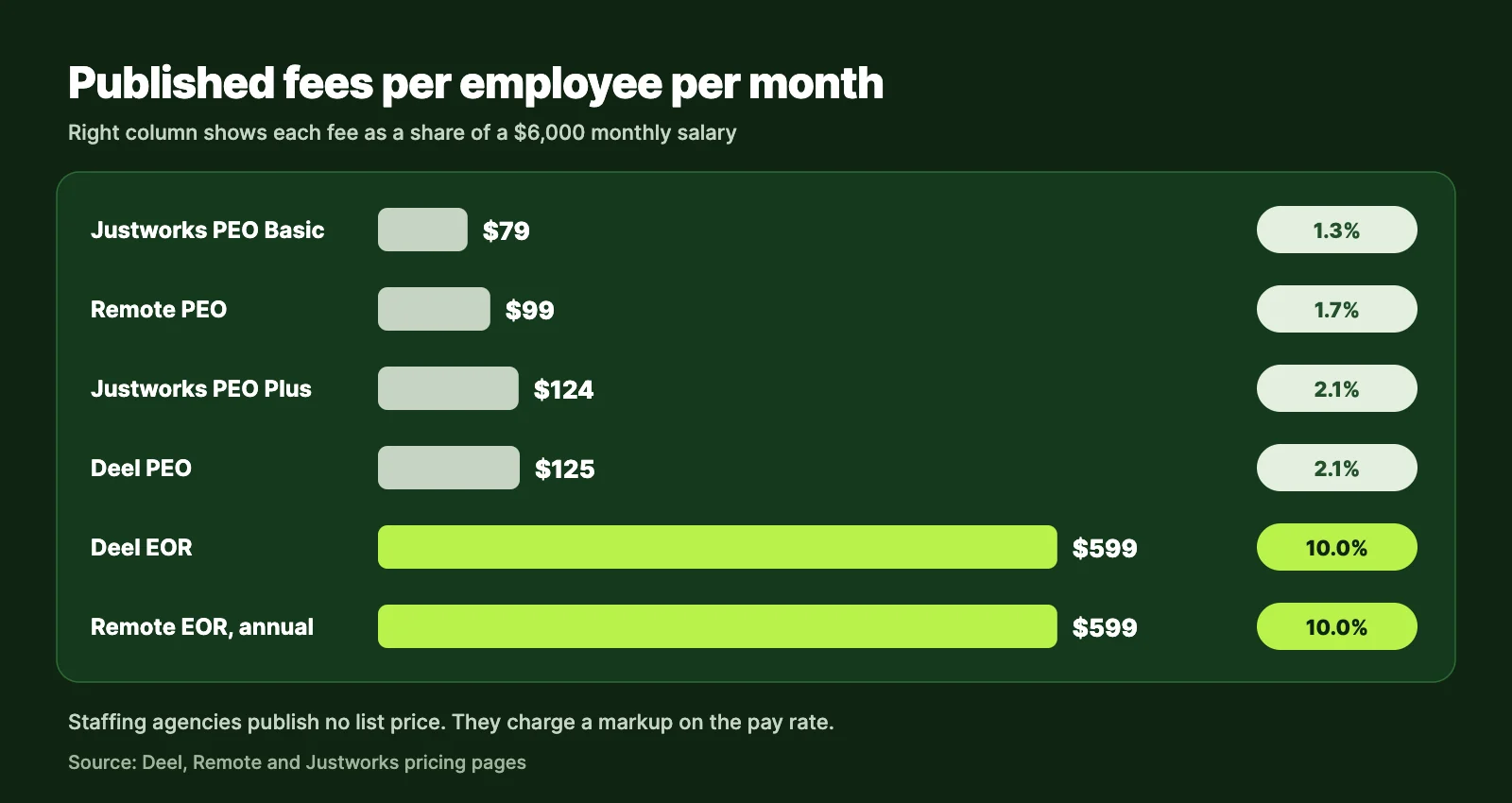
Published list prices
Verified October 2026Where the risk stays with you
No model gives you a clean exit from liability. What remains depends on how much control you exercise over the worker and where the work happens.
Which one should you use?
Start with where the person works, then how long you need them.
- Locate the workerNo entity in their country: go to step 2. US employee through your own entity: go to step 3.
- Abroad, ongoing roleUse an EOR. As headcount in one country grows, model the fee against opening an entity.
- US, ongoing teamUse a PEO if you want shared payroll, benefits and compliance support.
- Temporary coverUse a staffing agency for seasonal, project or leave cover.
Hire a developer in Brazil, no entity
Use an EOR.
Have 25 US staff and no HR team
Use a PEO with CPEO status.
Need 30 warehouse workers for a peak
Use a staffing agency.
Running a US team plus one remote hire abroad? You can use both: see using an EOR and a PEO together. Planning your first hire abroad? Run our international hiring readiness checklist or open the country hiring guides.
Contract red flags before you sign
Check these terms with any provider, because they decide who pays when something goes wrong.
- Who is named as the employer in the worker’s contract
- Who pays termination and severance costs, and how they are invoiced
- Deposit or pre-funding requirements and when they are returned
- Minimum term and exit fees, including any fee to move the worker to your own entity
- What the provider indemnifies if a misclassification or compliance claim reaches you
- For a PEO: current CPEO status on the IRS list
- For an agency: the temp-to-hire conversion fee and who owns work the person creates
Frequently Asked Questions
What is the main difference between an EOR, a PEO and a staffing agency?
An EOR becomes the sole legal employer of your hire in a country where you have no entity. A PEO co-employs your existing US employees through your entity. A staffing agency employs temporary workers and supplies them to you. The difference is who employs the worker and where.
Can a PEO hire employees abroad?
Not in the PEO sense. Co-employment is a US arrangement that needs your own entity. Providers that sell an international PEO generally operate as an EOR, so ask who signs the employment contract before you buy.
Is a staffing agency cheaper than an EOR?
For short projects it can be. For ongoing roles the markup is charged on every hour and agencies publish no list price, while EOR fees start from $599 per employee per month. Model both using your actual pay rate and the length of the role.
Does an EOR remove permanent establishment risk?
Not reliably. Law firm Simmons & Simmons advises that an EOR is unlikely to eliminate the risk, and that revenue-generating staff and senior managers raise it more than a small engineering team. Get local tax advice for sales roles.
Can I use an EOR and a PEO together?
Yes. Many companies use a PEO for US employees and an EOR for hires in countries where they have no entity. The two serve different workers, so check that benefits and payroll data stay consistent across both.
Who is liable when a temporary worker files a claim?
Potentially both the agency and you. The EEOC says staffing firms and their clients share equal employment opportunity responsibilities toward placed workers. Check indemnity and insurance terms in the agency contract.