


Manatal
$5.1M seed round closed February 2022, the company’s only disclosed raise.
Third-party audited. No ISO 27001 and no HIPAA are published.
Vendor figure, spanning Toyota, Randstad, KPMG and Bosch as named accounts.
Manatal puts AI candidate enrichment, AI recommendations and an automated video interviewer on its entry plan, which no other ATS under $20 per seat currently does. The cost of that decision shows up higher in the stack: the Open API, SSO and the advanced report builder are all held back to the $55 tier. All customer data is stored in the USA, which EU buyers should check against their own transfer position before signing.
What is Manatal?
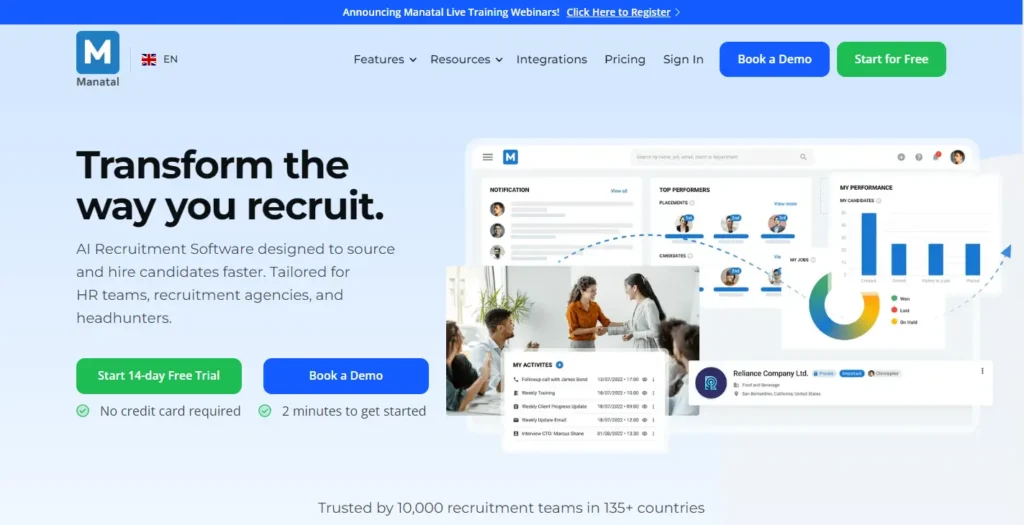
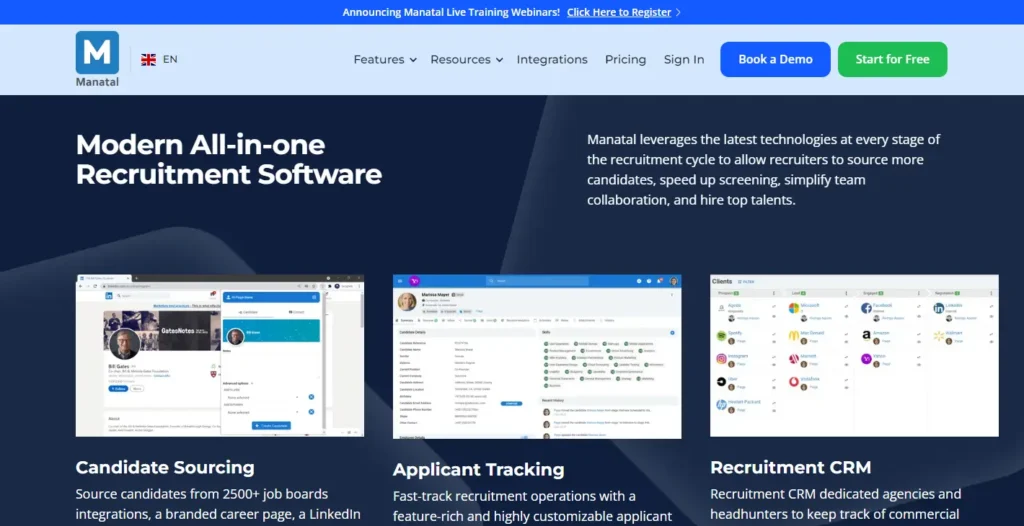
Manatal is a cloud-based applicant tracking system and recruitment CRM for teams that hire continuously. It covers sourcing, screening, pipeline management and offers inside one workspace. Staffing agencies and in-house talent teams both run on it.
Scope stops at the hire. There is no payroll, no benefits administration and no performance module, so Manatal sits beside an HRIS rather than replacing one. Candidate data, job distribution and hiring workflow are the whole product.
The buyer is usually a small agency or a lean internal talent team that has outgrown spreadsheets but cannot justify an enterprise recruiting suite. That middle band is where most ATS shopping actually happens, and it is crowded with products charging four to six times more.
Manatal’s answer to that crowd is to put AI screening, enrichment and automated video interviews on its cheapest tier instead of reserving them for enterprise contracts. That single decision explains most of what the product does well and most of what it leaves out.
Editor’s Rating for Manatal
Manatal competes on one proposition: give small recruiting teams enterprise-shaped AI tooling at a price they will not argue about. It works. The product is unusually dense for the money, and the named customer list backs that up.
The limitation is service consistency, not capability. Across sources that publish a breakdown, roughly one review in eight is a one-star entry, clustered on slow ticket resolution, job posting failures and refund handling. Manatal replies to most of them but averages over a month to do it.
We rate that as a real risk for agencies running client SLAs and a manageable one for internal teams hiring on their own timeline. The difference is what a two-week support queue actually costs you.
Strong value at the entry tier, with integration depth and support consistency the two documented risks.
At $15 per user per month on annual billing, Manatal undercuts Workable’s $299 flat rate and Recruit CRM’s $95 per seat. Check the 15-job cap first, because breaching it moves you to $35 and a 133% per-seat jump.
AI enrichment, semantic search and the AI Interviewer all sit on the $15 plan, though workflow automation waits until $35 and LLM integrations until $55.
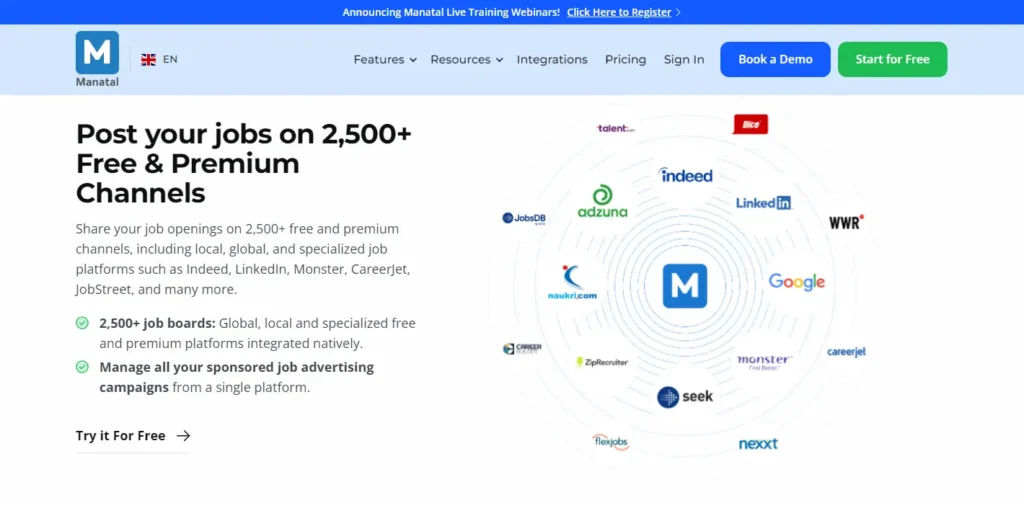
Manatal claims 2,500 free and premium channels, with Indeed, LinkedIn, Monster and ZipRecruiter posting natively. The LinkedIn Chrome extension draws the most consistent praise in verified reviews. Premium board posting runs on your own contracts, so budget that separately.
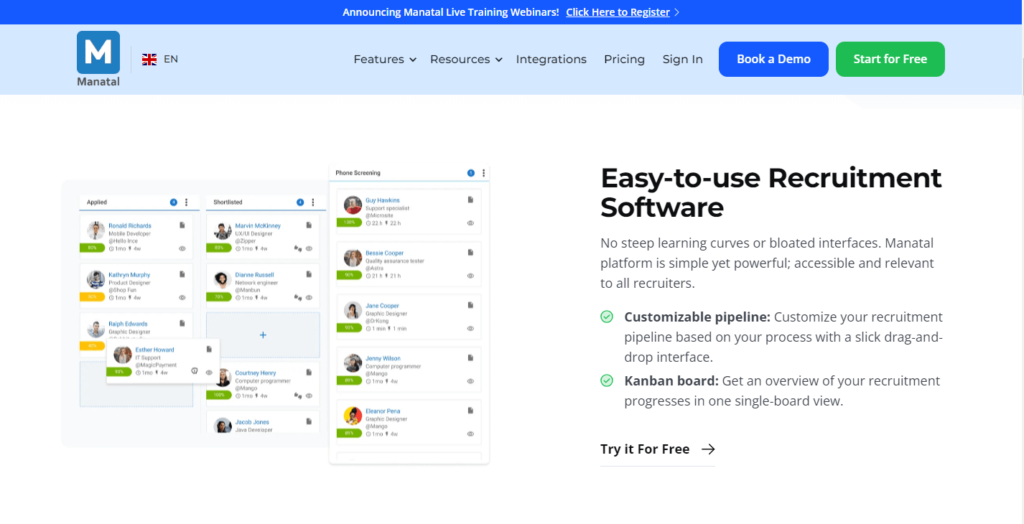
Pipeline visualisation, scorecards, custom fields and batch emailing cover the daily workflow well. The Professional tier caps you at 10,000 candidates, a ceiling an active two-recruiter agency can reach inside eighteen months.
Forty-seven connectors is thin for this category. There is one HRMS partner, Humaans, and no native payroll, accounting or background check integrations. The Open API sits on Enterprise Plus at $55, so API-dependent buyers pay 3.7 times the entry rate.
Basic reporting ships on every plan, but the advanced report builder is an Enterprise Plus feature, which is part of why the features sub-score of 4.4 trails ease of use at 4.7.
This is where the evidence splits. Directory reviews rate customer service 4.6, while 38% of one independent source’s 42 entries are one-star and cite support delays and refund disputes. One documented trial user waited nine days without resolution.
Ease of use scores 4.7 in verified reviews, the highest sub-score Manatal holds. Implementation averages one month, and the interface runs in English, Spanish, French and German with RTL support.
Manatal wins the sub-$20 ATS bracket on feature density rather than polish. Price the $55 tier from the start if you need API access, SSO or the advanced report builder, because that is where the real comparison against Workable and Recruit CRM begins.
Manatal: Strengths and Limitations
Every point below comes from 330 verified user reviews, Manatal’s published plan documentation and our own audit of which features are gated behind which of the four tiers.
AI enrichment, semantic search and the AI Interviewer all run on the $15 plan. Workable starts at $299 a month flat, Recruit CRM at $95 per seat. Nothing else in this bracket ships automated video screening at entry level.
Manatal publishes 2,500 free and premium channels, with Indeed, LinkedIn, Monster and ZipRecruiter posting natively. The LinkedIn Chrome extension is the single most praised feature in the verified record.
Ease of use scores 4.7, the highest sub-score Manatal holds anywhere in the verified record, and implementation averages one month for a product carrying a full recruitment CRM alongside the ATS.
A three-person agency pays $45 a month, not a platform fee sized for a 200-person company. Flat-rate rivals such as Breezy HR and Workable charge the same whether you run two recruiters or twenty.
SOC 2 Type II certified, 99.9% uptime published, daily backups retained 30 days and tested weekly. That is more than most sub-$20 ATS products put in writing. ISO 27001 is still absent.
Forty-seven connectors, one HRMS partner in Humaans, and no native payroll, accounting or background check integrations. Zoho Recruit ships over 50 integrations inside a suite that already carries HR and finance modules, which is the trade if connector breadth is your priority.
Open API access, SSO and custom permissions only appear on Enterprise Plus at $55 per user, 3.7 times the entry rate. Recruiterflow bundles API access into its single $149 seat price with no tier gate. Price the $55 rate from day one if HRIS sync matters.
Roughly one review in eight across sources publishing a breakdown is a one-star entry, concentrated on slow ticket resolution and refund disputes, including a trial user who documented a nine-day wait. Phone support arrives only on the unpriced Custom plan, whereas Workable includes it on Premier at $599 a month.
Professional stops at 15 active jobs and 10,000 candidates. Cross either line and you are on the $35 Enterprise tier, a 133% per-seat increase. Breezy HR charges $157 a month for unlimited users, which wins outright above ten seats.
Manatal’s Core Features
We rated each feature on what it delivers at the plan a typical buyer actually purchases, not on what appears in the top tier. Strong means it holds up against products costing three times more. Limited means verify it against your own workflow before you sign.
Drag-and-drop pipelines, scorecards and custom fields handle the daily workflow, with the Professional tier capped at 10,000 candidates.
Machine matching ranks applicants against the job requirement and returns a relevance score, available from the $15 plan upward.
Runs automated video screening around the clock, a capability Workable and Zoho Recruit either charge extra for or leave out entirely.
Pulls LinkedIn and social profile data into candidate records automatically, removing most of the manual profile-building step agencies used to bill clients for.
Posts to 2,500 free and premium channels, though premium placements run on contracts you supply and pay for separately.
Client, contact and placement tracking live in the same workspace as the ATS, which is why staffing agencies make up so much of the user base.
Builds a branded page with custom application forms, but design flexibility and language options draw repeated complaints in verified reviews.
Standard reports cover pipeline and source metrics, while the custom report builder stays locked to the $55 Enterprise Plus tier.
Forty-seven connectors with no payroll, accounting or background check partners, and the Open API gated to the top published plan.
A progressive web app rather than native software, so there is no App Store or Google Play listing to install on a phone.
Manatal Integrations
The grid below shows the named connectors inside a published list of 47, and the absences matter as much as the entries: no QuickBooks, no Xero, no payroll partner, no background check provider, and Open API access only on the $55 tier.

Manatal publishes 47 native connectors weighted heavily toward job boards, leaves payroll, accounting and background checks to Zapier or n8n, and restricts Open API access to the Enterprise Plus plan.
Who Should Use Manatal?
Manatal is built for teams that hire constantly on a budget that will not stretch to a four-figure monthly platform fee. Small staffing agencies are the core use case. The disqualifier is integration dependency: if the ATS has to feed payroll, HRIS or background checks without a middleware layer, this is the wrong product.
Client records, contacts, placements and candidate pipelines sit in one workspace, so there is no separate CRM subscription to carry. Per-seat billing at $15 means a three-recruiter shop pays $45 a month rather than a platform fee designed for a corporate talent function.
One or two recruiters covering a whole company get AI matching, semantic search and enrichment on the entry plan. That combination normally arrives with a procurement cycle and an annual contract attached.
The AI Interviewer screens candidates around the clock without a recruiter on the call, which is the only realistic way a small team processes hundreds of applicants a week. Quick-screen and batch emailing carry the rest of the load.
Manatal reports use across 135 countries, distributes to 2,500 free and premium channels, and runs its interface in English, Spanish, French and German with right-to-left support. Check the US data residency position first if you hire inside the EU.
The same design choices that make Manatal cheap for a five-person agency make it the wrong buy in four specific situations.
Manatal publishes one HRIS connector and no payroll or accounting partners, so every downstream handoff runs through Zapier, n8n or the Open API on the top tier. That is a middleware layer to build, maintain and pay for.
Consider Zoho RecruitSOC 2 Type II is the only certification Manatal publishes, and all customer data is stored in the USA. Security reviews at regulated employers routinely stop at both of those lines.
Consider WorkableTicket resolution is the most common theme in critical reviews, phone support exists only on the unpriced Custom plan, and one trial user documented nine days without a fix. An agency owing a client a Monday shortlist cannot absorb that.
Consider RecruiterflowPer-user billing is a gift at three recruiters and a liability at fifteen, because every hiring coordinator who needs write access adds another line to the invoice. Flat per-company pricing removes that decision entirely.
Consider Breezy HRManatal Pricing: What It Actually Costs
Manatal publishes all four plan rates, which is more than Recruit CRM or Recruiterflow manage on their own sites. What it does not publish: the price of the AI Interviewer, the branded guest portal or email marketing, all three listed as add-ons, and the cost of premium job board placements, which run on media contracts you supply yourself.
The number that decides most deals is seat count. Breezy HR charges $439 a month for unlimited users on its Business plan, so against Manatal Enterprise Plus at $55 per seat, Breezy wins from eight users up. The gap widens with every hiring coordinator you add.
Three tiers above the headline rate. A five-seat team that needs API access pays $3,300 a year rather than $900.
All three appear as add-ons on the pricing page with no figure attached. Get each one quoted before you commit to an annual term.
Manatal distributes to premium channels, but the contracts and their cost stay with you. The 2,500 channel figure is reach, not included spend.
All rates shown are billed annually and exclude local tax. Monthly billing runs $19, $39 and $59 per user, a 27% premium at the entry tier. Manatal does not publish a minimum contract term, a minimum seat count, an implementation fee or a refund policy, and refund handling is a recurring theme in critical reviews, so confirm all four in writing before payment.
Get four things in writing before signing: the refund and cancellation terms, whether the annual rate is locked at renewal, a quoted price for any add-on you intend to use, and what happens to your candidate records if you ever drop back below the 10,000 limit. That last one is the real trap, because the pricing page says nothing about it.
How Manatal Compares to Alternatives
We picked six products a Manatal shortlist actually runs against: Zoho Recruit and JazzHR on price, Recruit CRM and Recruiterflow on agency workflow, Workable and Breezy HR on flat per-company billing. Every rate below was verified from the vendor directly rather than taken from any comparison page Manatal publishes.
The comparison runs on four attributes that decide these deals. What a seat costs at entry, whether AI screening is included on the cheapest plan, how deep the integration and API layer actually goes, and how much of the real price each vendor is willing to put on its own website.
Manatal’s $15 seat is the lowest published rate among ATS products that carry a recruitment CRM alongside the pipeline. Zoho Recruit is the only other name here under $35 per recruiter. Everything else either doubles the seat cost or switches to a flat company fee starting at $157 a month.
Manatal puts AI recommendations, enrichment and an automated video interviewer on the $15 tier. Workable gives every plan 3,000 AI credits and then charges for more. On the rest, AI screening is either a paid credit add-on, an Enterprise-tier feature or absent from the published plan list entirely.
Forty-seven connectors, one HRIS partner and no payroll or accounting integrations put Manatal at the bottom of this group. Its Open API only unlocks at $55 per user, while Recruiterflow includes API access in its single seat price. Zoho Recruit ships over 50 integrations inside a suite that already carries finance and HR.
Manatal publishes three of its four rates, which beats the agency-focused products outright. The gap is the add-ons: AI Interviewer, guest portal and email marketing all appear with no figure. Recruit CRM shows no rates at all on its own site, and Zoho buries its staffing edition prices in help documentation.
| Provider | Entry Price | Rates Published | AI On Entry Plan | Under 5 Seats | Over 15 Seats |
|---|---|---|---|---|---|

Manatal
$15 per user / month
|
Leads |
Competitive |
Leads |
Leads |
Behind |
|
Zoho Recruit
$30 per recruiter / month
|
Competitive |
Competitive |
Behind |
Leads |
Competitive |
|
Breezy HR
$157 per month, flat
|
Competitive |
Leads |
Behind |
Competitive |
Leads |
|
JazzHR
$1,000 per year
|
Competitive |
Leads |
Behind |
Competitive |
Leads |
|
Recruit CRM
$95 per user / month
|
Behind |
Behind |
Behind |
Behind |
Behind |
|
Recruiterflow
$149 per user / month
|
Behind |
Competitive |
Behind |
Behind |
Behind |
|
Workable
$299 per month, flat
|
Behind |
Leads |
Competitive |
Behind |
Leads |
How Manatal Performs in Practice
Four buying situations, priced at what each team would actually pay rather than the headline rate. Two are clean wins. One works right up to a specific seat count, and one fails on a requirement that has nothing to do with recruiting features.
Client records, candidate pipelines and LinkedIn sourcing sit in one system, and AI enrichment strips out most of the profile-building work these firms used to bill hours for. The 15-job cap forces the $35 tier from day one. Time-zone gaps in support are the risk to price in.
Two people hiring for a 180-person business need a system they can run without training, and 4.7 on ease of use with a one-month average implementation is the entire argument. Fifteen active jobs gives enough headroom at this volume, so the entry plan holds.
API sync into Workday means Enterprise Plus, and twelve seats at $55 is $7,920 a year. Breezy HR Business runs $439 a month flat for unlimited users, which wins outright from eight seats up. Manatal still works here, but the price advantage is gone and every new coordinator widens the gap.
The blocker is not features. SOC 2 Type II is the only certification Manatal publishes. All customer data sits in the USA, and a single native HRIS connector will not carry a Personio integration. Workable clears the security review and ships a deeper connector layer for the same three-person team.
What Users Say About Manatal
Manatal carries 330 verified reviews across three independent sources, and they do not agree with each other. Two directories put it at 4.8 and 4.6 with heavy five-star weighting. The third sits at 3.6 across 42 reviews, where 38% are one-star and cluster on support delays, refund disputes and job posting failures.
Distribution covers the 183 reviews where a star breakdown is published. The shape matters more than the average: there is almost nothing between five star and one star, which is the signature of a product that either works cleanly or fails on a support ticket.
The extension that pulls candidates straight off a LinkedIn profile is the single most repeated piece of praise in the record. Recruiters describe it as the reason they stopped copying data by hand.
Value for money rates 4.5, and reviewers frame it the same way repeatedly: they expected to pay three or four times more for AI matching, enrichment and a CRM in one subscription.
Ease of use rates 4.7, the highest figure Manatal holds anywhere. Reviewers describe small teams working confidently inside the first month with no formal training.
Customer service rates 4.6 in directory reviews, with recruiters reporting fast answers on configuration, pipeline setup and permissions questions.
Slow resolution is the most repeated complaint in critical reviews. One trial user documented nine days without a fix, which consumed most of a 14-day evaluation window.
Critical reviewers describe postings that do not go live and board imports that arrive incomplete, leaving screening questions and application data to be copied across by hand.
Difficulty getting money back after account or verification problems runs right through the one-star cluster. Manatal publishes no refund policy, which is why these keep escalating in public.
Reviewers want more design control and more language options on the branded career page than the current builder allows, particularly for non-English hiring.
Data pulled 27 August 2026 from three independent review sources. Two publish a full star breakdown covering 183 reviews, the third does not publish one for its 147, so the distribution reflects the 183 that do. Reviewer roles could not be attributed reliably, so no reviewer mix is shown. Before signing an annual term, ask Manatal for its current median first-response and resolution times in writing.
Is Manatal Worth It?
Manatal is worth it if you are buying recruiting software rather than recruiting infrastructure. The hiring work it does well, and cheaply. What it does not do is sit in the middle of a systems architecture, and most of the disappointment in the public record traces back to buyers who needed that second thing.
Before signing, ask the question the marketing does not answer: what is the median time to resolve a ticket that stops you posting a job? Then ask what happens to 10,000 candidate records if you ever downgrade. Neither answer appears anywhere on the site.
The cheapest credible ATS with AI screening built into the base plan, held back by connector depth and inconsistent support outcomes.
FAQs About Manatal
Here are some of the commonly asked questions about Manatal and how to make best use of it.
Manatal publishes three plans billed annually: Professional at $15 per user per month, Enterprise at $35 and Enterprise Plus at $55. A fourth Custom plan is quote only. Monthly billing costs $19, $39 and $59 per user.
The figure most buyers get wrong is which tier they actually need. Open API access, SSO, custom permissions and the advanced report builder all sit on Enterprise Plus, so anyone integrating with an HRIS is buying the $55 plan rather than the $15 one.
Manatal offers a 14-day free trial with no credit card required, and there is no free forever plan.
Manatal runs as a progressive web app rather than native iOS or Android software, so there is no App Store or Google Play download. You reach it through a mobile browser, which covers reviewing candidates and moving pipeline stages but is not the same as a dedicated app.
Manatal publishes 47 native integrations, weighted heavily toward job boards. Named connectors include Indeed, LinkedIn, Monster, ZipRecruiter, Glassdoor, Talent.com, Google for Jobs, Codility, Mailchimp, Google Workspace, Microsoft 365 and Zapier.
Payroll, accounting and background checks are the gap. There is one native HRIS connector, Humaans, so anything else runs through Zapier, n8n or the Open API, and API access requires the $55 Enterprise Plus plan.
Manatal is SOC 2 Type II certified with compliance tooling for GDPR, CCPA and PDPA, publishes 99.9% uptime and runs daily backups retained for 30 days and tested weekly. All customer data is stored in the USA, and no ISO 27001 certification is published, both of which matter if your procurement process asks.
The interface runs in English, Spanish, French and German with right-to-left language support, which corrects the widely repeated claim that Manatal is English only.
Both use it, though the recruitment CRM layer makes it stronger for staffing agencies that need client, contact and placement records sitting alongside candidate pipelines. In-house teams under about eight seats get the same value, while larger internal teams usually find flat per-company pricing cheaper.
Three things. Integration depth is thin at 47 connectors with no payroll or accounting partners, the Open API is locked to the top tier at $55 per user, and support resolution time is the most common theme in critical reviews. Roughly one review in eight from sources publishing a star breakdown is a one-star entry.