
Quick answer: what is BPO?
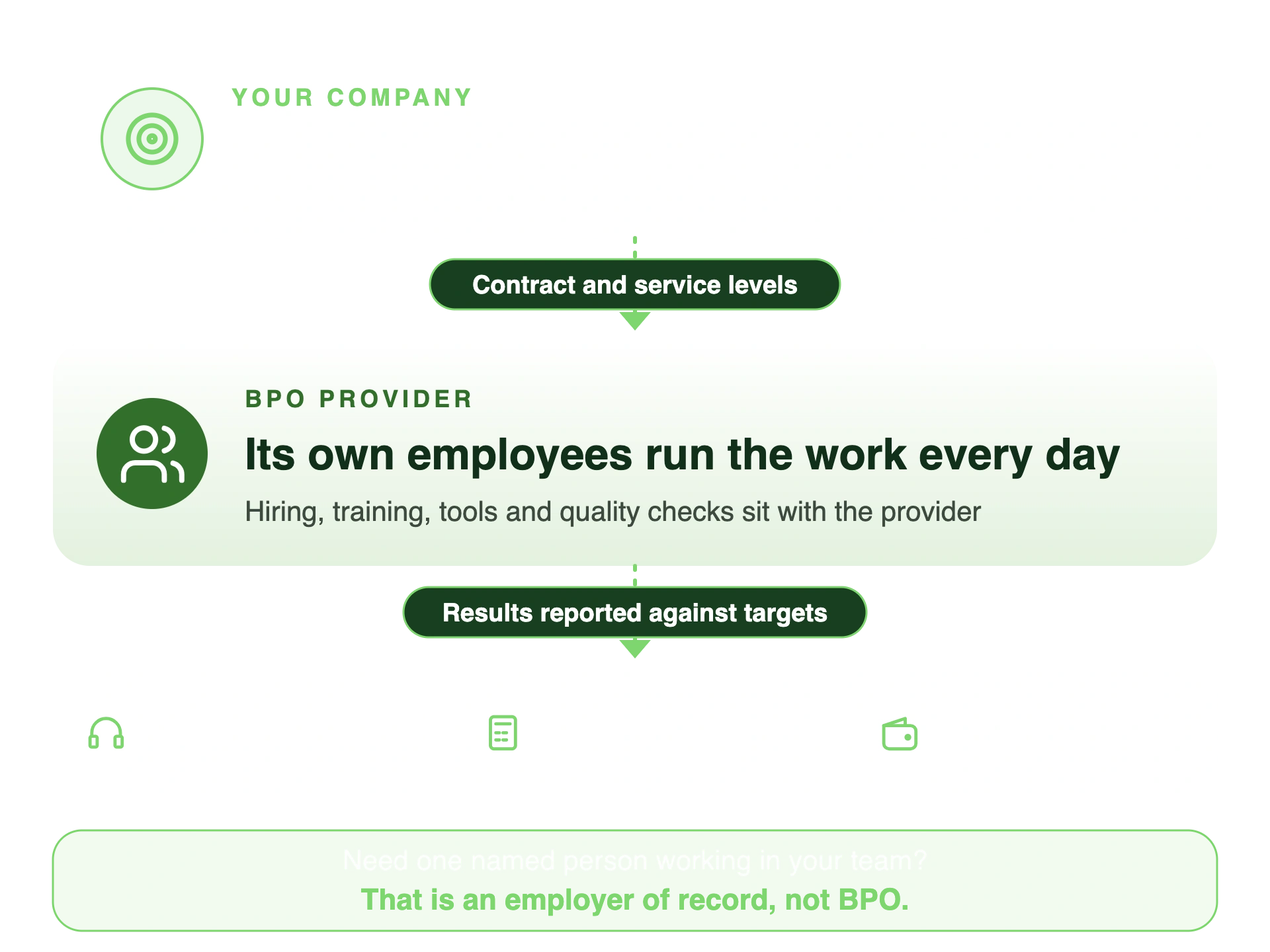
Business process outsourcing (BPO) is paying an outside company to run a defined business process, such as customer support or payroll, to agreed targets. The provider’s own staff do the work, and you manage results rather than people. BPO sits inside the wider ITES category. An employer of record is different: it employs a named person for you.
- PricingPer seat, per transaction or per outcome
- Best forRepeatable, high-volume work you can measure
- Main riskQuality drift and data exposure at the provider
- Not forHiring one named person. Use an employer of record
Key takeaways
BPO is one of the oldest outsourcing models and one of the most loosely used terms. People apply it to call centers, to payroll and to anything done offshore. This guide pins the term down: what BPO covers, how it differs from ITES, KPO, EOR, PEO and RPO, how contracts are priced, and what to put in writing before any data moves.
Video guide
Watch: What is BPO?
Business process outsourcing explained in under five minutes: meaning, pricing, contracts, risks and when it fits.
Chapters
- 0:17The definition in one line
- 0:31Six categories of outsourced work
- 0:52Five stages of an engagement
- 1:09BPO vs ITO, KPO and ITES
- 1:33BPO vs EOR, PEO and RPO
- 2:01How big the BPO market is
- 2:22Pricing models explained
- 2:46Seats vs per transaction break even
- 3:06Benefits and risks
- 3:27The contract checklist
- 3:42Data protection, GDPR and HIPAA
- 4:00BPO and AI
- 4:16Is BPO right for you?
What do companies outsource with BPO?
Companies outsource processes that repeat, follow rules and can be measured. Gartner groups BPO offerings into horizontal ones that work across industries, such as finance and customer service, and vertical ones that need industry process knowledge. The six categories below cover most contracts.
Customer support
Voice, chat and email queues, order status and returns, handled by the provider’s agents.
Finance and accounting
Gartner counts purchase-to-pay and order-to-cash among the transactional finance processes providers run.
HR and payroll admin
Payroll runs, benefits enrollment and HR helpdesk queues. Hiring has its own version, RPO.
Procurement
Supplier onboarding, purchase orders and invoice matching.
Healthcare back office
Medical coding, claims and billing. Patient data makes a HIPAA agreement mandatory.
Data and content
Data entry, document processing and content moderation at volume.
HR teams should treat two of these with care, because software or another model may do the job. If the process is only pay runs or leave tracking, price payroll software and HR software first. Our guide to payroll outsourcing covers the HR version in depth.
How does BPO work?
A BPO engagement moves one defined process to a provider in five stages. Scoping and transition get the least attention and do the most damage when rushed.
- ScopeWrite down the steps, volumes, exceptions and the targets that define good work.
- SelectShortlist providers with proof in your process and your data rules. Run a paid pilot.
- ContractFix service levels with numbers and remedies, the price model, data terms and exit rights.
- TransitionThe provider shadows your team and takes over in stages. Keep a fallback until targets hold.
- Run and reviewWeekly metrics, monthly reviews and a yearly check on scope and price.
At every stage the provider’s employees do the work and you manage results through the service level agreement. That is the line between BPO and employing people. Gartner’s definition has the same two parts: a provider that runs the process, and measurable performance targets.
BPO vs ITES, ITO and KPO
BPO is a subset of the wider ITES category, ITO outsources technology itself, and KPO outsources analysis that needs professional judgment. The split is by what the work is.
Many providers sell all three under one brand. Ask which team will do your work, what its members are qualified in, and who reviews the output. A BPO team handed a KPO problem is a mismatch you can see coming.
BPO vs EOR, PEO and RPO
BPO outsources a process, and the provider employs the people doing it. EOR, PEO and RPO outsource parts of employing or hiring your own people.
- BPO
- Outsources a process. The provider employs the team and you manage results.
- EOR
- Employs one named person in a country where you have no entity. The EOR is the legal employer.
- PEO
- Co-employs staff you already employ through your own US company. It runs payroll, benefits and tax filings.
- RPO
- Outsources hiring. The provider recruits and you employ the people it finds.
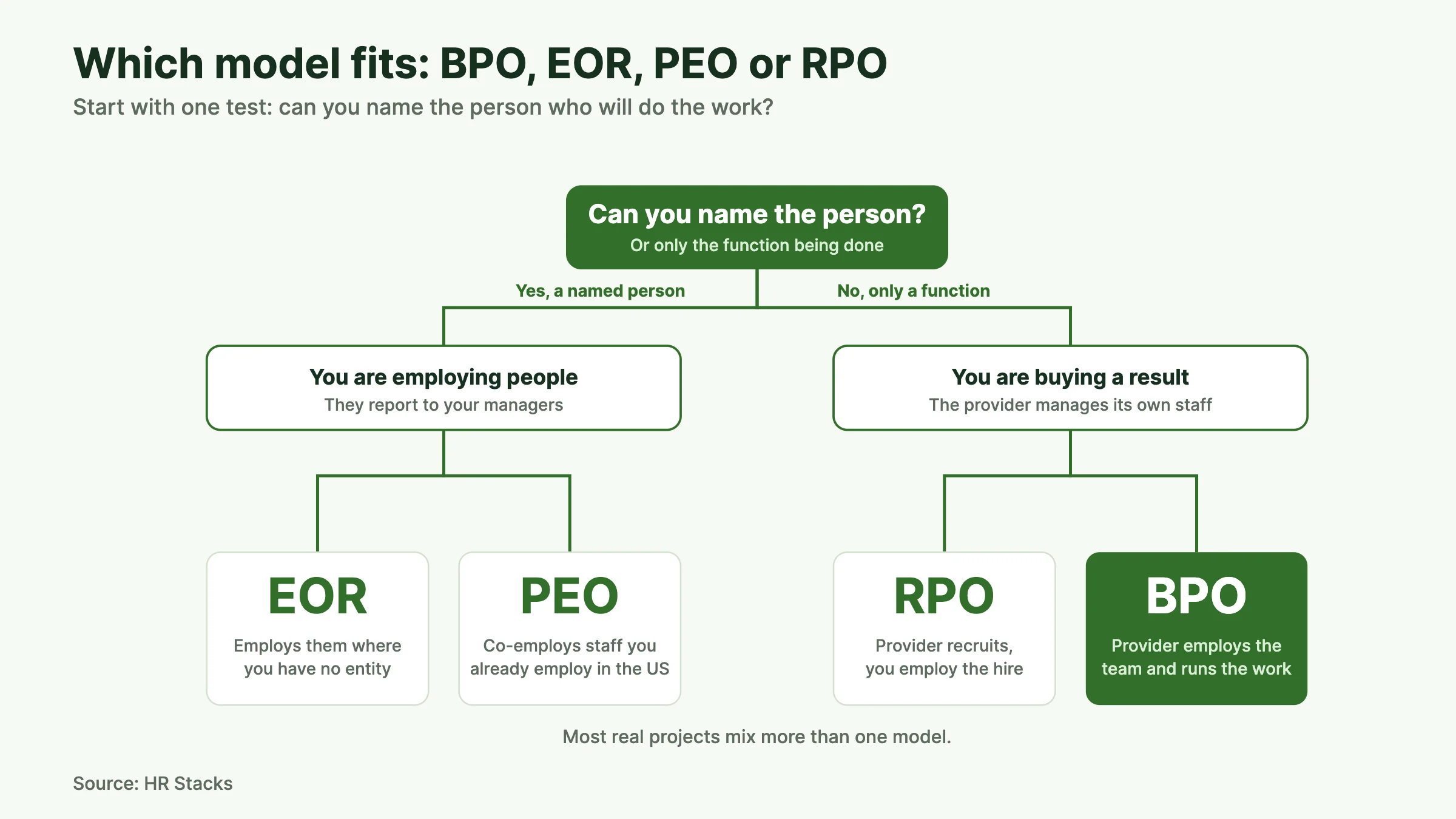
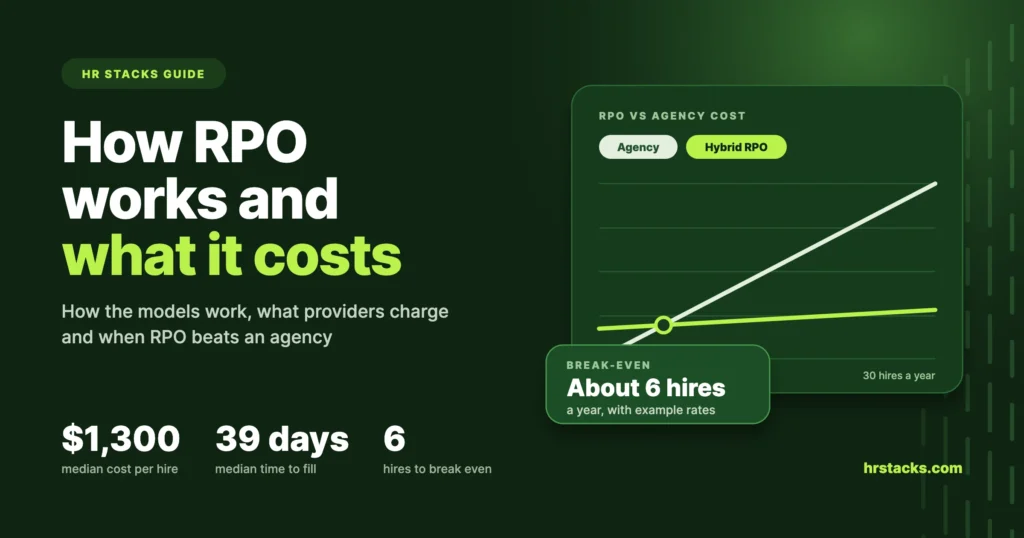
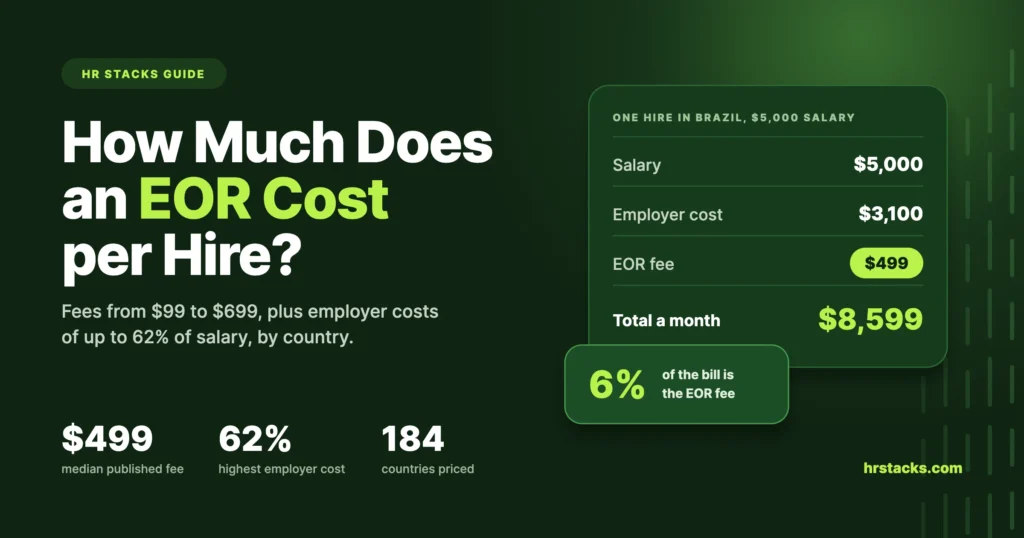
Use one test. If you can name the person, you need an employer of record (EOR) or, for US staff, a PEO. If you can only name the function, you need BPO. Our guides explain the PEO and RPO models, and what an employer of record costs shows the price of the employment route.
How big is the BPO industry?
Research firms put the global BPO market at roughly $327 billion to $328 billion for 2025: Grand View Research says $328.4 billion and Fortune Business Insights says $327.0 billion. Firms define BPO differently, so read any single figure as an order of magnitude.
NASSCOM puts India’s BPM revenue at $54.6 billion within a $282.6 billion tech industry. The Philippine association IBPAP reports export revenue above $40 billion in 2025, with 1.89 million employees. Concentrix, one of the largest providers, reports operations in 74 countries and about $9.8 billion in 2025 revenue. Delivery location affects language, time zone and data rules, so treat it as a contract term, not a detail.
How is BPO priced?
BPO is priced per seat (FTE), per transaction, per outcome, or as a hybrid, and the model decides who carries volume and quality risk. No public rate card exists across providers, so treat any universal per-hour figure as a vendor estimate. A 2025 HFS Research survey, as summarized by Stealth Agents, found this mix across current engagements (5% answered not applicable):
- Input based (per seat, time and materials)42%
- Transaction or output based26%
- Outcome based or shared revenue20%
- Hybrid8%
New buyers usually start per seat because they have no volume baseline yet. HFS Research notes that many move to per-transaction pricing once operations stabilize. Here is how the three core models differ:
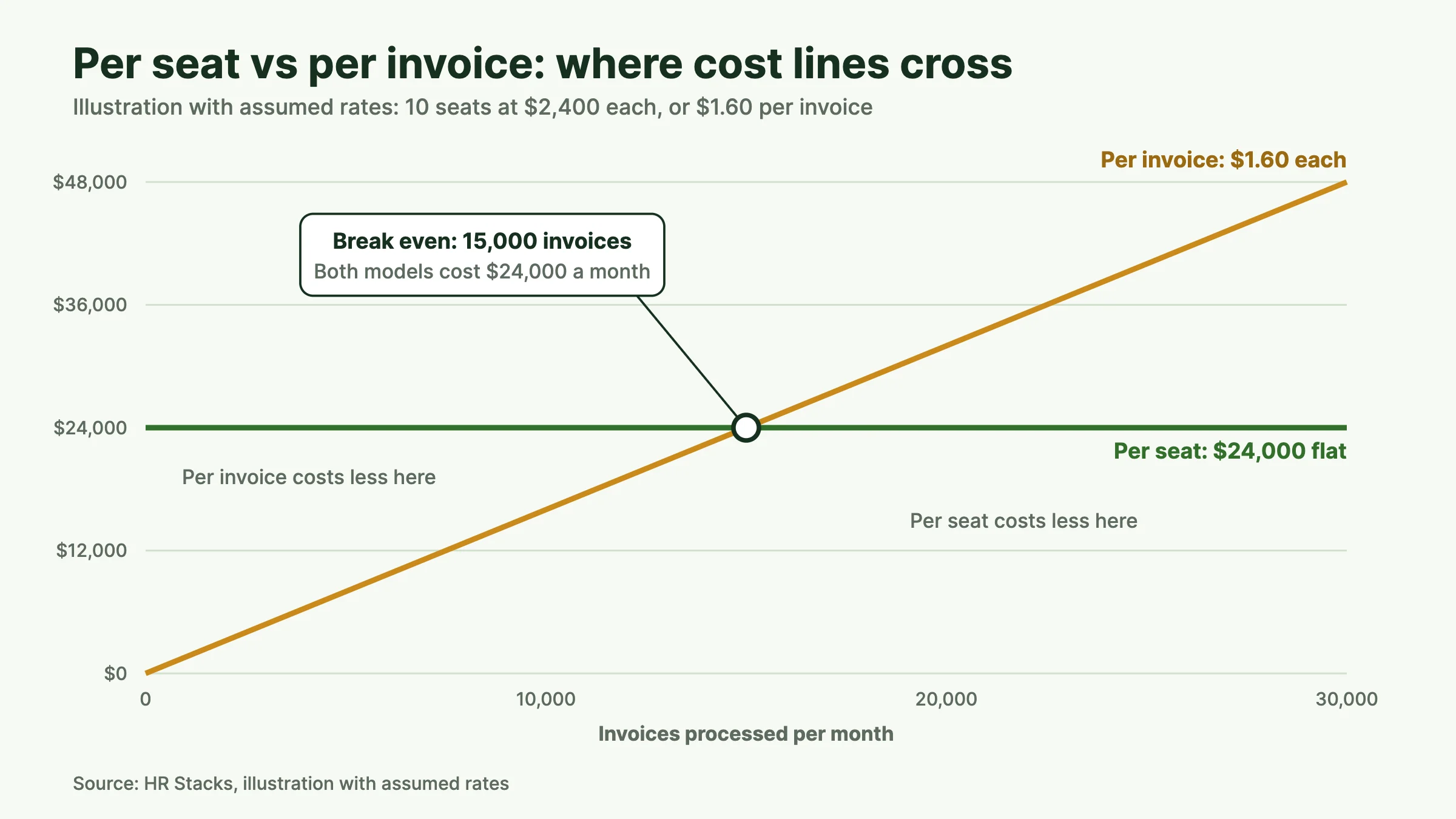
The mechanics come from SSF Global’s pricing overview and the outcome fit from HiveDesk’s BPO pricing guide. Illustration with assumed rates: ten seats at $2,400 a seat cost $24,000 a month. The same work at $1.60 per invoice costs $24,000 at 15,000 invoices ($24,000 ÷ $1.60). Below that volume per-transaction pricing is cheaper, above it per-seat pricing wins, as long as the seats can absorb the extra work. Both rates are assumptions for the arithmetic, not market prices.
BPO benefits and risks
BPO pays off when a process is stable, measurable and large enough to justify a contract. It fails when the buyer cannot describe the process or monitor the output.
Pros
- Capacity scales with volume instead of recruiting cycles.
- You buy trained teams, tooling and quality checks that already exist.
- Coverage across time zones without night shifts of your own.
- Management attention goes back to work customers pay you for.
Cons
- Your customer or employee data sits in the provider’s systems.
- Agent attrition drives quality. NICE measured 39% average contact center attrition for 2024.
- Once your in-house skill is gone, renewal talks favor the provider.
- The seat rate is not the full cost. Add transition, your own oversight, tools and rework.
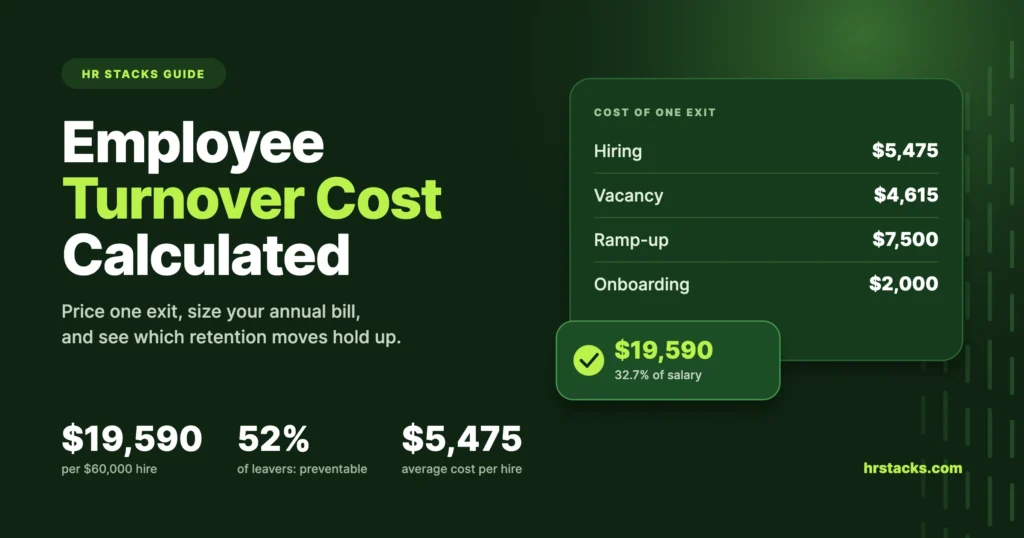
Judge BPO on process results, not wage gaps, because a wage gap is the part a competitor can copy. If provider attrition worries you, our employee turnover cost guide shows how to put a price on it before you sign.
What a BPO contract must include
A BPO contract must define the process, the volume baseline, service levels with remedies, the data terms and how you leave. Anything left vague becomes a change request later.
- Scope in writing: steps, systems, languages, hours and exclusions.
- A volume baseline, plus the rate bands that apply above and below it.
- Service levels with numbers, a measurement method and a remedy for each miss.
- Named sub-processors and your right to approve new ones.
- A right to audit, plus current SOC 2 Type II or ISO 27001 reports with the audit date.
- A breach notice deadline in hours, not “promptly”.
- Staffing terms: a named team lead, notice of changes and minimum training before an agent takes live work.
- Exit terms: transition help, data return or deletion, and notice periods that match your renewal.
Ask one question before signing: what happens in month one if volume runs 30% above the baseline? The answer shows whether the pricing model holds up under pressure.
GDPR and HIPAA rules for BPO
You stay legally responsible for the personal data you hand to a BPO provider, so privacy law requires a written contract before any data moves. Under GDPR Article 28, the provider must work only on your documented instructions, get your authorization before adding sub-processors, delete or return the data at the end, and allow audits. For US health data, 45 CFR 164.504(e) requires a business associate agreement with any vendor that handles protected health information.
How is AI changing BPO?
AI is absorbing routine customer contacts and pushing contracts toward outcome pricing, but it has not emptied contact centers. The evidence so far points to slower change than the forecasts suggest.
Gartner also forecasts that agentic AI will resolve 80% of common customer service issues without a human by 2029. That is a prediction, not a result. For buyers it means routine tiers will shrink while humans keep complex and escalated work, and per-seat pricing will look worse on routine volume. Ask a provider two questions: which steps it plans to automate in year one, and who keeps the savings. Pricing per resolved contact passes savings to you. Pricing per seat leaves them with the provider.
Is BPO right for your company?
BPO is right when the process is documented, repeats at volume and is not what customers pay you for. It is wrong when you need one named person or the volume is small.
run a repeatable, high-volume process
Use BPO. Start with a paid pilot on one queue or one invoice stream, with service levels and a volume baseline agreed first.
need one named person in another country
Use an employer of record. The person sits in your team and reports to your managers, which a BPO contract does not allow.
have low or irregular volume
Skip the contract. A formal engagement costs more to run than the work saves. Look at freelancer management software instead.
cannot write the process down
Document it first. Map the steps, volumes and exceptions, then decide whether to outsource.
Frequently Asked Questions
What does BPO stand for?
BPO stands for business process outsourcing. It means paying an outside provider to run a defined business process, such as customer support, payroll or invoice processing, against agreed performance targets. Provider staff do the work and you manage results.
What is an example of BPO?
A retailer that sends its customer chat and email queues to a provider is using BPO. So is a company that has a provider process supplier invoices from receipt to payment. In both cases the provider employs the team and reports against agreed service levels.
What is the difference between BPO and outsourcing?
Outsourcing is the broad term for using an outside party. BPO is the kind that hands over a business process. IT outsourcing hands over technology operations, and KPO hands over analysis that needs professional judgment. Most contracts for back-office or customer-facing work are BPO.
Is BPO the same as ITES?
No. ITES is the wider category of services delivered on IT infrastructure, and BPO is one subset of it. KPO and legal process outsourcing are others. Treating the terms as synonyms leads to vendor mismatches, because skills, risks and pricing differ by tier.
How is BPO priced?
The common models are per seat, per transaction, per outcome and hybrid. In a 2025 HFS Research survey, 42% of current engagements were input based, 26% transaction based, 20% outcome based and 8% hybrid. New contracts often start per seat and move to units later.
Is BPO the same as an employer of record?
No. BPO outsources a process and the provider employs the people doing it. An employer of record becomes the legal employer of one named person who works inside your team in a country where you have no entity. Pick by whether you can name the person or only the function.
What are the risks of BPO?
The main risks are data exposure, quality drift as staff turn over, dependency on the provider, and savings that shrink once transition and oversight costs are counted. Contract terms cover most of them: service levels with remedies, audit rights, sub-processor approval and exit support.
Does BPO need a data processing agreement?
If the provider handles personal data of people in the EU on your behalf, GDPR Article 28 requires a written contract with specific terms. For US health data, HIPAA requires a business associate agreement first. Other laws may apply, so check with counsel for your countries.