
Quick answer: how do you manage a remote business?
Managing a remote business means running it on written rules, outcome-based goals and a fixed meeting rhythm instead of watching people work. Managers hold one real conversation a week with each report, pick channels by message type and require MFA everywhere. Current remote work statistics show hybrid or fully remote is already the norm for remote-capable US roles.
- Core ruleWrite it down, then measure outcomes
- Key number1 real conversation per report each week
- Main riskTrust gaps and unclear expectations
- Start withRules, then channels, then tools
Key takeaways
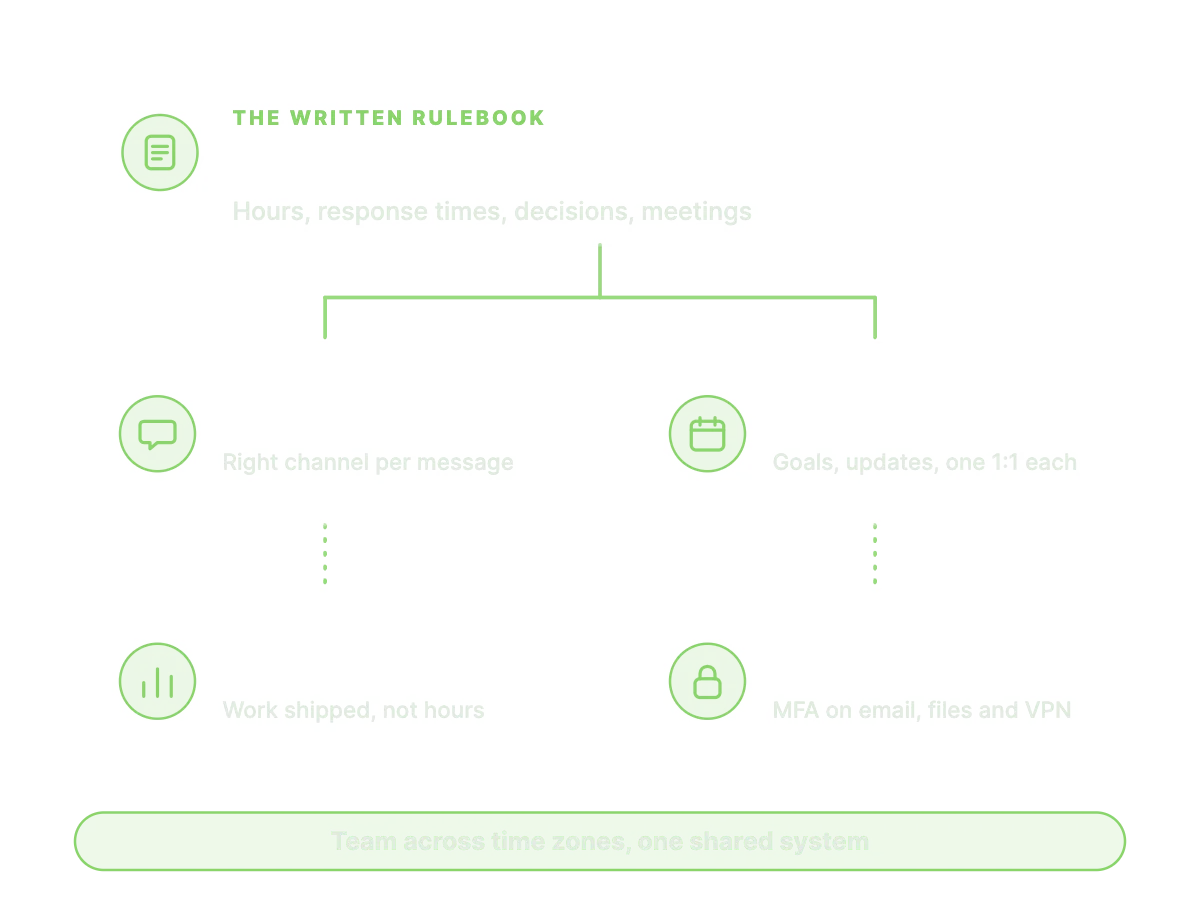
Tools rarely decide whether a remote team works. Unwritten rules do: when a reply is expected, who makes the call, what a good week looks like. This guide sets out the operating system a distributed business needs, in the order to build it.
It applies to fully remote and hybrid teams alike. Hybrid schedule design has its own guide on hybrid remote work, and the metrics side goes deeper in remote team KPIs. Figures are US data unless marked as global.
Set the operating rules first
Write one operating document before you add a tool. It answers six questions: when people overlap, how fast they reply, who decides, how meetings run, where work lives and what happens outside working hours.
Teams that skip it rely on guesswork. Gallup reports that 48% of hybrid workers say their team has never discussed a plan for how to collaborate. Where a plan exists, employees are 66% more likely to be engaged and 29% less likely to be burned out. Gallup measured this on hybrid teams, but fully remote teams face the same gap with less informal contact to fill it.
Start from these defaults. They are rules of thumb, not standards, so adjust them to your work.
- Shared hours
- 3 to 4 hours of overlap a day, where time zones allow
- Chat replies
- Same working day, with a phone call for anything urgent
- Docs and email
- Within 24 working hours
- Decisions
- One named owner, written down with a deadline
- Meetings
- Agenda first, notes posted within a day
- Working hours
- Visible on every calendar and respected outside them
GitLab, one of the largest all-remote companies, treats its handbook as the source of truth: changes are documented there first and every announcement links back to it. You do not need a public handbook. You need one place where the rules live and everyone knows the address.
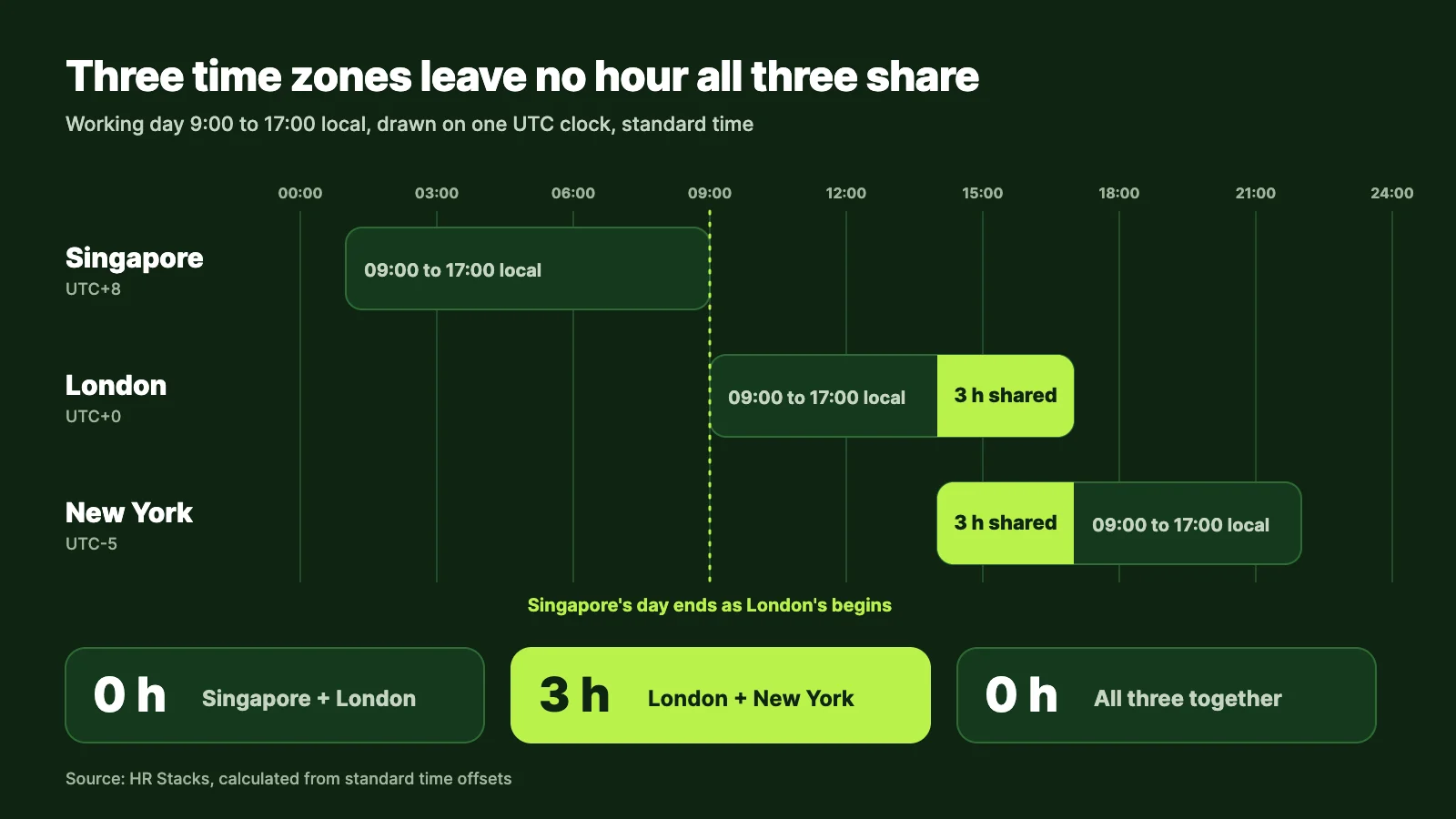
Overlap is the default that time zones break first. A team in Singapore, London and New York shares no hour when all three are at work, and London and New York share only three. When overlap is thin, stop forcing it. Move status updates into writing, rotate the live meeting time so one region does not always take the early or late call, and record every meeting. GitLab’s remote guidance says the same.
Which channel for which message
Use chat for quick questions, a written document for decisions and video for feedback and conflict. Choose by message type, not by habit. The table covers the cases managers hit most.
Two habits keep it working. As a rule of thumb, move any chat thread that passes ten messages into a document with an owner and a deadline. And keep criticism off text entirely: tone does not survive a chat window, so give it on a call with the camera on.
A weekly rhythm that replaces the office
A fixed weekly cycle does the job hallway conversation used to do. Set it once and protect it, because predictability is what remote staff cannot get from proximity.
Gallup recommends one meaningful conversation a week with each direct report, covering progress, barriers, wellbeing and collaboration. Practice lags: only 22% of US employees strongly agree they received meaningful feedback in the last week, and 27% strongly agree their supervisor keeps them informed.
- MondayEach person posts the one to three outcomes they will finish this week. Managers comment in the doc instead of calling a meeting.
- TuesdayOne-to-ones start. Give each report one 20 to 30 minute call with the camera on, spread across Tuesday to Thursday.
- WednesdayHold the single team call. Post the agenda a day ahead and record it for colleagues in other time zones.
- ThursdayWritten updates are due by end of day, in three lines: done, next, blocked.
- FridayThe manager posts a short summary of what shipped and names the people behind it.
Treat this as a template built on Gallup’s weekly conversation advice. Teams spread across several time zones can swap the Wednesday call for a recorded video update.
How to measure remote performance
Measure what people deliver and how well, not how long they appear online. Agree three to five outcomes per role, review them weekly and keep the definitions in writing.
Trust is the weak point, not output. Gallup finds only 54% of managers who supervise remote employees strongly agree they trust them to be productive, and only 57% of employees strongly agree they feel trusted. Gallup also reports that clear expectations, regular communication and accountability for results can raise trust by nearly 30 percentage points.
Location alone does not predict results. In a randomized trial at Trip.com covering 1,612 employees, two remote days a week left performance reviews and promotion rates unchanged and cut attrition from 7.2% to 4.8%, according to the Nature study. The 395 managers in the trial had expected a 2.6% productivity loss and ended up forecasting a 1.0% gain. That study tested hybrid work, not fully remote work.
Share of US employees who are engaged, by work arrangement
- Exclusively remote32%
- Hybrid31%
- On-site, remote-capable job28%
- On-site, job not remote-capable27%
Source: Gallup Hybrid Work Indicator, latest reading. The spread is small, which fits Gallup’s finding that the manager matters more than the location.
Track time only where work is billed by the hour or sold by project, which is where a time tracking tool earns its place. For metric examples by role, use our remote team KPIs guide.
Hire and onboard remote staff
Remote hiring works when the first 30 days are planned before the offer is signed. Screen for written communication and self-direction, because those two skills carry most of the day-to-day work on a remote team.
- Before day oneShip the laptop, create accounts and write the first-week plan.
- Day oneMeet the manager and a buddy, then read the operating document.
- Week oneShip one small piece of real work and get feedback on it.
- Day 30Review goals together and ask what the onboarding got wrong.
Contracts, e-signatures, equipment tracking and onboarding checklists sit in HR software. A team paid in several states or countries also needs payroll software that handles each jurisdiction. Choose both before headcount grows.
Remote security baseline
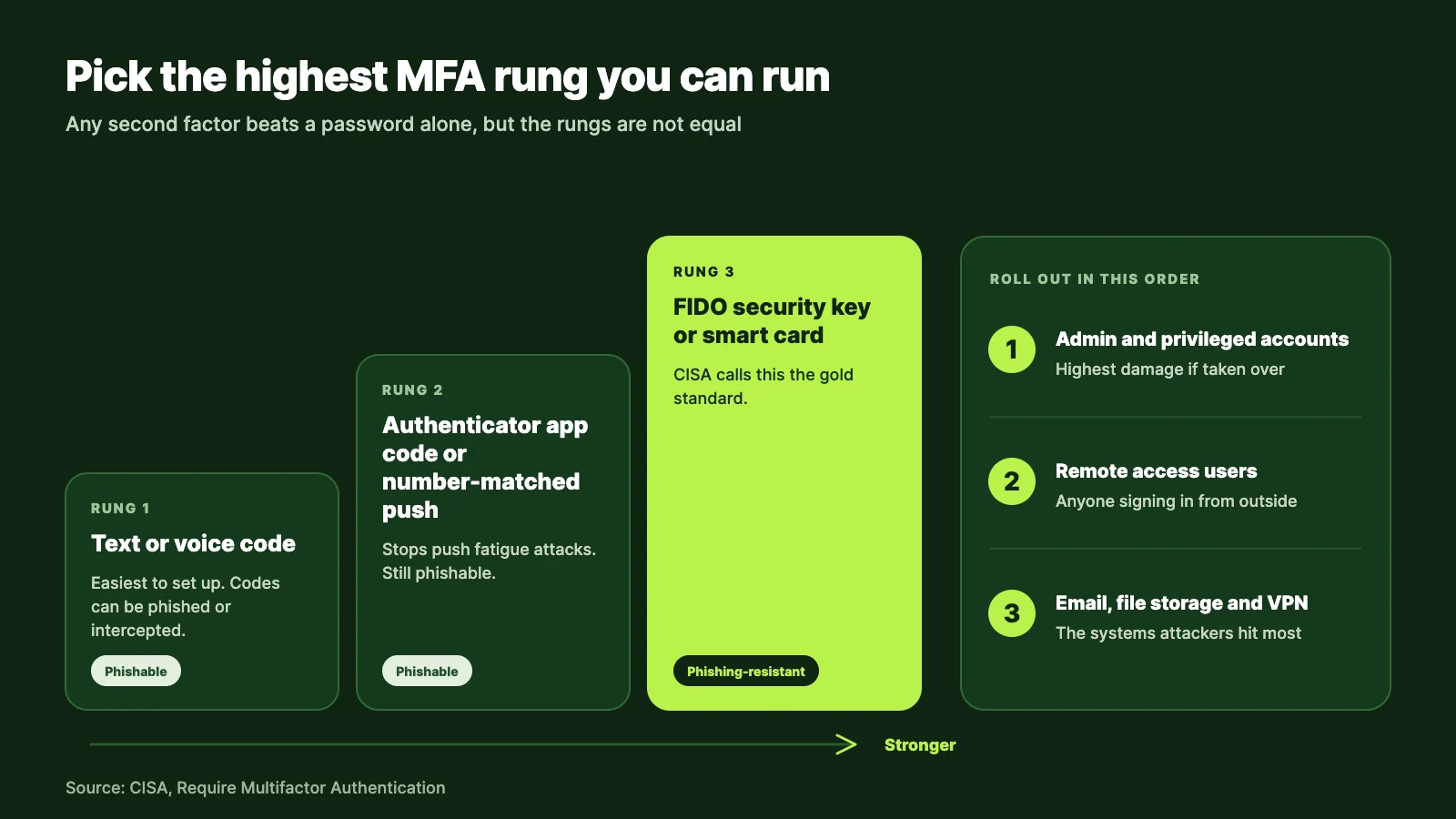
Start with multifactor authentication on email, file storage and VPN, beginning with admin and remote access users. That is the order CISA recommends, because those are the accounts and systems attackers hit most often.
The cost of getting it wrong is concrete. IBM’s Cost of a Data Breach Report puts the global average breach at $4.99 million, up 12% on the prior year. That is a cross-industry survey average, not a forecast for your business.
- MFA on admin accounts, email, file storage and VPN
- FIDO security keys for admins and anyone who approves payments
- Company laptops with disk encryption and automatic updates
- A password manager, with a unique password for every tool
- Access limited to what each role needs, reviewed every quarter
- A same-day offboarding checklist that revokes accounts and recovers devices
Keep culture alive without forced fun
Remote culture comes from what managers do every week, not from the social calendar. Gallup lists four habits: connect work to purpose, develop people, show care and play to strengths.
Recognition in the open
Name the person and the result in the team channel, not only in the one-to-one. Our guide to employee engagement programs covers formats that hold up.
Development on the calendar
Gallup warns that remote staff are easy to overlook for stretch work. Book career conversations instead of waiting for them to happen.
Optional social time
Offer it and never require it. See our virtual team building statistics for formats to try.
One in-person meetup
Where budget allows, bring the team together once or twice a year, for planning and relationships rather than status updates.
Structure protects culture too. In Gallup’s data, employees who set their hybrid schedules entirely on their own were more likely to name burnout as their biggest challenge than those on team-agreed norms. Flexibility works better inside shared rules.
When your team crosses borders
When someone works from another country, that country’s employment, tax and social security rules apply to them, wherever your company is registered. You can hire a contractor, set up a local entity or use an employer of record that employs the person locally on your behalf.
- You set their working hours
- You direct how the work is done
- They work for you full time, long term
- You want a full-time employee where you have no entity
- You need local contracts, payroll and benefits handled
- You still direct the daily work
Tests for contractor status vary by country, so treat control over hours and methods as a warning sign rather than a legal verdict. An employer of record removes the question for full-time roles, and the price is covered in how much an employer of record costs.
Local rules also reach your operating document. Rules like Australia’s right to disconnect follow the employee’s country, so a team with staff there needs a local line in its out-of-hours rule.
Where to start this week
Pick the situation closest to yours and take that step first.
have no written rules
Draft the six-line operating document from the defaults above and share it on Monday.
cannot tell who is performing
Agree three outcomes per person and start the weekly one-to-one.
hire full time in a new country
Compare employer of record providers before you sign a contractor agreement for the role.
Frequently Asked Questions
How do you manage a remote team effectively?
Write operating rules, set three to five outcomes per person, hold one real conversation a week with each report and choose channels by message type. Gallup attributes 70% of the variance in team engagement to the manager, so management habits matter more than tools.
What tools does a remote business need?
A chat tool, a shared document workspace, a video platform, project tracking and an HR system that holds contracts and onboarding. Add time tracking only for hourly or billable work. A few tools used consistently beat a large stack nobody checks.
How many hours of overlap should a remote team have?
A common starting point is three to four shared hours a day, which is a rule of thumb rather than a standard. If time zones prevent it, move updates to written posts, rotate the live meeting time and record every call for people who cannot attend.
Is remote work less productive than office work?
The evidence does not show that. In a randomized trial at Trip.com with 1,612 employees, two remote days a week left performance reviews and promotion rates unchanged and cut attrition from 7.2% to 4.8%. That study tested hybrid work, not fully remote work.
How do you track remote employee performance?
Track outcomes: work delivered, quality and goals met. Gallup advises weekly manager conversations and accountability for results, not attendance. Use time tracking only where work is billed by the hour. Gallup finds only 54% of managers of remote staff strongly trust them to be productive, so clear goals matter.
When do you need an employer of record for remote staff?
When you hire a full-time employee in a country where you have no legal entity. The employer of record becomes their legal employer locally, handling contracts, payroll, taxes and benefits, while you direct the work. Contractors suit defined projects, not long-term full-time roles.
What is the right to disconnect?
A legal right in some countries, such as Australia, for employees to refuse work contact outside their hours unless refusing is unreasonable. It has applied to employers with 15 or more employees since 26 August 2024 and to smaller businesses since 26 August 2025.