
Quick answer: what is global payroll compliance?
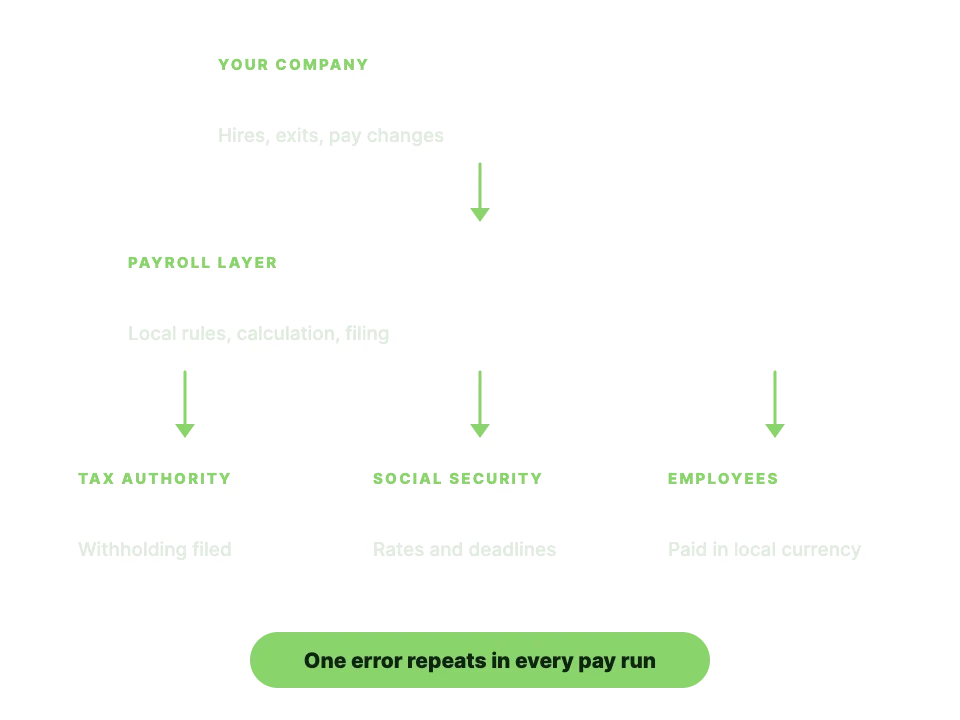
Global payroll compliance means paying employees in every country correctly and on time under local tax, social security, labor and data protection rules. Each country sets its own rates, filing dates and pay slip rules, so one setup error repeats in every pay run. Companies manage this through in-country providers, an aggregator or a single global payroll platform.
- Main riskErrors repeating across pay runs
- Check firstWho is liable in the contract
- Key numberGDPR fines can reach 4% of turnover
- Use insteadNo entity abroad? Use an EOR
Key takeaways
Payroll is where employment law, tax and data rules meet on one date each month. When a company pays staff in several countries, each country brings its own rates, deadlines and pay slip rules. This guide covers what to check, which rule changes are coming and how to choose between local, aggregator and global payroll models.
What global payroll compliance covers
Global payroll compliance covers six areas: tax withholding, social security, statutory pay rules, filings, data protection and worker classification. A gap in any one of them can lead to back payments, penalties or disputes with staff.
Tax withholding
Income tax is calculated and remitted under local brackets and filing frequency.
Social security
Employer and employee contributions follow country rates, wage bases and deadlines.
Pay rules
Minimum wage, overtime, leave pay and final pay follow local statute and often collective agreements.
Filings and records
Returns, year-end statements and pay records must reach the right authority on the right date.
Data protection
Payroll holds bank details and tax IDs, so storage and transfers fall under local privacy law.
Classification
Whether someone is an employee or a contractor decides which of the other areas apply.
The first four are carried out by whoever runs payroll in each country. The last two sit with your company, because they depend on what data you hold and how you engage each worker.
Where payroll penalties come from
Most penalties trace back to late or wrong filings, underpaid contributions and misclassified workers. Many tax authorities add interest and require back payment, so the cost grows for every month an error stays in place.
Data protection is the one area with a published ceiling. Under GDPR Article 83(5), fines for the most serious infringements can reach €20 million or 4% of worldwide annual turnover, whichever is higher. Payroll systems hold bank details and tax identifiers for every employee, which places them inside that regime.
Other countries set penalties locally, so there is no single global figure. Ask each in-country adviser for the late filing and underpayment penalty rates before you set the payroll calendar.
Rules changing in 2026 and 2027
Two changes need action from multi-country employers: the UK is moving benefits in kind into real-time payroll, and EU pay transparency rules are reaching national law. Both timelines have moved before, so check the current status in each country.
Rule changes to plan for
Verified 6 Nov 2026The UK dates come from HMRC’s interim guidance on phased payrolling. HMRC says final phase 1 guidance will follow the Autumn Budget 2026, and older articles that point to April 2026 are out of date.
On the EU side, member states had to pass national laws by 7 June 2026 under Directive 2023/970. Law firm trackers report that only four states had full rules in force on that date: Slovakia, Italy, Lithuania and Malta, with Greece following in July. We did not verify each national gazette, so check your countries directly.
Under the directive, the first report for employers with 250 or more workers covers calendar year 2026 and is due 7 June 2027, though national laws set the final dates. The pay data behind that report is being created in current pay runs.
Payroll compliance by country
Every country adds its own layer on top of base salary. Some of it shows up on the payslip. The rest sits in a reserve you only notice when someone leaves.
This table covers the twelve countries where we publish a full hiring guide. The rates come from the country records behind our EOR cost calculator, last updated October 2026.
These are headline rates. Salary ceilings, thresholds and age bands change what you pay in practice, so run a real salary through the EOR cost calculator before you budget a hire.
Employee data across borders
GDPR applies to employee data for EU staff, but Article 88 lets each member state add its own employment data rules. The result is one regulation with different local requirements, so a single global payroll privacy notice is rarely enough.
Article 88 allows national law or collective agreements to set more specific rules for hiring, contract performance, workplace monitoring and transfers within a corporate group. The EU Court of Justice narrowed this in 2023: a national rule that only repeats the general GDPR conditions is not a valid specific rule under Article 88 (case C-34/21). Document the Article 6 legal basis for each payroll data use and check each country’s employment data rules on top.
Worker classification risk
Calling someone a contractor does not make them one. The ILO’s Employment Relationship Recommendation says the facts of the work and the pay should guide the decision, whatever the contract calls the arrangement.
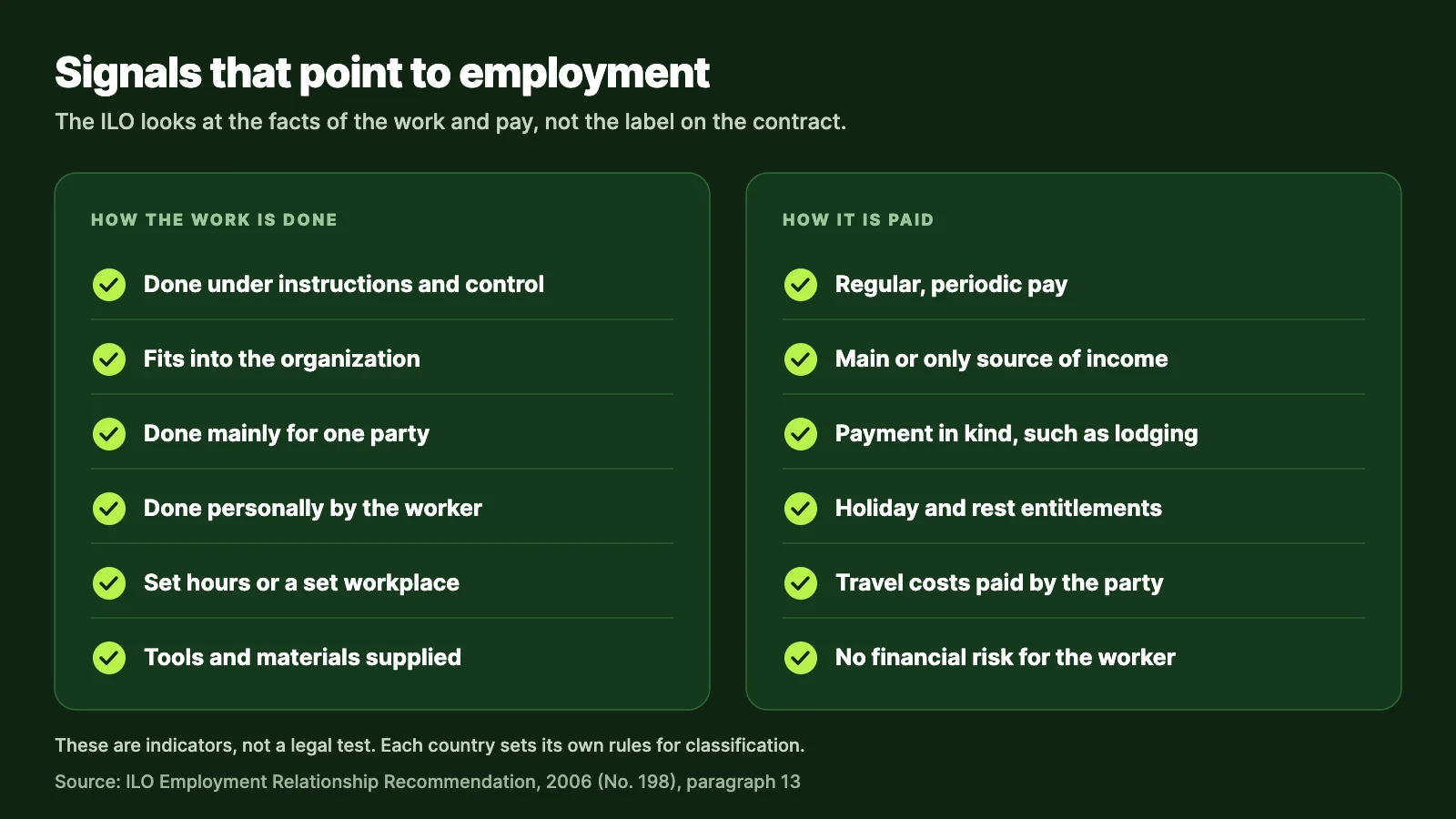
The same recommendation lists signals that national courts and agencies may weigh, from control over how work is done to payment patterns and who carries financial risk. Each country sets its own test, so a contractor setup that holds up in one country can fail in another.
If you want to employ someone in a country where you have no entity, an Employer of Record employs them locally and runs their payroll. Our guide to how much an Employer of Record costs shows what that route adds.
Global payroll vs local payroll
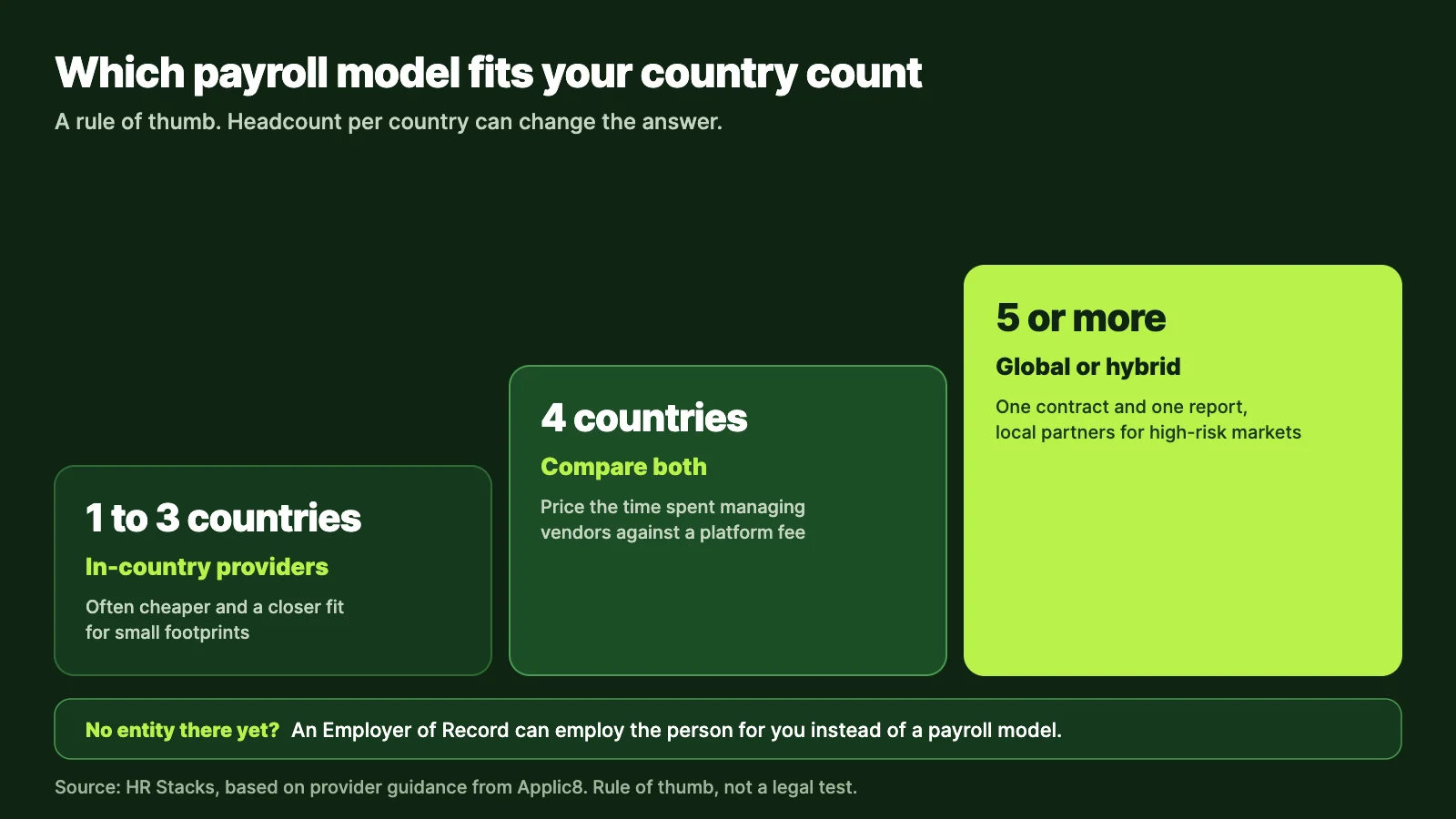
For one to three countries, local specialists often fit better and cost less. From five countries upward, a global or hybrid model usually reduces vendor management. That split is a rule of thumb from provider guidance, not a legal test, and headcount per country can override it.
There are four common ways to run multi-country payroll: in-house with local entities, an in-country provider per country, an aggregator that coordinates local partners, or a global provider. Most global payroll companies outsource all or part of the in-country work to local specialists, so ask which parts a provider runs itself. Vendor documentation also describes multi-country payroll software as a layer over local systems, not one engine that calculates pay everywhere.
Cost is not a per-country fee comparison. Total cost includes provider fees, the internal time spent coordinating vendors and the cost of compliance errors under each model.
Pros of centralized payroll
- One report and one contract across countries
- A single escalation point when something breaks
- Easier to add a new country
Cons of centralized payroll
- Setup and integration with HR and finance systems take effort
- Local depth varies by country
- Long contracts can make switching hard
1 to 3 countries
Start with in-country providers. Add a consolidated report only if finance needs one.
5 or more countries
Price a global or hybrid model against your current vendor count and internal hours.
one hire and no entity
Compare an Employer of Record before setting up an entity and payroll.
How to choose a payroll partner
Choose on three things first: who actually runs payroll in each of your countries, what the contract says about errors, and what evidence the provider gives for security and rule updates. Price comes after those answers.
- Which countries they run with their own entities and which through partners
- Who is liable, in writing, when a provider error causes a penalty
- How they track rule changes and when you are told
- An ISO 27001 certificate or SOC 2 report, plus their sub-processor list
- Employee support in the local language
- Pricing that lists setup, per-employee and add-on fees
- How data reaches your HRIS and finance system
To compare named vendors, start with our payroll software shortlist, the Deel review and the Papaya Global review. Providers that also act as an Employer of Record are covered in top EOR solutions, and this guide explains how an EOR and a PEO divide the work.
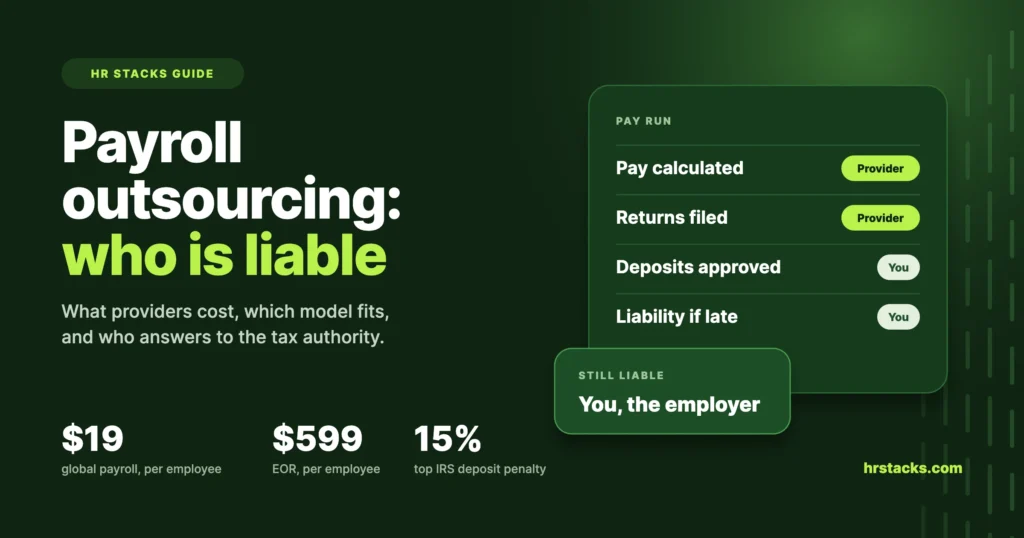
For the outsourcing side of this decision, including what it costs and who stays liable if a provider makes an error, read our payroll outsourcing guide.
Payroll compliance checklist for a new country
Use this list each time you add a country. It puts the rules above in the order you work through them.
- Classify the workerDecide employee or contractor under local rules before the first pay run.
- Confirm who the employer isYour own entity, a local payroll partner or an EOR must hold the employer registration.
- Register with the authoritiesGet the tax and social security numbers you need before the first payment, or confirm your provider already holds them.
- Collect the worker dataTax ID, bank details, residency status and right to work, stored under local data rules.
- Load rates and accrualsSet the country’s employer contributions, ceilings and thresholds, plus accruals such as severance or holiday pay. The table above shows what to expect.
- Match the local pay rulesCheck pay frequency, currency, payslip content and language, and any mandatory extra pay month.
- Calendar the filing datesList the monthly, quarterly and year-end submissions and give each one a named owner.
- Keep proofStore submission receipts, payslips and contracts for the local retention period.
A monthly compliance routine
Run the same four checks every pay cycle: lock inputs, review the register, confirm filings and reconcile to the ledger. The checks are short, and they catch errors while they affect one pay run instead of twelve.
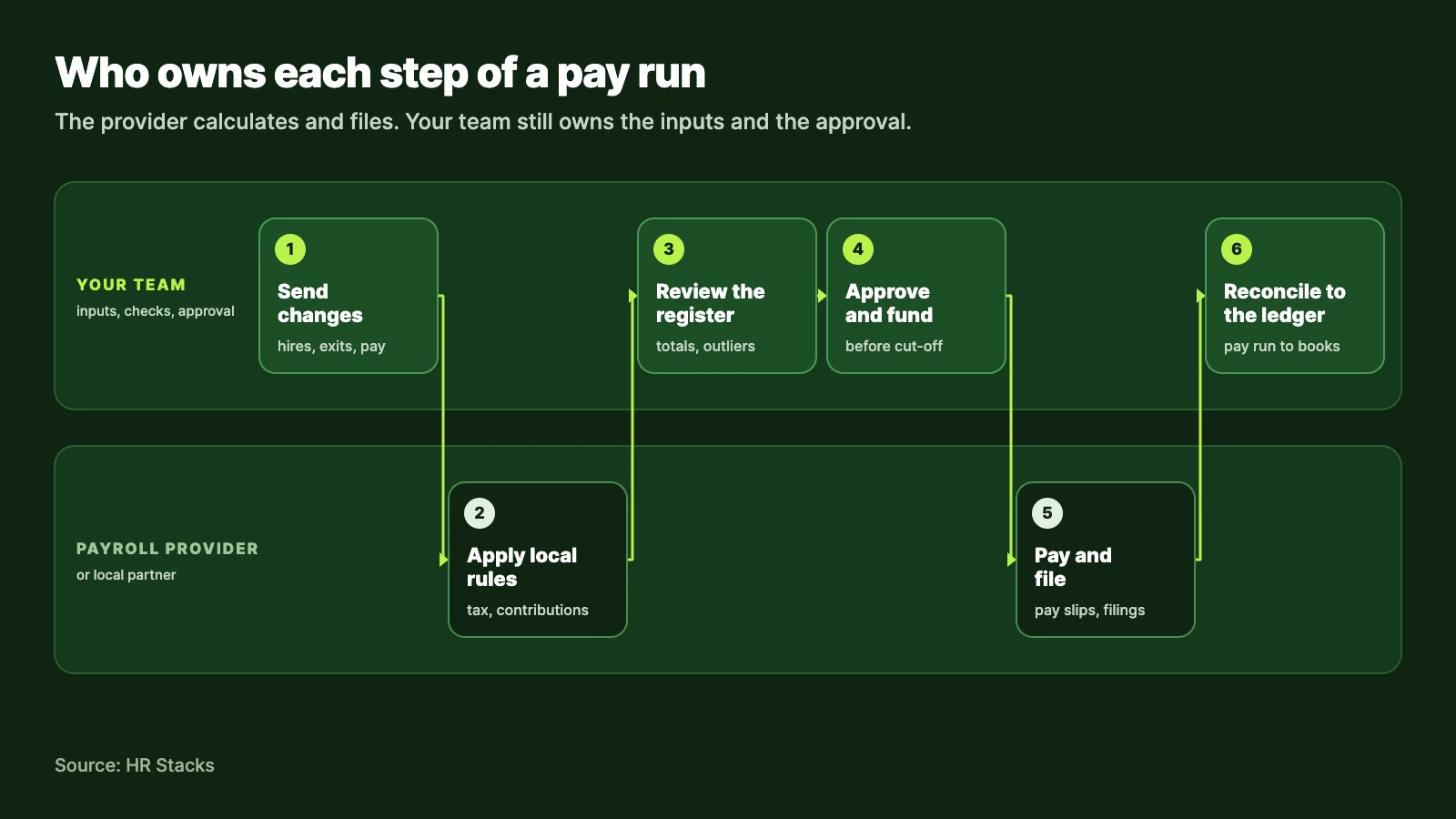
- Lock the inputsSet a cut-off for hires, exits and pay changes in each country.
- Review the registerCompare headcount and totals with last month and investigate large swings.
- Confirm filingsCheck that tax and social security submissions reached the right authority by the local deadline.
- Reconcile to the ledgerMatch payroll cost and cash paid to the general ledger, including currency conversion.
Myths that cause penalties
Three beliefs lead to avoidable payroll problems: that the provider carries all the risk, that a contractor label settles status, and that headquarters rules travel with the employee.
Frequently Asked Questions
What is global payroll compliance?
Global payroll compliance means paying employees in each country correctly and on time under local tax, social security, labor and data protection rules. It covers calculation, filings, pay slips, records and the legal basis for holding employee data. Each country sets its own requirements, so there is no single global standard.
What is the difference between global payroll and local payroll?
Local payroll uses a separate provider or team in each country. Global payroll puts several countries under one contract, platform and report, through entities the vendor owns or through local partners. Provider guidance suggests local fits one to three countries and global or hybrid fits five or more.
Does a global payroll provider make my company compliant?
Not automatically. A provider calculates and files payroll under local rules, but your company supplies the inputs, approves each run and usually remains the employer. The contract decides who pays a penalty caused by a provider error, so read that clause before you sign.
What happens if payroll is wrong in another country?
Outcomes depend on the country. Common results are back payment of tax and contributions, interest, penalties and corrections for employees. Repeated or deliberate breaches can bring harsher action in some jurisdictions. Ask a local adviser for the specific penalty rates before you set the payroll calendar.
When does mandatory payrolling of benefits in kind start in the UK?
HMRC guidance says phase 1 starts on 6 April 2027 for company cars, car fuel, vans, van fuel and employer-provided medical benefits. Phase 2 covers most other benefits from 6 April 2028. Loans and accommodation stay voluntary. The guidance is still interim, so check the current HMRC pages.
Do EU pay transparency rules apply yet?
The transposition deadline in the directive was 7 June 2026, and only a few member states had full national rules in force by then. Rules apply when each country adopts its own law. Under the directive, first pay gap reports for employers with 250 or more workers are due 7 June 2027.
Can a contractor be treated as an employee?
Yes. ILO Recommendation 198 says the facts of the work and pay should guide the decision, whatever the contract is called. Control over how work is done, set hours, one main client and regular pay all point toward employment. Each country applies its own test.
When should I use an Employer of Record instead of payroll?
Use an Employer of Record when you want to employ someone in a country where you have no legal entity. The EOR becomes the local employer and runs payroll. A payroll provider only processes pay for staff your own entity already employs.