







Oyster HR Vs Globalization Partners Comparison Summary
Choosing between Oyster HR and Globalization Partners isn’t just about price or country count; it’s about what kind of global operation you’re building.
Oyster is made for companies that want to hire anywhere and manage everything through modern software. It gives internal teams control, speed, and transparency without needing a legal footprint in each country.
Globalization Partners, on the other hand, is built for organizations that want deep compliance coverage and local expertise on call. It’s less about automation and more about assurance, a fit for enterprises that value white-glove support over self-serve speed.
Both handle payroll, contracts, and benefits worldwide, but they solve very different problems.
Oyster HR vs Globalization Partners: Overview
Both Oyster HR and Globalization Partners let you legally hire and pay employees in countries where you don’t have an entity. They handle contracts, payroll, benefits, and compliance.
But their philosophies couldn’t be more distinct.
Oyster believes in automation and transparency, giving internal teams control through a clean, tech-first platform.
G-P takes a service-driven route, anchored in owned legal entities and local expertise.
One is built for speed and simplicity. The other is built for certainty and personal guidance.
Oyster HR
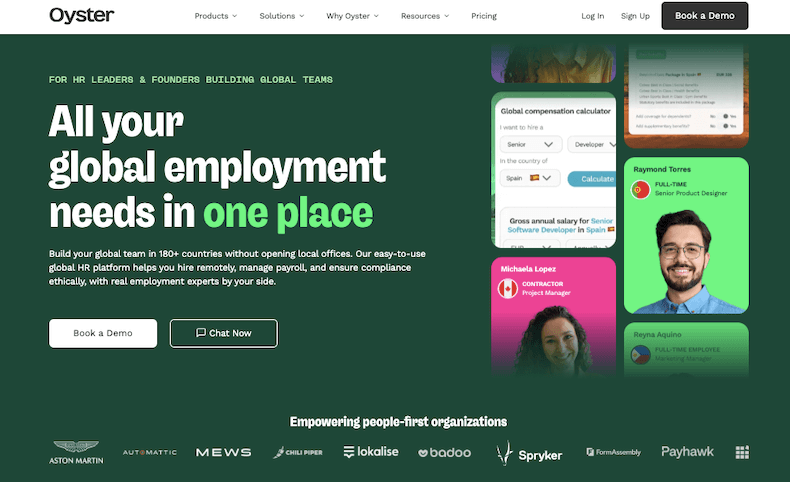
Oyster HR is designed for distributed companies that want to move fast. The platform lets you hire full-time employees in 120+ countries and manage contractors in 180+, all from one dashboard. Pricing is published and predictable, $699 per employee per month for EOR services.
Oyster’s pitch is self-service confidence. You can generate localized contracts, estimate total employment costs instantly, and onboard a new hire within a few days, often in under a week when documents are ready. The system automatically adjusts for currency, tax, and benefits rules by location.
It’s ideal for startups and scaling tech companies with lean HR teams that still want strong compliance. The product philosophy is clear: automate everything that can be automated, and keep humans in the loop only when nuance demands it.
Globalization Partners (G-P)
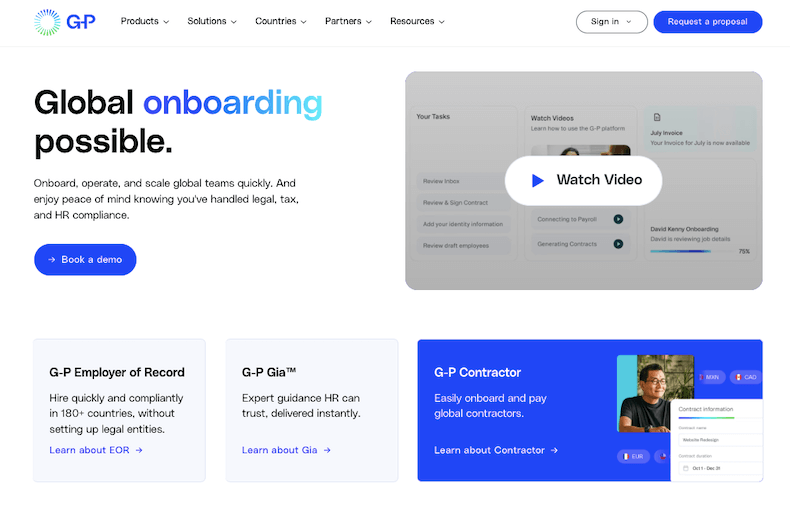
Globalization Partners, or G-P, takes a very different approach. They operate through 100+ wholly owned legal entities and cover 180+ countries worldwide. Instead of handing users a fully self-serve platform, G-P pairs technology with local HR, legal, and tax specialists who manage each employment lifecycle step.
There’s no published flat pricing; rates depend on region and complexity, but G-P positions itself as an enterprise-grade solution with high-touch support.
That hands-on model appeals to companies entering legally complex markets, or those with strict risk and compliance requirements, industries like finance, healthcare, and manufacturing. It’s less about moving fast and more about moving safely.
When an organization’s tolerance for compliance risk is low, G-P tends to be the go-to.
Oyster HR vs Globalization Partners: Feature Comparison
| Feature | Oyster HR | Globalization Partners (G-P) |
|---|---|---|
| Global Coverage | 120+ countries (full-time); 180+ (contractors) | 180+ countries (100+ owned entities) |
| Platform Type | Cloud-based, automation-first EOR | EOR & PEO hybrid with regional experts |
| Onboarding Speed | Typically 3–5 days, automated workflow (varies by country) | 5–10 days, compliance reviewed by local teams |
| Contractor Support | Yes – self-serve management | Yes – managed via account specialist |
| Payroll Engine | Centralized global payroll | Localized payroll via owned entities |
| Benefits | Pre-packaged global plans | Custom benefit design per market |
| Compliance & IP Protection | SOC 2 Type II, GDPR, IP transfer tools | ISO 27001 certified, local legal entity ownership |
| User Experience | Modern dashboard, cost calculator, transparent quotes | Enterprise-grade interface with guided workflows |
| Integrations | Open API + 500+ app connections (HRIS/finance) | Integrates with major HRIS and ERP systems |
| Customer Support | Live chat + success manager | 24/7 global support with in-region HR/legal experts |
| Pricing | $699 per employee / month (as of Nov 2025) | Custom enterprise pricing |
| Security Certifications | SOC 2 Type II + GDPR alignment | ISO 27001 + SOC2 adherence statement |
| Scalability | Best for fast-growth tech and distributed teams | Best for multi-entity or regulated enterprises |
Oyster HR Vs Globalization Partners: Feature Deep-Dive
Onboarding Experience
Oyster’s onboarding is largely automated. Once you approve a candidate, the system drafts a country-specific contract, calculates employer costs, and walks both sides through signing and setup. You’ll still need to upload a few documents, but you won’t be waiting on manual reviews for most countries.
With G-P, onboarding involves more conversation. Each hire goes through a compliance check with local HR and legal staff. You’ll have a named contact who ensures every clause meets local employment law. It takes a few extra days but gives organizations far greater assurance in high-regulation markets.
Bottom line: Oyster saves time; G-P minimizes legal risk. Different teams will value those outcomes differently.
Compliance and Legal Ownership
This is one of the biggest distinctions. Oyster operates through a mix of owned entities and vetted partners. It manages compliance centrally, alerting you to policy or law changes.
G-P, by contrast, owns most of its employing entities outright. That means your employment relationship is effectively through G-P’s local company, reducing dependency on third parties. For organizations that need a firm legal footing in sensitive regions (for example, China or the UAE), that ownership structure carries real weight.
Integrations and Data Flow
Oyster integrates easily with HRIS tools like BambooHR, Personio, and Rippling, along with accounting systems through an open API. It suits companies that want EOR data feeding straight into their HR stack.
G-P’s integrations are more targeted, built for enterprise environments using SAP, Oracle, or Workday. If your HRIS is one of those, the deeper sync options make sense.
Customer Experience
Oyster’s support model feels like a modern SaaS experience: live chat, clear documentation, and optional success managers. It’s quick, responsive, and digital.
G-P’s support feels more like working with a regional HR team. You’ll have 24/7 access to experts who understand local law, but you’ll also rely on them more, especially for policy changes or benefits customization.
Neither model is inherently better. The difference comes down to how much hands-on help you expect versus how much in-platform control you want.
Editor’s Note
If you strip the logos off and look at philosophy, the choice is pretty clear.
Oyster HR is built for teams that already think in systems. They want visibility, speed, and control without calling an account manager for every update. The transparency, pricing, cost calculators, and workflows make it easy to forecast budgets and scale fast.
Globalization Partners is built for companies that need to reduce risk exposure, not just automate processes. Its entity ownership, compliance rigor, and local legal coverage are especially valuable for heavily regulated industries or for organizations hiring in unfamiliar regions.
We’ve seen mid-size SaaS companies lean toward Oyster; multinational manufacturers and finance firms tend to stay with G-P. Each choice makes sense once you understand their risk tolerance and internal capacity.
Oyster HR vs Globalization Partners: Final Recommendation
Choose Oyster HR if you:
- Need a transparent, tech-driven EOR with fast onboarding
- Prefer to manage hiring and compliance through your own HR team
- Want clear, predictable pricing
- Already use modern HRIS or payroll tools and value API access
Choose Globalization Partners if you:
- Operate in complex or high-risk markets
- Want owned-entity legal assurance and in-region experts
- Value personalized, ongoing compliance guidance
- Don’t mind custom pricing in exchange for deeper legal coverage
Verdict
If your team runs on automation, data visibility, and predictable pricing, Oyster HR is the cleaner fit.
If your organization prioritizes compliance depth and localized expertise, Globalization Partners is the safer long-term partner.
Neither is objectively better; they’re built for different kinds of operators. Pick based on how your HR team works, not just where you’re hiring.