


Rippling vs. Keka: Detailed Comparison 2026

A detailed side-by-side Rippling vs. Keka comparison to help you select the best option between these two solutions. We have considered top features, pros and cons, pricing and other details to help you choose the right solution.
Featured HR Tech Solutions
When I Work Logo
When I Work
Company Profile When I Work Built by...
usemultiplier_logo
Multiplier
Company Profile Multiplier Built by Multiplier Technologies...
Deel Logo
Deel
Company Profile Deel Built by Deel, Inc....
Pebl Logo
Pebl
Company Profile Pebl Formerly Velocity Global ·...

Rippling vs. Keka: Overview

What is Rippling?

Rippling combines HR, IT, and finance into one system, but its real strength is how tightly everything connects. In this review, we break down where it works well and where it doesn’t.

Rippling Company Profile

Co Name: Rippling People Center, Inc.
HQ: California, United States
Est Year: 2016
Company Size
1001-5000 employees
Website

What is Keka?

Keka is a cloud-based HRM tool designed to elevate employee management expereince in a seamless way

Keka Company Profile

Co Name: Keka Technologies Private Limited
HQ: Hyderabad, India
Est Year: 2014
Company Size
900+ employees
Website

Rippling vs. Keka: HR Stacks Score

Rippling vs. Keka HR Stacks score based on a number of data points. We check the features, user feedback, community sentiments while adding the score. The score will give you some idea about the overall quality of the products.

Rippling Score

Ease of Use 92%
Features 94%
Value for Money 94%
Support 90%

Rippling: Editor's Rating

Pricing & Value
3.9/5
Rippling can be cost-effective if you’re using several modules together, because the unified system replaces multiple tools. But once you add EOR, payroll, IT management, and advanced automations, the total price climbs.
Global Coverage
4.3/5
Rippling supports hiring and payroll in dozens of countries. It works well for companies scaling a remote workforce, though it doesn't yet match the “hire anywhere” coverage of the largest dedicated EOR vendors.
Compliance & Local Expertise
4.2/5
Rippling performs reliably with contracts, statutory requirements, and payroll compliance across supported regions. Users praise how well the system handles U.S. and major international markets.
Payroll & Benefits
4.3/5
The payroll engine is fast and dependable, with accurate tax calculations and clear payment timelines. Benefits management is also strong, especially when integrated with the broader HR modules.
Onboarding & Employee Experience
4.2/5
Users consistently highlight Rippling’s smooth onboarding, device provisioning, access permissions, forms, payroll setup, all handled in a single workflow. Employees generally find the portal easy to use.
Platform & Ease of Use
4.4/5
Rippling’s unified dashboard is one of its biggest advantages. HR, payroll, IT, and EOR functions sit in one clean interface.
Integrations
4.4/5
The platform integrates with a wide ecosystem, HR systems, finance tools, identity management platforms, time-tracking apps, and more.
Customer Support
4.0/5
Support is generally helpful and knowledgeable, especially during guided onboarding. Users appreciate the structured implementation process.
Overall Score
4.2/5
Rippling is a strong choice for companies wanting an all-in-one platform that combines HR, payroll, IT management, and EOR. It’s especially well-suited for distributed teams and mid-size companies that value automation and a unified system.

Keka Score

Ease of Use 88%
Features 92%
Value for Money 92%
Support 88%

Keka: Editor's Rating

Pricing & Value
4.1/5
Strong value for a full HRMS + payroll suite; a bit pricier for smaller teams once you scale features.
Global Coverage
4.0/5
Cloud platform serves globally, though most strong feedback comes from Indian and APAC markets.
Compliance Strength
4.0/5
Handles payroll and statutory compliance well for core markets; broader employment compliance varies by region.
Onboarding Experience
4.3/5
Users report a smooth setup and quick adoption for core HR and payroll workflows.
Payroll & Benefits
4.1/5
Payroll is one of its strengths with accurate automation and self-service; benefits support is solid but not as deep as specialist tools.
Integrations
4.0/5
Good integrations with accounting tools, attendance systems, and device hardware; some users ask for deeper connectivity.
Customer Support
3.9/5
Generally helpful support, though responsiveness and follow-up vary by request and region.
Ease of Use
4.3/5
Consistently praised for a clean, intuitive dashboard and workflows that are easy for HR teams and employees alike.
Overall Score
4.1/5
A strong, modern HRMS with excellent payroll and core HR features; great for SMEs and growing teams, with room to refine advanced customization and support.

Rippling vs. Keka: Pricing Comparison

Rippling vs. Keka pricing comparison. The pricing is one of the most important aspect to look at when we compare two products. It can be an important aspect to make a decision.

Rippling Pricing Details

Free Version: No

Free Trail: Yes

Starting Price: $8/User

Keka Pricing Details

Free Version: No

Free Trail: Yes

Starting Price: Rs. 6,999

Rippling vs. Keka: Pros & Cons

Rippling Pros & Cons

Pros of Rippling

Unified HR and IT management
HR teams can manage employee data, devices, and app access from one platform, reducing tool fragmentation and manual coordination.
Powerful workflow automation
Custom workflows automate onboarding, approvals, and policy enforcement, helping teams reduce repetitive tasks and maintain consistency across processes.
Extensive integration ecosystem
The platform connects seamlessly with hundreds of business tools, allowing companies to centralize operations without disrupting their existing tech stack.
Fast and structured onboarding
New hires can be onboarded quickly with automated provisioning of accounts, payroll setup, and compliance tasks handled in a single flow.
Scalable for growing organizations
The system adapts well as companies expand, supporting additional modules, users, and workflows without requiring a complete system overhaul.
Strong payroll and compliance features
Payroll processing is reliable and automated, with built-in compliance support that reduces the risk of errors and regulatory issues.

Cons of Rippling

Modular pricing adds up quickly
Costs can increase significantly as companies add more features, making it less predictable for teams planning long-term budgets.
Initial setup can be complex
Configuring workflows, permissions, and integrations requires time and expertise, especially for organizations with more complex operational structures.
Customer support inconsistency
Support quality can vary depending on subscription tier, with some users experiencing slower responses or less personalized assistance.

Keka Pros & Cons

Pros of Keka

Reliable payroll processing
Payroll runs are consistent and accurate, helping HR teams reduce manual errors and stay compliant with Indian statutory requirements.
User-friendly interface design
The interface is intuitive and well-structured, allowing employees and HR teams to navigate features easily without extensive training or support.
Strong attendance automation
Attendance tracking integrates smoothly with policies, reducing manual intervention while ensuring accurate records for payroll and compliance workflows.
Employee self-service portal
Employees can manage leave, attendance, and personal details independently, reducing HR workload and improving overall operational efficiency.
Quick implementation process
Most organizations can get started relatively quickly, as the setup process is guided and does not require heavy technical involvement.
Integrated HR feature set
Core HR, payroll, and attendance are unified in one system, helping teams avoid using multiple disconnected tools for everyday operations.

Cons of Keka

Limited global capabilities
The platform is not designed for international workforce management, making it unsuitable for companies with multi-country payroll and compliance needs.
Restricted customization flexibility
Some HR workflows and policies cannot be deeply customized, which can be limiting for organizations with complex operational requirements.
Inconsistent support experience
While support is helpful initially, response times and resolution quality can vary, especially for ongoing or more complex issues.

Rippling vs. Keka: Demo

Understand the products better by checking the demo videos listed below. 

Rippling Demo Video

Youtube video

Keka Demo Video

Youtube video

Rippling vs. Keka Comparison Summary

Choosing between Rippling and Keka comes down to how you want your HR operations to actually run. Both handle core HR, payroll, and employee management. The difference shows up in how they approach control, scale, and day-to-day usability.

If you are comparing these two, you are really deciding between a system that tries to automate everything and one that focuses on doing HR and payroll cleanly without extra layers.

Product Overview

Both platforms cover the essentials, but they are built with different priorities.

Rippling is a unified platform that connects HR, IT, and finance. It is built for companies that want everything tied together, from payroll to app access to device management. The idea is simple. Centralize data, automate workflows, and reduce manual work across departments.

Rippling Review

Keka focuses on HR, payroll, and employee experience, with a strong emphasis on India. It works well for mid-sized companies that want something reliable and easy to use without dealing with unnecessary complexity. The goal here is clarity and efficiency, especially in payroll and compliance.

They are not trying to solve the same problem.
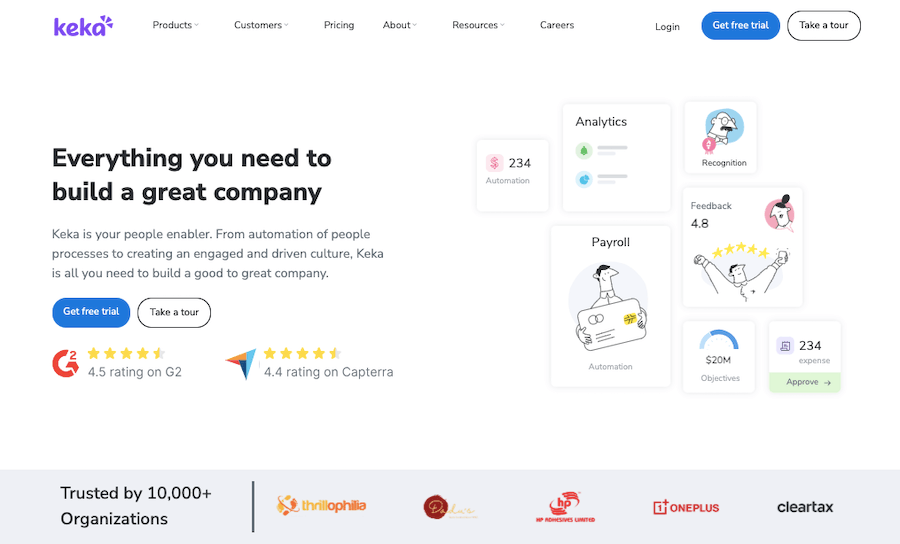
keka Review

Rippling vs. Keka: Feature Comparison

FeatureRipplingKeka
Global Coverage50+ countries through partners and EORPrimarily India-focused
Platform TypeUnified HR, IT, and FinanceHRMS with payroll and attendance focus
Onboarding SpeedHighly automated, often same-dayStructured, with some manual steps
Contractor SupportYes, global contractor paymentsLimited, mostly domestic
Payroll EngineMulti-country payroll supportIndia-first payroll with deep compliance
BenefitsIntegrated benefits, stronger in US and global marketsIndian statutory benefits and flexible salary structures
Compliance & IP ProtectionBuilt-in workflows and audit logsStrong Indian compliance including PF, ESI, TDS
UX / UIFeature-rich, system-oriented dashboardClean and intuitive interface
Integrations500+ integrations and API supportCore integrations for HR and finance
Customer SupportDedicated managers and chat supportStrong onboarding and responsive support
PricingModular and can increase with add-onsTransparent and cost-effective
Security CertificationsSOC 2, GDPR, ISOGDPR-aligned with solid data practices
ScalabilityHigh across teams and regionsBest for India-focused growth

Rippling vs. Keka: Feature Deep Dive

Onboarding and Employee Lifecycle

Rippling treats onboarding like a trigger. Add a new hire and the system can automatically create accounts, assign devices, enroll payroll, and set permissions. Everything connects.

We have seen teams reduce onboarding from hours to minutes once everything is configured.

Keka takes a more structured approach. It guides you through onboarding with clear steps, but some coordination still happens manually. It does not try to extend into IT or system provisioning.

So the experience is different. One is fully automated. The other is straightforward and controlled.

Payroll and Compliance

This is where Keka stands out.

For Indian companies, payroll is rarely simple. There are multiple statutory components and frequent compliance updates. Keka handles these well. PF, ESI, TDS, professional tax. It feels built for this environment.

Rippling is more flexible globally. It can run payroll across countries and manage contractors, but in India it does not feel as tailored.

If most of your workforce is in India, Keka feels more natural. If your team is spread across regions, Rippling has the advantage.

HR and IT Integration

This is where Rippling separates itself.

It connects HR data with IT systems. When someone joins, they get access to tools automatically. When they leave, access is removed instantly. No follow-ups, no gaps.

That level of control becomes important as teams grow.

Keka stays focused on HR. It does not try to manage devices or software access. For many companies, that is perfectly fine. Not every team wants HR tied into IT systems.

User Experience

Keka is easier to get comfortable with. Employees can navigate it without training. HR teams can run payroll, manage attendance, and track leaves without digging through layers.

Rippling offers more depth, but it takes time to get used to. The interface reflects its broader scope. It assumes you are managing multiple systems, not just HR.

In practice, smaller teams often prefer Keka. Larger or more technical teams tend to lean toward Rippling.

Integrations and Ecosystem

Rippling works well if you already use multiple tools. It connects with a wide range of systems and gives you flexibility through APIs.

If your HR stack includes finance tools, identity systems, and SaaS apps, Rippling fits naturally.

Keka covers the essentials. It integrates with common tools but does not try to be the center of your entire system architecture.

That makes it easier to manage, but less extensible.

Rippling vs. Keka: Editor’s Note

The difference between these two is not just features. It is how they think about HR.

Rippling treats HR as part of a larger operational system. Everything connects. That can reduce manual work and improve control, especially in distributed teams.

Keka focuses on doing HR and payroll well without expanding into other areas. It is easier to adopt and requires less setup.

We have seen Indian mid-sized companies choose Keka because it works immediately. There is less configuration and fewer moving parts. On the other hand, companies with global teams or more complex systems often prefer Rippling. It gives them more control, even if it takes longer to implement.

Both approaches make sense depending on your context.

Rippling vs. Keka: Final Recommendation

Choose Rippling if you:

  • Need one system for HR, IT, and finance
  • Manage employees across multiple countries
  • Want automation and centralized control
  • Have the resources to manage a more advanced platform

Choose Keka if you:

  • Operate mainly in India
  • Need strong payroll and compliance handling
  • Prefer a system that is easy to use and quick to adopt
  • Want predictable pricing without layered complexity

Verdict

If your priority is control and global scalability, Rippling is the stronger option. If your focus is reliable HR and payroll execution in India, Keka is the better fit.

It comes down to how your team works today and where you are headed. The right choice will feel obvious once you map the product to your actual workflows.


Rippling vs. Keka Comparison FAQs

For most India-based companies, Keka is the more natural fit. It is built around Indian payroll, tax structures, and compliance requirements. Rippling can still work, but it does not feel as tailored for India-first operations.
It can, but with trade-offs. Rippling supports payroll in India, yet it does not match the depth of Keka when it comes to statutory compliance like PF, ESI, or TDS. If payroll accuracy and local compliance are critical, most teams stick with Keka.
Not really. Rippling is built around automation across HR, IT, and finance. Keka automates HR workflows well, but it does not extend into device management or app provisioning. If you want full lifecycle automation, Rippling is ahead.
Rippling is the clear choice for global hiring. It supports multi-country payroll, contractor management, and international compliance workflows. Keka is primarily designed for India and does not offer strong global hiring capabilities.
For smaller teams, it can feel that way. Rippling offers more control and flexibility, but that comes with a learning curve. Keka is easier to adopt and works well without heavy configuration. It depends on how much complexity your team can handle.
Keka is generally more predictable and cost-effective, especially for Indian businesses. Rippling uses a modular pricing model, so costs can increase as you add features. It is more flexible, but also less straightforward.
Keka tends to win here for India-based teams. Its interface is simple, and employees can easily manage attendance, leaves, and payslips. Rippling is powerful, but it is designed more for system control than day-to-day employee interaction.
Not at the same level. Rippling supports global contractor payments and compliance. Keka is more focused on full-time employees within India, with limited contractor management capabilities.

Our Comparison Methodology: How We Research & Evaluate

Every HR Stacks comparison is built on structured independent research — not sponsored placements or vendor influence.
Independent Research
No sponsored placements — affiliate links never affect our verdicts
Hands-On Product Testing
Demos, trials, and live walkthroughs — not marketing material
User Review Analysis
We analyze real user reviews in publicly available platforms
Feature Verification
Every claim verified against live platforms or official documentation
Pricing Transparency Check
Public pricing vs. sales-only costs — hidden fees flagged clearly
Compliance & Legal Assessment
How each platform handles local law, tax, and buyer risk exposure
Support Experience Evaluation
Response times, availability, and support model tested directly
Regular Content Updates
All comparisons reviewed periodically as products and pricing change
Source: HR Stacks Editorial Standards © HR Stacks
Manjuri Dutta
Article By: Manjuri Dutta

Manjuri Dutta is the co-founder and Content Editor of HR Stacks, a leading HR tech and workforce management review platform, and EmployerRecords.com, specializing in Employer-of-Record services for global hiring. She brings a thoughtful and expert voice to articles designed to inform HR leaders, practitioners, and tech buyers alike.

HR Stacks offers comprehensive, data focused and unbiased solutions. We may earn a referral fee when you visit a vendor through our links

Related Comparisons

Rippling vs. Papaya Global Comparison

Rippling vs. Papaya Global

Pebl Vs Multiplier

Pebl Vs Multiplier

Deel vs Remofirst Comparison

Deel vs Remofirst

Remofirst vs. Pebl

Remofirst vs. Pebl

Deel Vs Pebl

Deel Vs Pebl

Remofirst vs. Oyster HR

Remofirst vs. Oyster HR

Pebl Vs Remote

Pebl Vs Remote

Pebl Vs Rippling

Pebl Vs Rippling

This website uses cookies to enhance user experience and to analyze performance and traffic on our website. By continuing to browse this site you are agreeing to our use of cookies.