
Quick answer: what is RPO?
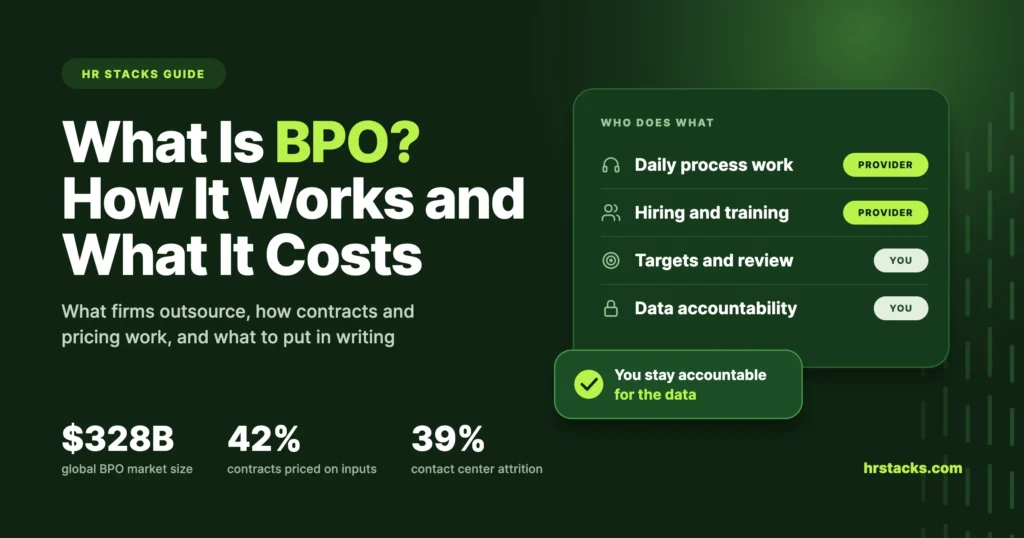
Recruitment process outsourcing (RPO) is when an outside provider takes over some or all of your hiring process and answers for the results. The provider designs and runs the process, often in your systems and under your employer brand, which separates it from a staffing agency. Fees are usually a monthly management fee, a fee per hire, or both.
- Pricing modelMonthly fee, per-hire fee or both
- Best forSteady or high-volume hiring
- Check firstWho owns candidate data and tools
- Not forA few one-off hires a year
Key takeaways
Recruitment process outsourcing (RPO) puts some or all of your hiring in the hands of an outside team that works as part of your talent function. Employers turn to it when hiring volume, speed or consistency outgrows what an in-house team and a few agencies can deliver. It usually runs alongside your own recruitment software instead of replacing it.
This guide covers what a provider does, the engagement models and fee structures, how RPO differs from agencies and search firms, a break-even example you can redo with your own rates, and what to put in the contract. It is written for employers deciding whether to outsource, and RPO is sold in most hiring markets.
What an RPO provider does
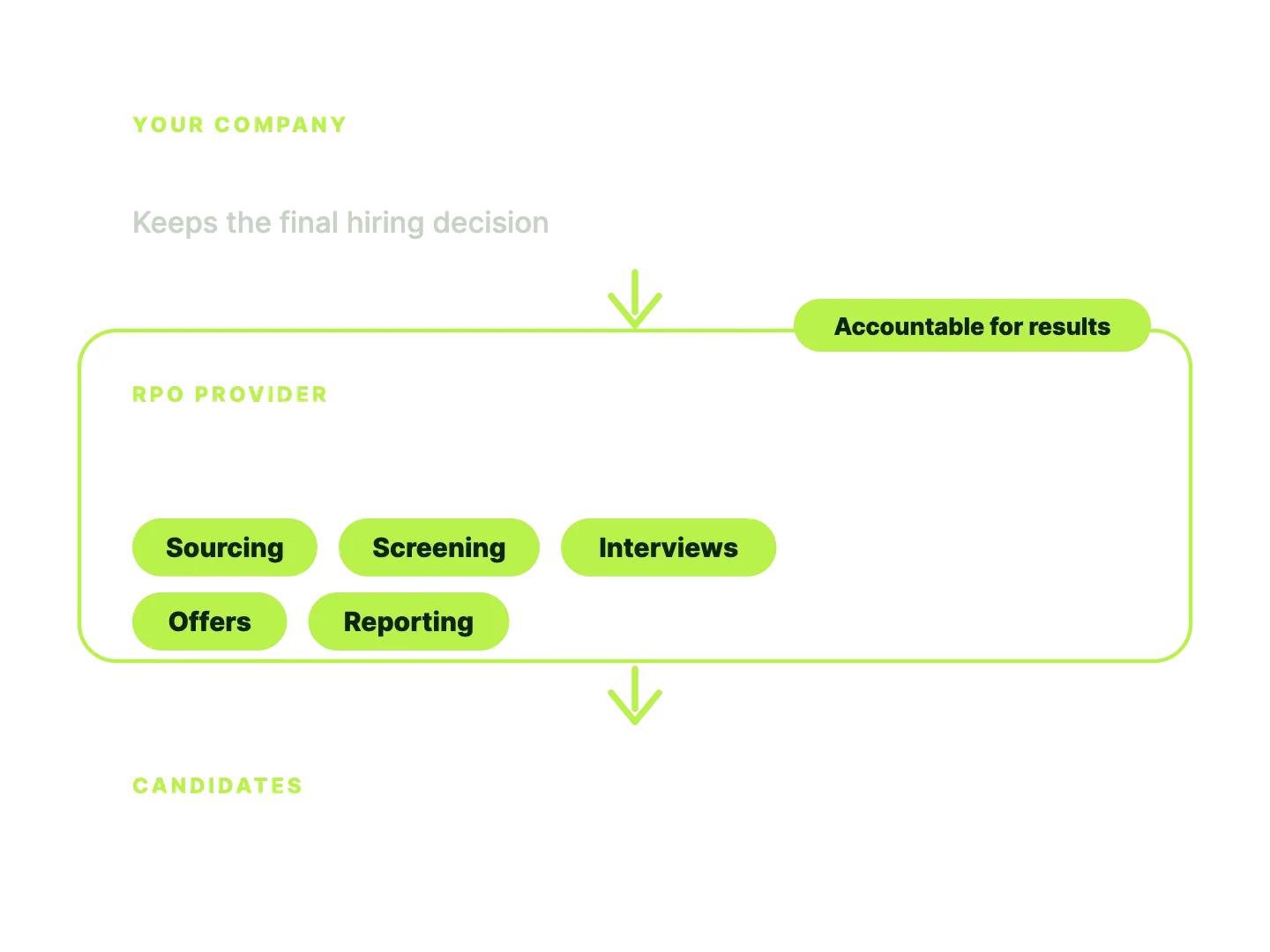
An RPO provider runs recruiting as a managed service: it plans the hiring, finds and screens candidates, coordinates interviews, supports the offer and reports on results. Scope varies, so one client may outsource sourcing and screening only while another hands over the whole function, including the relationship with hiring managers.
- Scope and planAgree roles, volumes, targets and who owns each stage.
- SourceBuild talent pools through job boards, outreach and referrals.
- ScreenAssess candidates against agreed criteria before managers see them.
- CoordinateSchedule interviews and keep candidates informed.
- Offer and reportSupport offers, hand off to onboarding and report monthly metrics.
Providers either bring their own recruiters and technology or work inside yours. The Recruitment Process Outsourcing Association puts the dividing line at ownership: an RPO provider takes over the design and management of the recruiting process and answers for its results, which agencies and search firms do not. The association has also published an executive paper on AI and the future of RPO (member or paid access), and our guide to AI agents is a useful primer if a provider pitches automated screening.
RPO models: enterprise, project and on-demand
Most RPO contracts reduce to three models, and the right one depends on how steady your hiring is. Providers name them differently, and some add a fourth that combines RPO with contingent workforce management, but scope and commitment are a useful way to compare offers.
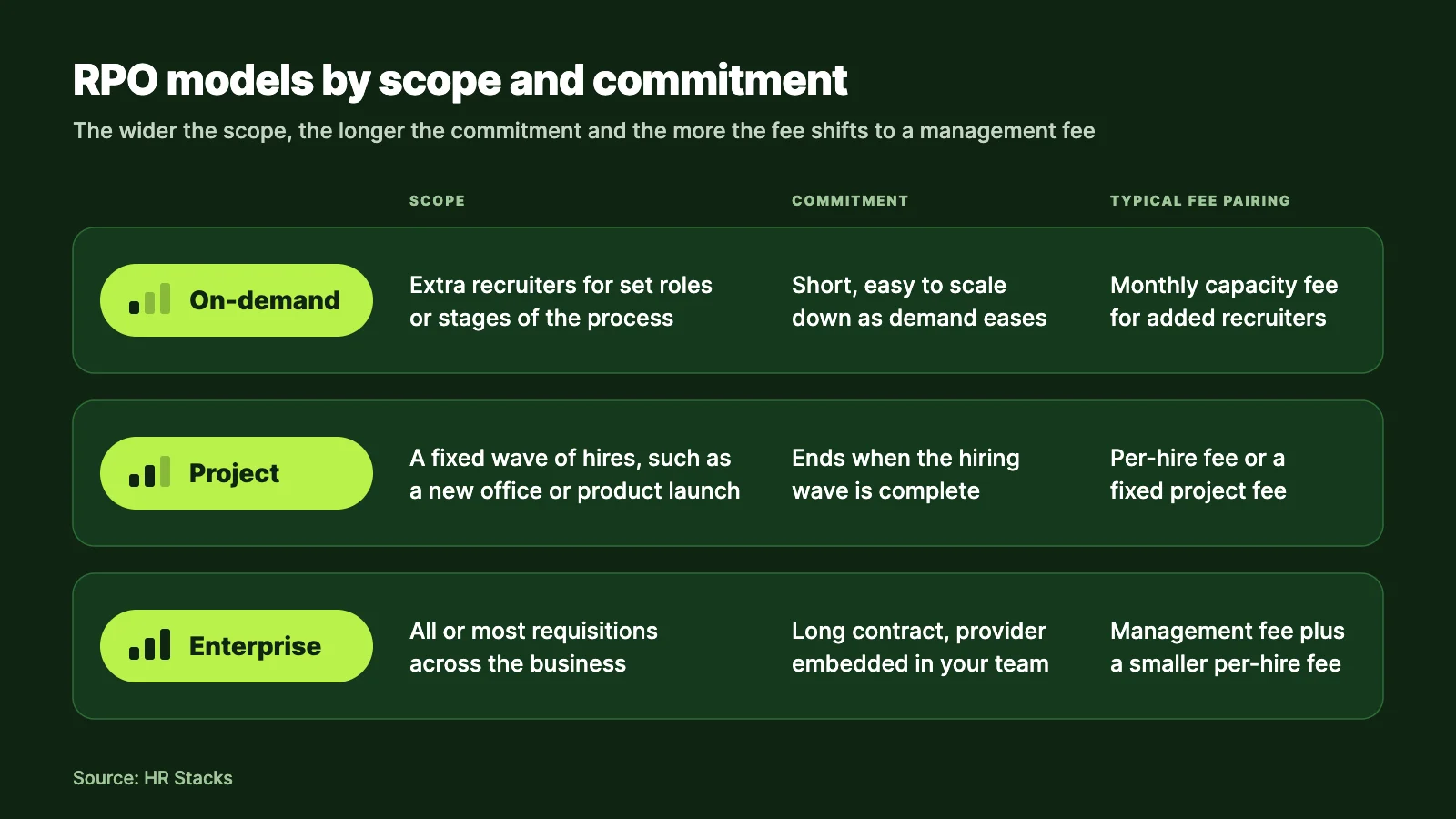
Enterprise RPO
The provider runs recruiting for all or most requisitions under a long contract. Best when hiring is steady and you want one accountable partner.
Project RPO
The provider delivers a fixed cohort, such as a new office, a product launch or a seasonal ramp, and the engagement ends when the wave is done.
On-demand RPO
Recruiters join your team for set roles or stages, then scale down when demand eases. Useful when headcount plans are uncertain.
A project or on-demand engagement is a low-risk way to test a provider before you commit to enterprise scope. Whatever the label, ask what is in scope: which roles, which stages, which locations, and whether employer branding and hiring-manager coaching are included.
RPO vs staffing agency vs retained search
The difference is who owns the process and how they are paid. An agency fills a role and is usually paid when you hire its candidate, while an RPO provider runs your hiring system and is held to metrics across many roles.
You can use all three. Many employers keep retained search for senior roles and an agency for rare skills while RPO handles repeatable volume. If what you need is workers on another company’s payroll, that is staffing, and our comparison of EOR vs PEO vs staffing agency covers it. RPO itself is one form of business process outsourcing, alongside payroll outsourcing and wider HR outsourcing. When the provider employs the people and runs a process on IT systems, such as a support desk, that is ITES, covered in our guide to IT-enabled services.
RPO pricing models and typical fees
RPO is quoted per engagement, usually as a monthly management fee, a fee per hire, or a blend, and most providers do not publish price lists. Treat any rate you see online as one provider’s starting point, not a market price. A useful reference before you ask for quotes is what hiring costs and how long it takes in general.
Those figures come from SHRM’s 2026 recruiting benchmarking. They are medians for all responding employers, so they show scale, not what an RPO provider should charge. Time to fill runs from requisition to accepted offer, which is also the definition to use in your contract. Four fee structures show up most often in quotes.
- Management fee
- A fixed monthly or weekly fee for a dedicated recruiter or team, whatever the number of hires. Predictable, and you carry the risk of slow months.
- Per-hire fee
- A fixed amount or a percentage of first-year salary for each completed hire. You pay for results, and the rate per hire is higher to cover the provider’s risk.
- Hybrid
- A lower monthly fee plus a smaller fee per hire. A common middle path for steady hiring with peaks.
- True-up
- A minimum monthly fee, with per-hire fees tallied at the end of the period and the higher amount paid.
Published prices are rare. One provider that shares an entry point, 4 Corner Resources, lists fixed-fee recruiting from $2,500 a month with no per-hire fee. Scope, recruiter seniority and region move that figure a lot, so use it to sanity-check a quote, not to build a budget.
Ask each provider to quote the same inputs: roles, volumes, locations, tools included, who pays for job boards and background checks, and what happens to fees when hiring slows.
RPO vs agency cost: a break-even check
Per-hire fees favor low volume and management fees favor high volume, so the break-even point tells you more than any quoted rate. The figures below are an illustration with assumed rates, set out so you can swap in your own quotes.
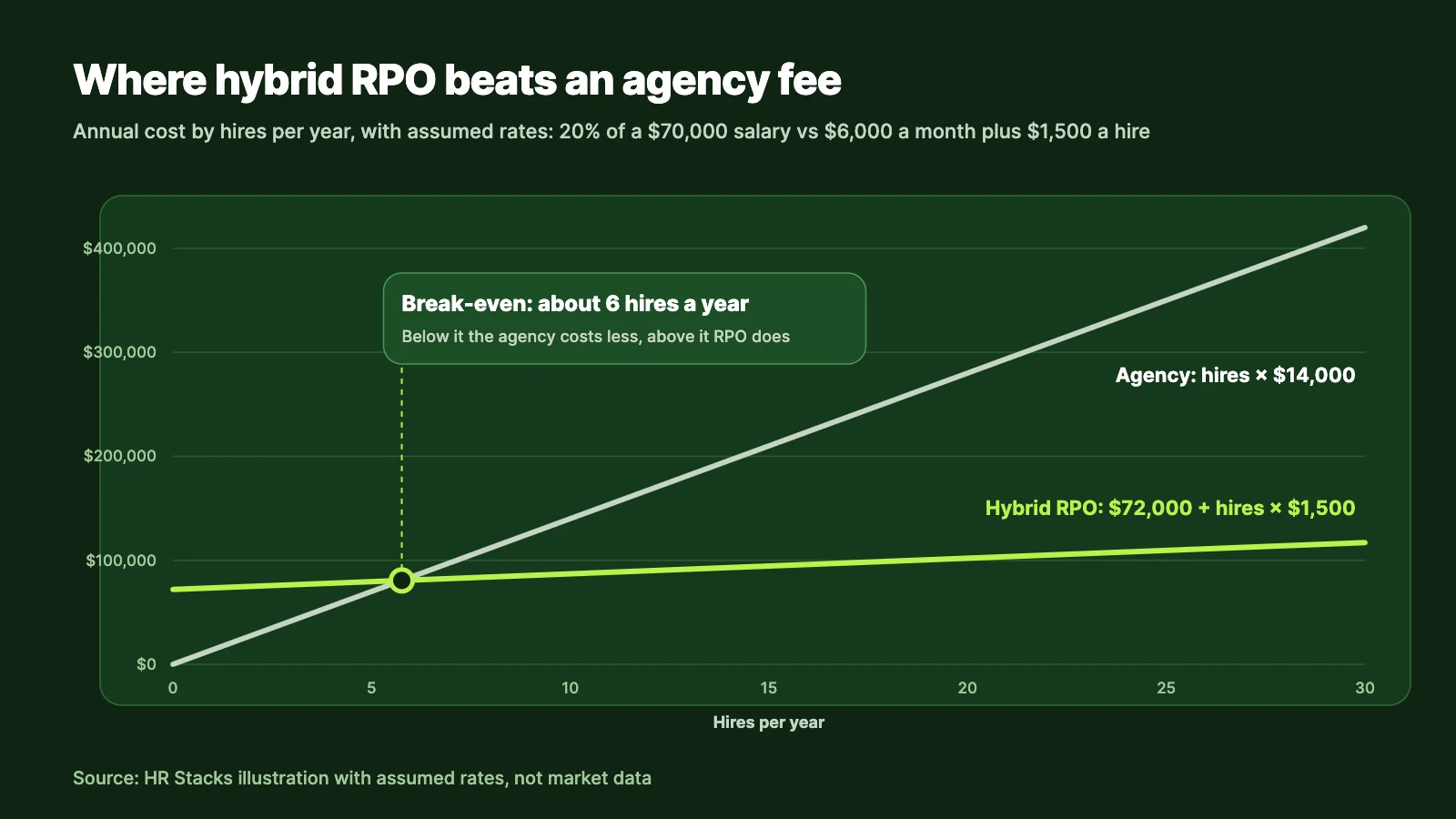
- 4 hires, agency$56,000
- 4 hires, hybrid RPO$78,000
- 12 hires, agency$168,000
- 12 hires, hybrid RPO$90,000
- 24 hires, agency$336,000
- 24 hires, hybrid RPO$108,000
What the example leaves out matters. It ignores quality and speed, and it compares against an agency rather than an in-house recruiter, whose cost is also fixed: salary, benefits, tools and job ads. A bad hire adds cost on top, and our guide to employee turnover cost shows how to calculate it. Run the same sums with your own quotes and a loaded in-house figure before you decide.
Is RPO right for your company?
RPO fits employers who hire often enough to justify a managed process, and it rarely pays for a handful of hires a year.
Pros
- Faster ramp for volume hiring without building a team
- One process, one set of data and reporting across locations
- Costs that scale with hiring instead of headcount
- Access to the provider’s sourcing tools and talent pools
Cons
- Less direct control over candidate experience and brand voice
- Management fees keep running in slow hiring months
- Switching providers mid-program is disruptive
- Quality depends on how well the provider learns your roles
Signs it is time: hiring managers wait weeks for shortlists, recruiters spend more time scheduling than sourcing, you cannot report cost per hire by source, or you are opening a new location. Signs to wait: unclear role requirements, nobody on your side to manage the provider, or too few hires to cover a management fee.
Demand follows hiring cycles. Everest Group’s state of the market summary reported another year of decline for the global RPO market in 2024 amid delayed hiring decisions and tighter budgets, so ask a provider how it handled slow periods for other clients.
How to choose and contract a provider
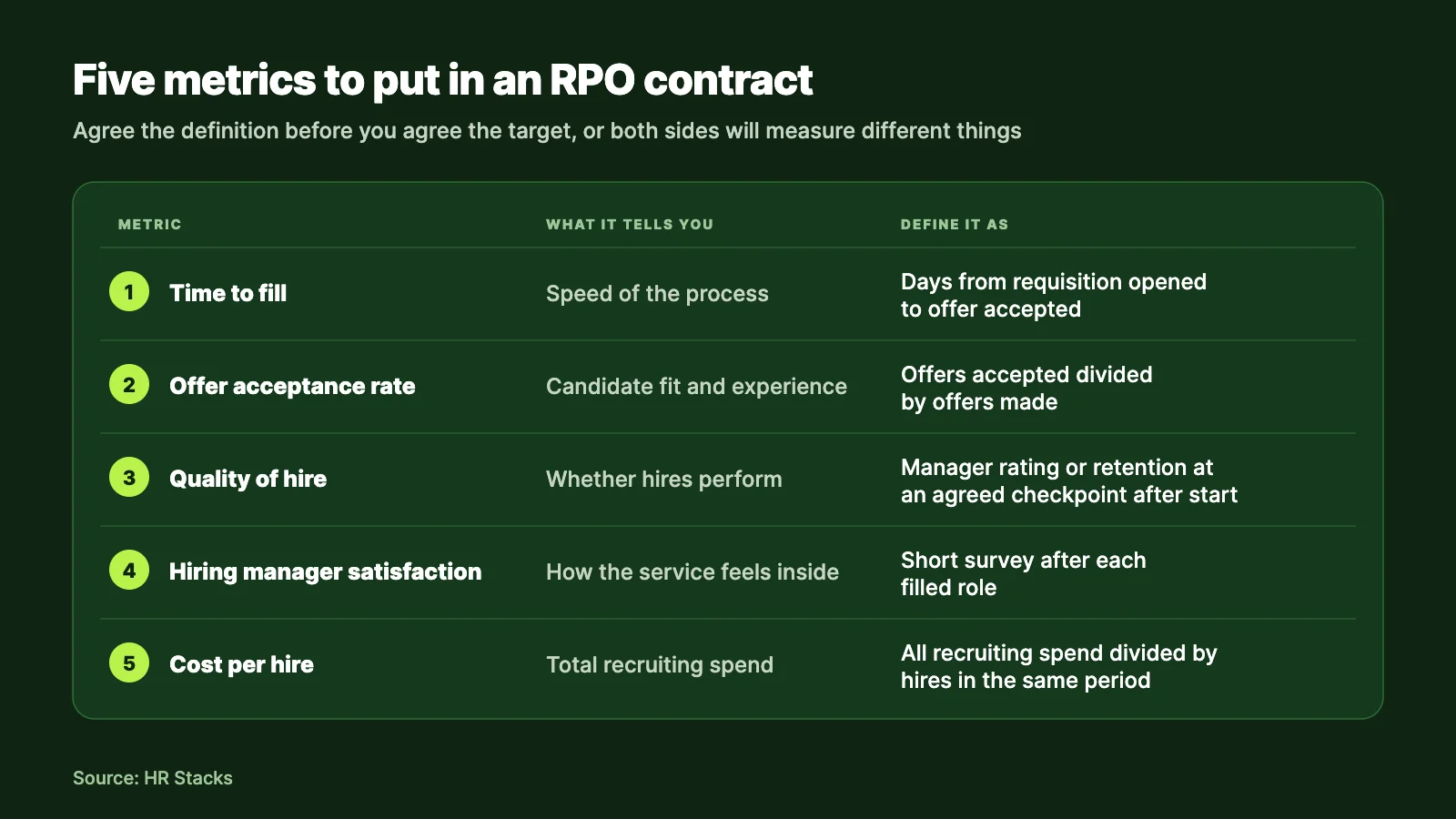
Choose on evidence from roles like yours, then lock the terms that protect you if the relationship ends. The metrics below belong in the contract with written definitions.
- Reference calls with clients who hired similar roles in your regions
- Named recruiters and the recruiter-to-requisition ratio in writing
- Metrics and targets with definitions, as in the scorecard above
- Ownership of candidate data, talent pools and job posts after exit
- Which tools it uses, yours or theirs, and who pays the licence
- Compliance duties: right-to-work checks, data protection and anti-discrimination
- Notice period, transition help and fee treatment for hires in progress at exit
Check whether your own applicant tracking software can be shared with a provider, because working inside your system keeps the data with you.
RPO and employer of record for global hiring
RPO finds candidates, it does not employ them. If your hire is in a country where you have no entity, you still need an employer of record or your own local entity to put them on payroll.
- Sources and screens candidates
- Coordinates interviews and offers
- Reports on time to fill and quality
- Does not hold the employment contract
- Employs the worker legally in the country
- Runs local payroll, tax and benefits
- Issues compliant employment contracts
- Does not usually run your recruiting
A common pattern is to find talent abroad through RPO or an agency, then onboard through an EOR while you decide whether to open an entity. Our ranking of employer of record companies and the guide on how much an employer of record costs show what that second step involves.
RPO terms in plain English
- Requisition
- An approved open position that recruiters work against.
- Time to fill
- Days from opening a requisition to an accepted offer.
- Cost per hire
- Total recruiting spend divided by hires in the same period.
- SLA
- Written service levels the provider commits to, such as time to fill or offer acceptance.
- Contingent vs retained
- Contingent fees are paid only if you hire. Retained fees are paid upfront for an exclusive search.
- MSP
- A managed service provider that runs contingent workers and the suppliers behind them. Sometimes bundled with RPO as a total talent offer.
Frequently Asked Questions
What is RPO in simple terms?
RPO is when an outside provider takes over some or all of your hiring and answers for the results. The provider designs and runs the process, often inside your systems and under your brand, and is paid through a monthly fee, a fee per hire, or both.
How is RPO different from a staffing agency?
A staffing agency fills individual roles and is usually paid when you hire its candidate. An RPO provider runs your recruiting process across many roles and is held to metrics such as time to fill and offer acceptance. RPO is a managed process, while an agency is a supplier.
How much does RPO cost?
There is no standard price. Providers quote a monthly management fee, a fee per hire, or a blend, based on your roles, volumes and scope. Work out your own break-even against agency fees and in-house costs, and ask every provider to quote the same inputs.
Is RPO worth it for a small company?
Usually only if you hire steadily. A management fee has to be covered by enough hires, and in our example with assumed rates break-even came at about six hires a year. Below that, an agency or a project or on-demand engagement is often the better fit.
How long does an RPO contract last?
It depends on the model. Enterprise contracts are typically multi-year, project engagements end when the planned hiring wave is complete, and on-demand terms are short and flexible. Ask about notice periods and what happens to hires in progress if you leave.
Does RPO replace my applicant tracking system?
No. Many providers work inside your existing system, and others bring their own. Decide up front which applies, who pays the licence, and who keeps the candidate data and talent pools when the contract ends.
Can RPO hire for roles in other countries?
Providers can recruit across borders, but RPO does not employ anyone. If you have no legal entity in the country, the hire still needs an employer of record or your own local entity to run payroll and sign the employment contract.
What should an RPO contract include?
Agreed metrics with written definitions, named recruiters, ownership of candidate data and talent pools, tool access, compliance duties, notice periods, and fee treatment for hires in progress at exit. Get the definitions of time to fill and quality of hire in writing.