


Lattice Key Facts
What Is Lattice?
Lattice is a people management platform centered on performance. It runs review cycles, calibration, goals and OKRs, engagement surveys, compensation and career growth, with manager tools for meetings, feedback and weekly updates.
Each product is priced per seat, and you buy the ones you need: Performance, Goals and OKRs, Engagement, with Compensation and Grow as add-ons. Teams that want records and onboarding usually keep a separate HRIS, which Lattice connects to.
Pricing is annual and carries a minimum agreement, so it fits mid-size teams better than very small ones. Companies with staff abroad usually pair it with an employer of record for employment itself. You can see current plans on the Lattice site.
Editor’s Verdict on Lattice
Lattice is one of the strongest options for running reviews, goals and engagement in one place, with prices posted for each product. It costs more as you add modules and is a poor fit for very small teams.
We score below the user average of 4.6 because users judge the review experience, while we also weigh the $4,000 minimum, per-module stacking and the short integration list.
Lattice Pros and Cons
Lattice’s biggest strength is a review and goals experience that managers and employees actually use, with every product priced on the page. Its biggest weakness is how costs stack: modules, a $4,000 minimum and annual-only billing. Mid-size teams get the most from it.
Strengths
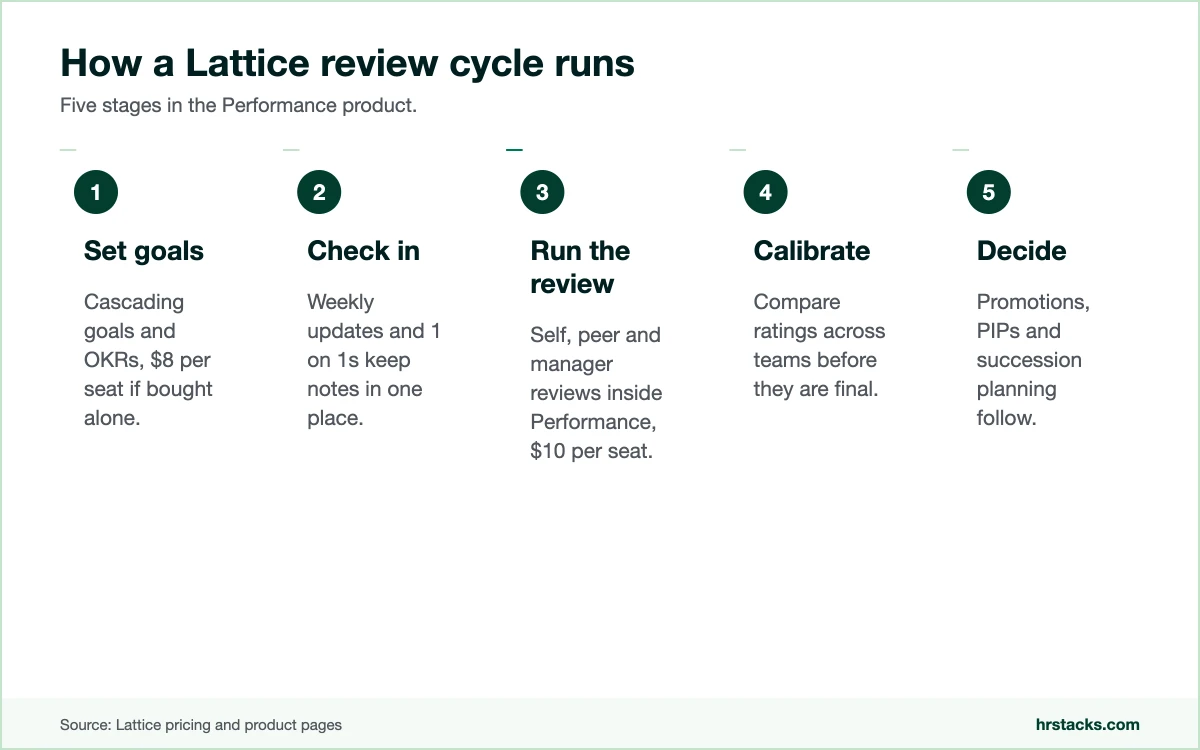
- Strongest review cyclesReviews, calibration, talent reviews, promotions and PIPs sit in one Performance product at $10 per seat.
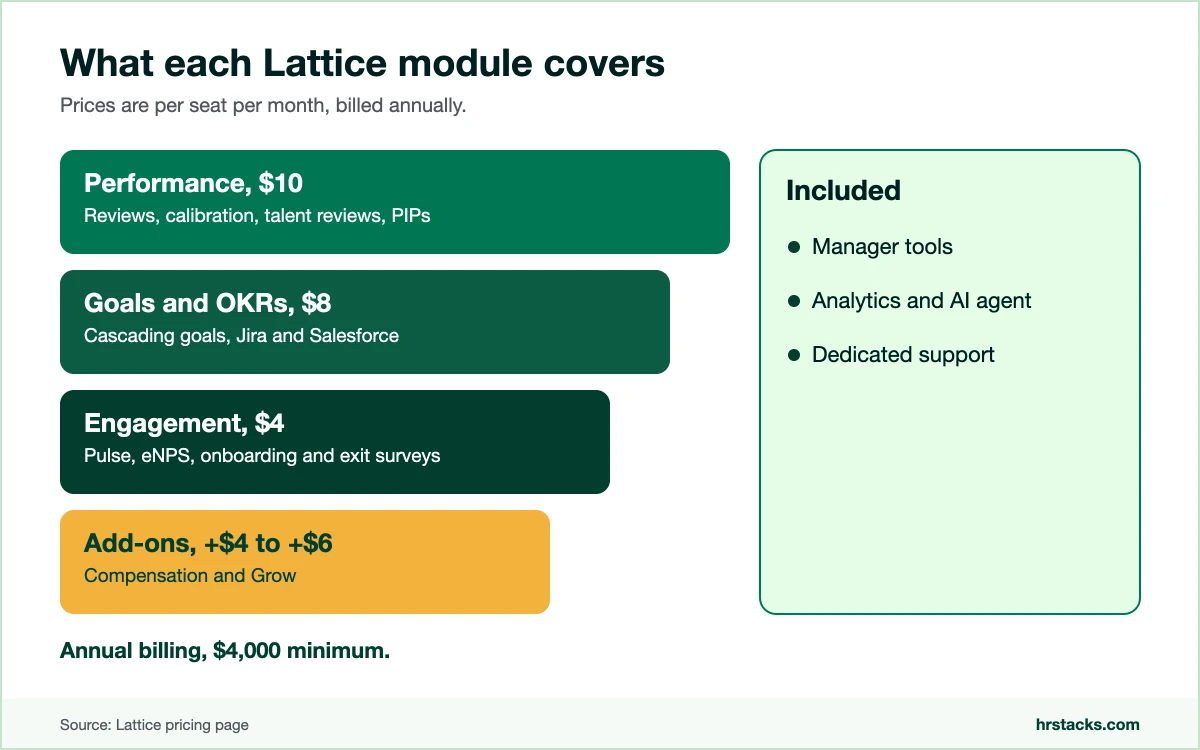
- Prices posted per modulePerformance is $10, Goals and OKRs $8 and Engagement $4 per seat per month, with Compensation and Grow as add-ons.
- Manager tools includedMeetings, weekly updates, feedback and Q and A boards come with every base product at no extra charge.
- Dedicated support in every contractSupport is included in all contracts, with Lattice University and a rollout toolkit for change management.
Limitations
- Modules stack up quicklyPerformance plus Engagement is $14 per seat, and Compensation adds $6, so the real cost passes the entry price fast.Alternative: 15Five, Perform at $11 per user per month
- Annual contract and minimumBilling is annual only with a $4,000 minimum agreement, which makes it a poor fit for very small teams.Alternative: Culture Amp, quote-based for any size
- Short integration listThe directory lists 26 integrations, mostly HRIS and SSO, and mentions no API for custom connections.Alternative: Leapsome, integrations included in every plan
Lattice Features
Lattice is strongest in performance and goals, with engagement and growth available as separate products. Check which products and add-ons your team needs before you compare totals.
Core features
- Performance reviewsReview cycles, calibration, talent reviews, promotions and PIPs in a single product.Strong
- Goals and OKRsCascading goals, progress updates and reminders, with Jira and Salesforce integrations.Strong
- Engagement surveysPulse surveys, eNPS, onboarding and exit surveys, action planning and AI analysis.Adequate
- Manager toolsMeetings, weekly updates, feedback and Q and A boards included with each base product.Strong
- Succession planningSuccession planning is part of Performance, alongside talent reviews and calibration.Adequate
Extras
- Compensation add-onGlobal benchmarks, comp bands, cycle management and multi-chain approvals for $6 per seat.Adequate
- Grow add-onCompetencies, IDPs, career tracks and AI-powered growth areas for $4 per seat.Adequate
- AI agentAn AI agent answers team questions, acts on data and coaches managers, and is included with base products.Limited
Lattice Integrations
Lattice lists 26 integrations, mostly HRIS and sign-on providers. Communication and productivity tools are covered, and three AI assistants connect through MCP.
 Workday
- BambooHR
- Rippling
- Gusto
- HiBob
- Personio
- Slack
- Microsoft Teams
- Jira
- Salesforce
- Okta
- OneLogin
- JumpCloud
Lattice Pricing
Lattice posts a price for each product, per seat per month. It sells annual contracts only, with a $4,000 minimum that can span products and seats. Enterprise is a custom quote, and there is no free trial, only interactive tours.
Published plans
Prices are per seat per month in USD. Annual billing only.
Fees and contract terms
What Lattice states publicly, and what to get in writing before you sign.
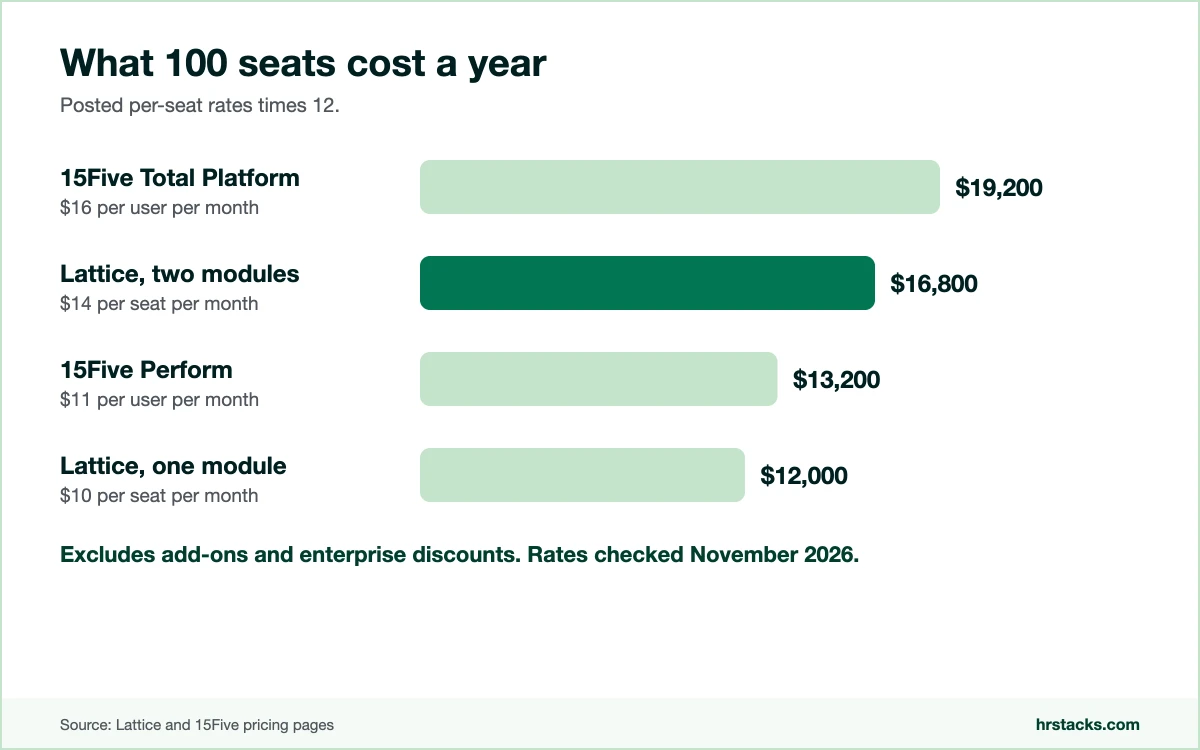
What 100 seats cost a year
Lattice with Performance and Engagement sits between two 15Five plans.
Who Should Use Lattice?
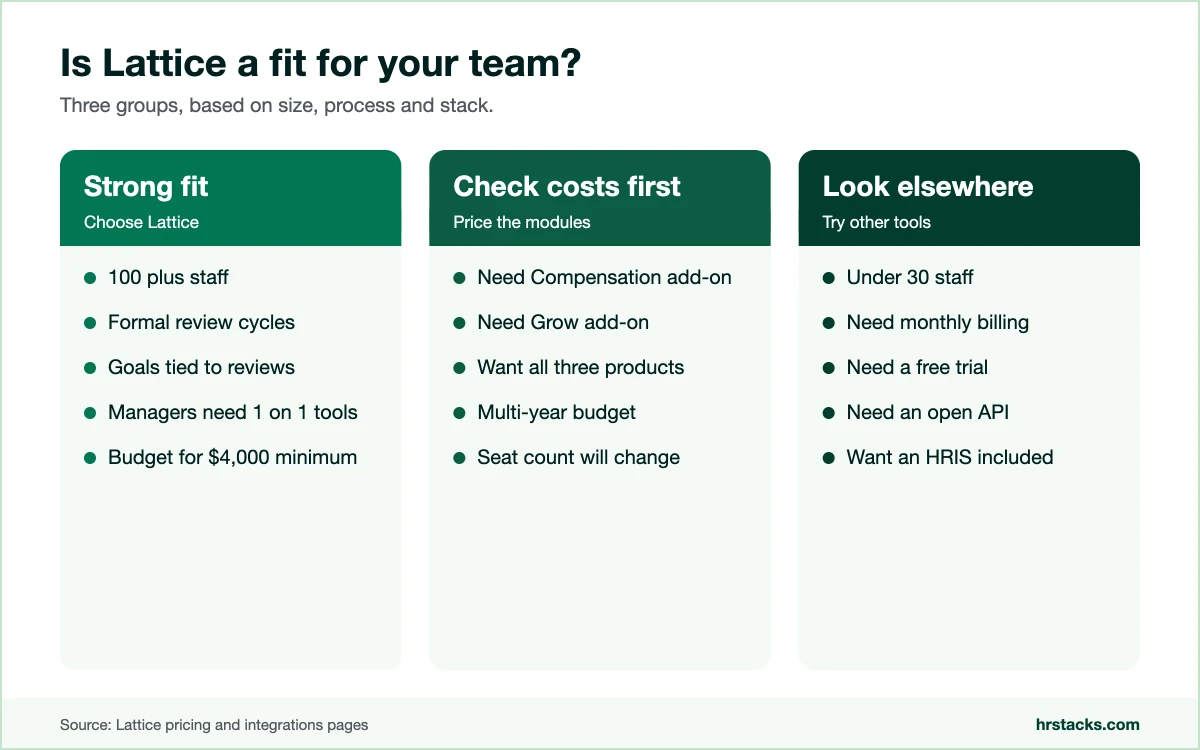
Lattice suits mid-size and growing companies that run formal review cycles and goals and want a tool managers will use. Very small teams and integration-heavy stacks should price alternatives.
Best for
- Companies of 100 or more staff that run structured review and calibration cycles.
- People teams that want goals, reviews and engagement surveys in one vendor.
- Managers who need weekly updates, 1 on 1 notes and feedback built into the same tool.
- Buyers who want every product priced on the page before a sales call.
Skip if
- You are a small team that cannot commit to a $4,000 annual minimum.Consider 15Five, Engage at $4 per user per month with no stated minimum
- You want an HRIS, recruiting and talent tools from one platform.Consider Leapsome, HRIS platform plus talent modules, integrations included
- You need a long integration list or an open API.Consider Culture Amp, quote-based, HRIS and Slack integrations in every plan
Lattice Alternatives
These three are the performance and engagement platforms Lattice most often meets. Two post their rates, so the cost gap is easy to check.
Lattice vs 15Five15Five posts bundles, Lattice posts per product
Choose 15Five if manager development and a bundled price matter most. Read our 15Five review
Lattice vs LeapsomeLeapsome adds an HRIS and a free trial, in euros
Choose Leapsome if you want an HRIS and talent suite together. Read our Leapsome review
Lattice vs Culture AmpCulture Amp is quote-only, Lattice posts its rates
Choose Culture Amp if survey depth and people science come first. Read our Culture Amp review
What Users Say About Lattice
Reviews are strong. The largest review site averages 4.6 from about 4,100 reviews and the second 4.5 from about 200, with most praise for ease of use and the review process. Complaints are thinner and cluster around visualization and getting started.
What users praise
- Easy to useReviewers describe an intuitive design and a simple sidebar covering 1 on 1s, growth, OKRs and reviews.
- Transparent reviewsOne reviewer says the whole performance process became more transparent and was taken more seriously.
- All-in-one for people teamsDirectors of talent say they run reviews, engagement surveys and 1 on 1s from one tool.
- Saves HR timeReviewers say reviews are easy to run, document and analyze.
What users complain about
- Learning curveSome reviewers say it takes a little time to get used to the tool.
- Visualization gapsReviewers ask for better data visualization and a cleaner UI in places.
- OKR tweaks wantedOne reviewer likes feedback and reviews but wants changes to how OKRs work.
- Cost for add-onsCompensation and Grow are separate paid add-ons, which some buyers expect to be bundled.
Is Lattice Worth It?
Choose Lattice if you run formal review cycles, want goals and engagement in the same vendor, and can commit to an annual contract. Skip it if you are a very small team, need a long integration list or want a free trial first.
Before signing, add up every module you need and confirm the $4,000 minimum. Ask for the SOC 2 report and request a rollout plan, since support is included in the contract.
Confirm these before you buy
None of them appear on Lattice’s pricing page.
- Module totalAdd Performance, Goals, Engagement and any add-ons for your headcount.
- Annual minimumConfirm the $4,000 minimum and how it applies across products.
- SOC 2 reportRequest the report, since it is available only on request.
- Integration fitCheck your HRIS and sign-on provider are on the list of 26.
- Rollout planAsk what training and the rollout toolkit include for your first cycle.
Lattice: Common Questions
These are the questions buyers ask most about Lattice. Answers come from the vendor’s pages and third-party listings, checked in November 2026.
How much does Lattice cost?
Performance is $10, Goals and OKRs $8 and Engagement $4 per seat per month. Compensation adds $6 and Grow adds $4, billed annually.
Is there a minimum contract?
Yes. Lattice lists a $4,000 annual agreement minimum, which can span products and seats, and billing is annual only.
Does Lattice have a free trial?
No. The pricing page offers interactive tours but no free trial, so ask for a demo and a reference call.
Is Lattice an HRIS?
No standalone HRIS is listed on the pricing page. It connects to HRIS tools such as Workday, BambooHR and Rippling.
Is Lattice secure?
The trust center lists SOC 2, GDPR and CCPA, and states that data is encrypted at rest and in transit.
The SOC 2 report is available on request, and ISO 27001 and HIPAA are not mentioned.
What are the best Lattice alternatives?
Does Lattice work for teams outside the US?
It bills in USD only, and employment itself needs a local entity or an employer of record.
How many employees can Lattice support?
Lattice lists customers from mid-size teams to large enterprises, with 4,500 plus organizations on its vendor profile. The $4,000 minimum makes it less practical for teams under about 30 people.
Does Lattice integrate with my HRIS?
Likely, if you use Workday, BambooHR, Rippling, Gusto, HiBob, Personio, ADP, UKG or Humaans. Check the full list of 26 before you sign.
Can I buy only some Lattice products?
Yes. Performance, Goals and OKRs and Engagement are priced separately, and Compensation and Grow are optional add-ons.
Who owns Lattice?
Lattice is an independent, venture-funded company founded in 2015 in San Francisco, with about $330 million raised according to third-party profiles.