
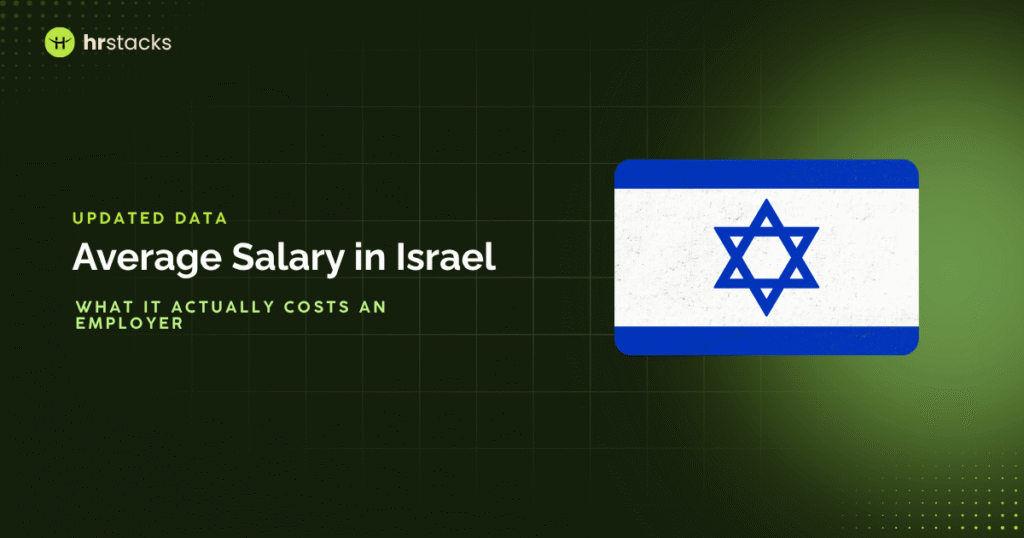



Quick Summary: Average Salary in Israel
Israel is one of the few markets where the average wage is a statutory figure rather than a statistic. It sets the minimum wage at 47.5%, fixes the lower Bituach Leumi bracket at 60%, and resets both every year, which means it changes what you owe rather than just what you should offer.
The current figure is ₪14,344 a month. The median is ₪10,586, and the gap between them is where most Israeli hiring budgets go wrong.
EOR guide
Israel
10 providers reviewed
Compare the top EOR providers for Israel
Independent rankings by Bituach Leumi bracket handling, Section 14 severance, pricing model and capital held at signing. Updated for 2026.
The average salary in Israel right now
The most recent confirmed figure from the Central Bureau of Statistics is ₪14,344 per month for February 2026 at current prices, about $4,688 at ₪3.06 to the dollar. Adjusted for the consumer price index, the same month reads ₪11,561.
Flash estimates for March 2026 came in much higher at ₪15,529 for all salaried workers and ₪15,979 for Israeli workers alone. March is a seasonal peak, and flash estimates are built on partial returns, so both figures get revised. Neither belongs in a salary benchmark.
Use the current prices original figure. It is the series the CBS itself carries forward into its year on year comparisons, and the one the National Insurance Institute reads when it resets statutory thresholds each April.
Four CBS wage figures, all current, all different
Which series to use, and which to ignore
Use the current prices original figure. It is the series CBS carries forward into its own year on year comparisons, and the one the National Insurance Institute reads when it resets statutory thresholds each April.
Ignore the constant prices series for offer setting. It strips out inflation to show real wage movement over time, which answers an economist’s question, not a hiring manager’s. Ignore flash estimates for the same reason you would ignore a preliminary quarter: they are built on partial returns and get revised.
The National Insurance Institute runs a separate dataset from monthly Form 100 employer filings, covering every salaried position in the country. Its figures will not reconcile with CBS and are not meant to. Use CBS for the average, NII for the median and for anything at city or sector level.
The median is the number you should actually benchmark against
NII filings for the first half of 2025 put the median monthly wage at ₪10,586, leaving a 43% gap between the median and the average in the same dataset. That gap is one of the widest in the OECD, and it is structural rather than cyclical. Wage
The gender split runs alongside it, with men averaging ₪18,441 against ₪11,940 for women. Company size compounds the effect, since firms with up to 19 workers account for about 92% of employers but only 24% of jobs, while the 1.5% of employers with more than 100 employees hold 58% of positions. WageWage
For a foreign employer, the practical read is that the national average describes a distribution shaped by a small, very well paid tech sector. Benchmarking a non technical role against ₪14,344 overpays. Benchmarking an engineer against it underpays by a wide margin.
Average against median in Israel
What the average wage triggers in Israeli law
This is where Israel differs from most markets. The average wage is not only a benchmark, it is a statutory input written into the National Insurance Law, and several employer obligations move with it automatically.
The minimum wage resets every April to 47.5% of the average wage, which took it to ₪6,443.85 a month on 1 April 2026, a 3.3% increase, with the hourly rate at ₪35.40. Bituach Leumi brackets move on the same basis. For 2026 the employer pays 4.51% on the portion of salary up to ₪7,703, which is 60% of the national average wage, and 7.6% on the portion between that and the ₪51,910 contribution ceiling. CWS ISRAEL Wikipedia
Two things follow for a foreign employer. Payroll configured against 2025 thresholds is wrong from January, and any provider quoting a single flat Bituach Leumi rate has not built for Israel. Both points are covered in more depth on the Israel EOR provider comparison.
Statutory thresholds keyed to the average wage
Sector and location move the number more than seniority does
The information and communication sector averaged ₪34,657 a month in February 2026, against a national figure of ₪14,344. Israeli tech workers earn roughly 2.8 times the national average, and R&D classified staff made up 50.6% of the tech workforce in 2024, up from 37.4% in 2012.
Two cautions on that ₪34,657. It is a mean drawn from a distribution containing staff engineers and security researchers well into six figures monthly, so the median hi-tech salary sits roughly 20 to 25% below it. And AI and machine learning roles entered the salary tables as a separate category for the first time in 2025, pulling the sector mean up faster than individual role pay actually moved.
Where the hire lives changes the benchmark
City level data from the NII filings shows the spread more honestly than sector data does, because it reports medians alongside averages. Tel Aviv-Jaffa reported an average of ₪22,359 against a median of ₪14,311, while Jerusalem reported ₪11,415 against ₪8,402. Modi’in leads on median pay at ₪16,402, with Herzliya second at ₪14,525. WageWage
Remote hiring flattens some of this but not all of it. An Israeli candidate anchors their expectation to local market pay, and a Jerusalem based hire quoted a Tel Aviv number will take it.
Median monthly pay by city
From gross salary to what the hire actually costs
Every figure above is gross salary. None of them is what you pay. Israeli statutory obligations add roughly 19 to 25% on top of gross depending on earnings level and seniority, so a ₪30,000 monthly offer to a software engineer costs closer to ₪36,000 to ₪37,500 in total headcount cost. Wikipedia
The components are pension at 6.5% employer share, a severance reserve at 8.33% under Section 14, employer Bituach Leumi across the two brackets, Dmei Havraah recovery pay, and travel reimbursement. Keren Hishtalmut, the study fund, is not statutory but is expected in tech offers and adds a further 7.5%.
That last point matters when benchmarking against sector averages. A tech salary survey figure usually excludes Keren Hishtalmut, so a ₪34,657 sector benchmark can carry over ₪45,000 in real monthly cost once the study fund and statutory reserves are funded.
What a ₪30,000 offer costs to employ
The shekel moved, and USD budgets moved with it
Israeli salaries are paid in shekels and Israeli law requires it, so a dollar denominated budget carries currency risk on every payroll run. Over the past twelve months that risk has been one directional.
The dollar traded at ₪3.46 at its 52 week high and sits near ₪3.06 in early August 2026. A fixed $10,000 monthly budget bought ₪34,600 at the top of that range and buys ₪30,600 now, a cut of about 11.6% in local terms. The Bank of Israel cut its benchmark rate to 3.50% in 2026 amid concerns over the strength of the shekel.
Two practical consequences. Benchmark in shekels and convert for reporting, rather than setting a dollar figure and letting the shekel value drift. And get the USD to ILS conversion method in writing from any provider, since a 2% spread quoted verbally has been documented as high as 8% in some corridors.
How to set an Israeli salary benchmark
Start with the median, not the average, unless the role sits in tech, finance or utilities. For most functions the national median of ₪10,586 is the honest anchor and the ₪14,344 average is not.
Adjust for city using median rather than average city pay, then adjust for sector using a role level survey rather than the national tech mean. The gap between a sector mean and a role median runs 20 to 25%, which is more than most seniority bands are worth.
Then add 20 to 25% for statutory employer cost, plus 7.5% if Keren Hishtalmut is part of the offer, and hold the whole calculation in shekels. Once you have that number, the EOR provider rankings for Israel show what each provider charges on top of it and which ones hold working capital at signing.
Frequently Asked Questions
What is the average salary in Israel in 2026?
The Central Bureau of Statistics reported ₪14,344 per month for February 2026 at current prices, roughly $4,688 at ₪3.06 to the dollar. The CPI adjusted figure for the same month was ₪11,561. March 2026 flash estimates ran considerably higher at ₪15,529, but flash estimates are built on partial returns and get revised.
Why do different sources give different average salaries for Israel?
Because the CBS publishes several series simultaneously: current prices against constant prices, all salaried workers against Israeli workers only, and original data against flash estimates. Sites quoting anywhere from ₪12,000 to ₪15,979 are all reading the same agency and picking different series.
Should I benchmark an Israeli offer against the average or the median?
The median, for most roles. National Insurance Institute filings put the median at ₪10,586 with the average 43% above it in the same dataset. The exception is tech, finance and utilities, where sector level data is the only useful anchor.
How much does an Israeli employee cost above gross salary?
Roughly 19 to 25% on top of gross, covering pension at 6.5%, a severance reserve at 8.33%, employer Bituach Leumi across two brackets, Dmei Havraah and travel reimbursement. A ₪30,000 offer costs about ₪36,000 to ₪37,500 a month. Keren Hishtalmut adds a further 7.5% where it applies, which in tech offers is most of the time. Provider fees sit on top of all of it, and the Israel EOR rankings break those down per provider.
Does the average wage in Israel affect what I legally have to pay?
Yes, more directly than in most markets. The minimum wage is fixed at 47.5% of the average wage and resets each April, reaching ₪6,443.85 on 1 April 2026. The lower Bituach Leumi bracket is set at 60% of the average wage, ₪7,703 for 2026, and the contribution ceiling sits at ₪51,910.
Can I pay an Israeli employee in US dollars?
No. Salary must be paid in shekels through Israeli payroll with all statutory deductions applied. A contract can reference a dollar equivalent for exchange rate protection, but an international transfer in dollars does not satisfy Israeli labour law.