


Payoneer Workforce Management Key Facts
What Is Payoneer Workforce Management?
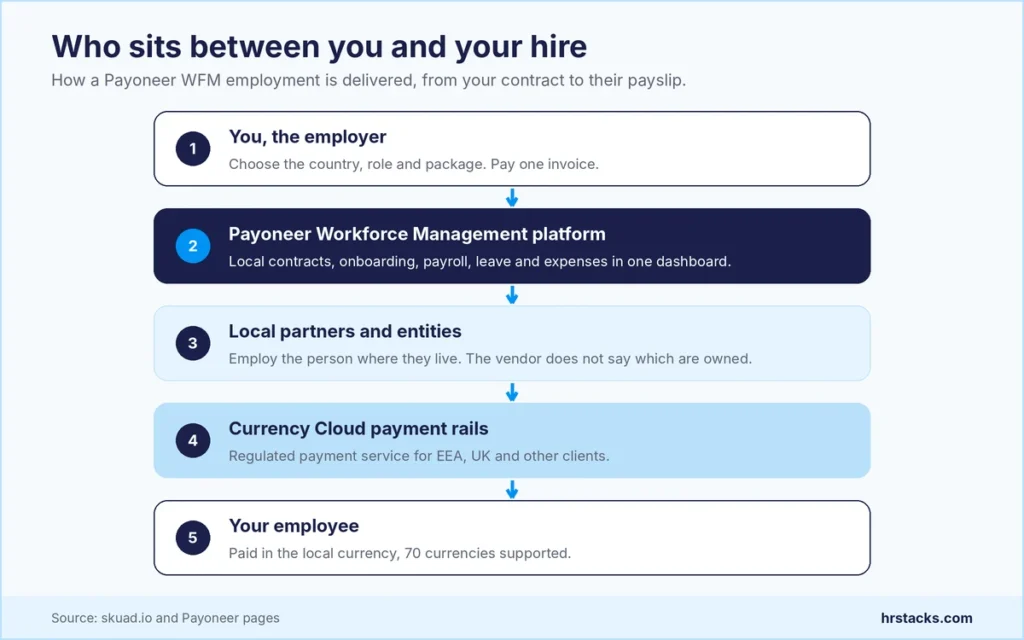
Payoneer Workforce Management, formerly Skuad, is an employer of record and contractor platform that employs your workers in other countries, so you can hire there without a local entity. Payoneer bought Skuad in August 2024, and skuad.io still runs the product.
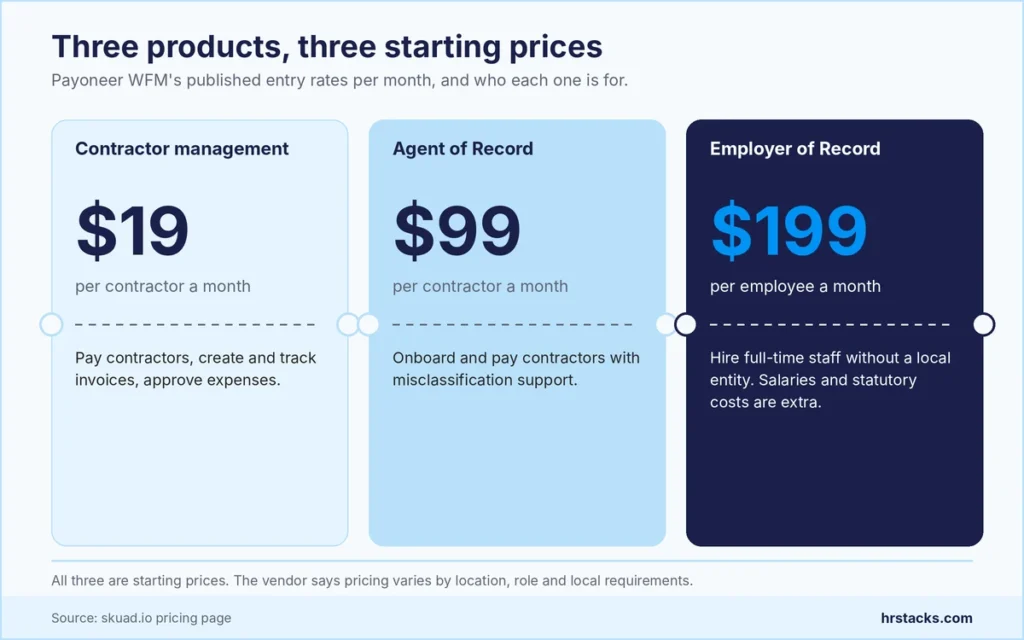
The core service is EOR from $199 per employee a month. It issues local contracts, handles tax and statutory benefits and runs payroll in 70 currencies. Agent of Record from $99 and contractor management from $19 cover contractors on the same platform.
It suits startups and small teams hiring a few people across many countries on a tight budget. It is a weaker fit for buyers who need named security certifications, or every fee listed before a sales call with Skuad.
Editor’s Verdict on Payoneer Workforce Management
Payoneer Workforce Management is a strong pick for small teams that want a low published EOR rate and one place for employees and contractors. The fit boundary is trust detail: no named security certifications, unlisted deposits and 24×5 support.
Users score it higher because payments land on time and replies are quick, while we mark down unclear fees, missing certifications and slow answers on billing.
Payoneer Workforce Management Pros and Cons
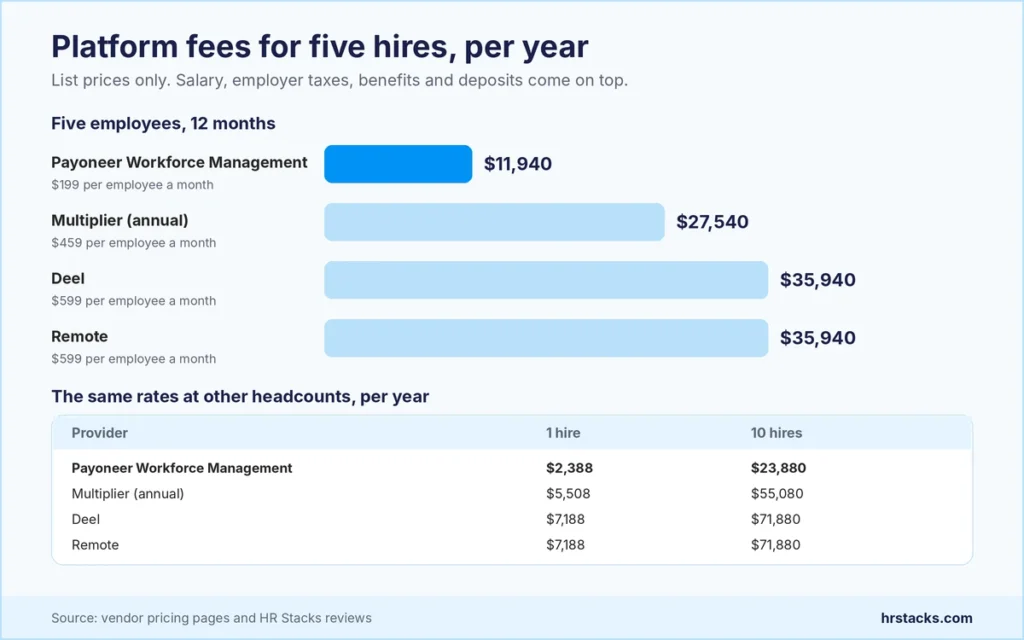
Its biggest strength is price: $199 per employee is far below the $459 to $599 charged by the rivals we track. Its biggest weakness is what the price page leaves out. Budget for deposits and extras before you compare totals.
Strengths
- Lowest published EOR rateAt $199 per employee a month, the EOR rate is about a third of Deel’s and Remote’s $599, which cuts platform fees for small teams.
- Employees and contractors togetherOne dashboard handles EOR employees, Agent of Record contractors and contractor payments from $19, so mixed teams avoid a second vendor.
- Payroll in 70 currenciesPayroll and contractor payments run in 70 currencies by invoice, card, bank transfer, wire or ACH, using regulated Currency Cloud services.
- Support users single outReviewers repeatedly praise quick answers and on-time payments, and the EOR plan lists a dedicated account manager with 24×5 support.
Limitations
- Fees and deposits unclearReviewers report hidden fees and deposits, and the pricing page lists no deposit, visa, background check or offboarding rates.Alternative: Oyster, $699 per employee with a refundable deposit stated
- No named security certificationsThe site says data privacy is a priority but names no SOC 2, ISO 27001 or similar certificate, so ask for audit reports.Alternative: G-P, which lists SOC 2 Type II, ISO/IEC 42001, GDPR and CCPA
- Slow billing supportReviewers report weeks-long replies on invoices and disputes, tickets closed without answers, and 24×5 cover that leaves weekends waiting.Alternative: Multiplier, from $459 per employee a month on annual billing
Payoneer Workforce Management Features
The core is a plain EOR and contractor service with payroll in many currencies. The weaker spots are extras sold by quote and HR tooling beyond payments, which reviewers find thin.
Core products
- Employer of RecordEmploys workers in 160+ countries through local partners and entities, with local contracts, tax and statutory benefits handled.Strong
- Agent of RecordPays contractors from $99 each per month, with contract support and help reducing misclassification risk.Adequate
- Contractor managementFrom $19 per contractor a month for invoicing, expense approval, payment history and a mobile app.Strong
- Global payrollPays staff and contractors in 70 currencies, though conversion rates and any exchange margin are not published.Adequate
Add-ons
- Compliance layerShield covers local employment law with legal support in 160+ countries, but no certifications are named.Adequate
- Visa, checks and recruitmentVisa guidance, background screening and talent discovery are offered as extras, each priced by quote.Limited
- HR admin toolsTime off, timesheets and expenses sit in the platform, though reviewers want more flexible reports and customization.Adequate
Payoneer Workforce Management Integrations
The site claims 70+ integrations in HRIS, accounting and time tracking categories, but names only a handful. A public API is not confirmed, so check your stack before you commit.
 ADP Run
- ADP Workforce Now
- BambooHR
- Alexis HR
- 7shifts
- Avionte
- Harvest
- Veriff
Payoneer Workforce Management Pricing
It publishes starting prices for three products and says rates vary by location, role and local requirements. The EOR rate is $199 per employee a month, and discounts grow with more onboardings. Everything beyond that sits behind a demo.
Published plans
Starting prices, per month. Salaries and employer costs are paid on top.
Fees and contract terms
What the vendor states publicly, and what to get in writing before you sign.
What 5 employees cost a year
Platform fees only, at list price. The rate here is a third of Deel and Remote.
Who Should Use Payoneer Workforce Management?
It fits buyers who put the entry price first and can chase the missing detail themselves. It is a poorer match for teams whose procurement needs certificates and fee schedules before a first call.
Best for
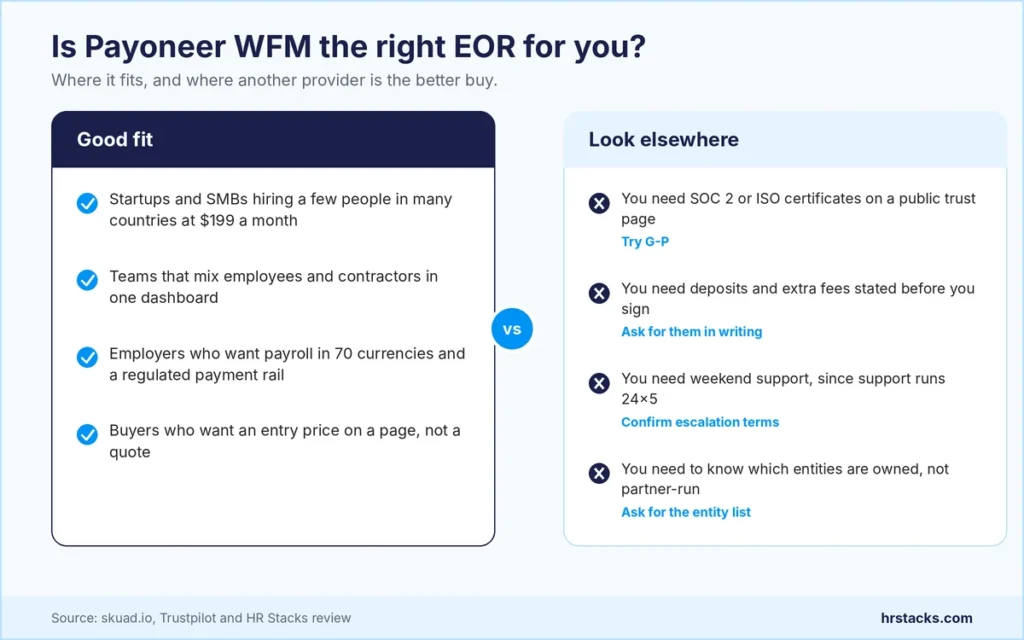
- Startups and small teams hiring a handful of people across many countries who want a low published EOR rate.
- Companies that mix full-time employees and contractors and want both managed in one dashboard.
- Employers paying staff in local currencies, where payroll in 70 currencies and regulated payment services matter.
- Buyers who want an entry price on a public page, not a quote, and are willing to negotiate the extras.
Skip if
- You need SOC 2 or ISO certificates on a public trust page before procurement will approve.Consider G-P, which lists SOC 2 Type II and ISO/IEC 42001
- You need deposits, visa fees and offboarding costs published before you talk to sales.Consider Oyster, $699 per employee with a refundable deposit stated
- You want an annual billing discount shown in dollars on the pricing page.Consider Multiplier, $459 annual against $499 monthly
Payoneer Workforce Management Alternatives
These four are the EOR providers buyers most often shortlist against it. All four cost more per employee, so its case rests on price, and the trade-offs sit in documentation and certifications.
Payoneer WFM vs DeelOne third of the rate, fewer countries listed by Deel
Choose Deel if its 130+ countries cover your hires and the $400 monthly gap per employee is not decisive. Read our Deel review
Payoneer WFM vs RemoteSame $599 as Deel, three times the rate
Choose Remote if you hire in its country list and want a flat published rate over a lower entry price. Read our Remote review
Payoneer WFM vs MultiplierMore than double the rate, annual billing option
Choose Multiplier if you want a documented annual rate and can accept more than double the monthly fee. Read our Multiplier review
Payoneer WFM vs G-P$400 more a month, certifications listed
Choose G-P if certifications and 180+ countries outweigh a $400 monthly gap per employee. Read our G-P review
What Users Say About Payoneer Workforce Management
Public ratings are high, though the volume is modest and Trustpilot has had no new reviews in 12 months. Praise centres on payments and replies, while complaints focus on fees, deposits and slow billing support.
What users praise
- Payments arrive on timeReviewers repeatedly say salaries and contractor payments arrive on schedule, even for people working remotely.
- Fast, helpful supportUsers report quick replies on small queries and staff who follow an issue through to resolution.
- Easy, quick interfaceReviewers find navigation simple, with invoicing, leave tracking and expense claims quick to use.
- Smooth onboarding processSeveral users call setup straightforward, with contracts and documents handled in one place.
What users complain about
- Hidden fees and depositsSome reviewers describe unexpected fees and deposits, and say charges differed from what was agreed.
- Slow billing supportComplaints include weeks-long replies on invoices and disputes, and tickets closed without an answer.
- Cost and transfer chargesOne reviewer says commissions and transfer costs grew high, which some employees dislike.
- Learning curve and reportingUsers say some features take time to learn and want more flexible reports and customization.
Is Payoneer Workforce Management Worth It?
Yes if you are a small or mid-size team hiring across many countries and want the lowest published EOR rate. No if procurement demands named security certifications or every fee in writing before a sales call.
Before signing, get deposits, extras and entity details in writing, and ask for audit reports.
Get these in writing before you sign
None of them appear on the vendor’s pricing page.
- Deposit and setup termsAsk whether any refundable or non-refundable deposit applies, since reviewers report them and none is listed.
- Fees for visas and checksGet written prices for visas, background checks and recruitment, which the pricing page leaves out.
- Offboarding and exit costsConfirm what termination costs and notice handling look like in each country you hire in.
- Entity and partner modelAsk which entity employs each hire and whether it is owned or a local partner.
- Security audit evidenceRequest SOC 2, ISO 27001 or equivalent reports, since none is named on its public pages.
- Weekend and escalation supportConfirm response times outside 24×5 hours and who handles invoice disputes.
Payoneer Workforce Management: Common Questions
These are the questions buyers ask most often before shortlisting it. Answers reflect published terms as of November 2026.
Is Skuad the same as Payoneer Workforce Management?
Yes. Payoneer bought Skuad in August 2024, and the product is now branded Payoneer Workforce Management. The skuad.io site still operates and says Skuad is now Payoneer Workforce Management.
How much does it cost?
Employer of Record starts at $199 per employee a month, Agent of Record at $99 per contractor and contractor management at $19 per contractor.
Pricing varies by location, role and local requirements, and discounts grow with more onboardings.
Does it charge a setup fee?
The homepage claims a $0 onboarding fee. Some reviewers report deposits and none is published, so get deposit terms in writing before you sign.
Is there a free trial?
No. You can request a demo, but there is no free trial.
Is there a minimum contract?
Its site says cancel any time with no long-term commitments, but it publishes no contract terms, so confirm the notice period.
How many countries does it cover?
It states 160+ countries and payroll in 70 currencies. It works through local partners and entities and does not say which are owned.
What is not included in the EOR price?
Salaries and employer taxes are paid on top of the fee, as with any EOR. Visa support and background checks are extras with unpublished rates.
Which certifications does it hold?
None is named on its public pages. The site cites security standards and audit readiness, so ask for SOC 2 or ISO 27001 reports.
Can it pay contractors?
Yes. Agent of Record starts at $99 per contractor a month and contractor management at $19, with payments in 70 currencies.
Who processes its payments?
Payment services come from Currency Cloud entities. The Dutch central bank authorises the one serving EEA clients and the UK regulator the one serving UK and other clients.
How does it compare with Deel?
Deel charges $599 per employee a month against $199 here. Deel lists 130+ countries and bills month to month. Read our Deel review for the full picture.
Is there a cheaper EOR alternative?
Not among the big names. Multiplier lists $459 per employee a month on annual billing, and Deel and Remote list $599. For contractors only, the $19 plan is the cheaper route.
Who owns Skuad?
Payoneer, which agreed to buy it in August 2024 for $61 million in cash, with up to $10 million more tied to performance.